Airport Passenger Boarding Bridges Market Summary:
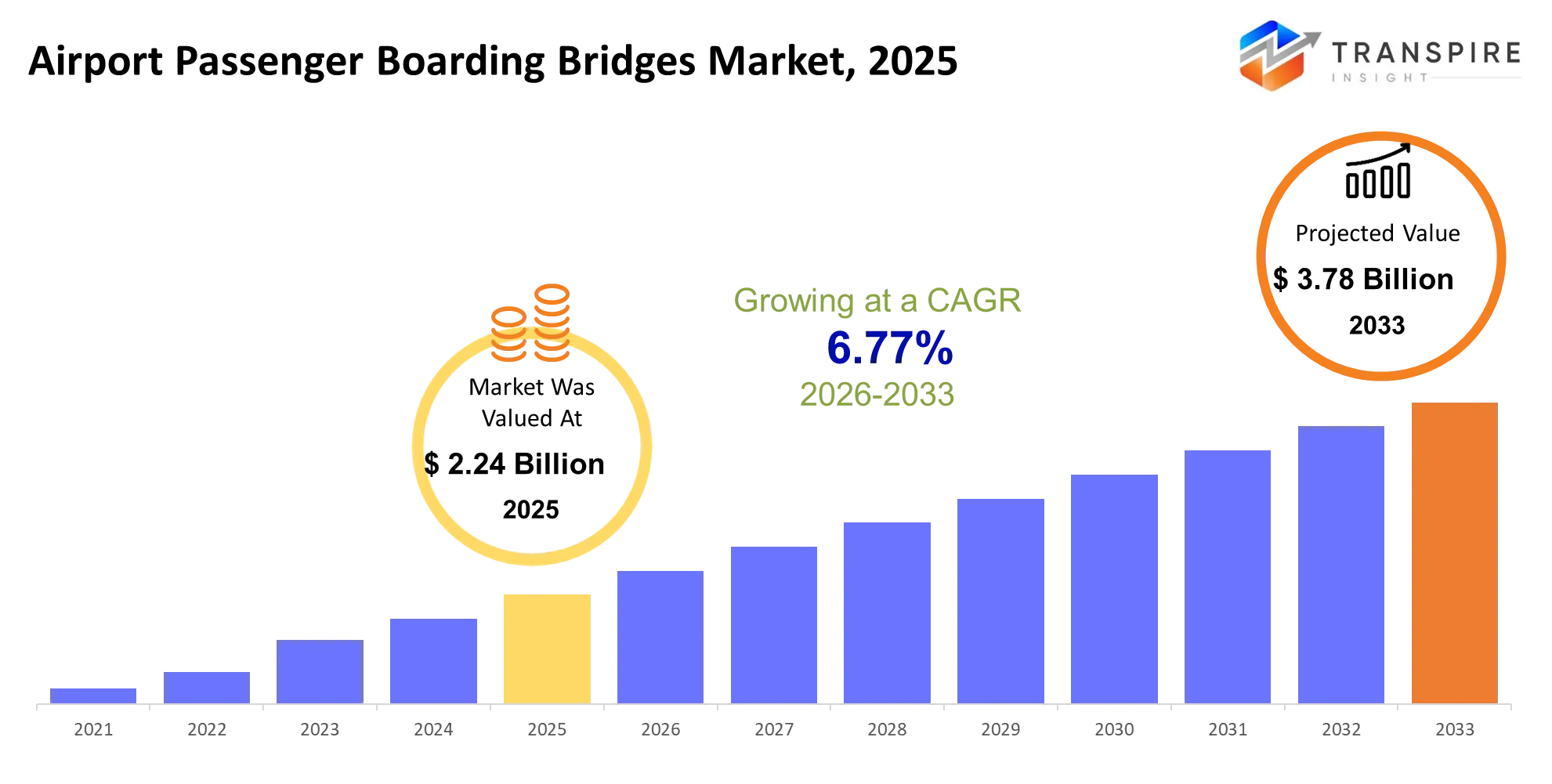
As per the Transpire Insight, the Airport Passenger Boarding Bridges Market size is estimated at USD 2.24 billion in 2025 and is anticipated to reach USD 3.78 billion by 2033, growing at a CAGR of 6.77% from 2026 to 2033.
The Airport Passenger Boarding Bridges Market enables passenger transport between terminal buildings and the aircraft by providing safe and weatherproof access, which helps airports to coordinate boarding/disembarking and aircraft turnaround activities. From the past three to five years, capital expenditure has shifted away from more refurbishment of ageing bridges to the deployment of automated docking systems, smart sensors, energy-efficient equipment, and digital maintenance systems. This effort has been backed up by airport expansion and terminal modernisation projects, often in locations where one or more types of aircraft must be handled efficiently without affecting gate schedules. A more tangible driver is the need to upgrade existing airport infrastructure while maintaining operations in ever-constricting terminal spaces. With airlines demanding predictable turnaround times, airports are seeking bridges capable of positioning accuracy, minimized manual handling, and integrated remote systems, thus driving demand for new installations and retrofits, although their high capital cost and lengthy build cycles still impact purchasing decisions.
Airport Passenger Boarding Bridges Market Size & Forecast:
- Market Size 2025: USD 2.24 Billion
- Expected Market Value (2033): USD 3.78 Billion
- Forecast CAGR (2026–2033): 6.77%
- Leading Region in 2025: Asia Pacific
- Fastest Growing Region: Middle East & Africa
- Key Company Profiles: CIMC Tianda, Thyssenkrupp Airport Systems, JBT AeroTech, ShinMaywa Industries, FMT, Airport Equipment Group, PT. Bukaka Teknik Utama, Adelte, Aviramp, FMT Aircraft Gate Support Systems, Hubner, NMC-Wollard, TK Airport Solutions, John Bean Technologies, Weihai Guangtai.
Key Airport Passenger Boarding Bridges Market Insights:
The market is moving from mechanical boarding infrastructure to connected, automated gate systems that enhance aircraft turnaround and equipment reliability. Retrofit capability, aircraft compatibility, and digital service support are becoming more and more important than just bridge supply for competitive advantage.
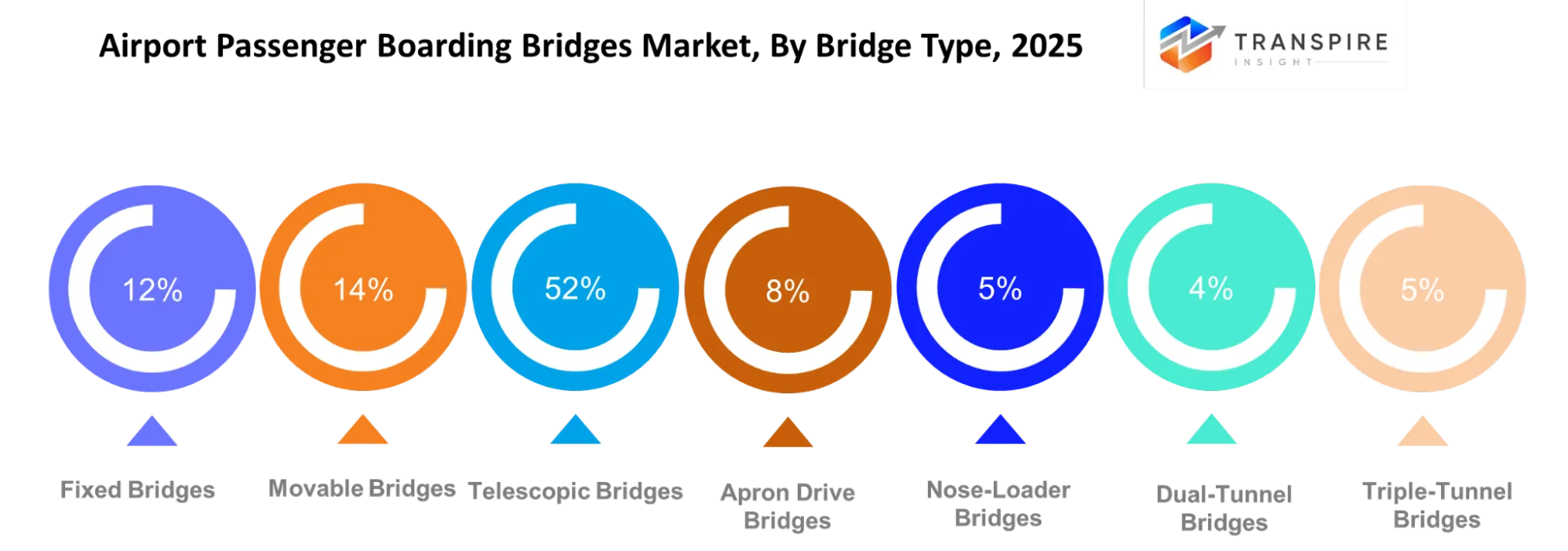
- Telescopic bridges account for 52.0% of the market, and CIMC TianDa's AI-assisted docking system decreases the need for manual work by 30%.
- Automated smart boarding bridges continue to grow at an 8.4% CAGR, and JBT AeroTech has launched an electric bridge with 20% less power.
- Fixed bridges account for 12.0% of demand; thyssenkrupp upgraded 85 units in Europe with IoT-based maintenance.
- Movable bridges represent 14.0 % of the total, while Adelte's automated docking reduces alignment time by 30 %.
- 8.0% are on the apron drive bridges, and FMT has developed eVTOL-compatible modular bridges tested at three airports.
- Nose-loader bridges account for 5.0% and Hübner distinguishes by customised systems for constrained terminal layouts.
- Dual- and triple-tunnel bridges account for 4.0% and 3.0%, respectively; operators are moving from hydraulic to electromechanical designs.
- Asia Pacific is the leader with 39.0%, and since 2023, CIMC TianDa has installed more than 150 smart aerobridges in China.
- The fastest-growing region is the Middle East & Africa with a CAGR of 7.6%, and today, TK Airport Solutions' MAX Automate is conducting approximately 1,000 remote operations per day at Madrid-Barajas.
What are the Key Drivers, Restraints, and Opportunities in the Airport Passenger Boarding Bridges Market?
Driver:
Airport terminal expansion, ageing bridge replacement, and aircraft turnaround targets are the main growth drivers. A clear trigger is the commissioning of new terminals and the need to accommodate higher passenger volumes without relying entirely on remote stands. India's airport infrastructure programme illustrates this investment cycle, with the Ministry of Civil Aviation reporting procurement and installation projects involving 38 passenger boarding bridges across multiple airports. Modern bridges improve gate accessibility and help airlines reduce boarding delays, supporting equipment sales, installation contracts and long-term maintenance revenue.
Restraint:
High installation costs, civil engineering requirements and limited apron space can delay projects. Bridges must match aircraft door heights, terminal geometry, gate layouts and local operating conditions. These requirements make standardised replacement difficult, while construction near active gates can disrupt airport schedules. Safety inspections, operator training and specialised maintenance further increase lifecycle expenditure, particularly for smaller regional airports with restricted capital budgets.
Opportunity:
Automation, retrofit programmes and emerging airport investment in Asia-Pacific offer attractive opportunities. AI-enabled docking, remote operation and sensor-based maintenance can improve bridge availability while reducing manual intervention. For example, TK Elevator's MAX Automate system at Madrid-Barajas demonstrates remote operation across 129 passenger boarding bridges. Such deployments create opportunities for software integration, control-system upgrades, and recurring service contracts. Suppliers that offer modular designs, accessibility improvements, and energy-efficient systems can capture projects where airports seek operational improvements without undertaking complete terminal reconstruction.
Driver Impact Analysis: Airport Passenger Boarding Bridges Market
|
Driver |
Relative Impact on Growth (%) |
Geographic Relevance |
Impact Timeline |
Demand Strength |
Growth Mechanism |
Key Beneficiaries |
Major Constraint |
|
New Airport Construction and Terminal Expansion |
30% |
Asia-Pacific, Middle East, North America |
Medium-term (2–4 years) |
High |
New terminals require bridges across additional aircraft contact gates. |
Bridge manufacturers, airport developers, EPC contractors |
Capital-intensive projects and lengthy construction schedules. |
|
Rising Passenger Traffic and Aircraft Movement |
25% |
Asia-Pacific, North America, Europe |
Long-term (≥4 years) |
High |
Higher flight volumes increase demand for contact-gate boarding infrastructure. |
Airport operators, bridge suppliers, airlines, maintenance providers |
Traffic volatility and limited terminal apron space. |
|
Replacement of Aging Bridges and Terminal Modernization |
20% |
North America, Europe, Asia-Pacific |
Short-term (≤2 years) |
High |
Aging bridges require replacement, upgrades, and improved operational reliability. |
OEMs, retrofit specialists, airport maintenance contractors |
Gate closures and restricted modernization budgets. |
|
Smart, Automated and Energy-Efficient Boarding Bridge Adoption |
15% |
Europe, North America, Asia-Pacific |
Medium-term (2–4 years) |
Medium |
Automation and electrification improve positioning accuracy and reduce energy consumption. |
Technology vendors, bridge manufacturers, airport operators |
High upfront costs and integration complexity. |
|
Accessibility, Passenger Safety and Sustainable Airport Standards |
10% |
Europe, North America, Asia-Pacific |
Long-term (≥4 years) |
Medium |
Accessibility and safety requirements encourage compliant bridge upgrades. |
Airport authorities, equipment manufacturers, accessibility solution providers |
Certification requirements and site-specific engineering constraints. |
|
Total |
100% |
— |
— |
— |
— |
— |
— |
What Has the Impact of Artificial Intelligence Been on the Airport Passenger Boarding Bridges Market?
AI is also revolutionizing the manual machine that is the Passenger Boarding Bridge (PBB), turning it into a decision support tool. Computer vision and aircraft-detection algorithms can identify the aircraft type, door location, and stand position, then automatically align the PBB, level it, and connect it to the cabin door, reducing operator dependence, preventing collisions, and providing a more standardized approach to dockings across the wide-body and narrow-body aircraft fleet. Machine sensors trained with aircraft and airport environment data give the PBB the ability to anticipate necessary adjustments, learning aircraft types, chassis conditions, and structural loads over time, leading to condition-based maintenance rather than scheduled maintenance. Remote diagnostics and real-time condition monitoring have led to reductions in plant downtime in initial deployments. When integrated with airport operations systems and real-time parking data, artificial intelligence can lead to faster aircraft turnaround times and increased schedule resilience, as well as reduced boarding times and improved gate utilisation at high-volume airports. The biggest challenge is in the complex process of integrating with existing infrastructure and verifying safety in a fail-safe manner. Reliability and operational safety can be compromised by faulty sensors and by gaps in operator training.
In March 2026, TK Elevator showcased its integrated smart apron ecosystem, showcasing the live application of its MAX Automate remote Passenger Boarding Bridge (PBB) and Apron Vision systems. By fusing LiDAR, stereo cameras, and artificial vision algorithms, the company demonstrated a proven solution that achieves automated docking assistance and centralized remote operations from a single control station.
Key Airport Passenger Boarding Bridges Market Trends:
Boarding bridges are increasingly being considered as part of the airport's operational assets and not just mechanical elements. Investment is moving to automation, lifecycle efficiency, and flexible gate infrastructure to meet evolving aircraft needs.
- Ageing bridges are being replaced by sensor-based bridges that enhance the ability to detect faults and plan maintenance.
- Autonomous docking is progressing from trials to commercial applications, which will decrease manual positioning requirements.
- The ability to control multiple bridges from a single central control point is possible, thanks to remote-control systems.
- Glass-walled designs are enhancing natural light and enabling modern terminal architecture.
- Accessibility features are being given increased focus, such as better cabin layout and boarding interfaces for wheelchairs.
- Airsports are incorporating bridge controls and visual docking guidance to enhance aircraft positioning and gate safety.
- Predictive maintenance is transforming service approaches from reactive maintenance to condition-based maintenance.
- Bridges are increasingly being encouraged to incorporate ground power and preconditioned air connections due to the desire to improve energy efficiency in ground services.
- Modular retrofit solutions are becoming relevant when airports require upgrading without a major reconstruction of terminals.
Airport Passenger Boarding Bridges Market Segmentation
Bridge Type:
Powered bridges include a variety of types. Telescopic bridges dominate the market with a 52.0% share, owing to extendable tunnels that can adapt to a variety of aircraft parking and terminal configurations, making them the go-to type for high-throughput commercial gates. Fixed bridges made up 12.0% of the market and are still widely used where aircraft parking is predictable. Movable bridges held 14.0% of the market, due to operators' desire for greater flexibility; apron drive bridges, 8.0%; nose-loader bridges, 5.0%; dual-tunnel bridges, 4.0%; triple-tunnel bridges, 3.0%; and miscellaneous types, 2.0%. Automated smart boarding bridges have an 8.4% compound annual growth rate, marking the fastest-growing subsegment driven by the deployment of docking automation, sensors, and remote diagnostics.
Airport Type:
International and hub airports account for the strongest adoption of passenger boarding bridges because high passenger volumes and frequent wide-body operations justify investment in advanced gate infrastructure. Domestic airports generate consistent demand through equipment replacement and terminal upgrades. Regional and low-cost airports typically prioritise affordability and efficient space utilisation. Military-civil and cargo-passenger airports require specialised configurations suited to their operational needs. Future procurement will depend on traffic forecasts, available capital, aircraft mix and terminal expansion plans.
Bridge Size:
Single- and double-tunnel configurations serve conventional gates and narrow-body operations, balancing functionality with installation costs. Triple-tunnel and extra-large bridges address specialised wide-body handling requirements, including operations involving the A380 and B787. Compact designs suit regional airports and terminals with limited apron space, while large configurations support busy international hubs. Future selection will increasingly reflect aircraft compatibility, gate geometry, passenger throughput and the need to accommodate changing airline fleets without costly structural modifications.
Application:
Passenger boarding and aircraft disembarkation represent the principal uses of passenger boarding bridges, providing protected access between terminals and aircraft. Wide-body and A380 operations may require specialised bridge arrangements to manage multiple access points and passenger flows. Narrow-body and regional aircraft benefit from adaptable systems that support efficient turnaround schedules. B787 operations also require suitable door alignment and service integration. Future demand will be influenced by fleet modernisation, terminal design and airlines' efforts to minimise ground delays.
Operation:
Manual and semi-automated bridges remain relevant where investment budgets and operational requirements favour simpler equipment. However, sensor-assisted, remote-controlled and AI-assisted systems are gaining strategic importance through improved docking precision and reduced operator workload. Smart passenger boarding bridges can integrate equipment monitoring, automated positioning, and predictive maintenance. These capabilities help airports identify faults earlier and improve equipment availability. Wider adoption will depend on integration costs, safety validation, cybersecurity, and the ability to upgrade existing control systems.
End User:
Airport authorities and airport operators represent the principal purchasing groups because they manage terminal infrastructure, capital expenditure, and equipment maintenance. Airlines and ground handlers influence procurement through turnaround targets, operational reliability and passenger-access requirements. Government agencies and military airports impose additional safety, security and compliance considerations. Private airports may prioritise premium passenger experiences and advanced automation. Going forward, purchasing decisions will increasingly balance upfront investment against lifecycle costs, maintenance support, operational resilience and measurable improvements in gate efficiency.
What are the Key Use Cases Driving the Airport Passenger Boarding Bridges Market?
The core use case is high-frequency passenger boarding at international and hub airports, where telescopic bridges account for 52.0% of the market and enable rapid, weather-protected transfer between terminal and aircraft. Their value is greatest for narrow-body and wide-body operations that require fast, repeatable gate cycles.
Expanding applications include wide-body, A380, and B787 handling, where double- and triple-tunnel bridges support higher passenger volumes and complex door interfaces. Airports are also deploying movable and apron drive bridges to serve multiple aircraft types from shared stands.
Emerging use cases centre on smart, remote-controlled boarding for automated aprons, accessibility-focused level-entry boarding, and electrified bridges integrated with pre-conditioned air and ground power. These applications align with airport decarbonisation programmes and the shift toward AI-assisted gate operations.
|
Report Metrics |
Details |
|
Market size value in 2025 |
USD 2.24 Billion |
|
Market size value in 2026 |
USD 2.39 Billion |
|
Revenue forecast in 2033 |
USD 3.78 Billion |
|
Growth rate |
CAGR of 6.77% from 2026 to 2033 |
|
Base year |
2025 |
|
Historical data |
2021 - 2024 |
|
Forecast period |
2026 - 2033 |
|
Report coverage |
Revenue forecast, competitive landscape, growth factors, and trends |
|
Regional scope |
United States; Canada; Mexico; United Kingdom; Germany; France; Italy; Spain; Denmark; Sweden; Norway; China; Japan; India; Australia; South Korea; Thailand; Brazil; Argentina; South Africa; Saudi Arabia; United Arab Emirates |
|
Key companies profiled |
CIMC Tianda, Thyssenkrupp Airport Systems, JBT AeroTech, ShinMaywa Industries, FMT, Airport Equipment Group, PT. Bukaka Teknik Utama, Adelte, Aviramp, FMT Aircraft Gate Support Systems, Hubner, NMC-Wollard, TK Airport Solutions, John Bean Technologies, Weihai Guangtai. |
|
Customization scope |
Free report customization (country, regional & segment scope). Available customized purchase options to meet your exact research needs. |
|
Report Segmentation |
Bridge Type (Fixed Bridges, Movable Bridges, Telescopic Bridges, Apron Drive Bridges, Nose-Loader Bridges, Dual-Tunnel Bridges, Triple-Tunnel Bridges, Others)Airport Type (International Airports, Domestic Airports, Hub Airports, Regional Airports, Military-Civil Airports, Low-Cost Airports, Cargo-Passenger Airports, Others)Bridge Size (Single Tunnel, Double Tunnel, Triple Tunnel, Compact, Standard, Large, Extra-Large, Others)Application (Passenger Boarding, Aircraft Disembarkation, Wide-Body Aircraft, Narrow-Body Aircraft, Regional Aircraft, A380 Handling, B787 Handling, Others)Operation (Manual, Semi-Automated, Automated, Remote-Controlled, Sensor-Assisted, Smart PBB, AI-Assisted, Others)End User (Airport Authorities, Airlines, Airport Operators, Ground Handlers, Government Agencies, Military Airports, Private Airports, Others) |
Which Regions are Driving the Airport Passenger Boarding Bridges Market Growth?
Asia Pacific accounts for 39.0% of the market, driven by the largest construction boom and expansion of domestic aviation and the strongest infrastructure support by the government in China, India, and Southeast Asia. New terminal designs are moving toward contact gates rather than bus boarding, which creates an instant demand for telescopic and intelligent bridges. Policy support to increase aviation capacity, huge capital expenditure budgets by large airport operators, and ample infrastructure investment by LCCs drive this market demand. The region's scale attracts local manufacturers, leading to shorter delivery times and lower installed system costs.
In February 2026, Airports Authority of India commissioned the fourth and fifth passenger boarding bridges at Patna’s Jay Prakash Narayan International Airport. The completion brought all five bridges at the new terminal into operation, improving direct aircraft access and passenger movement while reducing reliance on remote boarding arrangements.
https://www.aai.aero/sites/default/files/pr_articles_clippings/Press%20Clippings%2003-02-2026.pdf
Europe represents 27.0%, North America 23.5%, Middle East and Africa 6.0%, and Latin America 4.5%. The all-modes demand in Europe is more stable than in Asia Pacific as it mainly comprises the replacement of ageing bridges, accessibility standard compliance, decarbonisation and Internet of Things (IoT) based renewals rather than greenfield construction. North America also benefits from large-scale, well-established hub-renovation programmes in addition to a series of large gateway projects. Both regions also have procurement focused on reliability and safety certification in addition to lifecycle cost control, making them a reliable base for replacement and retrofit, not expansion through volume.
In October 2026, Otis Worldwide Corporation expanded its modernization and infrastructure retrofit footprint by securing massive transit contracts to upgrade 147 elevators across 72 stations using its specialised Gen3 mod technology and Otis 1 IoT service platform.
Middle East & Africa has a 6.0% share and is the region with the highest compound annual growth rate of 7.6%. The most recent focus of this region is to convert hyper-growth international airports into high-quality, high-throughput gate environments on the Gulf and large African flyways. With investment in new terminal developments, wide-body connectivity, and attempts to reduce aircraft turnaround times, there's significant demand for automated, remotely operable bridges. The opportunity for the future is to design out hydraulics now, with sensor-capable, energy-efficient gate infrastructure.
In August 2026, Dubai Airports awarded Dh13 billion ($3.54 billion) in contracts for the mega expansion of Al Maktoum International Airport. This major initial infrastructure injection directly accelerates the transformation of the hub into a high-throughput, AI-driven gate environment designed to handle massive wide-body connectivity and advanced automated ramp technologies.
Who are the Key Players in the Airport Passenger Boarding Bridges Market, and how do they compete?
Major competitors operating in the Airport Passenger Boarding Bridges Market compete in terms of development of reliable engineering, new aircraft compliance, project delivery, and lifetime service offerings, rather than price. CIMC Tianda is well known for its large-scale manufacturing and core airport-equipment capability; JBT Aero Tech, now part of Oshkosh Aero Tech, is unique with its focus on integrated airside solutions; Shin Maywa stands out with advanced automated docking solutions, and TK Airport Solutions operates based on remote operation and digital control. Thyssenkrupp Airport Systems and FMT both compete by providing bespoke bridge engineering and project customisation; Adelte provides unique terminal designs; whilst Aviramp focuses on highly accessible passenger-boarding access solutions for airports that need alternatives to traditional bridge arrangements. This enables all suppliers to meet the varied needs of terminal layouts and passenger types.
Other players in the region compete via regional supply, project engineering, or additional ground-support equipment, including Airport Equipment Group, PT. Bukaka Teknik Utama, Hübner, NMC-Wollard, and Weihai Guangtai (regional supply and engineering), while John Bean Technologies and JBT Aero Tech (part of JBT's airport-equipment business) are linked. Offerings that differentiate future suppliers will come from retrofit support, automation, local service offerings, and lifetime-cost reduction.
Key Players are:
- CIMC Tianda
- Thyssenkrupp Airport Systems
- JBT AeroTech
- ShinMaywa Industries
- FMT
- Airport Equipment Group
- PT. Bukaka Teknik Utama
- Adelte
- Aviramp
- FMT Aircraft Gate Support Systems
- Hubner
- NMC-Wollard
- TK Airport Solutions
- John Bean Technologies
- Weihai Guangtai
Airport Passenger Boarding Bridges Market — Enhanced Competitive Benchmarking
|
Company |
Est. Revenue Share Range |
Key Offerings |
Strategic Positioning |
Geographic Strength |
Technology Focus |
|
CIMC-Tianda Holdings Co., Ltd. |
20–30% (Estimated) |
Apron-drive bridges, automatic docking bridges, A380 bridges, integrated docking guidance |
scale leadership with manufacturing efficiency |
Asia Pacific, Europe, Middle East |
Automated docking, intelligent monitoring, precision controls |
|
ShinMaywa Industries, Ltd. |
12–18% (Estimated) |
PAXWAY bridges, A380-compatible bridges, regional aircraft bridges |
Premium engineering with aircraft-specific customization |
Asia Pacific, North America, Middle East |
Automated docking, precision positioning, accessible cabin design |
|
Oshkosh AeroTech, LLC |
10–16% (Estimated) |
JETWAY glass bridges, corrugated bridges, docking systems, bridge monitoring |
Installed-base strength with integrated gate equipment |
North America, Middle East, Asia Pacific |
Smart diagnostics, automated docking, power management |
|
TK Airport Solutions S.A. |
9–15% (Estimated) |
Apron-drive bridges, nose loaders, sliding T-bridges, A380 bridges |
Customized engineering for complex airport layouts |
Europe, Middle East, Asia Pacific |
Electromechanical lifting, synchronized movement, safety controls |
|
ADELTE Group S.L. |
7–12% (Estimated) |
Apron-drive bridges, nose loaders, T-bridges, commuter bridges |
Specialist innovation and full-lifecycle project delivery |
Europe, Middle East, Asia Pacific |
ARCOS remote control, electromechanical elevation, collision protection |
|
Dabico Airport Solutions / FMT |
4–8% (Estimated) |
Mobile telescopic bridges, over-the-wing bridges, dual bridges, commuter bridges |
Specialized bridge designs with airport-system integration |
Europe, North America, Middle East |
Computer-controlled docking, anti-collision systems, gate integration |
|
HÜBNER Group |
2–5% (Estimated) |
Passenger boarding bridge interfaces, flexible aircraft canopies, docking seals |
Component specialization in safe aircraft-to-bridge interfaces |
Europe, Asia Pacific, North America |
Touchless docking interfaces, flexible sealing, aircraft-contour adaptation |
|
Mitsubishi Heavy Industries, Ltd. |
2–5% (Estimated) |
Passenger boarding bridges, aircraft-access systems, customized bridge installations |
Engineering-led solutions for demanding airport projects |
Asia Pacific, Middle East |
Structural engineering, controlled lifting, accessibility-focused design |
|
PT Bukaka Teknik Utama Tbk |
2–5% (Estimated) |
Passenger boarding bridges, airport bridge systems, installation and maintenance |
Regional manufacturing and cost-competitive project execution |
Southeast Asia, Middle East |
Hydraulic lifting, bridge control systems, localized engineering |
|
Vataple Group |
1–4% (Estimated) |
Passenger boarding bridges, apron-drive systems, airport bridge installations |
Value-oriented supply and project customization |
Asia Pacific, Middle East, Africa |
Modular bridge construction, mechanical positioning, cost-efficient design |
Recent Development News
- In March 2026, Oshkosh AeroTech announced plans to showcase its Jetway passenger boarding bridges, JetDock automated docking systems, and integrated gate technologies at Passenger Terminal Expo World 2026. The showcase highlighted the integration of bridge automation, ground power, preconditioned air, and digital operations management, reinforcing the industry's shift toward connected airport gate infrastructure and more efficient aircraft turnaround. https://oshkoshaerotech.com/press-releases/oshkosh-aerotech-to-showcase-integrated-gate-and-airside-technologies-at-passenger-terminal-expo-2026
- In October 2026, Deerns completed the design for four new passenger boarding bridges at Amsterdam Airport Schiphol, with Tianda selected to manufacture the bridges for installation in late 2026. The project integrates bridge replacement with stand electrification, ground power, preconditioned air systems, and aircraft compatibility upgrades, supporting safer operations and more efficient aircraft turnaround. https://www.deerns.com/news/four-new-boarding-bridges-for-schiphol/
- In September 2026, Brussels Airport initiated major renovation works on the passenger boarding bridges in Pier A. This infrastructure project retrofits the existing structures serving Schengen flights with state-of-the-art technological enhancements, improving overall terminal operational efficiency and bolstering passenger comfort and safety during the boarding and disembarkation processes. https://www.airportsinternational.com/passenger-boarding-bridges
What Strategic Insights Define the Future of the Airport Passenger Boarding Bridges Market?
The market is moving toward the "gate-as-a-system" approach, with such combined products as automated docking, remote control, predictive maintenance, and electrified aircraft services. Though telescopic bridges will remain the volume leader at 52.0%, automated smart-bridge solutions will win an outsized share of the value. With the bridge increasingly remote-controlled and network-connected, security and operational lockdown have become an issue. Control system malfunctions or cyber incidents threaten to take down large chunks of gates at once. Vendors who rely on automation as an extra feature, separate from the airport as a whole, risk added liability and procurement pressure. Outlook for retrofit-led smart-gate conversion exists in Europe, North America and the Middle East & Africa (MEA), where existing terminals can be upgraded without reconstruction. TK's remote-control deployment at Madrid–Barajas, with 1,000 remote operations per day, points to a commercial opening. Suppliers should bundle bridges with remote control, cybersecurity, predictive maintenance, and energy-performance guarantees to turn one-off equipment sales into repeat service revenue and increase differentiation from low-cost regional competitors.
Key Segmentations are:
Bridge Type
- Fixed Bridges
- Movable Bridges
- Telescopic Bridges
- Apron Drive Bridges
- Nose-Loader Bridges
- Dual-Tunnel Bridges
- Triple-Tunnel Bridges
- Others
Airport Type
- International Airports
- Domestic Airports
- Hub Airports
- Regional Airports
- Military-Civil Airports
- Low-Cost Airports
- Cargo-Passenger Airports
- Others
Bridge Size
- Single Tunnel
- Double Tunnel
- Triple Tunnel
- Compact
- Standard
- Large
- Extra-Large
- Others
Application
- Passenger Boarding
- Aircraft Disembarkation
- Wide-Body Aircraft
- Narrow-Body Aircraft
- Regional Aircraft
- A380 Handling
- B787 Handling
- Others
Operation
- Manual
- Semi-Automated
- Automated
- Remote-Controlled
- Sensor-Assisted
- Smart PBB
- AI-Assisted
- Others
End User
- Airport Authorities
- Airlines
- Airport Operators
- Ground Handlers
- Government Agencies
- Military Airports
- Private Airports
- Others
By Regional Analysis
North America
- US
- Canada
- Mexico
Europe
- Germany
- UK
- France
- Italy
- Spain
- Russia
- Rest of Europe
Asia Pacific
- China
- Japan
- India
- South Korea
- Australia
- Rest of Asia Pacific
South America
- Brazil
- Argentina
- Rest of South America
Middle East & Africa
- UAE
- Saudi Arabia
- Qatar
- South Africa
- Rest of the Middle East & Africa
Frequently Asked Questions
Find quick answers to common questions.
The airport passenger boarding bridges market size was valued at USD 2.24 billion in 2025 and is poised to reach USD 3.78 billion by 2033, expanding at a 6.77% CAGR.
Key segments for the airport passenger boarding bridges market are Bridge Type (Fixed Bridges, Movable Bridges, Telescopic Bridges, Apron Drive Bridges, Nose-Loader Bridges, Dual-Tunnel Bridges, Triple-Tunnel Bridges, Others)Airport Type (International Airports, Domestic Airports, Hub Airports, Regional Airports, Military-Civil Airports, Low-Cost Airports, Cargo-Passenger Airports, Others)Bridge Size (Single Tunnel, Double Tunnel, Triple Tunnel, Compact, Standard, Large, Extra-Large, Others)Application (Passenger Boarding, Aircraft Disembarkation, Wide-Body Aircraft, Narrow-Body Aircraft, Regional Aircraft, A380 Handling, B787 Handling, Others)Operation (Manual, Semi-Automated, Automated, Remote-Controlled, Sensor-Assisted, Smart PBB, AI-Assisted, Others)End User (Airport Authorities, Airlines, Airport Operators, Ground Handlers, Government Agencies, Military Airports, Private Airports, Others).
Growth is primarily driven by airport expansion, terminal modernisation, ageing bridge replacement, rising automation adoption, and demand for safer, faster aircraft turnaround.
The airport passenger boarding bridges market is led by major manufacturers including CIMC Tianda, Thyssenkrupp Airport Systems, JBT AeroTech, ShinMaywa Industries, FMT, Airport Equipment Group, PT. Bukaka Teknik Utama, Adelte, Aviramp, FMT Aircraft Gate Support Systems, Hubner, NMC-Wollard, TK Airport Solutions, John Bean Technologies, Weihai Guangtai.
Asia-Pacific holds a 39.0% market share, supported by airport construction, aviation infrastructure investment, domestic air travel expansion, and regional manufacturing capabilities.
Key opportunities include AI-enabled docking, remote bridge operation, predictive maintenance, energy-efficient systems, and retrofitting existing airport infrastructure.
- CIMC Tianda
- Thyssenkrupp Airport Systems
- JBT AeroTech
- ShinMaywa Industries
- FMT
- Airport Equipment Group
- PT. Bukaka Teknik Utama
- Adelte
- Aviramp
- FMT Aircraft Gate Support Systems
- Hubner
- NMC-Wollard
- TK Airport Solutions
- John Bean Technologies
- Weihai Guangtai
About the Authors

Tejashri Dhatrak
I am Tejashri Dhatrak, a Senior Research Analyst at Transpire Insight, specializing in the Aerospace and Defence sector. My work focuses on analyzing industry trends, defence technologies, market developments, and emerging innovations that shape the global aerospace and security landscape. At Transpire Insight, I research complex topics, evaluate credible sources, and transform technical insights into accurate, well-structured, and easy-to-understand content for industry professionals and decision-makers. My goal is to provide reliable, research-backed information that helps readers stay informed about defence capabilities, aerospace advancements, strategic developments, and the evolving dynamics of the global defence ecosystem.

Chakradhar Khansole
Chakradhar serves as the Research Director at Transpire Insight, bringing over 8 years of experience in technology, innovation, and strategic market intelligence. He specializes in transforming complex market data into actionable business insights that enable organizations to make informed, growth-oriented decisions. Recognized for his strategic vision and analytical expertise, Chakradhar leads high-impact research initiatives, delivering comprehensive market assessments, competitive intelligence, and forward-looking industry analysis.
Recently Published Reports
-
Apr 2026
Aerospace Fluoropolymers Market
Aerospace Fluoropolymers Market Size, Share & Analysis Report By Type (PTFE, FEP, PFA, ETFE, and Others), By Application (Electrical Insulation, Seals & Gaskets, Coatings, and Others), By End User (Commercial Aviation, Military Aviation, General Aviation, and Others), and Geography (North America, Europe, Asia-Pacific, Middle East and Africa, South and Central America), 2021 - 2031
-
Apr 2026
Airborne SATCOM System Market
Airborne SATCOM System Market Size, Share & Analysis Report By Type (SATCOM Terminals, Transceivers, Airborne Radio, Modems and Routers, SATCOM Radomes, and Other), By Application (Government and Defense and Commercial), and Geography (North America, Europe, Asia-Pacific, Middle East and Africa, South and Central America), 2021 – 2031
-
Apr 2026
Ship Leasing Market
Ship Leasing Market Size, Share & Analysis Report By Vessel Type (Container Ships, Bulk Carriers, Tankers, and Specialized Vessels), By Lease Duration (Short-Term Lease (Less than 1 year), Medium-Term Lease (1-5 years), and Long-Term Lease (More than 5 years)), By Lease Type (Bareboat Charter, Time Charter, Financial Lease, and Others), By End-User Industry (Oil and Gas, Manufacturing and Industrial, Automotive, Agriculture and Food, Retail and Consumer Goods, and Others), and Geography (North America, Europe, Asia-Pacific, Middle East and Africa, South and Central America), 2021 – 2031
-
Apr 2026
Thread Rolling Dies Market
Thread Rolling Dies Market Size, Share & Analysis Report By Type (Flat Thread Rolling Dies, Circular (Cylindrical) Dies, Tangential Thread Rolling Dies, Planetary Thread Rolling Dies, and Other Types), By Material Type (High-Speed Steel (HSS), Carbide, Tool Steel, Alloy Steel, and Other Specialized Alloys), By Distribution Channel (Direct Sales, Distributors and Dealers, and Online Platforms), By Application (Automotive Industry, Aerospace and Defense, Construction and Infrastructure, Industrial Machinery, Electronics and Electrical Components, Medical Devices, and Fastener Production), and Geography (North America, Europe, Asia-Pacific, Middle East and Africa, South and Central America), 2021 – 2031
Our Clients