
Aircraft Nacelle Systems Market Summary:
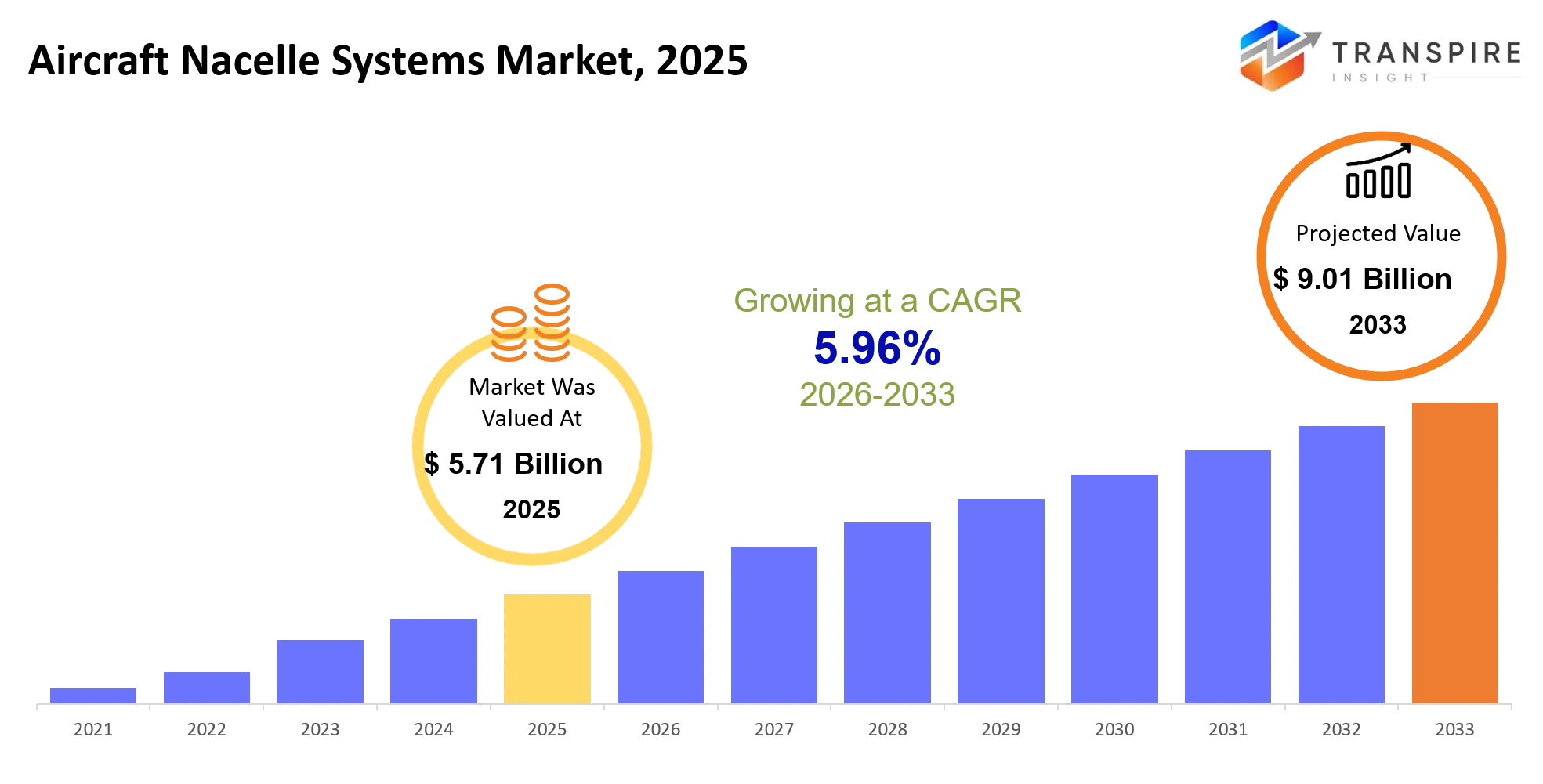
As per Transpire Insight Analysis, the Aircraft Nacelle Systems Market size is estimated at USD 5.71 billion in 2025 and is anticipated to reach USD 9.01 billion by 2033, growing at a CAGR of 5.96% from 2026 to 2033.
The aircraft nacelle systems market supports aircraft performance by holding engines inside the nacelle, controlling airflow around the nacelle, lowering engine noise from the nacelle and allowing the nacelle to reverse thrust during landing. In the past three to five years manufacturers have put more focus on building lighter nacelles using advanced composite materials for nacelles automating nacelle production and improving the quietness of nacelles. A big change in the industry is moving toward integrated propulsion systems that mix fuel efficiency, weight savings in nacelles and environmental rules for nacelles. Backlogs in aircraft production and the continued use of commercial aircraft have pushed suppliers to grow nacelle manufacturing capacity and make nacelle parts more available. As airlines look for operating costs and as manufacturers build more planes, nacelle suppliers are putting money into automating nacelle production using tougher materials for nacelles and offering long‑term maintenance, for nacelles.
Aircraft Nacelle Systems Market Size & Forecast:
- Market Size 2025: USD 5.71 Billion
- Expected Market Value (2033): USD 9.01 Billion
- Forecast CAGR (2026–2033): 5.96%
- Leading Region in 2025: North America
- Fastest Growing Region: Asia Pacific
- Key Company Profiles: Safran, Collins Aerospace, Spirit AeroSystems, GKN Aerospace, Boeing, Airbus, Leonardo, ST Engineering, FACC, Bombardier, Raytheon Technologies, Triumph Group, NORDAM, Hexcel, Hutchinson
Key Market Insights:
Market is moving towards production of commercial aircraft, advances in propulsion efficiencies, and demand for lightweight and low-noise aircraft components. Competition relies on manufacturing reliability, advanced materials, engineering expertise, and after-market services.
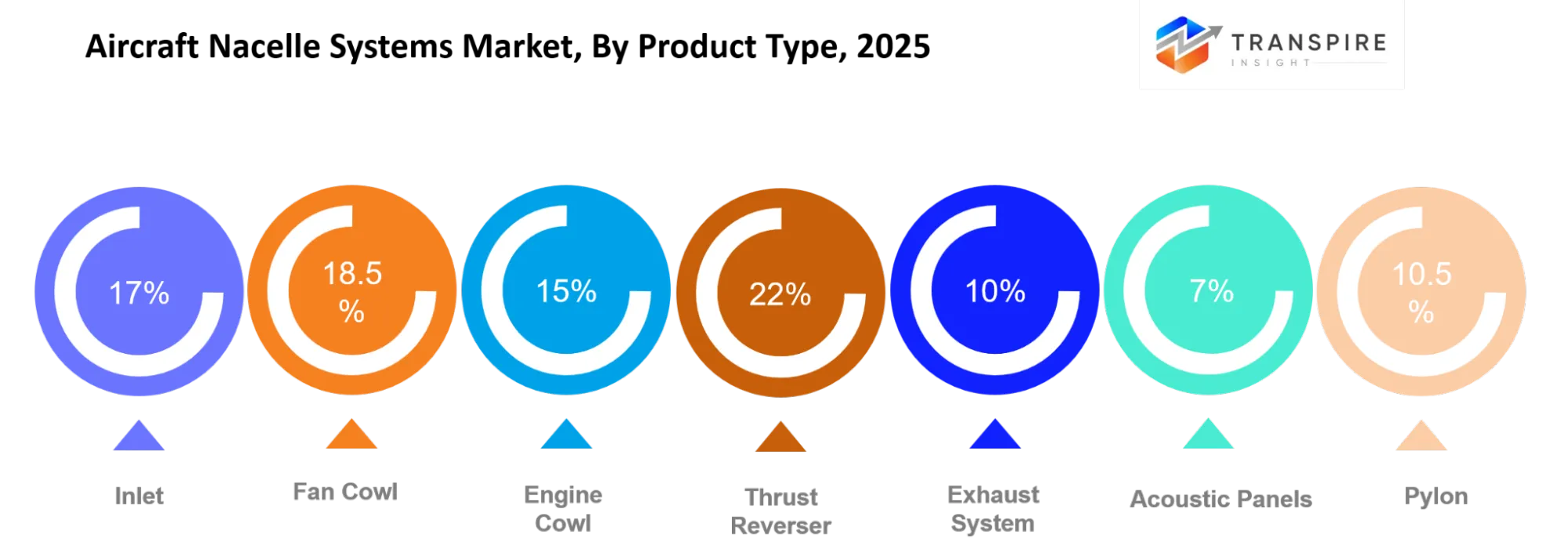
- Commercial aircraft constitute 62.0% of the market due to the significance of airlines' fleet growth and nacelle supply agreements for large-scale aircraft programs.
- Hybrid electric nacelles are expected to experience a 8.7% CAGR, providing suppliers with chances to develop designs suitable for new propulsion systems.
- Thrust reversers constitute 22.0% of the component segment due to their necessity for aircraft deceleration, system integration, and landing.
- Fan cowls comprise 18.5% of the component segment, prompting manufacturers to develop access for maintenance and reduction of structural weight and aerodynamic drag.
- Engine cowls hold 15.0% of the component segment, ensuring continued demand for durable protective structures and simplified inspection procedures.
- Exhaust systems make up 10.0% of the component segment, while manufacturers keep searching for heat-resistant materials and noise-reducing technologies.
What are the Key Drivers, Restraints, and Opportunities in the Aircraft Nacelle Systems Market?
Drivers
Commercial aircraft production and fleet renewal will continue to be factors driving growth in the worldwide market for aircraft nacelle systems. To reduce fuel consumption and operating costs, airlines are investing in newer, more efficient airframes, and OEMs are winning orders for aircraft nacelle assemblies, thrust reversers and other components according to regular delivery schedules. The increasing use of composites for lightweight parts and automation in manufacturing are two other trends that could help suppliers generate new equipment sales and ongoing replacement and repair revenue.
Restraints
Investment in product development and costs, lengthy certification requirements and difficult supplier qualification result in limited market penetration and delays in new product introduction. Nacelles are exposed to vibration, a wide temperature range, aerodynamic loads and continual operation – hence the requirement for rigorous standards for aircraft safety. New developments must be supported by significant engineering, testing, tooling and quality investment before an aircraft system is introduced into service.
Opportunities
Opportunities for advanced materials, digital manufacturing and new propulsion technologies could enable long-term growth. Development of hybrid-electric aircraft might generate preference for nacelle structures that consider varying electrical, thermal and aerodynamic parameters. Asia Pacific will remain attractive as airlines increase fleet size and regional maintenance networks evolve. Suppliers able to deliver lightweight components with automatable inspections and lifecycle solutions might enhance production efficiencies and strengthen ties with OEMs and operators.
|
Driver |
Relative Impact on Growth (%) |
Geographic Relevance |
Impact Timeline |
Demand Strength |
Growth Mechanism (5–10 words) |
Key Beneficiaries (5–10 words) |
Major Constraint (5–10 words) |
|
Rising Commercial Aircraft Production and Deliveries |
30% |
North America, Europe, Asia-Pacific |
Short-term to Medium-term |
High |
Higher aircraft deliveries increase demand for nacelle assemblies. |
Nacelle manufacturers, aircraft OEMs, engine manufacturers, suppliers. |
Production delays and engine shortages restrict nacelle deliveries. |
|
Growing Demand for Fuel-Efficient and Lightweight Nacelle Designs |
24% |
North America, Europe |
Medium-term to Long-term |
High |
Advanced aerodynamics and lightweight materials improve aircraft efficiency. |
Composite suppliers, nacelle OEMs, engine manufacturers, airlines. |
High development costs and stringent certification requirements. |
|
Expansion of Air Passenger Traffic and Fleet Modernization |
19% |
Asia-Pacific, North America, Middle East |
Short-term to Medium-term |
High |
Fleet expansion drives demand for new aircraft nacelles. |
Aircraft manufacturers, nacelle suppliers, airlines, leasing companies. |
Economic uncertainty and airline financing constraints delay purchases. |
|
Technological Advancements in Composite Materials and Engine Integration |
15% |
North America, Europe, Asia-Pacific |
Medium-term to Long-term |
High |
Advanced composites reduce weight and enhance nacelle performance. |
Materials suppliers, aerospace engineers, nacelle manufacturers, engine OEMs. |
Complex manufacturing processes and material qualification increase costs. |
|
Stricter Emissions, Noise, and Environmental Performance Requirements |
12% |
Europe, North America, Asia-Pacific |
Medium-term to Long-term |
Medium |
Regulatory requirements encourage quieter, cleaner nacelle technologies. |
Nacelle designers, engine OEMs, airlines, aerospace technology providers. |
Compliance expenses and lengthy certification processes delay adoption. |
|
Total |
100% |
— |
— |
— |
— |
— |
— |
What Has the Impact of Artificial Intelligence Been on the Aircraft Nacelle Systems Market?
Artificial intelligence is transforming and optimising nacelle designs, manufacturing quality, and maintenance planning. In product development, AI-powered engineering tools can be used to evaluate aerodynamic performance, compare different design options, and find areas where weight and material usage can be reduced. These tools can help engineers to evaluate nacelle designs prior to costly physical tests, but simulation results still need to be verified by engineers. In manufacturing, machine vision and AI-based inspections can be used to detect surface defects, structural inconsistencies in composites, and dimensional variations during the manufacturing process. When combined with automated systems, they can help to improve the consistency of inspections and to investigate quality issues. Predictive maintenance is another application that can be useful. Using inspection records, vibration measurements, operating conditions, and maintenance histories, analytical models can help to identify parts that need to be inspected before a failure will leave an aircraft grounded. The biggest obstacle for AI-based solutions is the high cost of implementing digital systems in manufacturing processes of certified products.
Instance
In September 2026, RTX used robotic machine vision to inspect aircraft nacelle parts in order to decrease manual workload and increase efficiency in the inspection process. This example clearly shows how AI can improve the maintenance process, minimise delays and increase after-market services in the aircraft nacelles market around the world.
Key Market Trends:
The industry trends move from traditional structural design to an integrated, lightweight, and service-based nacelle design.
- Nacelle production becomes more about the combination of economy of scale, acoustics, material science, digital inspection, and maintenance.
- Automation of drilling, riveting, finishing, and inspection becomes more relevant for those suppliers that value quality and quick production.
- The design of nacelles has become more interrelated with the performance of engines and airframes, which stimulates cooperation of aircraft producers, engine designers, and component suppliers.
- Acoustic engineering becomes vital for manufacturers striving to decrease the noise level of engines while keeping the aerodynamic and reliable performance of nacelles.
- Market competition becomes higher due to maintenance services, spare parts, and repair during the whole life cycle of the aircraft.
- The emergence of hybrid electric engines and other advanced propulsion systems stimulates research and development of new nacelle designs.
Aircraft Nacelle Systems Market Segmentation
By Component
the thrust reverser accounts for 22.0% of the market and thus represents the highest proportion among all the component categories in the provided segmentation details. The function of thrust reversal at the time of landing of the aeroplane makes performance, reliability, and compatibility with the aeroplane control system crucial purchasing criteria. The fan cowl accounts for 18.5% of the market, which is made possible due to its functionality in housing the fan section of the engine and providing access for servicing purposes. The inlet system accounts for 17.0%, the engine cowl accounts for 15.0%, and the exhaust system accounts for 10.0%. The acoustic panel accounts for 7.0%, the pylon for 6.5%, and the rest of the components account for 4.0%.
By aircraft type
The commercial aircraft constituted the biggest market share at 62.0%, and demand for nacelles and replacement systems arise from fast-paced operations in airlines and also fleet changes. Business jets, regional jets, military planes, helicopters, cargos, UAVs and other types of aircraft constitute additional segments, whose demand stems from their engines and type of operation. The business and regional aircraft emphasize the need for compact structure and high performance, whereas the military platforms require more durability or mission capability.
By engine type
Traditional turbofan engines are also an attractive market segment due to their heavy use in commercial aviation. In addition to thrust technology, turboprop, turbojet and turboshaft engines all need a nacelle or other airframe structure in the same way a conventional turbofan engine does. The document states that the hybrid-electric nacelle is the fastest-growing segment with an expected CAGR of 8.7%. Electric and geared turbofan configurations could also open up opportunities for differentiated structural integration, thermal management and flow management.
By material
Aluminium, titanium, composites, carbon, nickel alloys, advanced polymers, hybrid materials, and other materials are suitable for specific structural and performance needs. Aluminium and composites still have a place where weight, manufacturing techniques and costs are of concern. Ti and nickel alloys will be favoured where performance in a high thermal or mechanical environment is required, and composites and carbon fibres will be used for reducing overall structure weight. Advanced polymers and hybrid materials may be needed for evolution in manufacturing and design of components.
By application
OEM is linked to nacelles being supplied with new aircraft programs. The aftermarket includes maintenance/repair/overhaul of nacelles, as well as upgrades or retrofits. It is driven by the number of complete nacelle sets, fleet size, component condition, repair schedules and aircraft utilisation. Increased pressure to reduce life-cycle costs could benefit those suppliers with proven repair systems and dependable availability of spares
By end user
Aircraft operators are a major end user segment. It is essential for airlines to get nacelle parts with high reliability, good fuel efficiency and maintenance support for their fleet. Suppliers must be able to fulfil engineering, certification, quality and delivery specifications. For military aircraft, end users are defence forces that may need special nacelle structures; for maintenance, repair and overhaul operators, end users are maintenance and component repair providers. Leasing companies, cargo operators and business jet operators all have varying end user requirements related to fleet usage, operating costs and aircraft configuration.
What are the Key Use Cases Driving the Aircraft Nacelle Systems Market?
Commercial air transportation is a use case. Nacelles for airlines and aircraft manufacturers need to provide protection, regulation of airflow, noise reduction, and thrust reversibility when the aircraft lands. That is why nacelle reliability and maintainability become very important at all stages of an aircraft life cycle. Applications that can be expanded include business jets, regional aircraft, cargo planes, and military applications that require structural elements suitable for different environmental conditions. Maintenance and repairs in the aftermarket, component replacement, and restoration of an aircraft are additional factors that generate demand for nacelles. Future applications can include the development of hybrid propulsion systems and advanced lightweight structures that may require the redesign of nacelles due to changed thermal management, electrical integration, and aerodynamic properties.
|
Report Metrics |
Details |
|
Market size value in 2025 |
USD 5.71 Billion |
|
Market size value in 2026 |
USD 6.01 Billion |
|
Revenue forecast in 2033 |
USD 9.01 Billion |
|
Growth rate |
CAGR of 5.96%from 2026 to 2033 |
|
Base year |
2025 |
|
Historical data |
2021 - 2024 |
|
Forecast period |
2026 - 2033 |
|
Report coverage |
Revenue forecast, competitive landscape, growth factors, and trends |
|
Regional scope |
United States; Canada; Mexico; United Kingdom; Germany; France; Italy; Spain; Denmark; Sweden; Norway; China; Japan; India; Australia; South Korea; Thailand; Brazil; Argentina; South Africa; Saudi Arabia; United Arab Emirates |
|
Key company profiled |
Safran, Collins Aerospace, Spirit AeroSystems, GKN Aerospace, Boeing, Airbus, Leonardo, ST Engineering, FACC, Bombardier, Raytheon Technologies, Triumph Group, NORDAM, Hexcel, Hutchinson |
|
Customization scope |
Free report customization (country, regional & segment scope). Avail customized purchase options to meet your exact research needs. |
|
Report Segmentation |
Component (Inlet, Fan Cowl, Engine Cowl, Thrust Reverser, Exhaust System, Acoustic Panels, Pylon, Others)Aircraft Type (Commercial Aircraft, Business Jets, Regional Jets, Military Aircraft, Helicopters, Cargo Aircraft, UAVs, Others)Engine Type (Turbofan, Turboprop, Turbojet, Turboshaft, Hybrid-Electric, Electric, Geared Turbofan, Others)Material (Aluminum, Titanium, Composite Materials, Carbon Fiber, Nickel Alloys, Advanced Polymers, Hybrid Materials, Others)Application (OEM, Aftermarket, Maintenance, Repair & Overhaul, Retrofit, Upgrades, New Aircraft Production, Others)End User (Airlines, Aircraft Manufacturers, Defense Forces, MRO Providers, Leasing Companies, Cargo Operators, Business Aviation, Others) |
Which Regions are Driving the Aircraft Nacelle Systems Market Growth?
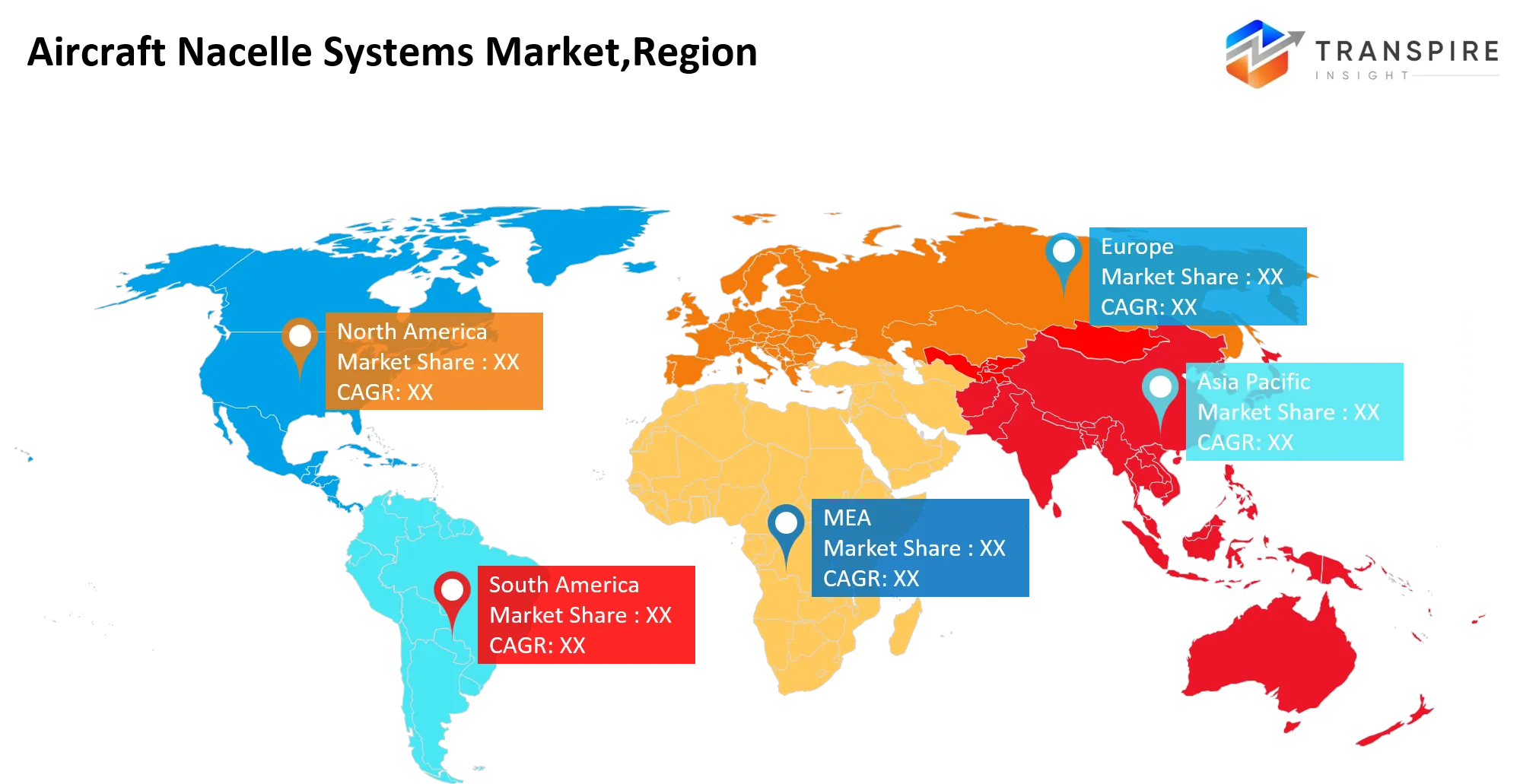
North America
North America leads the market of aircraft nacelle systems with 38.30% of shares because of its developed capabilities in aircraft manufacturing and the relationships of the manufacturers of the aircraft, engine systems and nacelles with each other. There is specific engineering expertise and well-developed system of certification and testing in North America. The commercial and defense aerospace sectors of the region create high demand for nacelles. Investments into aircraft manufacturing and nacelle production will help maintain the leadership position in the market.
In April 2026, Bell Textron reported that its Nacelle Improvement Program for the Bell Boeing V-22 Osprey resulted in maintenance time being cut by 75% and an increase of more than 10% in its operational readiness through 10,000+ flight hours. The improvements involve changes to nacelle wiring and structure, demonstrating ongoing investments in nacelles of military aircraft in North America.
Europe
Europe constitutes 30.0% of shares due to the presence of a developed aircraft manufacturing industry in Europe and also the presence of major companies providing nacelle and engine system solutions. Companies such as Safran Nacelles can contribute with their nacelle engineering, lightweight structures, acoustics and aftermarket services. Aerospace programs in Europe promote collaboration between aircraft manufacturers, engine developers and component producers. Capabilities of the European aerospace industry and its focus on environmental performance guarantee stability.
In April 2026, Daher signed a new logistics contract with Safran Nacelles for managing the warehouse in Hamburg, Germany, which will help in nacelle integration projects close to the Airbus A320neo final assembly line. This project enhances the supply chain structure involved in the production of aircraft nacelles in Europe and aids in meeting the logistics needs related to aircraft nacelle manufacturing.
Asia Pacific
The Asia Pacific region accounts for 20.5% of the market share and is expected to have the highest growth rate of 5.62% CAGR, which makes it the fastest-growing region from the available data. The growth in fleet size and development in aircraft manufacturing and maintenance in the region are providing openings for nacelle manufacturers. The commercial aircraft programs in China and the expansion of aviation services in the region may drive demand in the region.
In December 2025, AAR and Air France Industries KLM Engineering & Maintenance formed xCelle Asia in Chonburi, Thailand. The new company will provide next-generation aircraft nacelle MRO services, including those for GEnx, Trent 1000 and LEAP-1A/1B engine-powered aircraft.
Who are the Key Players in the Aircraft Nacelle Systems Market and how do they compete?
Competition in the aircraft nacelle systems market on a worldwide basis is determined by such factors as engineering, certification, manufacturing, materials, and aftermarket experience. The suppliers have to satisfy the stringent requirements of aircraft programs at the lowest possible cost and on consistent schedules. Existing suppliers use their existing relations with the aircraft and engine manufacturers, while specialised suppliers use component expertise and technological capabilities. Safran Nacelles is competing with the integrated nacelle system, lightweight construction, acoustic technologies, and after-market support. Its product range includes commercial aircraft, regional aircraft, and business jet aircraft. Also, its manufacturing includes automated assembly and composite construction. The company's industrial network and maintenance services help it serve its customers during the operation of the aircraft. Another source of competition of the company is customer service and repair services. Relevant competitors for Safran Nacelles are Spirit AeroSystems, GKN Aerospace, Leonardo, NORDAM, FACC, Triumph Group, and Ducommun. Their competitive advantages depend on specialisation, aircraft program participation, manufacturing capabilities, and aftermarket experience.
Aircraft Nacelle Systems Market companies
- Safran
- Collins Aerospace
- Spirit AeroSystems
- GKN Aerospace
- Boeing
- Airbus
- Leonardo
- ST Engineering
- FACC
- Bombardier
- Raytheon Technologies
- Triumph Group
- NORDAM
- Hexcel
- Hutchinson
|
Company |
Est. Revenue Share Range |
Key Offerings |
Strategic Positioning |
Geographic Strength |
Technology Focus |
|
Safran Nacelles |
Estimated 12–18% |
Complete nacelles, thrust reversers, fan cowls, acoustic panels |
leader in integrated nacelle systems |
Europe, North America, Asia Pacific |
Lightweight composites, acoustic optimization, thrust-reverser innovation |
|
Collins Aerospace (RTX) |
Estimated 10–16% |
Nacelle systems, thrust reversers, engine cowls, nacelle components |
Premium supplier with extensive aircraft OEM integration |
North America, Europe, Asia Pacific |
Advanced thrust reversal, lightweight structures, aerodynamic efficiency |
|
Spirit AeroSystems |
Estimated 7–12% |
Nacelle assemblies, engine inlets, thrust reversers, structural components |
Large-scale aerostructures manufacturing and OEM partnerships |
North America, Europe, Asia Pacific |
Composite fabrication, precision assembly, automated manufacturing |
|
GKN Aerospace |
Estimated 5–9% |
Nacelle structures, engine components, composite assemblies, metallic structures |
Engineering-led differentiation in advanced aerostructures |
Europe, North America, Asia Pacific |
Advanced composites, lightweight structures, sustainable manufacturing |
|
The NORDAM Group |
Estimated 3–6% |
Inlet cowls, fan cowls, thrust reversers, engine build-up systems |
Specialized nacelle engineering and aftermarket support |
North America, Europe, Asia Pacific |
Robotic manufacturing, acoustic composites, anti-icing systems |
|
ST Engineering Aerospace |
Estimated 2–5% |
Nacelle components, engine cowls, nacelle MRO, replacement parts |
Integrated manufacturing and lifecycle support specialist |
Asia Pacific, North America, Middle East |
Precision aerostructures, repair engineering, lifecycle optimization |
|
Leonardo S.p.A. |
Estimated 2–4% |
Aerostructures, nacelle-related structures, engine components, assemblies |
Diversified aerospace supplier with structural engineering expertise |
Europe, North America |
Lightweight structural design, advanced materials, precision assembly |
|
FACC AG |
Estimated 2–4% |
Composite engine components, aerodynamic structures, lightweight assemblies |
Composite-specialist supplier focused on weight reduction |
Europe, Asia Pacific, North America |
Carbon-fibre composites, automated lay-up, lightweight structures |
|
Triumph Group |
Estimated 1–3% |
Nacelle components, engine structures, precision aerospace assemblies |
Specialized component supplier serving selected aircraft programs |
North America, Europe |
Precision machining, structural integration, manufacturing optimization |
|
Aernnova Aerospace |
Estimated 1–3% |
Aerostructures, composite assemblies, engine-related structures, metallic components |
Engineering-focused challenger in selected aerostructure programs |
Europe, North America |
Composite engineering, structural optimization, advanced fabrication |
Recent Development News
In July 2026, Collins Aerospace and Etihad Engineering formed a joint venture to offer nacelle and thrust reverser maintenance services in Abu Dhabi, for Airbus A350 and Boeing 787 fleets. This new facility will be able to enhance the maintenance capability in the region and increase availability for wide-body aircraft maintenance services.
In April 2025, Safran Nacelles made delivery of its 100th nacelle for COMAC's C919 program. There were also higher delivery levels for some other commercial aircraft programs. These initiatives are indications of continuous involvement in both well-established and new aircraft manufacturing programs.
What Strategic Insights Define the Future of the Aircraft Nacelle Systems Market?
The future of the aircraft nacelle systems market will rely on how well the suppliers can manage to reconcile their growing demands for the production of aircraft with the improvements in weight, noise performance, manufacturing efficiencies, and maintenance. The demand from commercial aviation will continue to be important, but the research into hybrid electric propulsion may lead to opportunities in terms of more specific nacelles. Automated manufacturing, advanced composites, and digital inspection will enable better quality control and manufacturing efficiency. The hidden danger is the gap between the delivery plans of the aircraft manufacturers and the capabilities of the specialised nacelle suppliers. Disruptions in material supply, certification, and component production may affect deliveries and put pressure on working capital. The potential is in the combination of scalable manufacturing and aftermarket services along with regional maintenance partnerships. The manufacturers need to focus on flexible capacity, supplier diversification, validated digital quality systems, and customer support. They need to carefully assess the new propulsion technologies and invest in technical requirements rather than every experimental aircraft architecture.
Component
- Inlet
- Fan Cowl
- Engine Cowl
- Thrust Reverser
- Exhaust System
- Acoustic Panels
- Pylon
- Others
Aircraft Type
- Commercial Aircraft
- Business Jets
- Regional Jets
- Military Aircraft
- Helicopters
- Cargo Aircraft
- UAVs
- Others
Engine Type
- Turbofan
- Turboprop
- Turbojet
- Turboshaft
- Hybrid-Electric
- Electric
- Geared Turbofan
- Others
Material
- Aluminum
- Titanium
- Composite Materials
- Carbon Fiber
- Nickel Alloys
- Advanced Polymers
- Hybrid Materials
- Others
Application
- OEM
- Aftermarket
- Maintenance
- Repair & Overhaul
- Retrofit
- Upgrades
- New Aircraft Production
- Others
End User
- Airlines
- Aircraft Manufacturers
- Defense Forces
- MRO Providers
- Leasing Companies
- Cargo Operators
- Business Aviation
- Others
Frequently Asked Questions
Find quick answers to common questions.
The aircraft nacelle systems market size was valued at USD 5.71 Billion in 2025 and is poised to reach USD 9.01 Billion by 2033, expanding at a 5.96% CAGR.
Key segments for the aircraft nacelle systems market are Component (Inlet, Fan Cowl, Engine Cowl, Thrust Reverser, Exhaust System, Acoustic Panels, Pylon, Others)Aircraft Type (Commercial Aircraft, Business Jets, Regional Jets, Military Aircraft, Helicopters, Cargo Aircraft, UAVs, Others)Engine Type (Turbofan, Turboprop, Turbojet, Turboshaft, Hybrid-Electric, Electric, Geared Turbofan, Others)Material (Aluminum, Titanium, Composite Materials, Carbon Fiber, Nickel Alloys, Advanced Polymers, Hybrid Materials, Others)Application (OEM, Aftermarket, Maintenance, Repair & Overhaul, Retrofit, Upgrades, New Aircraft Production, Others)End User (Airlines, Aircraft Manufacturers, Defense Forces, MRO Providers, Leasing Companies, Cargo Operators, Business Aviation, Others)
Growth is primarily driven by increasing aircraft production, rising air passenger traffic, growing demand for fuel-efficient aircraft, advancements in lightweight composite materials, and increasing investments in commercial and military aviation. The need for improved engine performance, noise reduction, and efficient nacelle maintenance also supports market growth.
The market is led by major manufacturers including Safran, Collins Aerospace, Spirit AeroSystems, GKN Aerospace, Boeing, Airbus, Leonardo, ST Engineering, FACC, Bombardier, Raytheon Technologies, Triumph Group, NORDAM, Hexcel, Hutchinson
The North American continent dominates the international market for aircraft nacelle systems with a 38.30% market share. This is because there are many leading aircraft manufacturers and aerospace suppliers in the region, alongside high demand for both commercial and military aviation aircraft. The continuous investments in manufacturing of aircraft and their fuel-efficient nacelles have bolstered its market position.
Opportunities in the market for aircraft nacelle systems involve the growing need for energy-efficient and light nacelle systems, increased manufacturing of aircraft, and growth in the number of aircraft globally. There are also opportunities that can be exploited through the emergence of new composite materials, noise reduction technologies, and aftermarket services like nacelle maintenance and repair.
- Safran
- Collins Aerospace
- Spirit AeroSystems
- GKN Aerospace
- Boeing
- Airbus
- Leonardo
- ST Engineering
- FACC
- Bombardier
- Raytheon Technologies
- Triumph Group
- NORDAM
- Hexcel
- Hutchinson
About the Authors

Tejashri Dhatrak
I am Tejashri Dhatrak, a Senior Research Analyst at Transpire Insight, specializing in the Aerospace and Defence sector. My work focuses on analyzing industry trends, defence technologies, market developments, and emerging innovations that shape the global aerospace and security landscape. At Transpire Insight, I research complex topics, evaluate credible sources, and transform technical insights into accurate, well-structured, and easy-to-understand content for industry professionals and decision-makers. My goal is to provide reliable, research-backed information that helps readers stay informed about defence capabilities, aerospace advancements, strategic developments, and the evolving dynamics of the global defence ecosystem.

Chakradhar Khansole
Chakradhar serves as the Research Director at Transpire Insight, bringing over 8 years of experience in technology, innovation, and strategic market intelligence. He specializes in transforming complex market data into actionable business insights that enable organizations to make informed, growth-oriented decisions. Recognized for his strategic vision and analytical expertise, Chakradhar leads high-impact research initiatives, delivering comprehensive market assessments, competitive intelligence, and forward-looking industry analysis.
Recently Published Reports
-
Apr 2026
Aerospace Fluoropolymers Market
Aerospace Fluoropolymers Market Size, Share & Analysis Report By Type (PTFE, FEP, PFA, ETFE, and Others), By Application (Electrical Insulation, Seals & Gaskets, Coatings, and Others), By End User (Commercial Aviation, Military Aviation, General Aviation, and Others), and Geography (North America, Europe, Asia-Pacific, Middle East and Africa, South and Central America), 2021 - 2031
-
Apr 2026
Airborne SATCOM System Market
Airborne SATCOM System Market Size, Share & Analysis Report By Type (SATCOM Terminals, Transceivers, Airborne Radio, Modems and Routers, SATCOM Radomes, and Other), By Application (Government and Defense and Commercial), and Geography (North America, Europe, Asia-Pacific, Middle East and Africa, South and Central America), 2021 – 2031
-
Apr 2026
Ship Leasing Market
Ship Leasing Market Size, Share & Analysis Report By Vessel Type (Container Ships, Bulk Carriers, Tankers, and Specialized Vessels), By Lease Duration (Short-Term Lease (Less than 1 year), Medium-Term Lease (1-5 years), and Long-Term Lease (More than 5 years)), By Lease Type (Bareboat Charter, Time Charter, Financial Lease, and Others), By End-User Industry (Oil and Gas, Manufacturing and Industrial, Automotive, Agriculture and Food, Retail and Consumer Goods, and Others), and Geography (North America, Europe, Asia-Pacific, Middle East and Africa, South and Central America), 2021 – 2031
-
Apr 2026
Thread Rolling Dies Market
Thread Rolling Dies Market Size, Share & Analysis Report By Type (Flat Thread Rolling Dies, Circular (Cylindrical) Dies, Tangential Thread Rolling Dies, Planetary Thread Rolling Dies, and Other Types), By Material Type (High-Speed Steel (HSS), Carbide, Tool Steel, Alloy Steel, and Other Specialized Alloys), By Distribution Channel (Direct Sales, Distributors and Dealers, and Online Platforms), By Application (Automotive Industry, Aerospace and Defense, Construction and Infrastructure, Industrial Machinery, Electronics and Electrical Components, Medical Devices, and Fastener Production), and Geography (North America, Europe, Asia-Pacific, Middle East and Africa, South and Central America), 2021 – 2031
Our Clients