

Aerial Work Platforms Market Summary:
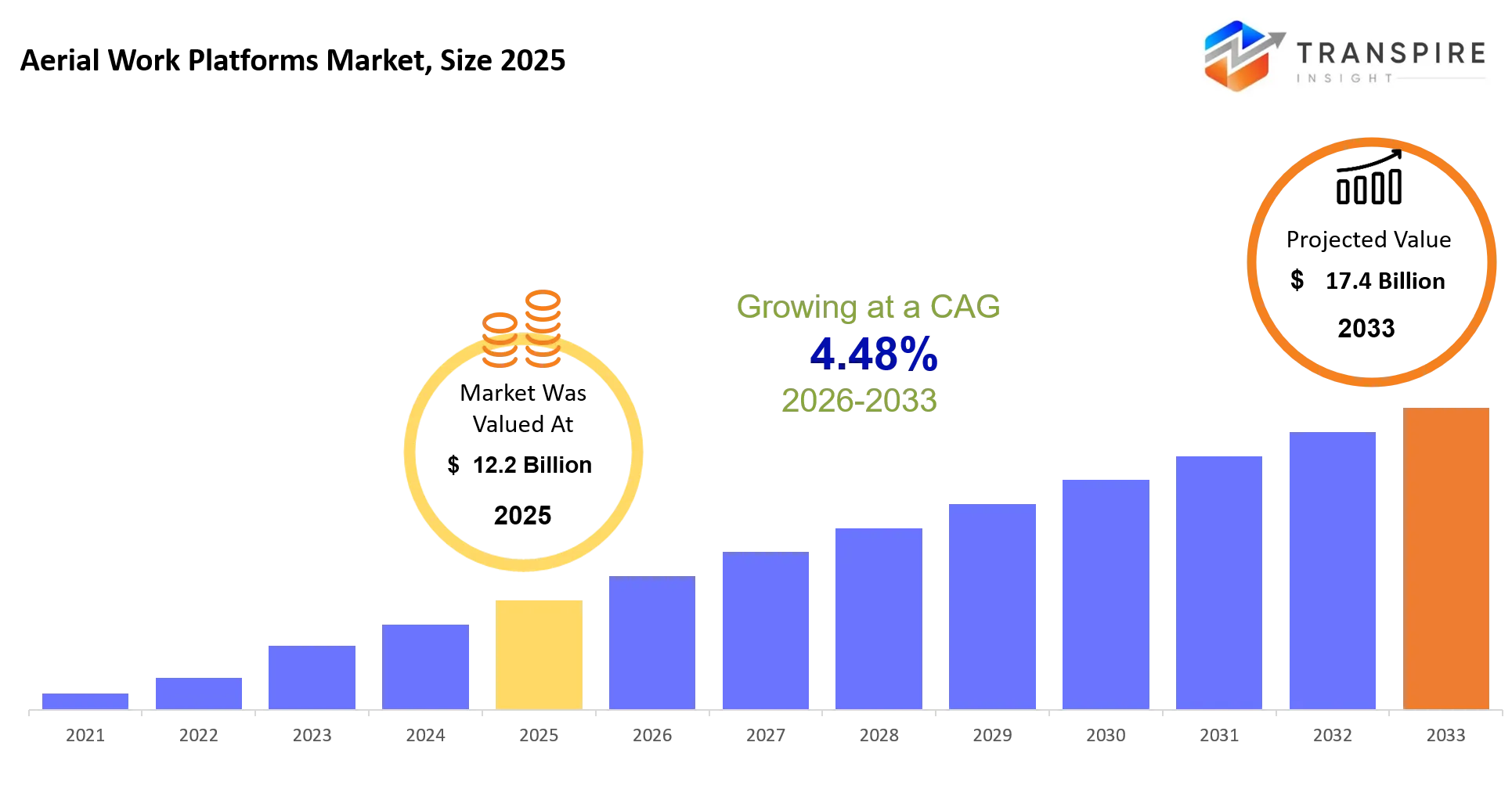
As per the Transpire Insight Analysis, The Aerial Work Platforms Market size is estimated at USD 12.2 billion in 2025 and is anticipated to reach USD 17.4 billion by 2033, growing at a CAGR of 4.48% from 2026 to 2033.
The market for aerial work platforms provides powered, mobile access at height for performing work that would traditionally be performed using ladders or scaffolding, to give greater efficiency and safety in construction, maintenance and industrial applications.
In the last 3-5 years, the market changed from a compliance-driven replacement cycle to a technology- and policy-led transformation. The key structural change is growing mandates for machine-specific training and fall-arrest requirements, along with design duties, which raised the standard for equipment capability and fleet documentation. Urban emissions/ noise regulations in large cities are driving contractors and rental companies toward Stage V and electric drivetrains to qualify for low-emission zones and win green jobsites. Growth is fuelled by more stringent safety and emissions standards that intensify replacement impetus and raise total-cost-of-ownership scrutiny, accelerating EHS-telemetry-enabled, lower-downtime, platform adoption that provides site access. At the same time, mega-projects and stimulus infrastructure provide ongoing fleet-refresh impetus, while higher rental penetration as users opt for dependence-reducing, scalable-challenging, compliant access instead of owned scaffolding.
Aerial Work Platforms Market Size & Forecast:
- Global Market Size 2025: USD 12.2 Billion
- Expected Market Value (2033): USD 17.4 Billion
- Forecast CAGR (2026–2033): 4.48%
- Leading Region in 2025: North America
- Fastest Growing Region: Asia Pacific
- Key Company Profiles: JLG Industries, Genie, Haulotte, Skyjack, Snorkel, Dingli Machinery, Zoomlion, XCMG, Manitou, MEC Aerial Work Platforms, Niftylift, Ruthmann, Bronto Skylift, Tadano, Teupen
Key Aerial Work Platforms Market Insights:
The AWP market is shifting from compliance-focused fleet refresh to technology-driven differentiation, with electrification, telematics, and AI changing AWP procurement and rental economics. The focus is on growth now and not only on unit volume, but also on operational efficiency, site access compliance, and sustainability requirements.
- North America accounts for 38% of the market, as infrastructure stimulus and tough OSHA/ANSI A92 safety regulations spur fleet modernization.
- Europe accounts for 29%, and the regulations on emissions and urban low-emission zones are driving contractors towards electric and hybrid platforms.
- Asia Pacific is expected to grow at 18.6% CAGR in the coming years and is projected to account for 26% of the market, driven by rapid urbanization, smart city initiatives, and increasing rental penetration.
- For warehouse automation and indoor maintenance, where stability and load capacity are most important, scissor lifts are the preferred option, and they lead in this category with a 37% share.
- Boom lifts account for 24% of sales, with a rise in sales in renewable energy and infrastructure projects that demand high-reach and outdoor use.
- Electric platforms are growing at 17.8% CAGR, with contractors addressing green jobsites and compatibility indoors in the face of emissions regulations.
- Rental fleets are making the switch to utilization-based procurement, with a preference for telematics-powered machines that minimize downtime and allow for flexible pricing.
- To stand out in markets with high utilization, JLG, Genie, and Dingli are making investments in hydrogen-electric hybrids and artificial intelligence-powered fleet optimization.
What are the Key Drivers, Restraints, and Opportunities in the Aerial Work Platforms Market?
Driver:
Enhanced workplace safety regulations mandate documentation of pre-use training, fall protection, and inspection on all mobile elevating work platforms. These regulations tightening occasioned fleet renewal as contractors look to replace venerable elevators with units integrating safety interlocks, load sensing, and telematics to obviate citations and insurance penalties. This benefits revenues as higher-end units attain premium rental prices and longer contracts while utilization jumps as sites seek compliant, traceable lift fleets.
Restraint:
High early capital investment and integration challenges, when combined with electric and connected platforms, prevent smaller contractors and emerging markets with weak power infrastructure from adopting new construction technologies. This is a structural issue due to the uneven nature of charging infrastructure, battery changeovers, and operator retraining in emerging markets, hindering complete electrification despite policy support.
Opportunity:
The next growth unlock is hydrogen-powered and long-runtime battery-based platforms for outdoor, high-utilization locations paired with AI fleet optimization. Rental operators who leverage telematics with predictive maintenance capability can achieve a 20-30% reduction in unplanned downtime, improving asset turnover and allowing dynamic pricing based on utilization and compliance data. Zero-emissions hydrogen-electric platforms, like the Niftylift HR17 H2E, enable long-runtime use in locations without available charging infrastructure, overcoming a significant obstacle to electrification on early-stage construction sites.
What Has the Impact of Artificial Intelligence Been on the Aerial Work Platforms Market?
In aerial work platforms (AWPs), AI is moving from peripheral telematics to fundamental jobsite intelligence. Heavy machinery now often contains trained machine learning models that study usage data, load cycles, and ambient conditions to facilitate lift-path optimization, platform stabilization, and auto-tuning to improve throughput on high-volume, normed tasks.
The most exemplary impact-predictive AI enables diagnostics that predict wear of hydraulics, batteries, and motors, allowing fleet managers to schedule maintenance before breakdown, minimising unexpected downtime, increasing asset life, and reducing overall ownership cost. In a rental-heavy industry, asset utilisation is a key source of revenue. In that regard, fleet managers employ AI to optimally allocate their machines; knowledge of location, expected length of work, and site limitations knowledge help for optimization. Nevertheless, accuracy disparity exists in varied jobsite data. If an AI model trained on a lab dataset is applied to irregular terrain or pervasive cold weather, mispredictions on wear or stability will be introduced, which discourages operators with risk biases from adopting AI. Also, high integration cost and inconsistent data pipelines among OEMs hinder enterprise-wide implementation, which restrains scalability even with obvious ROI.
Key Aerial Work Platforms Market Trends:
The AWP market is evolving from compliance-based fleet refresh to tech-driven differentiation, with electrification, telematics, and AI optimization reshaping the economics of procurement and rental. Operational efficiency and site access compliance are driving growth, rather than volume of units.
- Rental fleets are moving towards utilization-based procurement that includes electric vehicles and telematics-enabled vehicles complying with urban emissions and noise regulations.
- Electric drivetrains are finding their footing as contractors gear up for low-emission worksites and indoor applications, and Stage V and battery platforms are becoming the norm.
- Telematics and IoT connectivity are mandatory buying requirements and are now enabling predictive maintenance and real-time asset tracking.
- Urban development and retrofit activities are increasing, leading to a growing demand for compact, manoeuvrable platforms in confined indoor/outdoor locations.
- Safety-first operations are driving the adoption of AWPs faster than scaffolding, due to ANSI A92 and OSHA training and inspection requirements.
- The benefits of remote operability and automation are improving usability, reducing labour risks and allowing for single-operator workflows.
- Infrastructure stimulus and mega-projects are bringing long-term fleet replacement demand to the construction, utilities, and telecom sectors.
- Hybrid platforms or hydrogen are being developed for high runtime outdoor applications where pure electric is limited.
Aerial Work Platforms Market Segmentation
By Product Type:
Scissor Lifts dominate with 37% market share for providing steady vertical lifting for buildings, warehouses, and parks. Boom Lifts are second with a 24% market share due to providing horizontal reach for infrastructure and utility work. Vertical Mast Lifts have a 14% market share, growing steadily in smaller indoor businesses. Trailer-mounted Lifts are also growing with a 10% market share in providing mobility across various job sites. Spider Lifts scale 3% on difficult mountainous terrains and tight areas. Truck-mounted Lifts, Telehandlers, and Others populate the rest of the market with more specific industrial uses.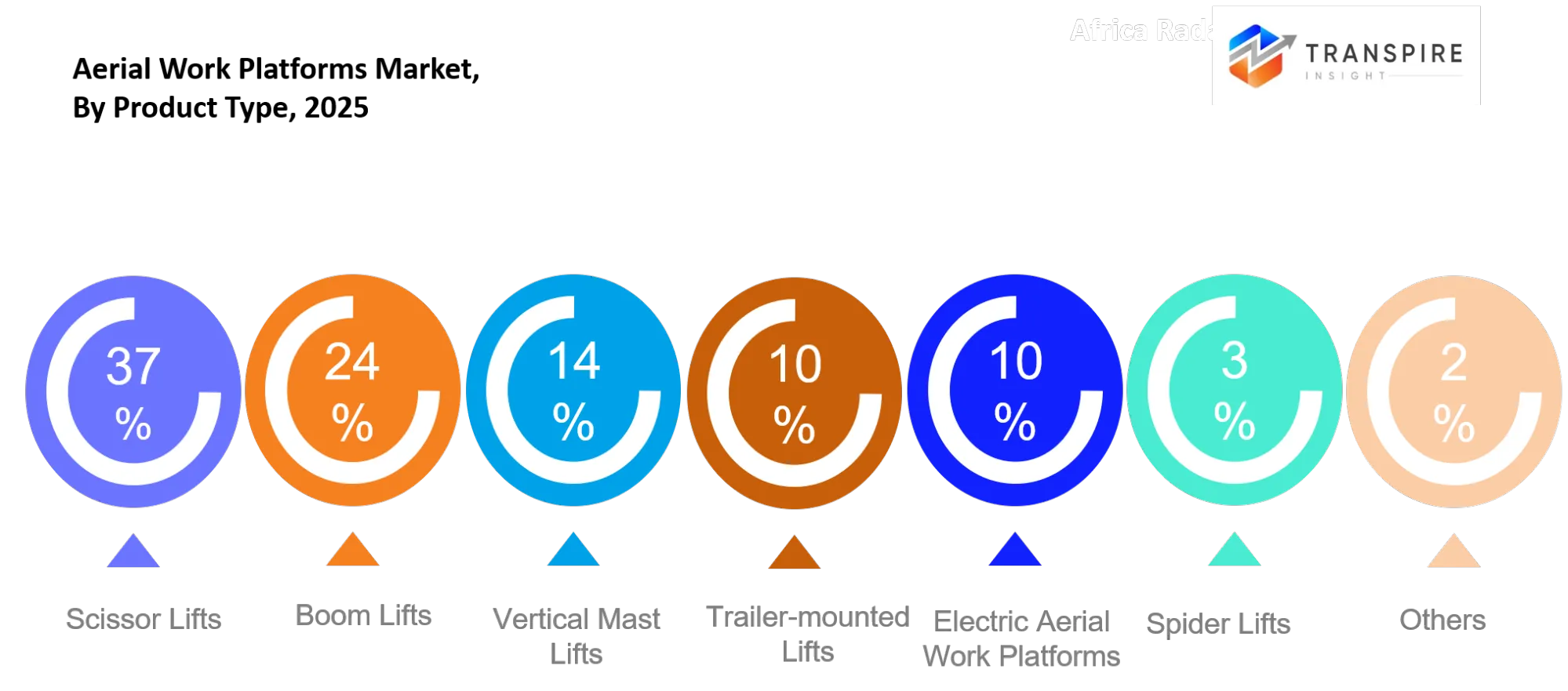
By Power Source:
Electric Aerial Work Platforms are anticipated to attain the fastest CAGR of 17.8% owing to emission standards, indoor construction activity, and increasing battery technology. Diesel-powered equipment is still required for heavy-duty outdoor work, but hybrid, LPG, battery, hydrogen and other alternatives are likely to find their ground as fleet investment plans change to meet targets for sustainability.
By End User:
Construction continues to be driven by the trends of infrastructure refurbishment and commercial expansion topped up by warehousing and logistics sectors, utilities, communications, manufacturing, aviation, municipal services and other industrial sectors where safe elevated access enhances the safety of the workforce and better productivity.
By Application:
Construction activities represent the largest equipment utilization, whereas building maintenance, industrial maintenance, warehousing, infrastructure projects, facility management, and other specialized operations are increasingly adopting sophisticated lifting solutions to minimize the human risks of accessing traditional methods, improve efficiency, and speed up project delivery.
By Distribution Channel:
Direct sales still benefit big contractors and industrial companies that need dedicated fleets; however, rental equipment companies are the fastest-growing channel thanks to flexible ownership models. With the growth of online B2B sites, OEM suppliers, dealer networks, and other channels, the availability of products and aftermarket services can be improved.
What are the Key Use Cases Driving the Aerial Work Platforms Market?
The fundamental application is safe, quick elevated access in construction/warehouse environments, where the scissor lift is prevalent for stable, heavy-duty, high-capacity activities on smooth ground, allowing swift erection, inspection, and repair that would be much slower using a scaffold or ladder.
Additional uses are utilities and telecommunications, where boom lifts and vertical mast lifts enable overhead line work, network upgrades, and renewables-benefits of infrastructure stimulation and grid modernization.
Emerging applications include municipal services, aviation, and facilities maintenance, with compact electric and spider lifts allowing work in congested urban settings, airports, or high-traffic sites where emissions, sound, and agility are important considerations.
|
Report Metrics |
Details |
|
Market size value in 2025 |
USD 12.2 Billion |
|
Market size value in 2026 |
USD 12.8 Billion |
|
Revenue forecast in 2033 |
USD 17.4 Billion |
|
Growth rate |
CAGR of 4.48% from 2026 to 2033 |
|
Base year |
2025 |
|
Historical data |
2021 - 2024 |
|
Forecast period |
2026 - 2033 |
|
Report coverage |
Revenue forecast, competitive landscape, growth factors, and trends |
|
Regional scope |
United States; Canada; Mexico; United Kingdom; Germany; France; Italy; Spain; Denmark; Sweden; Norway; China; Japan; India; Australia; South Korea; Thailand; Brazil; Argentina; South Africa; Saudi Arabia; United Arab Emirates |
|
Key companies profiled |
JLG Industries, Genie, Haulotte, Skyjack, Snorkel, Dingli Machinery, Zoomlion, XCMG, Manitou, MEC Aerial Work Platforms, Niftylift, Ruthmann, Bronto Skylift, Tadano, Teupen. |
|
Customization scope |
Free report customisation (country, regional & segment scope). Avail customised purchase options to meet your exact research needs. |
|
Report Segmentation |
By Product Type (Scissor Lifts, Boom Lifts, Vertical Mast Lifts, Trailer-mounted Lifts, Spider Lifts, Truck-mounted Lifts, Telehandlers, Others); By Power Source (Electric, Diesel, Hybrid, LPG, Battery-powered, Hydrogen-powered, Others); By End User (Construction, Warehousing & Logistics, Utilities, Telecommunications, Manufacturing, Aviation, Municipal Services, Others); By Application (Building Maintenance, Construction, Industrial Maintenance, Warehousing, Infrastructure Projects, Facility Management, Others); By Distribution Channel (Direct Sales, Equipment Rental Companies, Dealers & Distributors, Online B2B Platforms, OEM Suppliers, Others). |
Which Regions are Driving the Aerial Work Platforms Market Growth?
North America retains top spot at 38% share in the market. This is due to continued investment in infrastructure and rising demand for construction equipment, as well as an already mature rental market. Increasing safety stringency by OSHA and ANSI A92 standards, along with policies on emissions in cities, have driven a fleet replacement with compliant units, including Stage V metrics. All supported by the OEMs, rental market and training providers, ensuring fast-track adoption. In July 2026, Komatsu entered into a strategic partnership with AIM Intelligent Machines to deploy commercial autonomous construction systems on machinery in the U.S. This collaboration fast-tracks automated workflow adoption to counter regional labour shortages.
Europe represents 29%, with regulation around decarbonisation and the working environment, with positive drivers for Europe being decarbonisation-related mandates for green buildings, rail modernisation and offshore wind projects. Stability-related factors are multi-decade policy architectures, high penetration of rental at 45 – 65%, and contractor inclination for low-emission, indoor-compatible equipment under the EU Green Deal and national climate legislation.
In March 2026, the European Commission published a new Staff Working Document on life cycle approaches to decarbonise buildings. This action provides official guidance to operationalize "whole-life carbon" concepts across Europe's building stock.
Asia Pacific continues to be the fastest-growing region, with a share of 26% and an 18.6% CAGR. The key drivers have been an increase in urbanization, smart-city initiatives, and growing construction activity in the Chinese and ASEAN markets. The recent developments have been increasing focus on rental and government-supported infrastructure programs, which have created potential opportunities in warehousing, utilities and telecom sectors due to growth in e-commerce, industrial modernisation and increasing logistics activity.
In February 2026, KKR and Singtel signed definitive agreements to complete its acquisition of a strategic stake in STT GDC (ST Telemedia Global Data Centres). This expansion scaled up digital and utility-supporting infrastructure across Southeast Asia and the broader APAC region to meet rising data demands.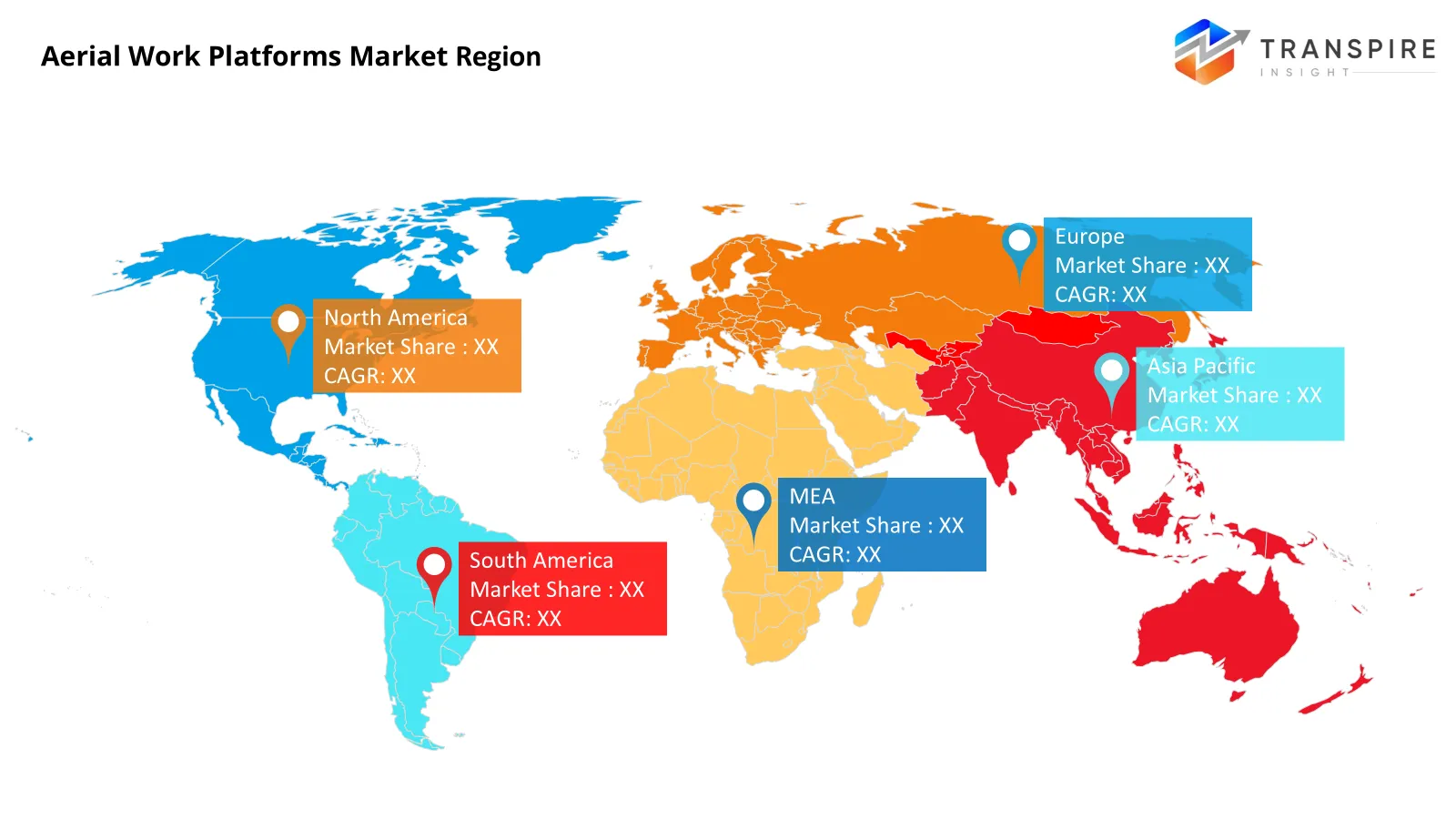
Who are the Key Players in the Aerial Work Platforms Market and how do they Compete?
The AWP market is fragmented but consolidating, with players acquiring small specialists to increase product range and expand geographically. Competition is driven by innovation, cost and regional expansion, with differentiation on electrification, telematics and safety.
Leading the innovation strategies are JLG Industries and Genie (Terex), investing in hydrogen-electric hybrid technology, AI-optimizing fleet management platforms such as ClearSky Smart Fleet,and high-reach platforms for infrastructure and renewable energy projects. Dingli Machinery and Zoomlion practice cost leadership by expanding electric platform and compact platform production to address Asia Pacific booming high-growth markets.Haulotte and Skyjack are targeting market niches for differentiation, with Haulotte pushing its environmentally friendly electric models onto European urban sites under increasing emissions regulations, and Skyjack selling efficient, agile, compact lifts for confined indoor warehousing and building maintenance work. Snorkel, Manitou, and MEC Aerial are growing through regional sales networks, and providing customised solutions for industrial maintenance and warehousing that respond quickly to client needs. Niftylift, Ruthmann, BrontoSkylift, Tadano, Teupen, and XCMG are marketing speciality machines with high-manoeuvrability spider lifts, truck-mounted platforms, and telehandlers for municipal work, airfields, and heavy construction where technical detail and regulation compliance are primary considerations.
Key Players are:
- JLG Industries
- Genie
- Haulotte
- Skyjack
- Snorkel
- Dingli Machinery
- Zoomlion
- XCMG
- Manitou
- MEC Aerial Work Platforms
- Niftylift
- Ruthmann
- Bronto Skylift
- Tadano
- Teupen
Recent Development News
- In April 2026, JLG Industries, Inc. unveiled a preview of its new 600AJ+ articulating boom lift. This next-generation model introduces advanced performance upgrades and intelligent connectivity to help rental fleets maximize active runtime and operational profitability.
- In May 2026, Sinoboom launched its next-generation intelligent equipment management platform, the SmartHub Screen. This advanced system automates manual-free fault diagnosis and real-time machine tracking to minimize fleet downtime for large-scale rental companies.
- In May 2026, Haulotte signed an innovation partnership agreement with construction robotics deeptech startup Builder Assist. This collaboration integrates a specialized robotic arm onto mobile elevating work platforms to automate highly repetitive, hazardous overhead tasks like drilling and facade painting.
What Strategic Insights Define the Future of the Aerial Work Platforms Market?
The future is technology-led differentiation as electrification, AI-enabled fleet optimisation and compliance analytics challenge the economics of procurement and rental. A concealed threat is in the unknown accuracy of AI models similar to those trained on controlled data sets, but mispredicting wear or stability on unruly terrain or during extreme weather may dampen adoption by the risk-averse. A new opportunity is hydrogen-powered and long-runtime battery platforms on outdoor, high-utilisation sites without on-site charging, overcoming the major challenge of early emissions adoption on ramp-up construction sites. Niftylift's HR15E and HR17E provide up to five days of battery-only uptime, and with hydrogen fuel cells doubling the runtime, create opportunities for zero-emission working on remote sites. OEMs and rental operators should focus on deployment of standardised data pipelines and AI integration to enable predictive maintenance, dynamic pricing and utilization-based procurement, turning compliance into a differentiator.
Key Segmentations are:
By Product Type
- Scissor Lifts
- Boom Lifts
- Vertical Mast Lifts
- Trailer-mounted Lifts
- Spider Lifts
- Truck-mounted Lifts
- Telehandlers
- Others
By Power Source
- Electric
- Diesel
- Hybrid
- LPG
- Battery-powered
- Hydrogen-powered
- Others
By End User
- Construction
- Warehousing & Logistics, Utilities
- Telecommunications
- Manufacturing
- Aviation
- Municipal Services
- Others
By Application
- Building Maintenance
- Construction
- Industrial Maintenance
- Warehousing
- Infrastructure Projects
- Facility Management
- Others
By Distribution Channel
- Direct Sales
- Equipment Rental Companies
- Dealers & Distributors
- Online B2B Platforms
- OEM Suppliers
- Others
Regional Outlook
North America
- US
- Canada
- Mexico
- US
- Canada
Europe
- Germany
- UK
- France
- Italy
- Spain
- Rest of Europe
Asia Pacific
- China
- Japan
- India
- South Korea
- Australia
- Rest of Asia Pacific
South America
- Brazil
- Argentina
- Rest of South America
Middle East & Africa
- UAE
- Saudi Arabia
- Qatar
- South Africa
- Rest of the Middle East & Africa
Frequently Asked Questions
Find quick answers to common questions.
The Aerial Work Platforms Market size was valued at USD 12.2 billion in 2025 and is poised to reach USD 17.4 billion by 2033, expanding at a 4.48% CAGR.
Key segments for the Aerial Work Platforms Market are By Product Type (Scissor Lifts, Boom Lifts, Vertical Mast Lifts, Trailer-mounted Lifts, Spider Lifts, Truck-mounted Lifts, Telehandlers, Others); By Power Source (Electric, Diesel, Hybrid, LPG, Battery-powered, Hydrogen-powered, Others); By End User (Construction, Warehousing & Logistics, Utilities, Telecommunications, Manufacturing, Aviation, Municipal Services, Others); By Application (Building Maintenance, Construction, Industrial Maintenance, Warehousing, Infrastructure Projects, Facility Management, Others); By Distribution Channel (Direct Sales, Equipment Rental Companies, Dealers & Distributors, Online B2B Platforms, OEM Suppliers, Others).
Growth is primarily driven by stricter worker-safety regulations (OSHA/ANSI A92), rapid urbanization and infrastructure modernization, rising rental penetration, warehouse automation in e-commerce logistics, and the shift toward electric and hybrid platforms to meet emissions mandates.
The Aerial Work Platforms Market is led by major manufacturers including JLG Industries, Genie, Haulotte, Skyjack, Snorkel, Dingli Machinery, Zoomlion, XCMG, Manitou, MEC Aerial Work Platforms, Niftylift, Ruthmann, Bronto Skylift, Tadano, Teupen.
North America holds a 38% share, dominating due to robust construction activity, mature rental ecosystems, stringent safety compliance, and sustained infrastructure investment under programs like the U.S. Infrastructure Act.
Key opportunities include hydrogen-powered and long-runtime battery platforms for remote outdoor sites, AI-driven fleet optimisation enabling predictive maintenance and dynamic pricing, and expansion in Asia Pacific’s smart-city and renewable energy projects where rental penetration is rising.
- JLG Industries
- Genie
- Haulotte
- Skyjack
- Snorkel
- Dingli Machinery
- Zoomlion
- XCMG
- Manitou
- MEC Aerial Work Platforms
- Niftylift
- Ruthmann
- Bronto Skylift
- Tadano
- Teupen
About the Authors

Kartik bhong
I am Kartik Bhong, a Senior Research Analyst at Transpire Insight, specializing in the Packaging, Manufacturing, and Construction industry. My work focuses on analyzing market trends, emerging technologies, industry regulations, and competitive landscapes to deliver accurate, data-driven insights. I am passionate about transforming complex industry information into clear, practical content that helps businesses, professionals, and decision-makers stay informed and make confident strategic decisions. Through continuous research and a strong commitment to accuracy, I strive to create reliable, well-researched content that reflects the latest developments across these dynamic industries and supports the vision of Transpire Insight in delivering valuable market intelligence.

Chakradhar Khansole
Chakradhar serves as the Research Director at Transpire Insight, bringing over 8 years of experience in technology, innovation, and strategic market intelligence. He specializes in transforming complex market data into actionable business insights that enable organizations to make informed, growth-oriented decisions. Recognized for his strategic vision and analytical expertise, Chakradhar leads high-impact research initiatives, delivering comprehensive market assessments, competitive intelligence, and forward-looking industry analysis.
Recently Published Reports
-
Apr 2026
Handling and Lifting Equipment Market
Handling and Lifting Equipment Market Size, Share & Analysis Report By Product (Cranes and Hoists, Forklifts, Conveyor Systems, Aerial Work Platforms, Others), By Application (E-Commerce, Automotive and Railway, Food and Beverages, Aviation, Others), and Geography (North America, Europe, Asia-Pacific, Middle East and Africa, South and Central America), 2021 - 2031
-
Apr 2026
HVAC Equipment Market
HVAC Equipment Market Size, Share & Analysis Report By Heating Equipment Type (Boilers and Furnaces, Heat Pumps, and Unitary Heaters), By Ventilation Equipment (Air Handling Units, Humidifiers and Dehumidifiers, Air Filters, and Fan Coiling Units), By Air Conditioning Equipment (Unitary Air Conditioners, Room Air Conditioners, Packaged Terminal Air Conditioners, and Chillers), By End User (Commercial, Residential, Industrial, and others), and Geography (North America, Europe, Asia-Pacific, Middle East and Africa, South and Central America), 2021 – 2031
-
Apr 2026
Refrigeration Valves Market
Refrigeration Valves Market Size, Share & Analysis Report By Type (Solenoid Valves, Expansion Valves, Check Valves, Service Valves, Others), By Application (Commercial Refrigeration, Industrial Refrigeration, Transport Refrigeration, Residential Refrigeration, Air Conditioning Systems), By End User (Food and Beverage Industry, Pharmaceutical Industry, HVAC Industry, Chemical Industry, Others), and Geography (North America, Europe, Asia-Pacific, Middle East and Africa, South and Central America), 2021 – 2031
-
Apr 2026
E-Commerce Packaging Materials Market
E-Commerce Packaging Materials Market By Material Type (Corrugated Boxes, Paper & Paperboard, Foam & Cushioning Materials, Plastic Packaging, Flexible Packaging, Protective Packaging, Others), By Product(Primary Packaging, Secondary Packaging, Tertiary Packaging), By Packaging Function (Protective Packaging, Branding & Presentation Packaging, Transit & Logistic Packaging, Sustainable Packaging, Tamper Evidence Packaging), By End-User (Retail & Consumer Goods, Electronic Appliances, Food & Beverages, Healthcare & Pharmaceutical, Fashion & Apparel, Home & Furnishing, Others); By Industry Analysis, Size, Share, Growth, Trends, and Forecasts 2021-2033