

Virtual Cards Market Summary:
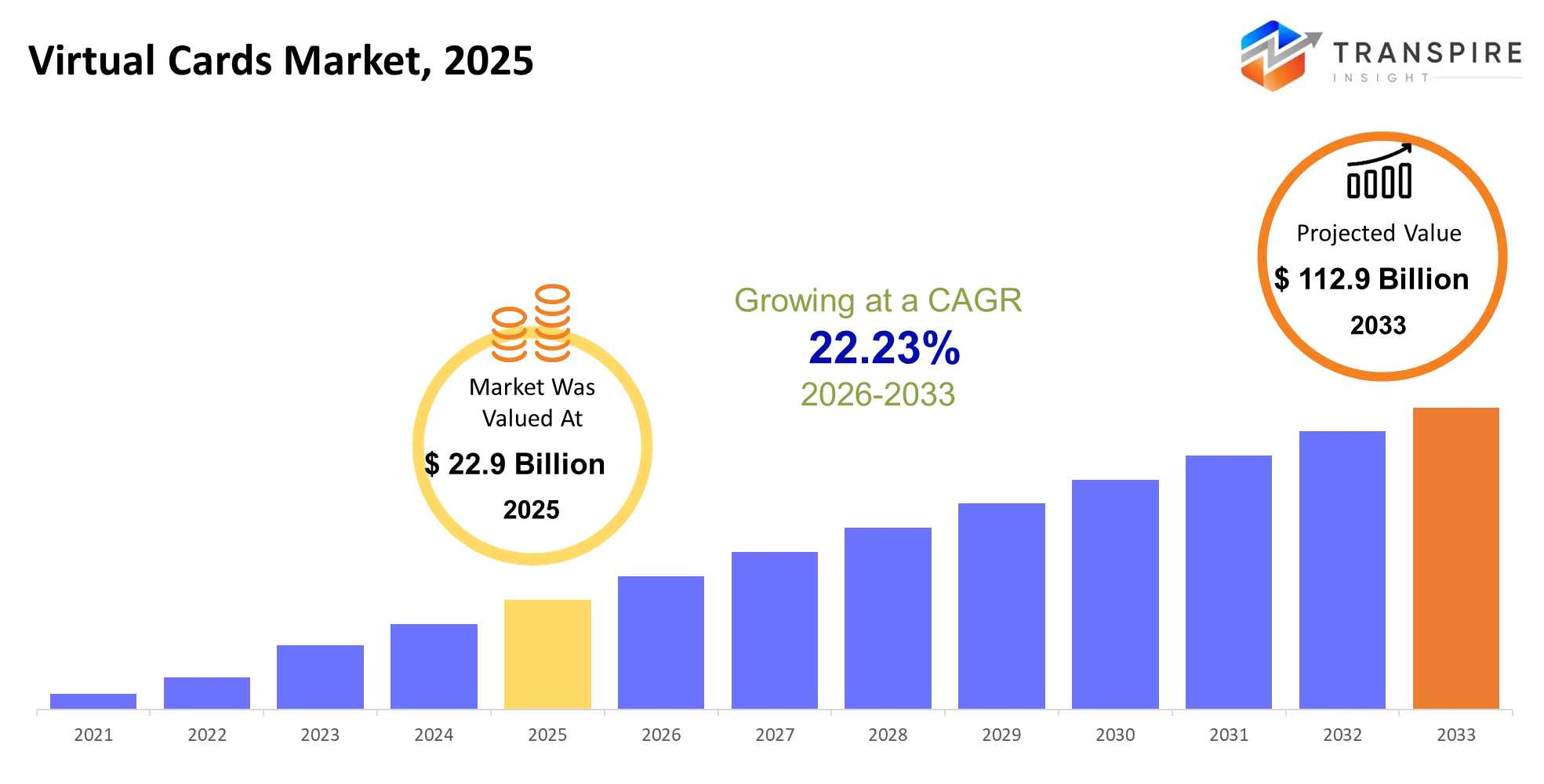
As per the Transpire Insight Analysis, The Virtual Cards Market size is estimated at USD 22.9 billion in 2025 and is anticipated to reach USD 112.9 billion by 2033, growing at a CAGR of 22.23% from 2026 to 2033.
The virtual cards market is evolving from a security-centric tool to an embedded financial workflow. Adoption of virtual cards in the last three to five years has shifted from online buying to accounts payable, travel and employee expenses, and procurement, while APIs and tokenisation have made issuance faster to deploy. The structural change is to embed virtual card credentials into ERP, expense, procurement and travel platforms, rather than e-banking portals or co-branded sites. HSBC and Mastercard launched mobile virtual cards forB2B use in the UAE in June 2026, supporting tokenised wallet-based B2B payments with customisable controls; while Mastercard expanded its virtual card platform offerings in July 2026 to offer stronger issuer and clearing controls and enhanced API connectivity. These flows automate manual payment steps, reduce reconciliation complexity, and limit visibility of card credentials, motivating corporates to consolidate and automate multiple disjointed payment processes into automated digital business workflows.
Virtual Cards Market Size & Forecast:
- Market Size 2025: USD 22.9 Billion
- Expected Market Value (2033): USD 112.9 Billion
- Forecast CAGR (2026–2033): 22.23%
- Leading Region in 2025: North America
- Fastest-Growing Region: Asia Pacific
- Key Company Profiles: Marqeta, Stripe, Visa, Mastercard, American Express, JPMorgan Chase, Capital One, WEX, Airwallex, Revolut, Wise, Adyen, Brex, DiviPay, BILL.
Key Virtual Cards Market Insights:
The virtual cards market is shifting from security-focused issuance to embedded, API-driven payment rails that automate AP, travel, and procurement workflows. Innovation now centres on flexible credentials, crypto-backed cards, and AI-powered controls that reduce fraud and reconciliation overhead.
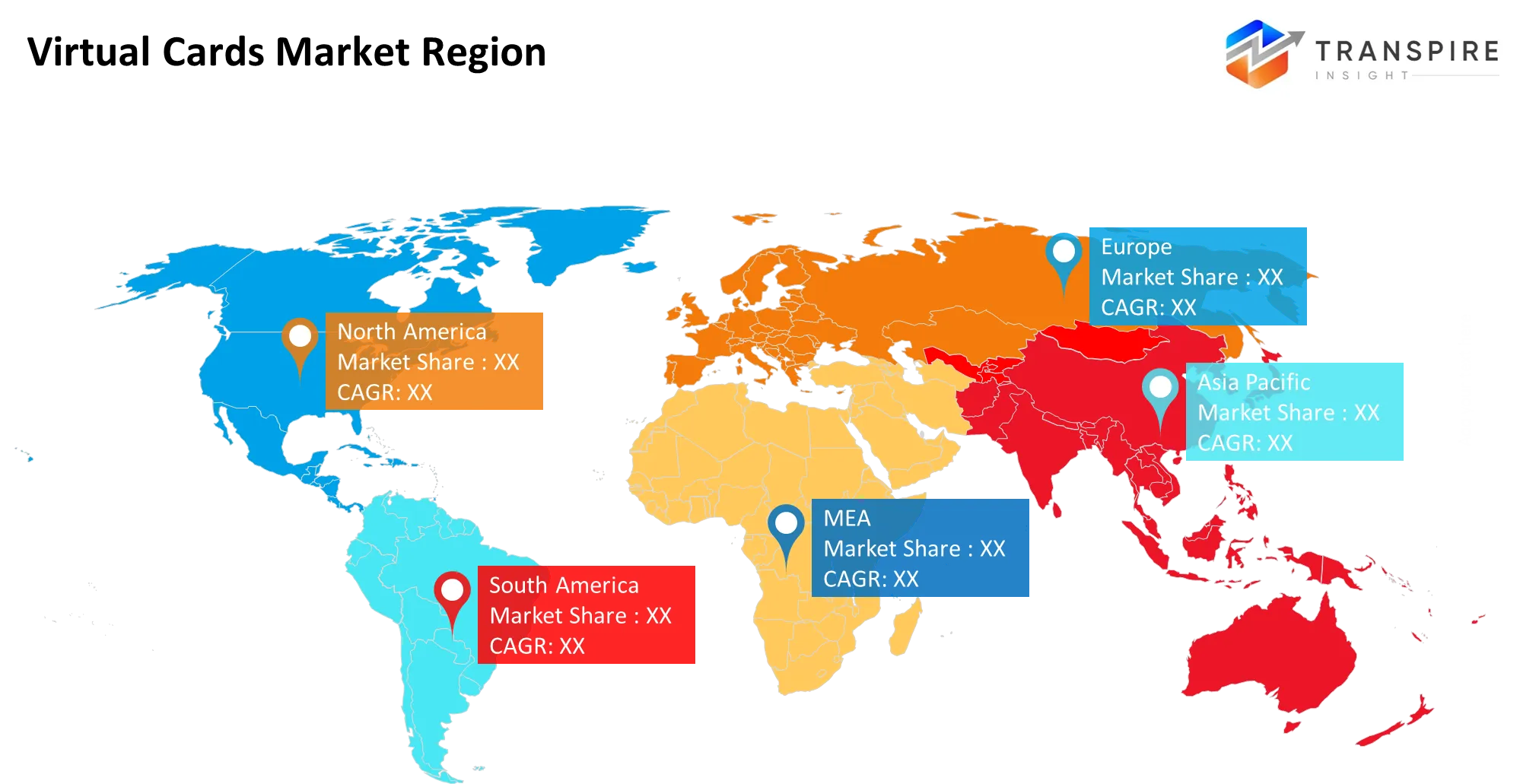
- North America holds a 38.74% share, driven by ERP mandates (SAP S/4HANA) and PSD3-style traceability rules.
- Europe commands 27%, with stable growth from open banking APIs and VAT recovery automation in travel.
- Asia Pacific grows at 23.44% CAGR, fueled by digital bank licensing in India, Indonesia, and the Philippines.
- Stripe leads with 12.42% revenue share, leveraging API-first embedded finance for marketplace payouts.
- Marqeta processes nearly $400B annually, advancing crypto-backed cards with Coinbase and Bitpanda.
- Visa and Mastercard expand flexible credential programs for BNPL and virtual card controls.
- WEX and Airwallex dominate corporate travel and cross-border B2B with guaranteed supplier payment.
- Revolut and Brex target SMEs with integrated expense management and automated reconciliation.
- Virtual cards represent 52.6% of modern card issuing, reflecting behavioural movement toward contactless, app-based spend.
What are the Key Drivers, Restraints, and Opportunities in the Virtual Cards Market?
Driver:
Embedded finance is the strongest adoption catalyst. Banks, card networks, and fintechs are moving virtual card creation into ERP, procurement, expense, and travel workflows. Visa’s 2026 integration of Visa Accounts Receivable Manager into its Commercial Solutions Hub targets supplier connectivity and reconciliation, while Mastercard’s expanded In Control platform adds controls and simpler virtual card creation. This reduces implementation friction and manual reconciliation, making programs easier to deploy across corporate accounts, expanding supplier participation and increasing transaction volume across spending.
Restraint:
Supplier acceptance and integration complexity still constrain expansion. Virtual cards create value only when suppliers can receive, process, and reconcile card payments efficiently. Fragmented systems, different issuer processes and legacy accounts-receivable workflows often require technical work, supplier enablement and operational change. These barriers persist because B2B payment chains involve multiple organizations, data formats and approval policies, slowing conversion from traditional payment methods.
Opportunity:
Scale-up with real-time, embedded and mobile issuance. Real-time, embedded and mobile issuing can accelerate take-up. With an announced UAE launch in June 2026, HSBC and Mastercard demonstrated that tokenised virtual cards can evolve from online-only to wallet-based POS spend. Cross-border, SME and travel procurement can accelerate transaction growth as APIs, auto KYC/KYB, and spend controls make issuance scalable and help expand the reach of supplier networks.
What Has the Impact of Artificial Intelligence Been on the Virtual Cards Market?
AI is automating virtual card programs by enabling more predictive and operational control. Companies can use machine learning to analyse merchant, spend category, and invoice data or transaction history to detect anomalies and support fraud screening and authorisations. Machine learning algorithms can also automate reconciliation, matching payments to invoices and suppliers, reducing finance teams' manual effort. The new Accounts Receivable Manager feature in Visa's 2026 roadmap relies on proprietary artificial intelligence to automate virtual card acceptance and payment-data flow management, while risk systems are increasingly combining proprietary network data with machine learning signals.
Predictive models can identify unusual spending before a payment loss, forecast payment patterns and recommendations, and match limits or approval criteria to changing conditions. AI can also help automate mundane tasks by reducing repetitive review, routing exceptions, and extracting payment information from documents. Yet, lessons include the importance of data quality and the need to integrate AI with legacy ERP, finance, and procurement systems, requiring ongoing governance and human oversight.
In May 2026, Visa expanded its Visa Commercial Solutions Hub by integrating the Visa Accounts Receivable Manager, a proprietary AI-powered tool built to automate end-to-end virtual card processing and invoice reconciliation across 69 geographies.http://usa.visa.com/about-visa/newsroom/press-releases.releaseId.22471.html
Key Virtual Cards Market Trends:
Virtual cards are evolving from isolated digital credentials into embedded, programmable payment infrastructure for workflows. The industry is moving toward real-time controls, automated reconciliation, and mobile acceptance, changing how businesses manage spend and supplier relationships.
- ERP and procurement integration has shifted toward embedded payment execution, reducing portal switching and manual payment entry.
- Tokenization is extending virtual cards from online checkout into mobile wallets and POS transactions, broadening corporate use beyond e-commerce.
- Spend controls are becoming more granular, with issuer-level, transaction-level, and clearing-stage rules supporting tighter policy enforcement and lower misuse.
- Automated reconciliation is gaining importance as suppliers and buyers seek cleaner invoice-to-payment matching and faster exception handling.
- Mobile issuance is shortening deployment cycles, allowing employees and travel teams to receive usable credentials without physical cards.
- Multi-currency and cross-border capabilities are becoming more practical for procurement and travel, reducing separate payment arrangements and reconciliation.
- API-led issuance is replacing heavier bespoke integrations, helping banks and platforms launch programs faster across enterprise workflows.
- SMEs are gaining access to digital spend platforms with automated KYC/KYB, real-time funding, approval workflows, and transaction analytics, lowering entry barriers for controlled business spending.
Virtual Cards Market Segmentation
By Card Type:
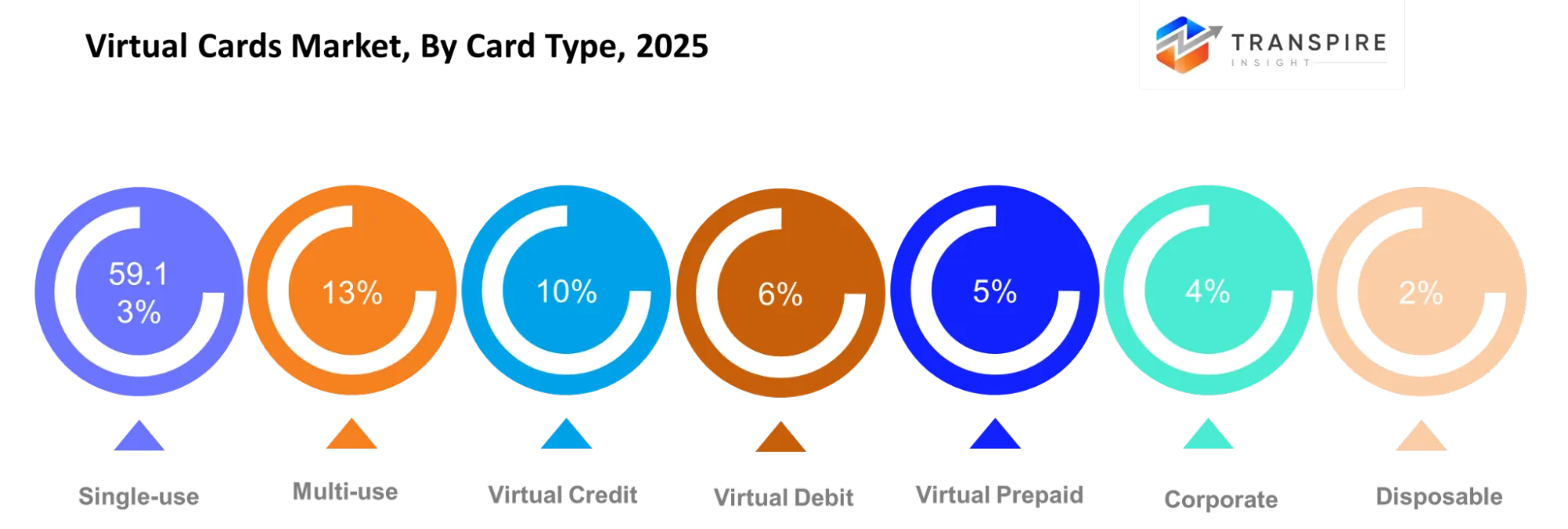
Single-use Cards lead with 59.13%, reflecting strong adoption for controlled, transaction-specific spending where businesses seek tighter authorization and fraud containment. Multi-use Cards account for 13%, followed by Virtual Credit Cards at 10%, Virtual Debit Cards at 6%, Virtual Prepaid Cards at 5%, Corporate Cards at 4%, Disposable Cards at 2%, and Others at 0.87%. This distribution highlights the continued importance of purpose-specific credentials, while multi-use and corporate formats are gaining relevance as enterprises require reusable payment tools with configurable limits, approval workflows, and greater spending visibility across operational activities.
By Use:
Single-use Cards account for 59.13%, supported by transaction-specific purchasing and supplier payments. Multi-use, Recurring, Subscription, Procurement, Travel, Expense Management, and Others extend virtual-card usage into repeat and structured spending workflows. Procurement and travel applications increasingly connect issuance with approval policies, while recurring and subscription payments benefit from automated controls. This broader use-case mix is gradually positioning virtual cards as embedded payment tools across corporate finance processes and operational workflows.
By Payment Type:
Remote Payments remain central to virtual-card activity, while POS Payments are projected to expand at a 21.22% CAGR as tokenization connects virtual credentials with mobile wallets and contactless terminals. Online, Contactless, Mobile, Cross-border, Recurring, and other payment formats provide complementary transaction routes. The shift toward mobile-enabled acceptance is extending virtual cards beyond traditional online transactions, allowing businesses to use digital credentials across physical and international payment environments.
By End User:
Business Accounts anchor adoption because organizations require controlled spending, centralized visibility, and automated reconciliation. Individual Users represent a complementary base, while SMEs and Large Enterprises increasingly apply virtual cards across procurement, travel, subscriptions, and employee expenses. Government, Travel Companies, E-commerce businesses, and Others add specialized demand. Adoption is therefore expanding from centralized finance departments toward distributed business functions where configurable limits and transaction-level controls support accountable spending.
By Application:
Corporate Payments, Online Shopping, Travel Booking, Subscription Services, Advertising, Expense Management, and Procurement represent distinct transaction environments. Corporate Payments and Procurement benefit from controlled issuance and approval workflows, while Expense Management improves visibility into employee spending. Travel Booking supports secure supplier transactions, and Advertising platforms can use virtual credentials for campaign-specific expenditure. Subscription Services also benefit from automated recurring payments, creating opportunities for virtual cards to become integrated financial controls.
By Provider:
Banks, Fintechs, Payment Networks, Card Issuers, Digital Banks, PSPs, and Technology Providers compete through API capabilities, issuance speed, transaction controls, and integration depth. Banks leverage established corporate relationships and payment infrastructure, while fintechs emphasise flexible digital onboarding and programmable issuance. Payment Networks strengthen acceptance and tokenisation, whereas PSPs and technology providers embed virtual-card functionality into business platforms. Competition is increasingly centred on workflow integration, automation, security, and scalability.
By Enterprise:
Large Enterprises remain important for complex spend programs, while Mid-sized Enterprises, SMEs, Startups, Freelancers, Government and Nonprofits create expansion opportunities through simpler digital issuance and automated compliance. Overall, the market is moving toward payment products and services that combine issuance, authorization, reconciliation, analytics, and policy controls securely within existing corporate finance systems, rather than treating the card as fully standalone.
What are the Key Use Cases Driving the Virtual Cards Market?
Single-use virtual cards are the core use case, consistent with their 59.13% share, because they provide transaction-specific credentials, defined limits and reduced exposure of underlying funding accounts. This supports supplier payments, procurement, travel bookings and controlled online purchases where authorisation and reconciliation matter.
Expanding applications include multi-use corporate spending, subscriptions, advertising, employee expenses and cross-border procurement. Mobile wallet integration is widening virtual cards into POS and contactless environments, while ERP and expense-platform embedding connects payment data with approval and reconciliation workflows.
Emerging uses include automated supplier settlement, embedded travel payments and SME spend management. HSBC and Mastercard’s UAE launch demonstrates mobile virtual cards for B2B and travel spending, while Visa’s 2026 AR integration targets automated supplier acceptance and reconciliation.
|
Report Metrics |
Details |
|
Market size value in 2025 |
USD 22.9 Billion |
|
Market size value in 2026 |
USD 27.7 Billion |
|
Revenue forecast in 2033 |
USD 112.9 Billion |
|
Growth rate |
CAGR of 22.23% from 2026 to 2033 |
|
Base year |
2025 |
|
Historical data |
2021 - 2024 |
|
Forecast period |
2026 - 2033 |
|
Report coverage |
Revenue forecast, competitive landscape, growth factors, and trends |
|
Regional scope |
United States; Canada; Mexico; United Kingdom; Germany; France; Italy; Spain; Denmark; Sweden; Norway; China; Japan; India; Australia; South Korea; Thailand; Brazil; Argentina; South Africa; Saudi Arabia; United Arab Emirates |
|
Key companies profiled |
Marqeta, Stripe, Visa, Mastercard, American Express, JPMorgan Chase, Capital One, WEX, Airwallex, Revolut, Wise, Adyen, Brex, DiviPay, BILL. |
|
Customization scope |
Free report customisation (country, regional & segment scope). Available customised purchase options to meet your exact research needs. |
|
Report Segmentation |
By Card Type (Virtual Credit Cards, Virtual Debit Cards, Virtual Prepaid Cards, Single-use Cards, Multi-use Cards, Disposable Cards, Corporate Cards, Others); By Use (Single-use, Multi-use, Recurring, Subscription, Procurement, Travel, Expense Management, Others); By Payment Type (Remote Payments, POS Payments, Online Payments, Contactless, Mobile Payments, Cross-border, Recurring Payments, Others); By End User (Business Accounts, Individual Users, SMEs, Large Enterprises, Government, Travel Companies, E-commerce, Others); By Application (Corporate Payments, Online Shopping, Travel Booking, Subscription Services, Advertising, Expense Management, Procurement, Others); By Provider (Banks, Fintechs, Payment Networks, Card Issuers, Digital Banks, PSPs, Technology Providers, Others); By Enterprise (Large Enterprises, Mid-sized Enterprises, SMEs, Startups, Freelancers, Government, Nonprofits, Others) |
Which Regions are Driving the Virtual Cards Market Growth?
North America currently leads at 38.74%, powered by enterprise ERP modernisation mandates (like SAP S/4HANA), where native virtual card rails are used to automate accounts payable, and financial infrastructure maturity (such as FedNow, RTP, and PSD3-style traceability rules favouring digital, auditable transactions over checks and ACH) pushing adoption. Corporate treasury in New York, California, and Texas (with the most quantum of value) is most driven to meet compliance and fraud reduction demands, creating a virtuous circle of policy, supply and demand.
In July 2026, Mastercard expanded its commercial tokenised infrastructure by launching enhanced issuer-enforced and clearing controls for its virtual card platform.https://www.mastercard.com/news/europe/en/newsroom/press-releases/en/2026/mastercard-expands-virtual-card-platform-with-new-security-controls-embedded-payments-network-and-single-api-access/
European share is 27%, driving smooth adoption of open banking APIs and standardised VAT refund systems, alleviating payment pains when moving travellers cross-border. Unlike North America, where growth has been facilitated by an ERP solution, European destination/attraction growth is rooted in harmonised regulations (PSD2/3) and travel industry update requirements (IATA TIP, NDC) for tracking payment rails. UK & EU cards and mobile payment infrastructure, plus fintech behemoths in Berlin, Amsterdam, and London, provide fintech stability to avoid wild swings in incremental adoption, especially stable because of a high penetration of digital payments, low fraud, and government-endorsed digital ID schemes.
In March 2026, HBX Group selected Outpayce from Amadeus to power a fintech transformation with cloud-native payments and virtual card issuing, simplifying transactions for travel agency clients.https://www.fintechfutures.com/b2b-b2c-payments/hbx-group-outpayce-travel-payments-partnership
Asia Pacific accounts for 24% and fastest growing at 23.44% CAGR, with recent digital bank licensing in India, Indonesia, and the Philippines enabling local virtual card issuance. What has changed is the decoupling of local virtual cards with UPI, Pay Now, and PromptPay real-time rails vs. cross-border USD travel virtual cards. The next opportunity is the embedding of virtual cards into super-apps (Grab, Gojek, Paytm) for SME lending, marketplace disbursements, and subscription commerce. This shift towards app-based, contactless spend could see Asia Pacific take over more than 30% of transaction value by 2030.
In March 2026, Visa and Trip.com Group entered into a agreement to launch a specialised virtual travel card program. Issued via Trip.com’s fintech division, TripLink, the initiative was deployed across key Asia-Pacific hubs like Singapore and Hong Kong to optimise automated business-to-business payment processes, enhance data visibility for regional suppliers, and reduce manual verification friction.https://www.aninews.in/news/business/-virtual-travel-card-program-launched-by-visa-and-tripcom-to-make-travel-payments-simpler-and-more-seamless-in-asia-pacific20260311100725
Who are the Key Players in the Virtual Cards Market, and how do they compete?
The virtual cards market is as competitive as it is diverse. Payment providers are competing not on price but on innovation, vertical-specific embedded finance API's, and native integrations with prime card networks. The race is on to integrate with providers and remove all frictions in the end-to-end process, such as reconciliation.
Visa and Mastercard are executing innovation strategies, broadening flexible credential offerings and next-generation virtual card controls to lower fraud in the payment lifecycle. Mastercard and Visa's differentiator is the scale of their networks and relationships with embedded finance ecosystem players, allowing enterprise clients to administer payments with more authority. Stripe owns an API-first embedded finance strategy, gaining 12.42% revenue share while embedding virtual cards into marketplace and SaaS workflows. Marqeta differentiates with crypto-enabled cards and stablecoin settlement, processing nearly 400B/year with Coinbase and Bitpanda integrations. WEX and Airwallex cater to niche verticals, corporate travel and cross-border B2B, with guaranteed supplier payments and automated VAT recovery. Revolut and Brex serve SMEs with integrated expense management and automated reconciliation, minimising onboarding friction for mid-market companies. BILL and Divi Pay compete on cost and workflow automation, with integrated virtual cards at AP and procurement platforms to automate manual processing. American Express and JPMorgan Chase leverage their brand equity and corporate card ecosystems to upsell virtual issuance to existing business customers.
Key Players are:
- Marqeta
- Stripe
- Visa
- Mastercard
- American Express
- JPMorgan Chase
- Capital One
- WEX
- Airwallex
- Revolut
- Wise
- Adyen
- Brex
- DiviPay
- BILL
Recent Development News
- In March 2026, J.P. Morgan Payments and Mastercard launched a new B2B virtual card partnership in Europe. This initiative modernises supplier payments across sectors like healthcare and travel by replacing paper checks with digital onboarding and automated workflows.https://www.pymnts.com/partnerships/2026/jpmorgan-payments-and-mastercard-launch-virtual-card-partnership/
- In July 2026, JAGGAER partnered with Conferma to launch embedded virtual card payments within JAGGAER’s procurement platform. The integration enables organisations to generate virtual cards at the point of order and issue cards for employee purchases and travel, connecting supplier payments more directly with procurement workflows.https://www.jaggaer.com/press-release/jaggaer-conferma-embedded-virtual-card-payments
- In September 2026, Thredd partnered with iPayLinks to power a new Mastercard virtual commercial debit card programme. The solution extends iPayLinks’ cross-border payments offering into card issuing, with Thredd providing processing, 3DS, fraud monitoring, BIN setup, and spend-control capabilities.https://www.thredd.ai/company/press-releases/thredd-selected-by-ipaylinks-to-power-new-virtual-commercial-debit-card-programme
What Strategic Insights Define the Future of the Virtual Cards Market?
The industry is moving to programmable payment infrastructure, with virtual cards becoming part of procurement, ERP, travel, and AI-enabled workflows, not new form factors of credentials. The latent hazard for increased automation is an increase in fraud or authorization errors if controls, identity checks, and transaction review fail to evolve with autonomous payment use. Our 2026 Visa research on agentic commerce shows the inevitable trend toward a shift from people-led to software-assisted payments. The most promising near-term opportunity is to unlock virtual cards with AI, mobile-wallet, and real-time decisioning - to automate supplier payments and still maintain policy controls. An API-first design, supplier integrations, tokenization, and adaptable transaction rules should be the focus for providers, not simply outpacing competitors with their issuance. As Mastercard's 2026 platform upgrades illustrate, clearing-stage controls and integrated supplier connections are adding virtual-card value past authorization.
Key Segmentations are:
By Card Type
- Virtual Credit Cards
- Virtual Debit Cards
- Virtual Prepaid Cards
- Single-use Cards
- Multi-use Cards
- Disposable Cards
- Corporate Cards
- Others
By Use
- Single-use
- Multi-use
- Recurring
- Subscription
- Procurement
- Travel
- Expense Management
- Others
By Payment Type
- Remote Payments
- POS Payments
- Online Payments
- Contactless
- Mobile Payments
- Cross-border
- Recurring Payments
- Others
By End User
- Business Accounts
- Individual Users
- SMEs
- Large Enterprises
- Government
- Travel Companies
- E-commerce
- Others
By Application
- Corporate Payments
- Online Shopping
- Travel Booking
- Subscription Services
- Advertising
- Expense Management
- Procurement
- Others
By Provider
- Banks
- Fintechs
- Payment Networks
- Card Issuers
- Digital Banks
- PSPs
- Technology Providers
- Others
By Enterprise
- Large Enterprises
- Mid-sized Enterprises
- SMEs
- Startups
- Freelancers
- Government
- Nonprofits
- Others
By Regional Analysis
North America
- US
- Canada
- Mexico
Europe
- Germany
- UK
- France
- Italy
- Spain
- Russia
- Rest of Europe
Asia Pacific
- China
- Japan
- India
- South Korea
- Australia
- Rest of Asia Pacific
South America
- Brazil
- Argentina
- Rest of South America
Middle East & Africa
- UAE
- Saudi Arabia
- Qatar
- South Africa
- Rest of the Middle East & Africa
Frequently Asked Questions
Find quick answers to common questions.
The virtual cards market size was valued at USD 22.9 billion in 2025 and is poised to reach USD 112.9 billion by 2033, expanding at a 22.23 % CAGR.
Key segments for the virtual cards market are By Card Type (Virtual Credit Cards, Virtual Debit Cards, Virtual Prepaid Cards, Single-use Cards, Multi-use Cards, Disposable Cards, Corporate Cards, Others); By Use (Single-use, Multi-use, Recurring, Subscription, Procurement, Travel, Expense Management, Others); By Payment Type (Remote Payments, POS Payments, Online Payments, Contactless, Mobile Payments, Cross-border, Recurring Payments, Others); By End User (Business Accounts, Individual Users, SMEs, Large Enterprises, Government, Travel Companies, E-commerce, Others); By Application (Corporate Payments, Online Shopping, Travel Booking, Subscription Services, Advertising, Expense Management, Procurement, Others); By Provider (Banks, Fintechs, Payment Networks, Card Issuers, Digital Banks, PSPs, Technology Providers, Others); By Enterprise (Large Enterprises, Mid-sized Enterprises, SMEs, Startups, Freelancers, Government, Nonprofits, Others).
Growth is primarily driven by embedded payment integration, rising corporate adoption of automated accounts-payable workflows, tokenization, real-time spend controls, mobile-wallet integration, and demand for secure cross-border transactions.
The virtual cards market is led by major manufacturers, including Marqeta, Stripe, Visa, Mastercard, American Express, JPMorgan Chase, Capital One, WEX, Airwallex, Revolut, Wise, Adyen, Brex, DiviPay, and BILL.
North America, holding 38.74%, influences market dynamics through mature commercial-payment infrastructure, established fintech ecosystems, strong corporate-card adoption, and widespread integration with ERP, procurement, and expense-management platforms.
Key opportunities include AI-enabled payment automation, mobile-wallet and POS integration, SME-focused virtual cards, cross-border payments, supplier settlement, and embedded virtual-card solutions within procurement and financial platforms.
- Marqeta
- Stripe
- Visa
- Mastercard
- American Express
- JPMorgan Chase
- Capital One
- WEX
- Airwallex
- Revolut
- Wise
- Adyen
- Brex
- DiviPay
- BILL
About the Authors

Mayur Shinde
I am Mayur Shinde, a Senior Research Analyst at Transpire Insight, specializing in the Automotive & Transportation and Information & Communication Technology (ICT) Industry. My work focuses on analyzing emerging market trends, technological advancements, competitive landscapes, and industry developments to deliver accurate, data-driven insights. I am passionate about transforming complex market information into clear, actionable content that helps businesses, professionals, and decision-makers stay informed and make confident strategic decisions.

Chakradhar Khansole
Chakradhar serves as the Research Director at Transpire Insight, bringing over 8 years of experience in technology, innovation, and strategic market intelligence. He specializes in transforming complex market data into actionable business insights that enable organizations to make informed, growth-oriented decisions. Recognized for his strategic vision and analytical expertise, Chakradhar leads high-impact research initiatives, delivering comprehensive market assessments, competitive intelligence, and forward-looking industry analysis.
Recently Published Reports
-
Apr 2026
3D Optical Profiler Market
3D Optical Profiler Market Size, Share & Analysis Report By Type (Desktop 3D Optical Profiler, and Portable 3D Optical Profiler), By Technology (Confocal Technology, and White Light Interference), By End-Use Industry (Manufacturing, Research Institutions, Automotive, Aerospace and Defense, Medical Devices, and Other), and Geography (North America, Europe, Asia-Pacific, Middle East and Africa, South and Central America), 2021 - 2031
-
Apr 2026
Depth Sensor Market
Depth Sensor Market Size, Share & Analysis Report By Type (Infrared Depth Sensors, Time-of-Flight (ToF) Sensors, Stereo Vision Sensors, Structured Light Sensors, Ultrasonic Depth Sensors), By Application (Automotive, Robotics, Gaming, Consumer Electronics, Industrial Automation, Healthcare, Security & Surveillance, Others), By End Users (Automotive Manufacturers, Consumer Electronics Companies, Healthcare Providers, Industrial Companies, Security Agencies, Gaming Companies, Robotics Companies, Others), and Geography (North America, Europe, Asia-Pacific, Middle East and Africa, South and Central America), 2021 – 2031
-
Apr 2026
Digital Manufacturing Market
Digital Manufacturing Market Size, Share & Analysis Report By Component (Hardware, Software, and Services), By Technology (Robotics, 3D Printing, Internet of Things (IoT), and Others), By Application (Automotive and Transportation, Aerospace and Defense, Consumer Electronics, Industrial Machinery, and Others), By Process Type (Computer-Based Designing, Computer-Based Simulation, Computer 3D Visualization, Analytics, and Others), and Geography (North America, Europe, Asia-Pacific, Middle East and Africa, South and Central America), 2021 – 2031
-
Apr 2026
Digital Visa Services Market
Digital Visa Services Market Size, Share & Analysis Report By Type (Individual Travelers, Group Travelers), By Application (Tourism, Business Travel, Others), and Geography (North America, Europe, Asia-Pacific, Middle East and Africa, South and Central America), 2021 – 2031