
Aug 05, 2026
Market Forecast
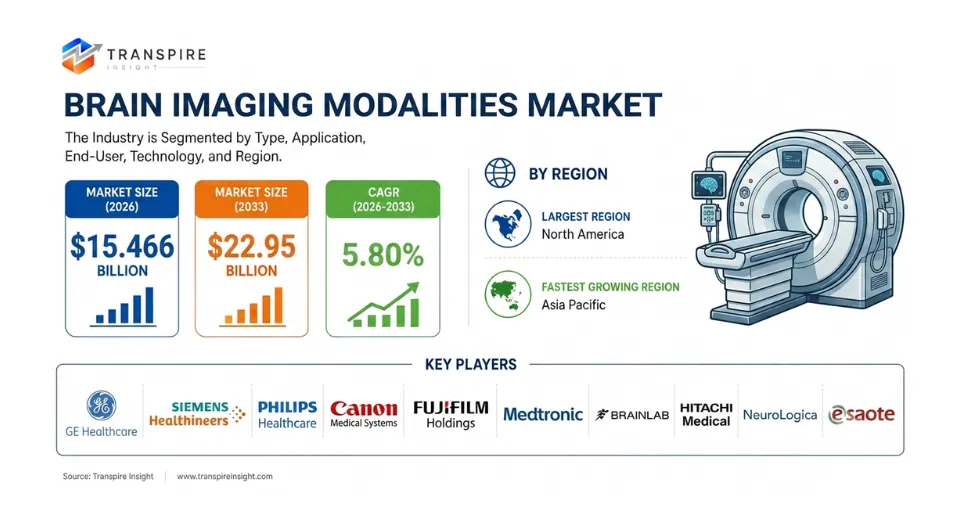
According to a new report by Transpire Insights, The brain imaging modalities market size is projected to grow from USD 15.466 billion in 2026 to USD 22.95 billion by 2033, advancing at a CAGR of 5.80% over the 2026-2033. An increasing neurological disease burden coupled with a faster adoption of AI-assisted diagnostics and ongoing investments in healthcare infrastructure drives this trajectory forward. Brain imaging is now used more frequently at the point of diagnosis rather than being confined to specialized services alone, with hospitals, research institutions, and diagnostic centres continually expanding their imaging equipment to cope with a rising number of patients worldwide.
Brain Imaging Modalities Market Growth & Trends
Neurological conditions such as Alzheimer's disease, stroke, epilepsy, and Parkinson's disease affect over one billion individuals globally - according to the World Health Organization. Such a large disease burden generates continuous and increasing clinical demand for very reliable, high-resolution brain imaging in every type of healthcare facility.
Government funding for brain research, wider reimbursement for diagnostic imaging procedures, and an increase in preventive neurology practices all help create ongoing cycles of equipment purchases. Our healthcare systems are starting to view early imaging as an even more cost-effective measure that ultimately decreases our downstream treatment costs significantly. All these factors really do keep the market moving very strongly up to 2033.
Emerging Economies & Technology
Developing markets throughout Asia, Latin America, and the Middle East hold quite a lot of untapped growth potential still. Building programs for new hospitals, government directives for digitalization, and local incentives for manufacturing reduce costs considerably and make advanced imaging capabilities available to many more semi-rural and rural healthcare facilities for the very first time.
Technological innovation compounds this geographical expansion further. AI-powered image reconstruction, cloud-based remote reading platforms, and highly efficient scanner designs all change our procurement priorities quite dramatically. Very eco-friendly design features are now often included in public hospital tender requirements, giving manufacturers an incentive to develop their products with environmental goals in mind. Digital procurement channels have also opened up some new avenues for purchase to smaller clinics and specialized centres - places that were often difficult for traditional sales networks to reach.
MRI Systems Segment
MRI systems make up 47% of the brain imaging modalities market - holding the biggest share amongst all modality types. Their excellent soft-tissue contrast, lack of ionizing radiation, and fairly wide insurance coverage really set MRI apart as the typical go-to tool for evaluating the nervous system in almost every clinical setting.
Continuous improvements in hardware - such as stronger magnetic fields, quicker gradient systems, and more varied coil designs - are continually expanding its practical uses even further. Additionally, an ever-growing list of MRI-compatible products and accessories really minimizes disruptions to workflows, making MRI even more dominant throughout hospitals and imaging facilities in both established and emerging markets.
Functional MRI Systems: Rapidly Expanding Type
Functional MRI systems show the quickest growth amongst all modality types at a CAGR of 10. 8%. Their special capacity to map actual-time brain function creates them absolutely necessary for pre-surgical planning, cognitive neuroscience research, and new clinical psychiatric applications.
Academic medical institutions and government-funded brain research projects really drive purchases because translational neuroscience funds are increasing. Advances in simultaneous multi-slice acquisition have greatly reduced scan times, addressing a long-standing problem that previously limited regular clinical use. The personalized medicine movement also speeds up adoption quite a bit, with doctors employing functional data to create customized treatment plans for depression, schizophrenia, and autism spectrum disorder.
Hospitals: Largest End-User Segment
Hospitals constitute the biggest end-user group within the brain imaging modalities market. Very high patient loads, highly trained neurology teams, and relatively good reimbursement policies provide hospitals with not just the clinical justification but also the financial means to hold diverse, very heavily used imaging fleets. Tertiary care and academic teaching hospitals run several modality types side-by-side so as to manage incredibly complex neurological patient loads all the time.
Diagnostic imaging centers form the second major end-user group. Their outpatient-focused operational model encourages the adoption of compact, extremely high-volume scanners. Hybrid partnership structures between hospitals and independent centers more and more influence capital equipment decisions, service agreements, and referral networks across both well-established and emerging markets.
North America's Market Supremacy
North America has 39% of the world's brain imaging modality market - its biggest regional share by far. An extremely interconnected group of academic medical institutions, quite high per-head health care expenditure, and a societal predisposition towards embracing new technologies really helps drive sales of top-of-the-line equipment - and also maintains very regular replacement cycles throughout both the US and Canada.
Very favorable compensation plans for MRIs, CTs, and PET scans greatly enhance usage rates significantly. On-going National Institutes of Health financing for brain-related study programs actually leads to buying more advanced functional imaging systems for research purposes. A highly experienced team of radiologists and neuroimaging experts also helps support extremely complex imaging volumes that really justify ongoing investments in even more advanced modalities.
Asia Pacific - The Fastest-Growing Region
Asia Pacific moves forward at the quickest regional CAGR of 11. 9 percent, really driven by super-fast growth in healthcare infrastructure all over China, India, Japan, South Korea, and Southeast Asia. Huge national brain health initiatives plus an increase in public-private investments in medical tech manufacturing speed up the deployment of equipment throughout the whole area.
An enormous and very quickly aging population base generates ongoing clinical demand. Government plans like India's Ayushman Bharat and China's Healthy China 2030 initiative put aside substantial funds for diagnostic imaging. Local manufacturers in China and India compete quite well on cost, significantly increasing market access beyond Tier One cities and into semi-rural healthcare centers that had no access to sophisticated imaging systems before.
AI-Assisted Imaging: Setting the Technology Landscape
AI-assisted imaging truly represents the biggest and fastest-growing tech segment inside the brain imaging modalities market. Deep learning algorithms now take care of lesion detection, image reconstruction, and noise reduction tasks, reducing analysis times from several hours down to just a few minutes. Major manufacturers actually embed AI modules right into scanner software, creating competitive differences that go way beyond raw hardware specs itself.
Regulatory approvals for AI-driven neuroimaging tools continue to grow slowly but surely in the US and Europe, confirming clinical use at a much larger scale. Radiologists start adopting AI decision-support systems so they can handle growing scan volumes - all without getting a corresponding increase in personnel. This efficiency argument really wins out for hospital managers deciding on capital equipment budgets in this age of limited healthcare funding.
Eco-friendly and low-dose imaging: an emerging segment
Helium-free MRI technology and low-dose CT protocols represent the most rapidly growing product innovation segment in brain imaging. Helium-free magnet systems significantly reduce infrastructure needs, eliminate very expensive cryogen refills - and cut lifecycle costs greatly indeed. Hospitals all over Europe adopt these systems so they can really push forward their carbon neutrality targets without losing any ground on diagnostic performance or patient flow.
Low-dose CT brain imaging protocols get regulatory approval in several major markets, reducing patients' radiation exposure even more while keeping image quality intact. Environmental purchasing standards are showing up more and more often in public hospital RFPs throughout the European Union, the UK, and Australia. Manufacturers who focus on sustainability as a fundamental part of their products instead of just a marketing slogan will see a real commercial edge in these highly competitive tender-driven markets.
Cognitive research & mental health assessment: high-growth applications
Cognitive research and mental health assessment applications experience even faster adoption as worldwide brain science funding really takes off. Governments in the US, EU, and Japan make long-term budget commitments to truly grasp the neural structure of depression, PTSD, schizophrenia, and dementia itself. This continued funding generates lots of demand for functional and hybrid imaging systems specially designed for research-heavy environments.
The World Health Organization's mental health action plan puts objective measurement and early diagnosis right at the heart of its policy plan. Functional MRI, EEG, and magnetoencephalography systems see more clinical use as psychiatrists look for tangible biomarkers that go way beyond our subjective behavioral evaluation methods. This combination of research urgency and clinical adoption really makes mental health imaging one of the most structurally compelling growth opportunities by 2033.
What Are the Recent Developments in the Brain Imaging Modalities Market?
Market participants continue to intensify innovation activity and strategic partnerships as demand accelerates across regions and applications:
January 2025 – GE HealthCare: Launched an AI-powered MRI workflow solution that reduces scan times and improves image quality for neurological applications across its SIGNA product line.
February 2025 – Siemens Healthineers: Received expanded FDA clearance for its AI-Rad Companion brain MRI tool, enabling automated volumetric analysis of brain structures to support Alzheimer's and dementia diagnosis.
March 2025 – Philips Healthcare: Announced a collaboration with a leading academic neurology center to co-develop 7T MRI protocols for real-time functional brain mapping in clinical settings.
April 2025 – Brainlab: Expanded its digital brain mapping software to integrate multimodal data from MRI, PET, and EEG systems, enhancing precision for neurosurgical planning.
May 2025 – Canon Medical Systems: Introduced a helium-free MRI system targeting emerging markets to reduce total cost of ownership and expand neuroimaging access in cost-sensitive healthcare environments.
June 2025 – Compumedics: Launched an upgraded high-density EEG system with embedded machine learning to improve artifact rejection and diagnostic reliability for epilepsy monitoring.
July 2025 – Elekta: Signed a multi-year agreement with a European hospital network to deploy integrated MR-guided radiation therapy systems for brain tumor treatment and monitoring.
About Transpire Insight
Turning Complex Data into Clear, Actionable Market Intelligence
In today’s hyper-competitive and fast-moving economy, guessing isn’t a business strategy. To lead your industry, launch game-changing products, or scale into new geographies, you need precise, reliable market intelligence, not just high-level noise.
At Transpire Insight, we are a full-service market research, data analytics, and strategic consulting firm. We help corporate leaders, innovators, and investors navigate complex market shifts with absolute confidence.
By combining rigorous primary research, deep statistical modeling, and hands-on domain expertise, we convert raw data into high-impact strategic roadmaps that drive measurable growth.
What Drives Us
Markets don’t stand still, and neither do we. Our core mission is simple: to empower organizations with verified, technology-enabled insights that remove guesswork from strategic planning.
Whether you are evaluating a niche technological shift, assessing supply chain dynamics, or looking for high-growth target segments, our intelligence gives you a decisive competitive edge.
Why Leading Enterprises Trust Transpire Insight
1. Deep Industry Specialization
We don't offer one-size-fits-all research. Our analysts specialize in dedicated verticals—from Biotechnology and Semiconductors to Advanced Automotive, Clean Energy, and Industrial Manufacturing. We speak your industry's language and understand the specific nuances, regulatory shifts, and economic drivers shaping your market.
2. Comprehensive Research Offerings
Syndicated Market Reports: In-depth, turn-key research studies covering market size, share, competitive benchmarking, and multi-year forecasts.
Customized Market Intelligence: Tailored research engagements built around your exact business questions, specific product lines, or targeted regional dynamics.
Strategic Consulting: On-demand analytical support, entry-strategy planning, and direct consultation to help you act on data with speed and accuracy.
3. A Multi-Layered Research Methodology
Reliable forecasts demand ground-truth data. Our research process combines comprehensive desk research with extensive primary interviews across key industry stakeholders including C-suite executives, supply chain leaders, procurement heads, and subject matter experts. Every report undergoes strict validation to ensure maximum precision and relevance.
Our Core Sectors
We provide continuous tracking and deep-dive analytical coverage across high-impact industries:
Manufacturing and Construction
Let’s Shape Your Growth Strategy Together
Whether you are preparing for your next fiscal cycle, analyzing market entry barriers, or looking for deep-dive quantitative data, Transpire Insight is your trusted intelligence partner.
Ready to gain a clearer view of your market?
Email Us: [email protected]
Speak to Our Analyst: +91 7666513636
Want to dive deeper? Head over to www.transpireinsight.com or join our community on Twitter, LinkedIn, and Facebook for the latest updates

 [email protected]
 APAC:+91 7666513636
 Address


