
Aug 18, 2026
By Transpire Insight
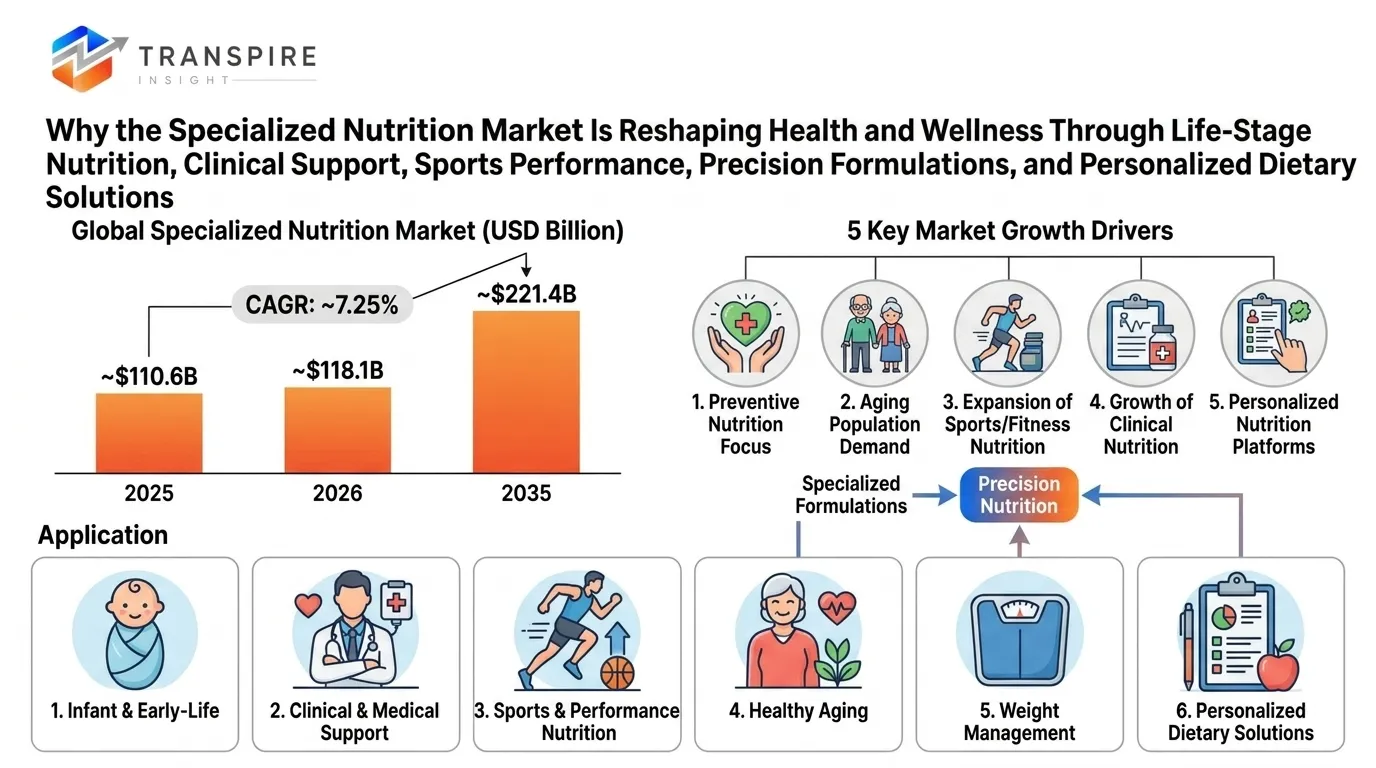
According to Transpire Insight, the global specialized nutrition market is estimated at approximately USD 110.6 billion in 2025 and is expected to reach around USD 118.1 billion in 2026. The market is projected to reach approximately USD 221.4 billion by 2035, expanding at an estimated CAGR of 7.25% during the forecast period 2026–2035.
The specialized nutrition market is becoming an increasingly important part of the global food, healthcare, wellness, and performance ecosystem as consumers, clinicians, caregivers, athletes, and food manufacturers place greater emphasis on nutrition designed around specific physiological requirements.
Specialized nutrition encompasses products formulated for particular life stages, health needs, clinical conditions, dietary requirements, or physical-performance goals. The category can include infant and early-life nutrition, clinical and medical nutrition, sports nutrition, nutrition for older adults, weight-management products, specialized dietary formulations, and other targeted nutritional solutions.
The market is changing because consumers are moving away from a one-size-fits-all approach to nutrition. Different age groups, activity levels, medical conditions, recovery requirements, and dietary restrictions can create different nutritional needs. This is encouraging manufacturers to develop products with more precisely defined nutrient profiles, ingredient combinations, formats, and consumption occasions.
The healthcare system is also playing an increasingly important role. Nutritional intervention can form part of patient support during illness, recovery, aging, and specific medical conditions. At the same time, sports nutrition is increasingly moving into mainstream wellness, while infant nutrition continues to depend heavily on product quality, safety, nutritional adequacy, and regulatory oversight.
In 2026, global nutrition policy is also receiving greater attention because affordability remains closely linked to access to healthy diets. The 2026 State of Food Security and Nutrition in the World report, released on July 21, places particular emphasis on the rising cost of healthy diets and the policy measures needed to improve nutrition access.
These developments are creating a market that is no longer defined solely by supplements or fortified foods. Specialized nutrition is increasingly becoming a strategic category connecting food science, healthcare, sports performance, aging, infant development, personalized nutrition, and preventive health.
Market Overview
Specialized nutrition products are designed to provide targeted nutritional support for people with specific dietary, developmental, physiological, medical, or performance-related requirements.
The category covers a broad range of products, including infant formulas, follow-on nutrition, oral nutritional supplements, enteral nutrition products, sports protein and recovery products, meal replacements, condition-specific formulations, foods for special dietary use, and nutrition products developed for older adults.
One of the most important areas is infant nutrition. Early-life nutritional products require carefully controlled formulations because infants have specific nutritional and developmental requirements. Product development increasingly focuses on protein quality, fats, vitamins, minerals, and other nutrients required to support growth.
Regulatory scrutiny is particularly important in infant nutrition. In the United States, the Food and Drug Administration issued final guidance in May 2026 on the design, conduct, evaluation, and reporting of protein-quality studies for infant formula, reinforcing the importance of demonstrating adequate biological protein quality in new formulas.
Clinical nutrition represents another significant application. Products may be used to help manage nutritional requirements associated with disease, recovery, malnutrition risk, or specific physiological conditions. Depending on the product and jurisdiction, these formulations can be administered orally, enterally, or through other medically supervised routes.
Sports nutrition is undergoing a major transformation as protein products, hydration products, performance nutrition, and recovery formulations increasingly reach consumers beyond professional athletes. Fitness participation, recreational exercise, strength training, endurance activities, and lifestyle-oriented wellness are widening the user base.
Adult and healthy-aging nutrition is also becoming more strategically important. Aging can be associated with changes in appetite, nutrient utilization, muscle mass, bone health, and dietary patterns. This is creating demand for products designed around the specific needs of older consumers.
Latest Market Statistics
The global specialized nutrition market is expected to maintain a strong growth trajectory as healthcare providers, consumers, sports participants, caregivers, and food manufacturers increasingly recognize the importance of targeted nutrition.
Transpire Insight estimates that the market was approximately USD 110.6 billion in 2025 and is expected to rise to around USD 118.1 billion in 2026. By 2035, the market could reach approximately USD 221.4 billion as specialized nutritional products become more integrated into preventive health, clinical support, fitness, aging, infant care, and personalized dietary strategies.
Market expansion is being supported by demographic change, increasing healthcare awareness, greater participation in organized fitness, consumer interest in protein and functional ingredients, rising demand for nutrition products for older adults, and continued innovation in infant and medical nutrition.
One of the most important structural changes is the movement toward specific nutritional outcomes. Consumers increasingly want products that correspond to a particular stage of life, physical activity, dietary restriction, recovery objective, or nutritional concern.
This is encouraging manufacturers to develop products with more targeted nutrient combinations, improved ingredient traceability, convenient formats, and clearer positioning.
Another major change is the growing overlap between nutrition and digital health. Mobile applications, online consultations, wearable devices, body-composition monitoring, and digital food tracking can increasingly provide information used to personalize dietary strategies.
The result is a market where product differentiation increasingly depends on formulation science, evidence, convenience, sensory quality, trust, regulatory compliance, and the ability to address specific consumer needs.
Major Growth Drivers
Increasing focus on preventive nutrition: Consumers are increasingly interested in nutrition as part of broader health-maintenance strategies rather than relying only on intervention after health problems emerge.
Aging population: Growing numbers of older consumers are increasing demand for products designed around protein intake, nutritional adequacy, healthy aging, and specific age-related requirements.
Expansion of sports and fitness nutrition: Protein, recovery, hydration, endurance, and performance products are increasingly being adopted by recreational and everyday fitness consumers.
Growth of clinical nutrition: Hospitals, care settings, and home healthcare environments require nutritional products for individuals who may be unable to meet nutritional requirements through conventional diets alone.
Changing infant nutrition needs: Demand for specialized infant products continues to encourage innovation around formulation quality, protein composition, nutrient density, and product safety.
Personalization of nutrition: Digital health tools and increasing consumer awareness are supporting more individualized approaches to nutritional planning and product selection.
Download the exclusive Specialized Nutrition Market sample report today to uncover expert insights, emerging trends, and the opportunities defining the future of the industry.
Key Applications
Infant nutrition represents a critical segment of the specialized nutrition market. Products are designed to provide carefully balanced nutrition during early development, with formulations differentiated according to age, feeding requirements, and specific nutritional needs.
Clinical nutrition is another major application. Specialized products can support nutritional management for individuals facing disease, recovery, malnutrition risk, swallowing difficulties, or other conditions that affect normal dietary intake.
Sports nutrition includes products designed to support exercise performance, muscle recovery, protein intake, energy requirements, hydration, and training routines.
Healthy-aging nutrition is becoming increasingly important as older adults seek convenient ways to maintain adequate nutrient intake and support active lifestyles.
Weight-management nutrition represents another application, including products designed to support calorie-controlled eating patterns, meal replacement strategies, or structured nutritional programs.
Special dietary nutrition can address particular dietary needs, including products developed around restricted diets, intolerances, allergies, or specific nutritional requirements.
Government Initiatives and Nutrition Modernization
Government policies and food-safety regulations are playing a significant role in shaping the specialized nutrition market because several categories involve vulnerable populations or medically relevant nutritional requirements.
In India, specialized nutrition falls within a formal regulatory framework covering health supplements, nutraceuticals, foods for special dietary use, foods for special medical purposes, functional foods, and novel foods. FSSAI maintains dedicated regulations and guidance covering these categories.
FSSAI also maintains guidance related to food for special medical purposes and continues to update regulatory information and application status for non-standardized foods and ingredients. Its 2026 regulatory resources show continued activity around approval, safety assessment, product standards, and specialized food categories.
The Indian regulatory framework also distinguishes specialized categories such as foods for sportspersons and foods for special medical purposes, with specific requirements concerning intended use, labeling, nutritional composition, and professional guidance.
Internationally, specialized nutrition products are also subject to detailed regulatory requirements. In the European Union, foods for special medical purposes are governed by specific compositional and safety requirements, including requirements based on sound medical and nutritional principles and scientific evidence.
These frameworks are influencing the market by increasing the importance of scientific validation, product quality, accurate labeling, formulation controls, and responsible communication of nutritional benefits.
Technology and Formulation Overview
The specialized nutrition market depends heavily on formulation science and food-processing technology.
Protein technology is one of the most important areas. Manufacturers are developing different protein sources, blends, concentrations, and processing approaches to support products ranging from infant nutrition to sports and clinical applications.
Micronutrient fortification enables manufacturers to add vitamins and minerals according to the intended nutritional profile of the product.
Lipid technology is also significant, especially in infant and clinical nutrition where the type and balance of fats can influence the nutritional characteristics of a formulation.
Carbohydrate and fiber systems are being developed to manage energy delivery, digestive characteristics, texture, and nutritional density.
Probiotic and prebiotic technologies are increasingly incorporated into selected specialized products where appropriate, particularly as research into the relationship between nutrition and the gut microbiome continues to expand.
Microencapsulation and controlled-delivery technologies can help protect sensitive ingredients and improve their stability during processing, storage, and consumption.
The market is also moving toward cleaner formulations and improved sensory performance. Consumers increasingly expect specialized products to provide nutritional functionality without sacrificing taste, texture, convenience, or product experience.
Future Importance
The future of the specialized nutrition market will be closely connected to precision nutrition, healthy aging, clinical nutrition, infant development, sports performance, preventive health, and data-driven dietary personalization.
The market is expected to move increasingly toward products designed around clearly defined nutritional outcomes rather than broad wellness positioning.
Personalized nutrition could become especially important. Genetic information, microbiome data, body-composition measurements, dietary records, activity data, and health histories may increasingly contribute to the development of individual nutrition strategies.
However, the commercial value of personalization will depend on the scientific validity of recommendations, regulatory boundaries, affordability, data privacy, and consumer trust.
The future market is therefore likely to emphasize a combination of scientific evidence and consumer usability.
Top Market Trends
The specialized nutrition market is evolving quickly as nutritional science, healthcare, sports, and consumer wellness increasingly overlap.
Technological Advancements
Technology is one of the strongest forces transforming specialized nutrition.
Precision formulation systems allow manufacturers to control nutrient quantities and ingredient combinations more accurately.
Advanced protein processing is improving the functionality, solubility, digestibility, and sensory characteristics of different protein sources.
Microencapsulation can protect sensitive ingredients from environmental exposure and improve stability.
Shelf-life and stability technologies are particularly important for medical and infant nutrition products, where consistent nutrient delivery and product safety are essential.
Digital formulation platforms are also becoming more valuable. Manufacturers can increasingly use modeling and data analysis to evaluate ingredient interactions, nutritional composition, consumer preferences, and manufacturing variables.
The convergence of food science and digital technology is therefore creating opportunities for more precisely engineered specialized nutrition products.
Artificial Intelligence and Personalized Nutrition
Artificial intelligence has the potential to become an important component of next-generation specialized nutrition.
AI systems can process dietary records, activity data, nutritional preferences, consumer behavior, and other information to support personalized recommendations.
For sports consumers, intelligent systems could potentially help adapt nutritional strategies according to training volume, recovery requirements, body composition, and performance goals.
For older adults, digital systems could support meal planning and nutritional monitoring based on dietary patterns, preferences, and selected health considerations.
In clinical environments, data-driven tools may eventually assist healthcare professionals in monitoring nutritional intake, identifying potential nutritional risks, and supporting individualized nutrition plans.
However, AI should complement rather than replace qualified healthcare and nutrition professionals, particularly in medical and infant nutrition. Data quality, privacy, clinical validation, bias, and regulatory oversight remain important considerations.
Major Applications
Infant Nutrition: Specialized products provide targeted nutritional support during important stages of early growth and development.
Clinical Nutrition: Products support nutritional management in healthcare and homecare settings when conventional food intake may not meet requirements.
Sports Nutrition: Protein, hydration, energy, recovery, and performance products support a wide range of exercise and training routines.
Healthy-Aging Nutrition: Products are increasingly developed around nutritional adequacy and the needs of older consumers.
Weight Management: Structured nutritional products can support selected calorie-management and meal-replacement approaches.
Special Dietary Nutrition: Products can be formulated for particular dietary restrictions, intolerances, allergies, or nutritional requirements.
Proceed to Checkout to purchase the exclusive Specialized Nutrition Market report and gain instant access to in-depth market intelligence, strategic analysis, and future growth opportunities.
Investment and Growth Opportunities
The expansion of specialized nutrition is creating opportunities for food manufacturers, biotechnology companies, ingredient suppliers, healthcare organizations, sports-nutrition brands, digital-health companies, and specialized distributors.
One major opportunity is healthy-aging nutrition. The growing need for convenient, nutrient-dense products for older adults creates significant potential for innovative formulations and delivery formats.
The clinical nutrition segment also offers substantial opportunity. Expansion of home healthcare and post-acute care can increase demand for nutritional products that support patients beyond traditional hospital settings.
The sports nutrition market provides another attractive area, particularly where brands can combine protein, hydration, recovery, convenience, and evidence-based positioning.
There is also substantial potential in personalized nutrition platforms that connect digital recommendations with specialized food and nutrition products.
Emerging economies represent additional growth opportunities as healthcare infrastructure, digital access, retail distribution, and consumer awareness expand.
Market Segmentation
The specialized nutrition market can be segmented based on product type, application, end user, formulation, and distribution channel.
By product type, the market includes infant nutrition, clinical and medical nutrition, sports nutrition, adult and healthy-aging nutrition, weight-management nutrition, and other specialized nutritional products.
By application, major areas include infant development, clinical support, sports and fitness, healthy aging, general wellness, weight management, and condition-specific nutrition.
By end user, the market includes infants and young children, adults, athletes and active consumers, older adults, patients, caregivers, and healthcare institutions.
By formulation, major categories include powders, ready-to-drink liquids, bars, gels, capsules or other supplement formats, and specialized solid or semi-solid foods.
By distribution channel, the market includes hospitals and healthcare institutions, pharmacies, specialty nutrition retailers, supermarkets, direct-to-consumer platforms, e-commerce, sports outlets, and other channels.
Leading and Fastest-Growing Segments
The infant nutrition segment is expected to remain a major contributor because of the essential nature of early-life nutritional products and the importance placed on product safety and nutritional adequacy.
The clinical nutrition segment represents a significant long-term opportunity as healthcare systems increasingly address malnutrition risk, recovery, chronic conditions, and nutrition support in outpatient and homecare settings.
The sports nutrition segment is expected to remain among the fastest-changing areas as protein and performance nutrition continue to move beyond professional athletics into mainstream fitness and lifestyle consumption.
The healthy-aging segment is expected to gain increasing importance as demographic shifts create greater demand for convenient products designed around the nutritional requirements of older adults.
The personalized nutrition segment represents a developing opportunity as digital tools become more capable of connecting nutritional information with individualized recommendations.
Competitive Landscape
Competition in the specialized nutrition market is increasingly focused on formulation quality, scientific validation, ingredient selection, sensory performance, safety, regulatory compliance, convenience, and brand trust.
Companies are investing in specialized product portfolios rather than relying exclusively on broad nutritional categories.
Product differentiation increasingly involves factors such as protein source, nutrient composition, ingredient quality, delivery format, digestibility, taste, texture, packaging convenience, and targeted nutritional positioning.
Clinical and infant nutrition require particularly strong attention to quality systems, safety controls, regulatory compliance, and scientific support.
In sports and adult nutrition, companies are increasingly competing around product convenience, ingredient transparency, specialized formulations, flavor development, personalized recommendations, and digital engagement.
Strategic partnerships involving ingredient suppliers, healthcare providers, research institutions, sports organizations, and technology companies are also likely to increase.
Challenges and Restraints
Despite strong market opportunities, the specialized nutrition industry faces several challenges.
Regulatory complexity is one of the most significant. Specialized nutrition products can fall under different regulatory categories depending on composition, claims, target population, and intended use.
Scientific substantiation is another important consideration. Companies must distinguish between nutritional support and unsupported disease or health claims.
Cost and affordability can limit access to premium specialized products, particularly in lower-income markets and populations with significant nutritional needs.
Sensory acceptance can also affect product success. High-protein, high-fiber, fortified, or condition-specific formulations may require careful development to maintain acceptable taste and texture.
Consumer confusion is another challenge. The growing number of specialized products can make it difficult for consumers to distinguish evidence-based nutritional solutions from products relying heavily on marketing.
Data privacy and responsible use of personal information will become increasingly important as personalized nutrition platforms expand.
Nevertheless, scientific innovation, demographic change, healthcare needs, and increasing consumer awareness continue to create substantial opportunities for the industry.
Regional Market Outlook
The specialized nutrition market is expanding across major regions as healthcare systems, consumer wellness, sports participation, aging populations, and premium food markets continue to develop.
North America remains an important market because of its established healthcare infrastructure, sports-nutrition ecosystem, consumer interest in wellness, strong retail distribution, and growing emphasis on personalized health strategies.
Europe represents a mature market supported by healthcare infrastructure, aging demographics, developed food manufacturing capabilities, and strong attention to nutrition-related regulation and product quality.
Asia-Pacific represents a major long-term growth opportunity. Rising disposable incomes, urbanization, expanding healthcare access, growing fitness participation, changing dietary patterns, infant-nutrition demand, and aging populations are supporting specialized nutrition consumption across China, India, Japan, South Korea, Australia, and Southeast Asia.
Latin America provides additional opportunities through expanding healthcare access, sports and wellness consumption, infant nutrition demand, urban middle-class growth, and improving retail and digital distribution.
Middle East & Africa are also expected to provide growth opportunities as healthcare infrastructure, sports participation, private healthcare, specialized retail, and nutrition-awareness initiatives expand.
Future Market Opportunities
One of the strongest opportunities lies in personalized nutrition systems that connect individual dietary information with targeted products and recommendations.
The healthy-aging segment provides another important opportunity. Products designed around convenient protein and nutrient delivery can address changing dietary behaviors among older consumers.
Home-based clinical nutrition is also expected to become increasingly significant as healthcare systems look for ways to support recovery and nutritional management outside hospitals.
The sports nutrition sector offers continued opportunities through specialized products for endurance, strength, recovery, hydration, and active lifestyles.
There is also significant potential in next-generation infant nutrition, where formulation science, ingredient technology, product safety, and nutritional adequacy will remain important areas of innovation.
Customize the exclusive Specialized Nutrition Market report today to receive tailored insights, country-specific analysis, and business-focused market intelligence.
Role of Technology and Advanced Manufacturing
Technology is changing the way specialized nutrition products are formulated, manufactured, distributed, and monitored.
Automated manufacturing can improve dosing accuracy and production consistency, which is particularly important for products requiring tightly controlled nutrient composition.
Digital quality-control systems can monitor raw materials, processing variables, packaging conditions, and batch consistency.
Advanced ingredient processing can improve the stability and functionality of proteins, vitamins, minerals, lipids, probiotics, and other sensitive components.
Digital manufacturing systems can also enable greater flexibility in producing multiple specialized formulations without requiring entirely separate production environments.
E-commerce and direct-to-consumer channels are further changing distribution by making specialized products more accessible to consumers outside traditional retail and healthcare settings.
Future production systems could increasingly combine precision formulation, automated quality control, digital traceability, and personalized product configuration.
Personalized and Precision Nutrition
The shift toward personalized nutrition is expected to influence nearly every major segment of the specialized nutrition market.
Consumers differ in age, activity level, dietary patterns, preferences, body composition, health circumstances, and nutritional requirements.
This creates opportunities for products designed around more specific consumer groups rather than broad demographic categories.
Digital tools can help identify preferences and nutritional patterns, while laboratory and health data may increasingly support more precise nutritional planning under appropriate professional oversight.
In sports nutrition, personalization may involve training intensity and recovery goals.
In healthy aging, it may involve dietary preferences, protein intake, convenience, and nutritional adequacy.
In clinical nutrition, personalization can involve the patient's condition, nutritional requirements, tolerance, and route of administration.
This evolution could ultimately move the market toward precision-designed nutritional products matched to specific individuals or well-defined populations.
Key Strategic Developments
Companies operating in the specialized nutrition market are expected to focus on:
These strategies demonstrate that competition is moving beyond conventional supplements toward scientifically designed, life-stage-specific, personalized, and increasingly integrated nutrition solutions.
Recent Industry Developments
The specialized nutrition industry is experiencing increased regulatory and scientific activity across several major categories.
On May 21, 2026, the U.S. Food and Drug Administration issued final guidance on protein-quality studies for infant formula. The guidance focuses on how manufacturers and laboratories should design, conduct, evaluate, and report Protein Efficiency Ratio studies, reinforcing the importance of nutritional quality assessment for new infant formulas.
In India, FSSAI's 2026 regulatory resources continue to reflect active oversight of health supplements, nutraceuticals, foods for special dietary use, foods for special medical purposes, functional foods, and novel foods. FSSAI's current resources also show ongoing processing and risk assessment of non-specified food and ingredient applications.
On July 21, 2026, the United Nations system's State of Food Security and Nutrition in the World 2026 was published with a focus on the rising cost of healthy diets and the policy mechanisms needed to improve nutrition access and affordability. This broader policy emphasis is relevant to specialized nutrition because product innovation increasingly has to balance nutritional sophistication with accessibility.
These developments indicate that the market is moving toward greater scientific accountability, more structured regulation, and stronger attention to access, quality, and nutritional effectiveness.
Market Expert View
From a market perspective, the specialized nutrition market is positioned for continued transformation because it sits at the intersection of food science, healthcare, sports performance, infant development, aging, preventive health, and digital personalization.
The market is becoming more sophisticated because consumers increasingly want products that address clearly defined nutritional requirements rather than broad wellness claims.
This is likely to increase the value of scientific evidence and transparent formulation. Products that can demonstrate clear nutritional purpose while remaining convenient and enjoyable may gain stronger consumer trust.
The competitive environment is also likely to become more segmented. Infant nutrition, clinical nutrition, sports nutrition, and healthy-aging nutrition have different consumers, regulatory conditions, distribution channels, and formulation requirements.
Another important shift will be the increasing relationship between products and services. Nutrition platforms, healthcare providers, digital tools, personalized recommendations, and specialized products can increasingly operate together rather than as separate categories.
Future Outlook
The future of the specialized nutrition market is expected to be shaped by precision nutrition, healthy aging, clinical support, sports performance, infant innovation, personalization, scientific validation, and digital health integration.
Infant and clinical nutrition should remain strategically important because of their specialized requirements and strong emphasis on safety and nutritional adequacy.
Sports nutrition is expected to continue expanding as protein, recovery, hydration, and performance products become increasingly mainstream.
Healthy-aging nutrition is likely to become more prominent as demographic changes increase the need for convenient, nutrient-dense solutions for older consumers.
Personalized nutrition could become one of the industry's most significant long-term developments as digital systems improve the ability to connect individual data with nutrition recommendations.
Emerging economies are expected to provide additional opportunities as healthcare infrastructure, disposable incomes, digital commerce, nutrition awareness, and specialized distribution networks expand.
Schedule a meeting with our market experts to discuss the exclusive Specialized Nutrition Market report and identify the best research solution for your organization.
Conclusion
The specialized nutrition market is reshaping the relationship between food, health, performance, and individual nutritional requirements. From infant nutrition and clinical support to sports performance, healthy aging, weight management, and personalized dietary solutions, the industry is evolving toward products designed around increasingly specific needs.
Advances in protein technology, micronutrient formulation, functional ingredients, food processing, digital health, and personalized nutrition are expanding the capabilities of specialized products. At the same time, regulatory developments are placing greater emphasis on safety, scientific evidence, nutritional adequacy, labeling, and responsible product positioning.
Looking ahead, the market will increasingly depend on the ability of manufacturers and healthcare-oriented nutrition providers to combine scientific validation, nutritional precision, sensory quality, affordability, convenience, safety, and personalized consumer value.
As consumers and healthcare systems increasingly recognize that nutritional requirements vary according to life stage, health status, activity level, and individual circumstances, next-generation specialized nutrition products are expected to become an increasingly important part of the global food, healthcare, and wellness economy.


Send us a brief description of your challenge and we'll get back to you within 24 hours.

 inquiry@transpireinsight.com
 APAC:+91 7666513636
 Address


