
Aug 18, 2026
By Transpire Insight
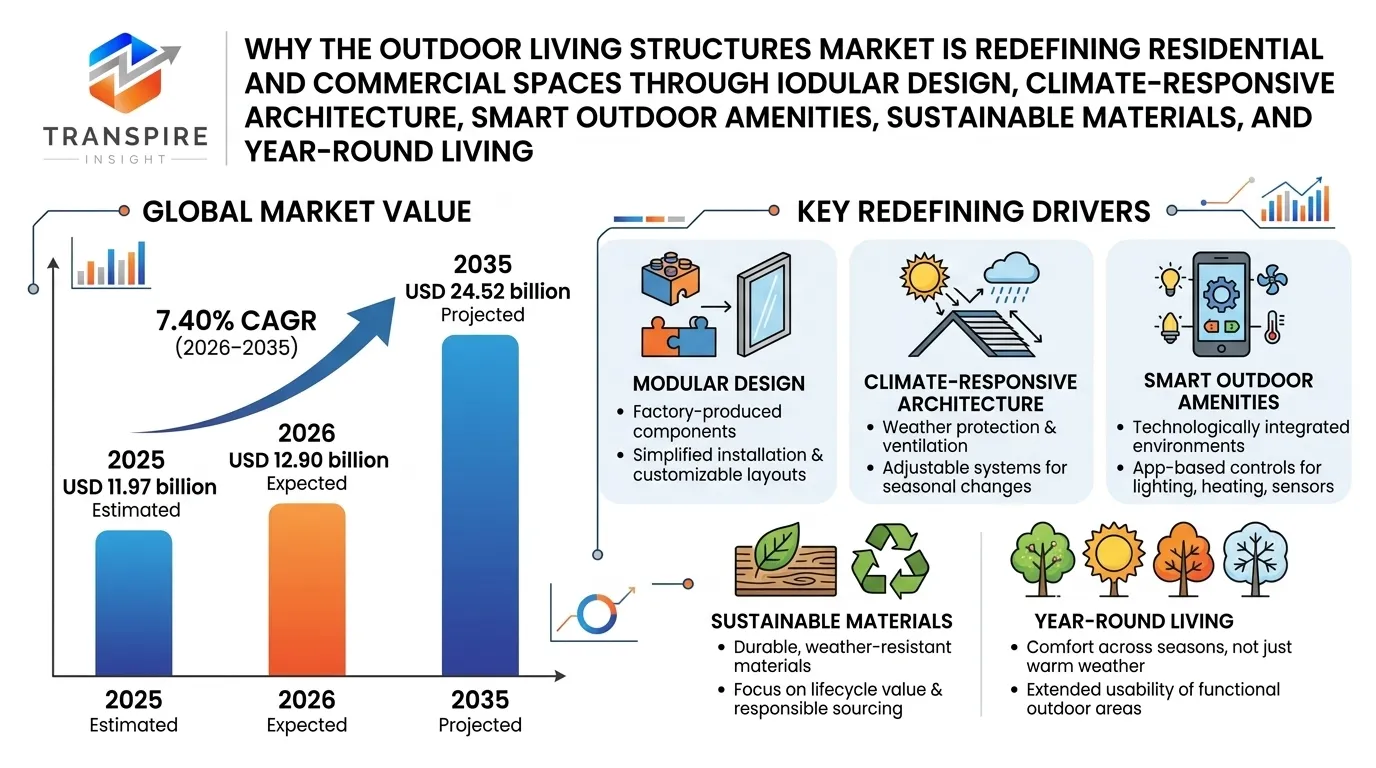
According to Transpire Insight, the global outdoor living structures market is estimated at approximately USD 11.97 billion in 2025 and is expected to reach around USD 12.90 billion in 2026. The market is projected to reach approximately USD 24.52 billion by 2035, expanding at an estimated CAGR of 7.40% during the forecast period 2026–2035.
The outdoor living structures market is entering a new phase as homeowners, property developers, hospitality operators, and commercial organizations increasingly treat outdoor areas as extensions of usable indoor space. Pergolas, patios, gazebos, pavilions, outdoor kitchens, covered decks, shade structures, screened spaces, and modular outdoor rooms are increasingly being designed as functional environments rather than standalone landscaping additions.
The shift is being driven by changing lifestyles, urbanization, rising interest in home improvement, demand for social spaces, and the growing value placed on flexible environments for entertainment, relaxation, dining, recreation, and remote work. Outdoor areas are increasingly expected to perform several functions throughout the year, encouraging greater investment in weather protection, lighting, heating, cooling, furniture integration, and architectural finishes.
Climate considerations are also becoming more influential. Buyers are increasingly interested in structures that can provide shade during intense heat, protection from precipitation, improved ventilation, and greater usability during seasonal weather changes. This is encouraging manufacturers and designers to develop adjustable louvers, retractable systems, screened structures, insulated roofs, weather-resistant materials, and modular enclosures.
At the same time, outdoor living structures are becoming more technologically integrated. Lighting, fans, audio systems, heating elements, motorized shades, outdoor kitchens, security systems, sensors, and smart-home controls can increasingly be incorporated into a single outdoor environment.
The result is a market that is moving beyond basic garden structures toward architecturally integrated outdoor living environments designed around comfort, functionality, aesthetics, sustainability, and year-round usability.
Market Overview
Outdoor living structures are permanent or semi-permanent installations designed to increase the functionality, comfort, and visual appeal of outdoor residential or commercial spaces. The category can include pergolas, patios, gazebos, pavilions, outdoor kitchens, covered decks, screened enclosures, shade structures, cabanas, modular outdoor rooms, and other customized exterior structures.
One of the most important applications is residential outdoor expansion. Homeowners increasingly seek additional usable space without undertaking the cost and disruption associated with conventional indoor extensions. A well-designed outdoor structure can create a dining area, lounge, entertainment zone, kitchen, workspace, or recreational environment.
The market is also benefiting from home renovation activity. Outdoor improvements can be incorporated into broader remodeling projects, particularly where homeowners are seeking to increase lifestyle value, improve property appearance, or make better use of gardens, terraces, balconies, rooftops, and backyards.
Hospitality and tourism represent another major opportunity. Hotels, resorts, restaurants, clubs, and destination properties are increasingly using outdoor areas for dining, recreation, wellness, entertainment, and guest experiences.
Outdoor living structures are also becoming increasingly relevant to commercial properties. Offices, mixed-use developments, residential communities, senior-living facilities, and retail destinations can use outdoor areas to create social spaces and improve the overall attractiveness of a property.
The category is therefore expanding from conventional residential landscaping into a broader architectural and property-development ecosystem.
Latest Market Statistics
The global outdoor living structures market is expected to maintain a strong growth trajectory as consumers and property developers increasingly allocate resources toward functional exterior environments.
Market expansion is being supported by several structural factors, including increased home-improvement expenditure, greater interest in outdoor recreation, growing demand for entertaining areas, increased adoption of modular structures, expanding hospitality investment, and the search for additional usable property space.
An important change is the transition from single-purpose outdoor structures to multifunctional environments. A pergola may now incorporate adjustable shading, lighting, ceiling fans, an outdoor kitchen, seating, entertainment equipment, and weather-management systems.
The market is also becoming increasingly premium. Consumers are moving from basic structures toward custom-built environments featuring higher-quality materials, integrated technology, architectural detailing, and customized layouts.
This premiumization is increasing the average value of outdoor projects while creating additional opportunities for design firms, contractors, material suppliers, smart-home technology providers, and specialty outdoor-living manufacturers.
Major Growth Drivers
Growing preference for outdoor living: Consumers increasingly view outdoor environments as important parts of daily life, entertainment, dining, relaxation, and family activities.
Expansion of home improvement: Renovation projects increasingly include decks, patios, pergolas, outdoor kitchens, shade systems, and other exterior upgrades.
Demand for multifunctional spaces: Homeowners and property developers are seeking structures capable of supporting several activities instead of traditional single-use outdoor installations.
Climate-responsive design: Increasing exposure to heat, precipitation, strong sunlight, and changing weather patterns is strengthening demand for shaded, ventilated, covered, and adaptable outdoor spaces.
Growth of hospitality and tourism: Hotels, restaurants, resorts, and leisure properties are investing in attractive outdoor environments to improve guest experiences and increase usable commercial space.
Advances in materials and modular construction: New composite, aluminum, engineered wood, fabric, glass, and weather-resistant materials are enabling structures that require less maintenance and support more flexible designs.
Download the exclusive Outdoor Living Structures Market sample report today to uncover expert insights, emerging trends, and the opportunities defining the future of the industry.
Key Applications
Residential properties represent the largest and most diverse application base. Homeowners use outdoor structures for dining, entertaining, relaxation, recreation, gardening, cooking, and additional living space.
Hospitality is another important application. Hotels, resorts, restaurants, clubs, and vacation properties increasingly use outdoor structures to create dining terraces, lounges, poolside areas, wellness environments, and event spaces.
Commercial properties can use outdoor structures for employee recreation, customer seating, public gathering areas, outdoor dining, and amenity spaces.
Multi-family housing represents a growing opportunity. Apartment communities and residential developments can incorporate shared outdoor kitchens, patios, pergolas, rooftop spaces, and social areas as premium amenities.
Recreation and leisure properties such as golf facilities, resorts, clubs, and private recreational venues can use outdoor structures to enhance user experience and extend usable space.
Government Initiatives and Urban Space Modernization
Government investment in urban development, housing modernization, public-space improvement, tourism infrastructure, and resilient construction is contributing to the broader environment in which outdoor living structures are being adopted.
Urban areas are increasingly seeking ways to improve the usability of limited outdoor space. Rooftop terraces, balconies, courtyards, community gardens, covered plazas, and compact recreational environments can all benefit from adaptable outdoor structures.
In India, rapid urbanization, residential construction, hospitality investment, commercial development, and rising lifestyle spending are increasing interest in professionally designed outdoor environments.
Government and municipal requirements related to construction permits, structural safety, zoning, drainage, fire safety, electrical installations, and property setbacks remain important considerations. As outdoor structures become more permanent and integrated with buildings, compliance requirements can become more complex.
The growing focus on sustainable building practices is also encouraging the use of durable materials, efficient lighting, water-conscious landscaping, and designs intended to minimize maintenance and lifecycle costs.
Material and Technology Overview
The outdoor living structures market includes several important material categories.
Wood remains an established material because of its natural appearance, design flexibility, and compatibility with traditional and contemporary architecture. Engineered and treated wood products can improve durability and environmental resistance.
Aluminum is increasingly important because of its relatively low weight, corrosion resistance, design flexibility, and suitability for contemporary structures.
Steel is used where structural strength and larger spans are required. It can support durable frames and architectural structures for demanding residential and commercial applications.
Composite materials are gaining attention because they can provide the visual characteristics of wood while requiring less maintenance in certain applications.
Vinyl and polymer-based materials can offer weather resistance, low maintenance, and relatively straightforward installation for selected residential applications.
Glass and fabric systems are also becoming important for semi-enclosed structures, retractable roofs, screened areas, and climate-responsive outdoor rooms.
Another major development is the use of modular construction. Factory-produced structural elements can simplify installation and shorten project timelines while providing greater design consistency.
Future Importance
The future of the outdoor living structures market will be closely connected to space optimization, climate adaptation, smart-home integration, modular construction, sustainability, and experiential property design.
Outdoor areas are increasingly being evaluated as extensions of indoor space. This means consumers are demanding better flooring, lighting, furniture integration, cooking facilities, entertainment systems, and climate management.
The market is therefore moving toward outdoor environments that can function across several seasons rather than being limited to warm-weather use.
Technology is expected to play an increasingly important role. Motorized roofs, smart lighting, automated shades, outdoor heating, weather sensors, irrigation controls, security systems, and app-based management can transform outdoor structures into connected environments.
The overall industry is shifting toward year-round outdoor architecture, creating opportunities for products that combine physical structures with technology and climate-responsive design.
Top Market Trends
The outdoor living structures market is evolving rapidly as homeowners and commercial property owners seek more versatile and sophisticated exterior spaces.
Technological Advancements
Technology is becoming one of the strongest forces transforming the outdoor living structures market.
Motorized louvered roofs can allow users to control the amount of sunlight entering an outdoor space while providing protection against precipitation when closed.
Retractable shade systems provide flexibility by allowing users to adjust coverage based on weather and desired outdoor conditions.
Smart lighting can be integrated into structural elements and controlled through mobile devices, schedules, sensors, or broader home-automation systems.
Outdoor climate-management systems are also developing. Heating units, fans, misting systems, ventilation solutions, and weather monitoring can increase comfort across different seasons.
Advanced materials are improving durability. Powder-coated metals, engineered composites, weather-resistant fabrics, treated woods, and corrosion-resistant components are expanding the range of environments in which structures can be installed.
The integration of these technologies is transforming outdoor structures from static architectural elements into adaptive living environments.
Artificial Intelligence and Smart Outdoor Environments
Artificial intelligence could become increasingly relevant to the outdoor living structures market through intelligent climate management and predictive automation.
AI-enabled systems could analyze temperature, sunlight, wind, precipitation, humidity, and occupancy information to adjust shades, louvers, lighting, fans, and heating systems automatically.
A smart outdoor environment could potentially identify when a space is being used and adjust comfort settings accordingly.
AI could also support design personalization. Digital design tools may analyze property dimensions, climate conditions, sun exposure, usage preferences, and landscaping characteristics to recommend suitable outdoor structures and configurations.
In commercial settings, intelligent systems could help hospitality operators optimize lighting, temperature, energy consumption, and space utilization.
However, cost, interoperability, connectivity, reliability, and cybersecurity will remain important factors influencing adoption.
Proceed to Checkout to purchase the exclusive Outdoor Living Structures Market report and gain instant access to in-depth market intelligence, strategic analysis, and future growth opportunities.
Major Applications
Residential Outdoor Living: Pergolas, patios, decks, pavilions, outdoor kitchens, cabanas, and covered spaces can extend the functional area of a home.
Hospitality: Hotels, restaurants, resorts, and clubs use outdoor structures for dining, entertainment, wellness, events, and guest experiences.
Multi-Family Housing: Shared outdoor kitchens, lounges, rooftop structures, and recreational spaces can enhance residential amenities.
Commercial Properties: Offices and mixed-use developments can create outdoor gathering areas, employee amenities, and customer-facing spaces.
Recreation and Leisure: Golf facilities, private clubs, resorts, parks, and recreational destinations use outdoor structures to support visitor activities.
Investment and Growth Opportunities
The expansion of outdoor living is creating opportunities for construction companies, architects, landscape designers, material manufacturers, smart-home technology providers, specialty retailers, and installation contractors.
One major opportunity is the development of integrated outdoor rooms that combine structural protection with kitchens, seating, lighting, entertainment, storage, and climate-control technologies.
The luxury residential segment also offers substantial potential. High-value properties can support customized outdoor environments incorporating premium materials, architectural lighting, outdoor kitchens, pools, fireplaces, water features, and advanced automation.
The hospitality segment represents another attractive area. Hotels and resorts increasingly seek outdoor environments that increase guest engagement and create additional dining and entertainment capacity.
Emerging urban markets also offer opportunities through rooftops, balconies, compact terraces, courtyards, and shared community spaces.
Market Segmentation
The outdoor living structures market can be segmented based on structure type, material, application, design, and distribution channel.
By structure type, major categories include pergolas, patios, gazebos, pavilions, outdoor kitchens, covered decks, shade structures, screened enclosures, cabanas, modular outdoor rooms, and other structures.
By material, the market includes wood, aluminum, steel, composites, vinyl, fabric, glass, and other materials.
By application, major areas include residential, hospitality, commercial, multi-family housing, recreation, and other property types.
By design, the market can be differentiated into open structures, semi-enclosed structures, fully enclosed structures, retractable systems, modular systems, and customized architectural installations.
By distribution channel, major channels include specialty dealers, home-improvement retailers, contractors, landscape professionals, architectural firms, direct-to-consumer channels, and e-commerce.
Leading and Fastest-Growing Segments
The pergola and patio segment is expected to remain a major part of the market because of its ability to create usable outdoor space without requiring fully enclosed construction.
The modular structure segment represents strong growth potential because prefabricated systems can simplify installation and provide greater customization.
The outdoor kitchen segment is also expected to expand as outdoor areas become increasingly integrated with cooking, dining, and entertainment activities.
The smart and motorized structure segment is gaining importance as consumers seek automated shade, lighting, climate management, and entertainment.
The premium residential segment is expected to remain a major source of market value because high-end homeowners are increasingly investing in customized and architecturally integrated exterior environments.
Competitive Landscape
Competition in the outdoor living structures market is increasingly centered on design flexibility, material durability, installation efficiency, customization, technology integration, aesthetics, and lifecycle value.
Manufacturers are investing in modular systems, adjustable roofs, retractable technologies, engineered materials, integrated lighting, and other features that can increase functionality.
Customization is another major competitive factor. Consumers increasingly seek structures designed specifically around property dimensions, architectural style, climate, landscaping, and intended use.
Installation capabilities are also important because complex projects can require engineering, electrical work, drainage, foundations, landscaping, and other specialized services.
Companies that can provide comprehensive solutions covering design, structural systems, accessories, installation, and after-sales support may gain an advantage as consumers increasingly prefer simplified project management.
Challenges and Restraints
Despite strong growth prospects, the outdoor living structures market faces several challenges.
Installation costs can be significant, particularly for customized structures involving foundations, electrical systems, premium materials, climate controls, and landscaping integration.
Building regulations can also influence project timelines and feasibility. Structural requirements, zoning restrictions, property setbacks, drainage, and electrical regulations may vary by location.
Weather exposure creates durability challenges. Outdoor structures must withstand sunlight, moisture, wind, temperature variation, corrosion, and other environmental conditions.
Seasonality can affect purchasing patterns in certain climates. Demand may be stronger during spring and summer months, creating logistical and inventory-management challenges.
Material costs are another concern. Changes in prices for wood, aluminum, steel, composites, glass, and transportation can influence project economics.
Nevertheless, product innovation and modular construction are providing manufacturers with opportunities to reduce installation complexity and improve lifecycle performance.
Customize the exclusive Outdoor Living Structures Market report today to receive tailored insights, country-specific analysis, and business-focused market intelligence.
Regional Market Outlook
The outdoor living structures market is expanding across major regions as residential renovation, hospitality investment, outdoor recreation, and lifestyle-oriented property development continue to develop.
North America remains an important market because of strong home-improvement activity, established outdoor-living culture, larger residential properties in many suburban areas, and substantial investment in decks, patios, kitchens, pergolas, and entertainment spaces.
Europe represents a mature but evolving market supported by architectural design, garden culture, hospitality, urban terraces, and demand for aesthetically integrated outdoor environments. Compact-space solutions, weather adaptability, and sustainable materials are particularly relevant in dense urban markets.
Asia-Pacific represents a significant long-term growth opportunity. Rising urban incomes, residential construction, hospitality development, premium real estate, and increasing interest in home lifestyle products are creating demand across China, India, Japan, South Korea, Australia, and Southeast Asia.
Latin America offers opportunities through residential development, hospitality, tourism, outdoor entertainment, and expanding premium property markets.
Middle East & Africa are expected to provide additional growth opportunities as luxury hospitality, resort construction, residential development, tourism infrastructure, and climate-responsive outdoor design expand.
Future Market Opportunities
One of the strongest opportunities lies in year-round outdoor living environments. Structures that combine weather protection, heating, ventilation, shading, lighting, and entertainment can increase outdoor usability across more months of the year.
The development of smart outdoor structures represents another major opportunity. Automated roofs, sensors, lighting, climate management, and app-based controls can transform outdoor areas into connected environments.
Modular and prefabricated construction can also expand the market by reducing installation time and making customized outdoor structures accessible to a broader group of consumers.
There is also strong potential for sustainable outdoor architecture, including recycled materials, durable composites, energy-efficient lighting, water-conscious landscaping, and designs intended to reduce replacement and maintenance requirements.
The hospitality sector can create further opportunities through branded outdoor experiences, rooftop dining, poolside environments, wellness spaces, and resort-style amenities.
Role of Automation and Advanced Manufacturing
Automation is changing both the production and operation of outdoor living structures.
Computer-controlled manufacturing can improve precision in metal cutting, composite fabrication, joinery, and modular component production.
Automated coating and finishing systems can support consistent surface treatment and weather protection.
Digital design software is also making it easier to customize structures before manufacturing begins. Three-dimensional visualization can allow homeowners and developers to evaluate dimensions, materials, furniture placement, lighting, and landscaping.
On the installation side, modular systems can reduce the amount of on-site fabrication required and improve project consistency.
Future outdoor structures may increasingly be designed, manufactured, delivered, and installed through digitally connected workflows.
Personalized and Precision Outdoor Design
Personalization is expected to become one of the strongest future themes within the outdoor living structures market.
Every property has different architectural characteristics, available space, climate conditions, sunlight exposure, landscaping, and usage requirements.
Consumers are therefore increasingly seeking designs tailored to their specific environments rather than standardized structures.
Digital design tools can support this transition by allowing customers to configure dimensions, roof styles, materials, lighting, seating, cooking facilities, storage, and technology.
This could lead to greater adoption of custom-fit modular structures, combining standardized manufacturing efficiency with personalized design.
Key Strategic Developments
Companies operating in the outdoor living structures market are expected to focus on:
These strategies demonstrate that competition is moving beyond basic structures toward complete outdoor environments designed around comfort, technology, aesthetics, and year-round usability.
Recent Industry Developments
The outdoor living structures industry is increasingly shifting toward multifunctionality, modularity, and technology integration.
During 2026, product-development activity across the sector continues to emphasize structures capable of serving several purposes simultaneously, including outdoor dining, cooking, entertaining, relaxation, and climate protection.
Motorized roofs, adjustable louvers, retractable shade systems, integrated lighting, outdoor kitchens, and connected controls are increasingly becoming part of the premium outdoor-living specification rather than optional additions.
Sustainability is also becoming more closely linked with durability. Buyers increasingly want materials that can withstand outdoor exposure for longer periods while reducing repainting, replacement, and maintenance requirements.
Another important development is the expansion of modular and digitally designed systems. Standardized structural components can now be adapted to different property dimensions and architectural styles, helping manufacturers provide greater customization without completely bespoke manufacturing for every project.
These changes indicate that outdoor living structures are increasingly being developed as integrated architectural systems rather than isolated garden products.
Market Expert View
From a market perspective, the outdoor living structures market is positioned for continued transformation because it sits at the intersection of residential construction, home improvement, hospitality, architecture, outdoor recreation, smart-home technology, and lifestyle consumption.
Outdoor space is increasingly being treated as valuable functional property rather than secondary space.
This is changing purchasing decisions. Consumers are increasingly evaluating outdoor structures according to comfort, usability, visual appeal, maintenance requirements, technology, and their ability to support several activities.
The future competitive environment is likely to favor companies that can combine structural quality with design flexibility and integrated technology.
Another important factor will be the development of project ecosystems. Customers increasingly want a complete solution that includes structure, flooring, lighting, kitchen equipment, furniture, landscaping, climate control, and installation rather than sourcing every component separately.
Future Outlook
The future of the outdoor living structures market is expected to be shaped by multifunctional design, smart automation, modular construction, climate adaptation, sustainability, and premium outdoor experiences.
Pergolas, patios, gazebos, pavilions, and covered structures will remain important, but future growth is likely to come increasingly from integrated environments that combine multiple functions.
Smart technology will expand the capabilities of outdoor areas through automated lighting, shades, roofs, climate systems, sensors, entertainment, and security.
Modular manufacturing can further improve affordability and installation efficiency while supporting customization.
The expansion of premium residential construction, urban outdoor-space development, hospitality projects, tourism infrastructure, and lifestyle-oriented real estate is expected to provide additional opportunities across developed and emerging markets.
Schedule a meeting with our market experts to discuss the exclusive Outdoor Living Structures Market report and identify the best research solution for your organization.
Conclusion
The outdoor living structures market is redefining the relationship between indoor and outdoor space by transforming patios, gardens, terraces, rooftops, and backyards into functional environments for dining, entertainment, relaxation, work, recreation, and social interaction.
Advances in modular construction, weather-resistant materials, motorized roofs, smart controls, outdoor kitchens, sustainable composites, digital design, and climate-responsive architecture are expanding the capabilities of modern outdoor structures.
At the same time, consumers and commercial property owners are increasingly evaluating outdoor projects through the same lens applied to interior spaces: comfort, aesthetics, functionality, technology, durability, and long-term value.
Looking ahead, the market will increasingly depend on the ability of manufacturers, designers, and contractors to combine architectural quality, customization, climate adaptability, smart technology, sustainability, and complete lifestyle functionality. As outdoor areas become an increasingly important part of modern property design, next-generation outdoor living structures are expected to become a major component of residential, hospitality, and commercial space development.


Send us a brief description of your challenge and we'll get back to you within 24 hours.

 inquiry@transpireinsight.com
 APAC:+91 7666513636
 Address


