
Aug 12, 2026
By Transpire Insight
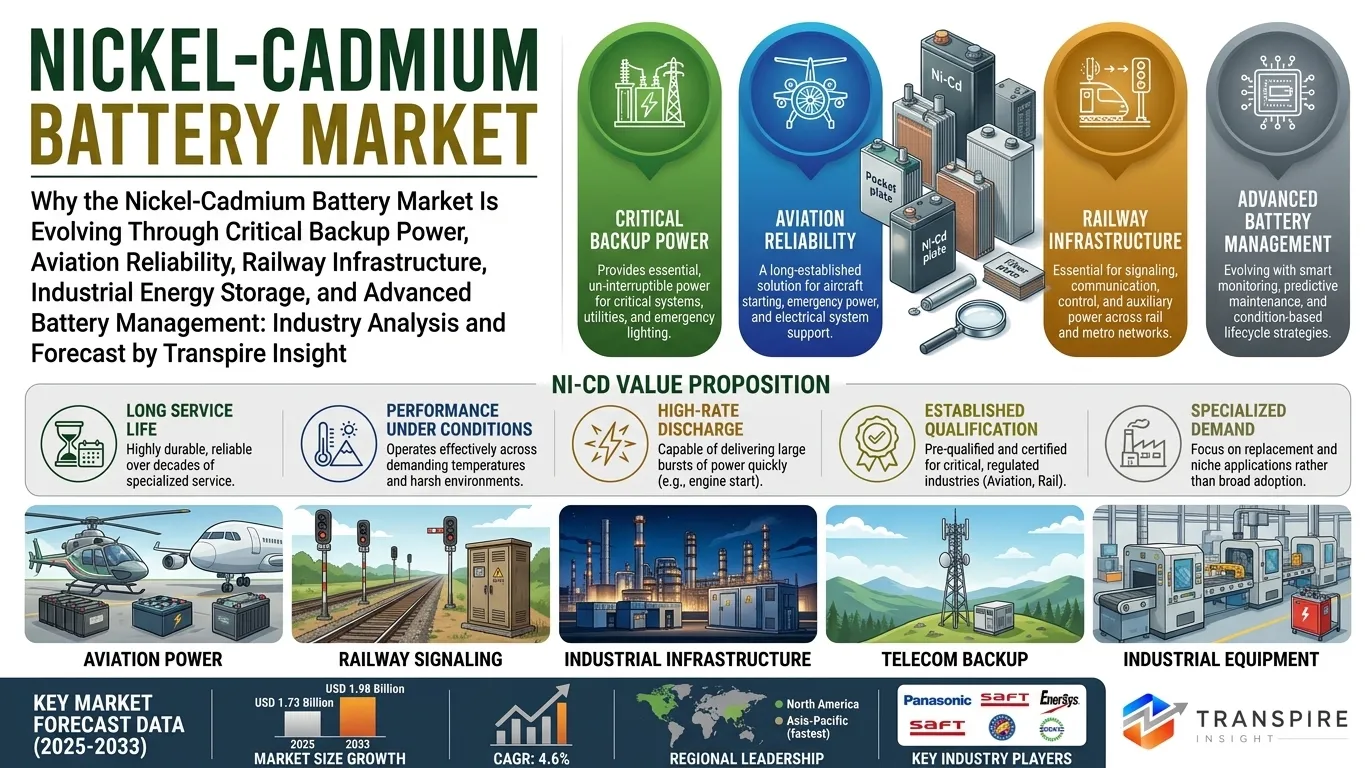
According to a research report published by Transpire Insight, the Global Nickel-Cadmium (Ni-Cd) Battery Market Size is projected to grow from USD 1.73 Billion in 2025 to approximately USD 1.98 Billion by 2033, at a CAGR of 4.6% during the forecast period 2026–2033.
The nickel-cadmium battery market is evolving as industries continue to prioritize dependable rechargeable power for applications where battery reliability, high-rate discharge capability, long service life, and performance under demanding operating conditions are essential. Ni-Cd batteries remain relevant across industrial equipment, aviation, railway systems, telecommunications, emergency power, military and defense, and other specialized applications where an interruption in backup power can create significant operational or safety consequences.
Unlike mainstream lithium-ion batteries, which have achieved extensive adoption across consumer electronics, electric vehicles, and modern energy-storage applications, nickel-cadmium batteries occupy a more specialized position. Their value is increasingly linked to established infrastructure, replacement demand, high reliability, and applications that require predictable performance under challenging conditions. Transpire Insight identifies industrial equipment, aviation, railway systems, telecommunications, emergency power systems, and military and defense among the major application categories in the market.
At the same time, the market is undergoing a significant technology transition. Lithium-ion batteries are increasingly being introduced into applications historically served by Ni-Cd systems, particularly where higher energy density, lower weight, and newer system architectures provide advantages. In April 2026, Saft highlighted this transition in aviation with a new 28V lithium-ion aircraft battery, explicitly describing the shift from traditional nickel-cadmium and lead-acid technologies toward lithium-ion for embedded systems.
This combination of continued specialized demand and technological substitution is shaping the next phase of the nickel-cadmium battery industry.
Latest Market Statistics and Growth Outlook
The global nickel-cadmium battery market is developing within the wider rechargeable battery industry while maintaining a concentrated role in specialized industrial and infrastructure applications. According to Transpire Insight, the market was valued at USD 1.73 billion in 2025 and is projected to reach approximately USD 1.98 billion by 2033, representing a CAGR of 4.6% from 2026 to 2033. North America is expected to dominate the market, while Asia-Pacific is projected to record the fastest growth during the forecast period.
The market is segmented by battery type into pocket plate Ni-Cd batteries, sintered plate Ni-Cd batteries, fiber plate Ni-Cd batteries, and others. Applications include consumer electronics, industrial equipment, aviation, railway systems, telecommunications, emergency power systems, military and defense, and other specialized uses. End users are categorized into industrial, commercial, residential, and government segments.
North America remains strategically important because of its established aviation, defense, utility, telecommunications, railway, and industrial infrastructure. Transpire Insight reports that U.S. Ni-Cd battery exports were approximately USD 154.61 million in 2024, representing about 2.15 million pieces, highlighting the region's continuing role in international battery trade.
Asia-Pacific is expected to expand at the fastest rate, supported by industrial infrastructure, transportation development, telecommunications, and demand for dependable backup power. However, the region is also experiencing strong substitution pressure from lithium-ion and other chemistries, making the future growth of Ni-Cd increasingly dependent on specialized applications rather than broad battery adoption.
Download the exclusive Nickel Cadmium Battery Market sample report today to uncover expert insights, emerging trends, and the opportunities defining the future of the industry.
Growth Drivers
One of the strongest drivers for the nickel-cadmium battery market is the continuing requirement for dependable backup power in critical infrastructure. Industrial plants, utilities, substations, transportation networks, telecommunications installations, and emergency systems require batteries capable of supplying power when the primary electrical system becomes unavailable.
Ni-Cd batteries have historically been valued in these applications for their durability, high-rate discharge capability, and ability to operate across demanding environmental conditions. Their established use in industrial infrastructure also creates replacement opportunities as existing battery installations reach the end of their service lives.
Aviation is another important driver. Aircraft require highly dependable battery systems for starting, emergency power, and electrical-system support. The established use of Ni-Cd technology in aviation creates an installed base that requires maintenance, testing, replacement, and technical support.
Railway infrastructure represents another specialized opportunity. Signaling, communications, emergency lighting, control systems, and other railway functions depend on reliable auxiliary power. As rail and metro infrastructure expands, particularly in emerging economies, demand for dependable backup systems can increase.
Telecommunications infrastructure also supports demand. Network operators require backup power to maintain connectivity during electrical outages, especially at locations where grid reliability is limited or where uninterrupted communication is critical.
Applications Across Energy, Transportation, and Industry
The applications of nickel-cadmium batteries extend across a broad range of mission-critical systems. In aviation, Ni-Cd batteries have long been associated with aircraft electrical systems because of their ability to deliver high-rate power and operate within demanding conditions.
Railway systems represent another important application. Batteries can provide auxiliary power for signaling, communications, emergency lighting, control equipment, and other systems that must remain functional during interruptions in primary power.
Industrial equipment represents a major application category. Ni-Cd batteries can be incorporated into power plants, substations, oil and gas facilities, manufacturing plants, emergency systems, control systems, and other infrastructure requiring dependable standby power.
Telecommunications operators can also use rechargeable battery systems to maintain network availability during grid interruptions. The requirement is particularly important for remote and distributed network infrastructure.
Military and defense applications provide another specialized demand center. Defense systems can operate in harsh environments and require dependable power under conditions where conventional battery performance may be challenged.
Government Initiatives and Battery Safety
Government policies related to critical infrastructure modernization, railway development, aviation safety, telecommunications reliability, defense modernization, and industrial resilience can indirectly support demand for dependable battery systems.
However, the nickel-cadmium industry operates within a complex environmental and regulatory environment because cadmium is a hazardous substance. Regulations governing cadmium-containing batteries have restricted Ni-Cd use in several applications, particularly consumer-oriented portable products, while specialized industrial applications remain important.
Battery lifecycle management is therefore becoming increasingly significant. Manufacturers, distributors, and users must address appropriate collection, transportation, recycling, storage, and end-of-life treatment.
The European Union's battery regulatory framework is also increasing the emphasis on lifecycle information and digital traceability. The EU's Digital Product Passport framework includes batteries, with battery passport requirements scheduled for relevant categories under the implementation timetable beginning in February 2027.
These developments are encouraging battery manufacturers and industrial users to place greater emphasis on documentation, traceability, responsible recycling, and lifecycle management.
Technology Overview
Technology development within the nickel-cadmium battery market is increasingly focused on improving reliability, monitoring, maintenance, and lifecycle performance rather than simply increasing energy density.
Pocket plate, sintered plate, fiber plate, and other battery configurations provide different performance characteristics for specialized applications. Manufacturers can engineer battery systems according to required voltage, capacity, discharge rate, operating temperature, installation environment, and service-life requirements.
Battery monitoring is becoming increasingly important. Digital systems can monitor voltage, temperature, current, charging behavior, and cell-level performance. This information can help operators identify abnormal conditions and schedule maintenance before a battery failure occurs.
Remote monitoring is particularly useful for distributed infrastructure such as telecommunications networks, railway systems, substations, and remote industrial installations.
The competitive technology environment is also changing. On April 2, 2026, Saft published an aviation technology update describing the transition from traditional Ni-Cd and lead-acid batteries toward lithium-ion systems and announced a new 28V lithium-ion aircraft battery. This development demonstrates that Ni-Cd suppliers are operating within an increasingly competitive technology environment.
Future Importance of the Nickel-Cadmium Battery Market
The future of the nickel-cadmium battery market will increasingly depend on applications where reliability, durability, high-rate discharge, established qualification, and performance under demanding conditions remain critical.
The market is therefore unlikely to expand uniformly across every battery application. Instead, its strongest opportunities are expected to remain concentrated in industrial equipment, aviation, railway systems, telecommunications, emergency power, utilities, defense, and replacement applications.
The next stage of market development is likely to involve advanced monitoring, predictive maintenance, improved battery testing, recycling systems, digital traceability, and application-specific engineering.
Ultimately, the nickel-cadmium battery market represents a specialized segment of the global rechargeable battery ecosystem. Its continued relevance will depend on how effectively manufacturers address environmental requirements while maintaining the technical advantages that have supported Ni-Cd adoption in critical infrastructure.
Rising Demand for Reliable Backup Power
The nickel-cadmium battery market is benefiting from the increasing importance of power continuity across industrial and infrastructure systems.
Modern utilities, manufacturing facilities, transportation systems, telecommunications networks, hospitals, airports, and industrial plants depend on electricity for control systems, communications, safety equipment, monitoring systems, and emergency functions.
When the primary power supply fails, backup batteries can maintain essential systems until another power source becomes available. In these environments, reliability can be more important than maximizing energy density.
Ni-Cd batteries can therefore retain relevance where operators value established technology, predictable performance, and long operating life.
Aviation and Railway Applications Create Specialized Opportunities
Aviation remains an important application because aircraft electrical systems require highly dependable battery performance.
However, aviation also demonstrates the competitive pressure facing Ni-Cd technology. Saft's April 2026 announcement of a new 28V lithium-ion aircraft battery shows that lithium-ion technology is increasingly being developed for embedded aviation applications historically associated with conventional battery chemistries.
This creates both a challenge and an opportunity. Ni-Cd manufacturers must continue improving lifecycle performance, maintenance practices, monitoring, and application support while serving aircraft platforms where existing Ni-Cd systems remain qualified.
Railway systems offer another specialized opportunity. Battery systems can support signaling, communication, emergency lighting, and control equipment. Expansion of rail networks and metro systems in developing economies can create new demand, while established networks generate replacement opportunities.
Replacement Demand Is Creating New Market Opportunities
Replacement demand represents one of the most important commercial opportunities for Ni-Cd battery suppliers.
Industrial battery systems can remain in operation for extended periods, but they eventually require replacement because of aging, capacity deterioration, changes in operating requirements, or scheduled asset-management programs.
Utilities, airports, railway operators, telecommunications companies, industrial facilities, and other infrastructure owners may therefore require replacement battery banks even when the overall application category is not expanding rapidly.
This creates recurring demand for manufacturers and service providers that can supply compatible systems, engineering support, installation services, battery testing, maintenance, and recycling.
The replacement market can also favor established technologies because customers may prefer to minimize redesign, qualification, integration, and operational risk.
Industrial and Utility Infrastructure Drives Demand
Industrial and utility infrastructure remains a core demand center for nickel-cadmium batteries.
Power plants and substations require backup systems for control equipment, switchgear, protection systems, communications, and emergency operations.
Oil and gas facilities represent another specialized application because battery systems may operate in remote locations and demanding environmental conditions.
Industrial plants similarly require reliable standby power for control systems, safety equipment, emergency lighting, and other critical functions.
As infrastructure operators modernize their facilities, opportunities can emerge not only for new battery installations but also for replacement systems, battery monitoring, testing, maintenance, and lifecycle services.
North America Remains a Key Market
North America is expected to remain the leading regional market for nickel-cadmium batteries during the forecast period, according to Transpire Insight.
The region benefits from established aviation, defense, industrial, telecommunications, railway, and utility infrastructure.
The United States is particularly important because of its extensive aviation network, defense applications, industrial facilities, and critical infrastructure. Transpire Insight reports approximately USD 154.61 million in U.S. Ni-Cd battery exports in 2024, indicating continuing participation in international trade.
Replacement demand is likely to remain an important component of the regional market as industrial operators maintain existing backup-power installations.
At the same time, North American buyers increasingly evaluate battery systems according to lifecycle economics, environmental compliance, maintenance requirements, and integration with digital monitoring technologies.
Proceed to Checkout to purchase the exclusive Nickel Cadmium Battery Market report and gain instant access to in-depth market intelligence, strategic analysis, and future growth opportunities.
Asia-Pacific Is Expanding at the Fastest Rate
Asia-Pacific is projected to be the fastest-growing regional market for nickel-cadmium batteries during the forecast period, according to Transpire Insight.
The region's industrialization, transportation infrastructure, telecommunications networks, and utility development provide opportunities for specialized battery systems.
China, Japan, India, and South Korea are particularly important because of their large industrial bases and extensive infrastructure.
Railway and metro development can create opportunities for batteries used in signaling, communications, emergency systems, and auxiliary power.
However, the regional outlook is not uniformly positive for Ni-Cd technology. Asia-Pacific is also one of the world's major centers for lithium-ion battery manufacturing, creating strong competitive pressure from newer battery technologies. This means future Ni-Cd demand is likely to concentrate on applications where its technical characteristics continue to provide a meaningful advantage.
Sustainable Battery Management Creates Opportunities
Sustainability is becoming increasingly important within the nickel-cadmium battery market because of the environmental risks associated with cadmium.
Responsible collection and recycling are therefore essential components of the industry's lifecycle.
Battery manufacturers and users can improve environmental performance through controlled collection systems, specialized recycling, material recovery, traceability, and responsible end-of-life management.
Long operating life can also contribute to lifecycle efficiency by reducing the frequency with which industrial battery systems must be replaced.
However, the sustainability performance of Ni-Cd batteries must be evaluated across their complete lifecycle, including raw-material sourcing, manufacturing, transportation, operation, maintenance, collection, and recycling.
Digitalization and Smart Battery Management
Digitalization is creating new possibilities for industrial Ni-Cd battery management.
Modern monitoring platforms can collect data on voltage, temperature, current, charging behavior, and cell performance.
For large battery banks, cell-level monitoring can help maintenance teams identify weak cells and abnormal operating conditions.
Remote monitoring can be especially useful for geographically distributed assets such as telecommunications sites, railway infrastructure, utility substations, and remote industrial facilities.
Predictive analytics could eventually allow operators to identify degradation patterns and estimate remaining useful life. This could help transition maintenance programs from fixed schedules toward condition-based strategies.
For smaller operators, however, adoption will depend on system cost, cybersecurity, technical expertise, data availability, and integration with existing infrastructure.
Telecommunications Infrastructure Expands Market Reach
Telecommunications networks require dependable backup power because service interruptions can affect businesses, emergency communications, transportation, and consumers.
Battery systems provide an important layer of resilience for network infrastructure during power interruptions.
Ni-Cd batteries can remain relevant in specific telecom installations where temperature tolerance, durability, long service life, and established infrastructure are important.
The expansion of communication networks in developing regions can create additional opportunities, particularly for remote infrastructure.
However, lithium-ion batteries are increasingly competing in telecom backup applications. Ni-Cd suppliers therefore need to emphasize reliability, lifecycle performance, maintenance support, environmental resilience, and total cost of ownership.
Emergency Power and Safety Systems Support Demand
Emergency lighting, alarms, fire-safety equipment, airports, tunnels, hospitals, industrial buildings, and public infrastructure require dependable backup power.
Battery failure in these systems can create operational and safety consequences, making reliability an important purchasing criterion.
Ni-Cd technology can therefore retain a role in selected emergency and safety applications where established battery infrastructure and operational requirements support continued use.
The expansion of transportation hubs, industrial facilities, healthcare infrastructure, and commercial buildings can create opportunities for specialized emergency battery systems.
Digital Distribution and Technical Services Influence Market Access
The nickel-cadmium battery industry is primarily business-to-business, but digital channels are becoming more useful for replacement products, technical documentation, maintenance services, and specialized battery components.
Manufacturers can use online platforms to provide battery specifications, compatibility information, installation instructions, testing procedures, maintenance guidance, and technical support.
For complex industrial systems, however, direct engineering consultation remains important because battery sizing and installation requirements depend on application-specific operating conditions.
Digital services can therefore complement rather than completely replace traditional industrial sales channels.
Major Challenges Facing the Market
Despite its established advantages, the nickel-cadmium battery market faces several structural challenges.
The strongest challenge is competition from lithium-ion technology. Lithium-ion batteries generally provide higher energy density and lower weight, while their rapidly expanding manufacturing ecosystem supports continuous innovation and cost optimization.
The aviation sector illustrates this transition. Saft's April 2026 announcement of a new 28V lithium-ion aircraft battery demonstrates that lithium-ion is increasingly being engineered for embedded systems that have historically used Ni-Cd technology.
Environmental regulation is another major challenge. Cadmium's hazardous properties require strict management and have contributed to restrictions on Ni-Cd use in several applications.
The industry must also maintain specialized recycling infrastructure, which can increase lifecycle complexity.
Another challenge is changing customer expectations. Industrial customers increasingly want remote monitoring, predictive maintenance, digital documentation, sustainability reporting, and transparent lifecycle information.
Future Opportunities for Battery Producers and Industrial Companies
The market offers opportunities for manufacturers that combine established Ni-Cd performance with modern digital and lifecycle-management capabilities.
Battery producers can develop improved industrial systems with enhanced monitoring compatibility, optimized maintenance requirements, and application-specific configurations.
Service providers can expand into battery testing, capacity assessment, replacement planning, predictive maintenance, remote monitoring, and recycling coordination.
Aviation and railway markets offer additional opportunities because certification, installed-base requirements, and replacement cycles can create long-term customer relationships.
Industrial customers can also increasingly evaluate battery systems through total cost of ownership, including installation, maintenance, replacement frequency, downtime risk, and end-of-life management.
Competitive Landscape and Industry Development
Competition in the nickel-cadmium battery market includes global battery manufacturers, industrial battery specialists, aviation suppliers, railway battery manufacturers, regional producers, distributors, and lifecycle-service providers.
Transpire Insight identifies companies including Panasonic Corporation, Saft Groupe S.A., EnerSys, GS Yuasa Corporation, VARTA AG, AEG Power Solutions, HBL Power Systems Limited, Alcad Ltd., Nilar International AB, and Exide Technologies among the companies covered in its market analysis.
Large manufacturers can benefit from engineering capabilities, global distribution, industrial relationships, certification expertise, and broad product portfolios.
Specialized suppliers can compete through customized battery configurations, application engineering, maintenance services, replacement support, and technical expertise.
The competitive landscape is also increasingly shaped by technology substitution. Companies operating in the Ni-Cd segment must demonstrate why the chemistry remains suitable for specific applications while continuing to develop monitoring, maintenance, recycling, and lifecycle services.
Outlook
The nickel-cadmium battery market is moving toward a more specialized role within the global rechargeable battery industry.
Industrial backup power, aviation, railway systems, telecommunications, emergency power, utilities, defense, and replacement applications are expected to remain important demand centers.
The market's future will be influenced by two opposing forces: continued demand for reliable specialized battery systems and accelerating substitution by lithium-ion and other technologies.
This makes application-specific performance increasingly important. Ni-Cd suppliers that focus on reliability, lifecycle value, harsh-environment operation, technical support, and responsible recycling can strengthen their position in specialized markets.
Innovation Is Reshaping the Nickel-Cadmium Battery Market
Innovation is becoming increasingly important as Ni-Cd manufacturers respond to competition from newer battery chemistries.
Research and development is increasingly focused on cell construction, electrode design, monitoring systems, charging methods, maintenance optimization, and lifecycle management.
Rather than attempting to compete with lithium-ion on energy density, Ni-Cd technology can create value by improving characteristics such as operational reliability, durability, discharge performance, and service life.
The development of digital battery monitoring can further increase the value of existing Ni-Cd installations by providing operators with greater visibility into battery health.
At the same time, the introduction of lithium-ion alternatives in aviation and other specialized applications demonstrates why continuous technology development is essential for the Ni-Cd industry.
Battery Monitoring Technology Creates Product Differentiation
Battery monitoring is becoming an increasingly important area of differentiation.
Large industrial battery banks may contain numerous individual cells, making manual inspection labor-intensive.
Digital monitoring systems can measure voltage, temperature, current, charging conditions, and other operating parameters.
This information can help maintenance teams identify weak cells before they compromise the performance of the complete battery system.
Remote monitoring can also reduce the need for frequent physical inspections at geographically distributed sites.
Predictive maintenance represents a further opportunity. By analyzing historical performance and operating data, operators may be able to identify degradation trends and schedule interventions before failures occur.
Recycling Technology Supports Market Sustainability
Recycling represents a critical component of the long-term nickel-cadmium battery value chain.
Because cadmium requires controlled handling, specialized recycling systems are essential for responsible end-of-life management.
Collection, transportation, processing, material recovery, and documentation must be coordinated to minimize environmental risks.
Improved recycling systems can also help recover useful materials and support circular-economy objectives.
Digital traceability may become increasingly important as battery regulations place greater emphasis on lifecycle information.
For Ni-Cd manufacturers, strong recycling partnerships and transparent end-of-life programs can therefore become important elements of competitive differentiation.
Customize the exclusive Nickel Cadmium Battery Market report today to receive tailored insights, country-specific analysis, and business-focused market intelligence.
Regional Opportunities
North America is expected to remain the leading regional market because of its mature aviation, defense, industrial, telecommunications, railway, and utility infrastructure. Replacement demand and critical backup-power applications are expected to remain important.
Europe provides opportunities across aviation, railways, industrial backup power, emergency systems, and specialized infrastructure. However, environmental regulation and cadmium-related requirements make regulatory compliance and recycling particularly important.
Asia-Pacific is projected to be the fastest-growing region, supported by industrialization, transportation development, telecommunications infrastructure, and investment in critical systems.
Latin America offers opportunities through telecommunications, utilities, transportation, industrial facilities, and infrastructure modernization.
The Middle East and Africa can provide specialized opportunities in oil and gas, utilities, telecommunications, transportation infrastructure, and remote industrial installations where dependable power systems are important.
India Offers Attractive Growth Potential
India represents a developing opportunity for the nickel-cadmium battery market because of its expanding railway and metro infrastructure, telecommunications networks, industrial base, utilities, defense requirements, and critical infrastructure investment.
Railway modernization and metro development can create demand for auxiliary and backup power systems supporting signaling, communications, emergency lighting, and control equipment.
Industrial facilities and utilities also require dependable backup systems for substations, control equipment, emergency systems, and communications.
India's growing focus on domestic manufacturing and infrastructure modernization can create opportunities for battery production, distribution, engineering services, testing, maintenance, and recycling.
The development of organized battery recycling and lifecycle-management systems will become increasingly important as industrial battery installations expand.
Sustainability and Responsible Battery Production
Sustainability is expected to become a stronger consideration throughout the nickel-cadmium battery market.
Because cadmium is hazardous, manufacturers and users must maintain responsible processes for production, storage, transportation, collection, recycling, and disposal.
Long service life can contribute to lifecycle efficiency by reducing replacement frequency, but environmental performance must be assessed across the complete battery lifecycle.
Improved recycling, material recovery, digital traceability, and responsible supply-chain management can help reduce environmental risks.
Companies that combine technical performance with transparent environmental practices may gain stronger acceptance among industrial customers and regulators.
Consumer and Industrial Education Will Be Critical
Although the nickel-cadmium battery market is primarily industrial, technical education remains essential.
Users need appropriate information about charging, maintenance, ventilation, battery testing, storage, operating conditions, safety, and recycling.
Manufacturers can provide technical manuals, training programs, battery-sizing tools, maintenance services, monitoring platforms, and field-support programs.
Aviation provides a strong example of the importance of specialist knowledge. Saft continues to provide aviation Ni-Cd battery maintenance training, demonstrating that technical expertise remains an important component of the battery lifecycle.
As battery monitoring and predictive maintenance become more sophisticated, technical education will increasingly include digital diagnostics and data interpretation.
Product Diversification Will Strengthen Market Growth
The future nickel-cadmium battery market will not depend on a single configuration. Product diversification can allow manufacturers to address different industrial requirements.
Potential categories include:
These products can address different capacity requirements, discharge profiles, operating temperatures, installation environments, and lifecycle expectations.
Application-specific customization can also help Ni-Cd manufacturers compete more effectively against standardized battery solutions.
Competitive Strategies for Market Participants
Companies operating in the nickel-cadmium battery market can strengthen their competitive position through several strategies.
Reliability and quality consistency will remain fundamental because customers in aviation, railway, utilities, telecommunications, and industrial infrastructure require predictable battery performance.
Application engineering can provide another competitive advantage. Battery sizing, installation, testing, maintenance, replacement planning, and technical support can create value beyond the battery itself.
Digital monitoring is another major opportunity. Companies that integrate battery health monitoring, remote diagnostics, predictive maintenance, and digital reporting can provide customers with a more complete lifecycle solution.
Recycling and environmental compliance will also become increasingly important. Transparent collection and recycling programs can strengthen customer confidence and support regulatory compliance.
Partnerships between battery manufacturers, infrastructure operators, railway companies, aviation organizations, utilities, telecommunications companies, recycling companies, and technology providers can further strengthen market reach.
Challenges That Could Influence Future Growth
The nickel-cadmium battery market will continue to face strong competitive and regulatory pressures.
Lithium-ion substitution represents the largest technological challenge. New lithium-ion systems are increasingly being engineered for applications where Ni-Cd has traditionally been used, including specialized aviation systems.
Environmental requirements surrounding cadmium can also constrain market expansion and increase compliance costs.
The rapidly expanding lithium-ion manufacturing ecosystem provides another competitive disadvantage for Ni-Cd because newer battery technologies benefit from large-scale investment, extensive supply chains, and continuous innovation.
The decline of Ni-Cd use in several consumer applications has also narrowed the technology's addressable market.
Future growth will therefore depend on maintaining strong technical performance in specialized applications while improving recycling, monitoring, maintenance, and lifecycle services.
Future Outlook
The future of the nickel-cadmium battery market is closely connected to several major infrastructure trends, including industrial modernization, aviation reliability, railway expansion, telecommunications resilience, utility modernization, defense requirements, smart battery monitoring, and responsible battery management.
As critical infrastructure operators place greater emphasis on power continuity, Ni-Cd batteries can continue to serve applications where their established reliability and operating characteristics remain valuable.
However, technology substitution will remain a defining feature of the market. Manufacturers must therefore focus on applications where Ni-Cd provides measurable operational value rather than attempting to compete directly with lithium-ion in every battery category.
The strongest opportunities are likely to emerge from industrial replacement demand, aviation, railway systems, utilities, telecommunications, emergency power, and specialized defense applications.
Schedule a meeting with our market experts to discuss the exclusive Nickel Cadmium Battery Market report and identify the best research solution for your organization.
Conclusion
The nickel-cadmium battery market is evolving through the convergence of critical infrastructure requirements, aviation reliability, railway modernization, industrial backup power, telecommunications resilience, digital battery monitoring, and responsible battery management.
The technology faces substantial competition from lithium-ion and other rechargeable chemistries, but Ni-Cd batteries continue to occupy specialized applications where reliability, high-rate discharge capability, durability, established qualification, and performance under demanding operating conditions remain important.
Future market development will depend on the ability of manufacturers and service providers to improve monitoring, strengthen recycling systems, support regulatory compliance, optimize maintenance, and develop application-specific solutions.
The market's strongest potential is therefore likely to come from specialized infrastructure and replacement applications rather than broad consumer adoption.
With continued innovation in battery construction, monitoring, maintenance, recycling, digital traceability, and industrial engineering, the nickel-cadmium battery market can maintain a strategically important position within the global rechargeable battery ecosystem through 2033.


Send us a brief description of your challenge and we'll get back to you within 24 hours.

 inquiry@transpireinsight.com
 APAC:+91 7666513636
 Address


