
Aug 18, 2026
By Transpire Insight
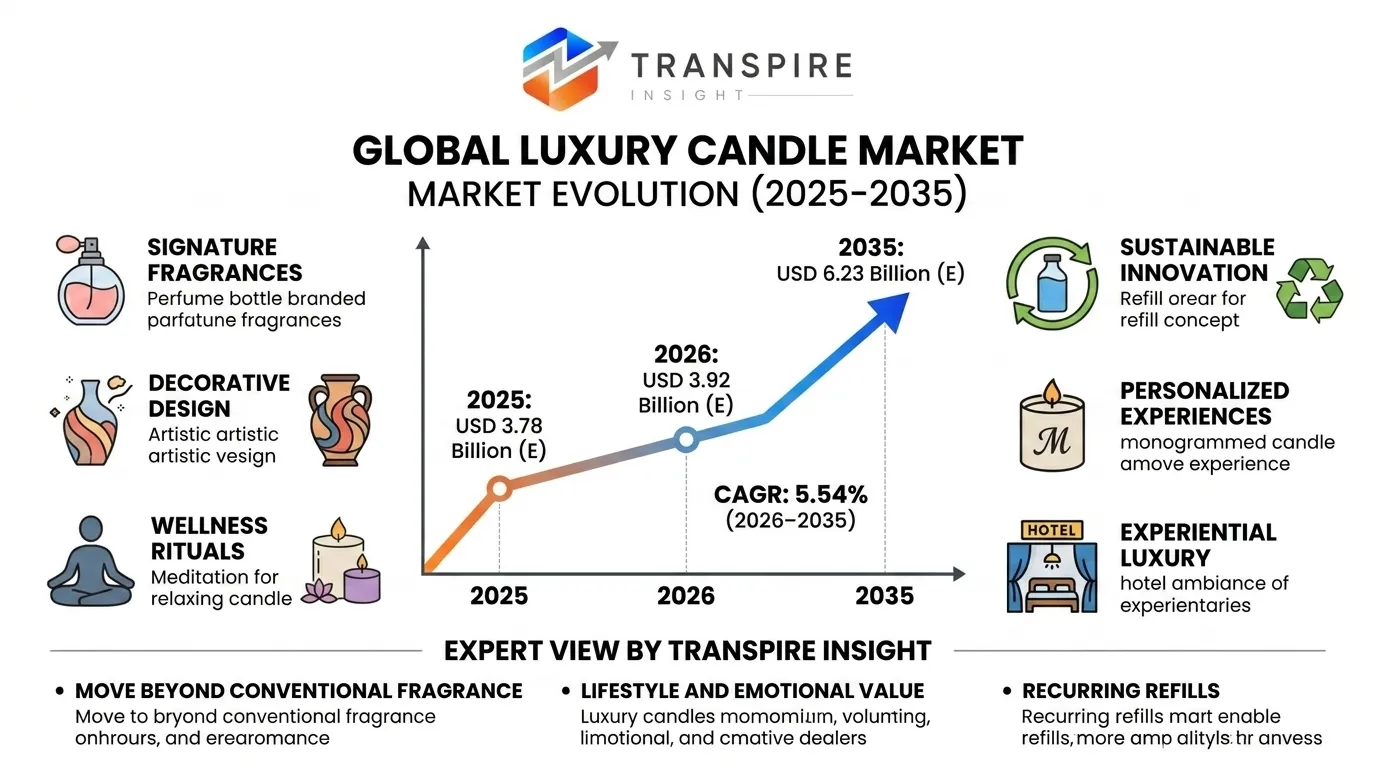
According to Transpire Insight, the global luxury candle market is estimated at approximately USD 3.78 billion in 2025 and is expected to reach around USD 3.92 billion in 2026. The market is projected to reach approximately USD 6.23 billion by 2035, expanding at an estimated CAGR of 5.54% during the forecast period 2026–2035.
The luxury candle market is moving beyond conventional home fragrance as consumers increasingly seek products that combine scent, design, craftsmanship, atmosphere, and personal expression. Premium candles are becoming part of broader lifestyle spending, where the value of a product is determined not only by its fragrance but also by the emotional experience, visual identity, packaging, vessel design, and brand story surrounding it.
This transition is changing the way candles are positioned in the premium consumer market. A luxury candle can function as a fragrance product, a decorative accessory, a gifting item, a wellness product, and an element of interior styling at the same time. This wider role is allowing brands to compete on experience rather than relying only on scent intensity or burn performance.
The market is also being influenced by premiumization. Consumers who are increasingly spending on beauty, wellness, home décor, and lifestyle products are showing greater willingness to purchase higher-value home-fragrance products that offer distinctive materials, sophisticated fragrance profiles, and stronger design appeal.
Sustainability is another factor changing product development. Luxury consumers are becoming more attentive to packaging waste, material sourcing, vessel reuse, refill concepts, ingredient transparency, and product longevity. This is encouraging manufacturers to reconsider not only how candles are made but also how the product is used and what remains after the candle has finished burning.
Market Overview
Luxury candles are premium home-fragrance products designed around enhanced fragrance quality, refined presentation, distinctive materials, craftsmanship, brand identity, and elevated consumer experience.
The category differs from conventional candles because the product is often purchased for several reasons simultaneously. Consumers may select a luxury candle because they like its fragrance, want to create a particular atmosphere, appreciate its vessel as an interior object, or want a recognizable premium gift.
One of the most important applications is premium home ambiance. Consumers increasingly use fragrance products to influence the atmosphere of living rooms, bedrooms, bathrooms, dining areas, personal offices, and other spaces.
The market is also benefiting from wellness and self-care routines. Candle lighting is increasingly associated with relaxation, evening rituals, reading, bathing, meditation, quiet time, and mood creation. This is expanding the category's relevance beyond decorative use.
Luxury gifting is another major opportunity. Premium candles can provide an accessible form of luxury compared with higher-cost categories such as jewelry, fashion, or fine accessories. Their relatively broad price range allows brands to target different levels of premium consumers.
The hospitality sector is also becoming increasingly relevant. Hotels, resorts, spas, restaurants, and private clubs can use scent and candle presentation to reinforce atmosphere and brand identity while also creating opportunities for branded retail products.
The candle vessel itself is becoming an important part of the value proposition. Glass, ceramic, porcelain, stone, and metal containers can be designed to remain useful or decorative after the fragrance has been consumed, strengthening the perception of long-term value.
Latest Market Statistics
The global luxury candle market is expected to maintain a positive growth trajectory as consumers continue to allocate spending toward premium home experiences, fragrance, wellness, gifting, and interior aesthetics.
Market expansion is being supported by several structural trends, including higher demand for premium home décor, increasing interest in self-care rituals, growth in luxury gifting, expansion of premium retail, and the increasing use of fragrance to shape residential and hospitality environments.
Importantly, market growth is being influenced by value per purchase as much as by unit volume. More complex fragrance formulations, larger vessels, premium packaging, limited collections, designer collaborations, and personalized gifting can increase the average value of individual transactions.
The market is therefore becoming increasingly segmented between everyday home fragrance and premium experiential products.
Another noticeable shift is the increasing demand for signature fragrances. Consumers are becoming more familiar with fragrance families and increasingly seek distinctive combinations rather than conventional single-note profiles.
This development gives luxury brands opportunities to build recognizable olfactory identities that can extend across candles, diffusers, room sprays, perfumes, bath products, and other fragrance categories.
Download the exclusive Luxury Candle Market sample report today to uncover expert insights, emerging trends, and the opportunities defining the future of the industry.
Major Growth Drivers
Premiumization of home fragrance: Consumers are increasingly willing to spend more on products that provide distinctive fragrances, refined design, premium packaging, and a stronger sensory experience.
Growth of wellness and self-care: Candles are increasingly integrated into relaxation, personal-care, mindfulness, evening, and home-based wellness routines.
Expansion of luxury gifting: Premium candles are becoming important for holidays, celebrations, weddings, corporate gifting, hospitality, and personal occasions.
Increasing importance of interior design: Decorative vessels and premium packaging allow luxury candles to function as interior accessories in addition to fragrance products.
Growing interest in signature scents: Consumers are increasingly attracted to distinctive fragrance combinations that communicate personality, mood, seasonality, or brand identity.
Expansion of premium urban consumption: Rising spending on lifestyle products in major cities is creating favorable conditions for high-end home-fragrance categories.
Key Applications
Home Décor represents a major application area. Luxury candles can enhance room atmosphere while contributing to the visual styling of residential interiors.
Wellness and Self-Care is becoming increasingly important as consumers integrate fragrance into evening routines, relaxation, meditation, bathing, and personal rituals.
Luxury Gifting remains a significant use case because candles can combine recognizable branding, attractive packaging, fragrance, and premium presentation within a relatively accessible luxury format.
Hospitality offers opportunities in hotels, resorts, restaurants, spas, and private clubs where scent can be part of the overall guest experience.
Events and Celebrations represent an additional application, particularly for weddings, private gatherings, luxury dinners, corporate functions, and premium event styling.
Retail and Brand Experience is another emerging application as luxury brands increasingly use fragrance to create immersive physical environments and memorable customer interactions.
Government Initiatives and Consumer Product Modernization
Product safety, chemical management, labeling, packaging, and consumer information are increasingly important considerations within the broader fragrance and home-product industry.
Luxury candle manufacturers must manage multiple aspects of product quality, including fragrance formulation, wax composition, wick selection, vessel compatibility, burn behavior, labeling, packaging, and consumer-use instructions.
The growing emphasis on sustainability is also encouraging manufacturers to consider material efficiency, packaging reduction, vessel reuse, refillability, and longer product lifecycles.
In India and other emerging markets, organized retail, premium malls, e-commerce growth, hospitality development, urban lifestyle consumption, and expanding premium consumer segments are supporting greater awareness of luxury home-fragrance products.
As premium consumer markets become more sophisticated, buyers are increasingly evaluating products on a broader set of criteria that includes quality, safety, sustainability, design, and brand authenticity.
Technology and Product Innovation Overview
The luxury candle market combines fragrance craftsmanship with increasingly advanced manufacturing and product-design techniques.
Wax formulation is a major area of development. Manufacturers can use different wax systems and blends to influence burn duration, fragrance release, surface appearance, vessel compatibility, and overall performance.
Wick engineering is equally important. Wick selection and positioning can affect flame behavior, melt-pool development, scent distribution, and burn consistency.
Fragrance formulation has become a key source of differentiation. Premium candle fragrances can use multiple layers of scent to create a more complex experience as the candle burns.
Precision manufacturing is helping improve consistency in filling, cooling, curing, wick positioning, and quality control.
Decorative vessel manufacturing is also becoming more sophisticated, allowing brands to use premium glass, ceramics, metals, stone-inspired finishes, textures, embossing, engraving, and specialty coatings.
The combination of these technologies allows luxury candles to serve simultaneously as fragrance products, lifestyle products, and decorative objects.
Future Importance
The future of the luxury candle market will be closely connected to experiential luxury, personalization, wellness, premium craftsmanship, sustainability, and interior aesthetics.
Consumers increasingly seek products that offer emotional value in addition to practical functionality. Luxury candles are well positioned to benefit because fragrance, visual design, packaging, and ritual can all contribute to the perceived experience.
This will encourage brands to develop products around specific themes, moods, occasions, rooms, seasons, and lifestyle preferences.
The market is also likely to become more focused on product longevity. Reusable vessels and refill concepts can potentially change the traditional single-use consumption model while creating repeat purchase opportunities.
The next stage of competition is therefore likely to focus on the complete experience around a candle rather than the candle itself.
Top Market Trends
The luxury candle market is evolving rapidly as consumers demand greater fragrance differentiation, design value, and personalization.
Proceed to Checkout to purchase the exclusive Luxury Candle Market report and gain instant access to in-depth market intelligence, strategic analysis, and future growth opportunities.
Technological Advancements
Technology is becoming increasingly important in luxury candle production without eliminating the role of craftsmanship.
Advanced fragrance formulation is helping perfumers create more complex and differentiated scent structures.
Wax optimization can improve fragrance diffusion, surface quality, burn behavior, and product stability.
Digital quality-control systems can support consistency across premium production batches by monitoring fill levels, cooling conditions, wick placement, and product appearance.
Advanced packaging technologies are enabling luxury brands to create more distinctive presentations through specialty printing, embossing, rigid structures, reusable formats, and high-end finishing.
Another emerging development is refill-oriented product architecture, in which the vessel is intentionally designed for continued use rather than disposal after a single candle cycle.
Artificial Intelligence and Personalized Fragrance Experiences
Artificial intelligence could become increasingly relevant to luxury candles through consumer personalization and digital fragrance discovery.
AI-powered recommendation systems can potentially use purchasing behavior, fragrance preferences, product reviews, lifestyle information, and seasonal trends to suggest suitable products.
A consumer who prefers woody and amber fragrances, for example, could receive recommendations based on those preferences rather than being shown an undifferentiated product catalog.
AI can also support brands in analyzing customer feedback and identifying emerging fragrance themes or changing purchase behaviors.
In the future, digital fragrance discovery could combine preferred scent families with room type, occasion, time of day, desired mood, and previous purchases.
However, creative direction and perfumery expertise will remain central because premium fragrance is strongly influenced by artistic composition, cultural context, storytelling, and human sensory judgment.
Major Applications
Home Décor: Luxury candles provide fragrance while adding decorative value to residential spaces.
Wellness and Self-Care: Candles support relaxation, evening rituals, bathing, meditation, and mood-oriented experiences.
Luxury Gifting: Premium candles are increasingly used for holidays, weddings, corporate gifting, celebrations, and personal occasions.
Hospitality: Hotels, resorts, restaurants, spas, and clubs can use fragrance to develop distinctive guest experiences.
Events and Celebrations: Candles can contribute to event styling, table settings, ambient lighting, guest gifts, and atmosphere.
Premium Retail: Luxury retailers can use fragrance and candle collections to strengthen immersive brand experiences.
Investment and Growth Opportunities
The expansion of premium home fragrance is creating opportunities for candle manufacturers, fragrance developers, packaging companies, luxury retailers, hospitality groups, and specialty distributors.
One major opportunity is refillable luxury candles. This model can create repeat sales while extending the functional life of premium containers.
The luxury gifting segment also provides strong potential through customized labels, seasonal editions, limited collections, curated sets, and corporate programs.
Another opportunity exists in hospitality partnerships, where hotels, resorts, and spas can create branded fragrance products or exclusive candle collections.
The expansion of luxury consumption in Asia-Pacific and the Middle East is also creating new opportunities for premium brands seeking geographic diversification.
Market Segmentation
The luxury candle market can be segmented based on wax type, fragrance profile, vessel material, application, and distribution channel.
By wax type, the market includes paraffin-based formulations, vegetable-derived waxes, beeswax, coconut-based waxes, and proprietary blended formulations.
By fragrance profile, major categories include floral, woody, citrus, fruity, gourmand, amber, spicy, herbal, fresh, and blended or signature fragrances.
By vessel material, the market includes glass, ceramic, porcelain, metal, stone, and specialty decorative materials.
By application, major areas include home décor, wellness, gifting, hospitality, events, and premium retail.
By distribution channel, the market includes specialty stores, department stores, luxury retailers, brand-owned stores, online channels, hospitality channels, and other premium outlets.
Leading and Fastest-Growing Segments
The premium scented candle segment is expected to remain a major contributor because fragrance continues to represent the central reason for purchase.
The decorative vessel segment is expected to grow as consumers increasingly see luxury candles as interior objects rather than temporary consumables.
The refillable candle segment represents an attractive future opportunity because it combines sustainability considerations with recurring purchases.
The gifting segment is also expected to remain highly relevant, particularly during holidays, weddings, celebrations, and corporate events.
The digital and e-commerce segment is likely to continue expanding as consumers become increasingly comfortable purchasing premium fragrances online.
Competitive Landscape
Competition in the luxury candle market is increasingly centered on fragrance originality, product design, brand identity, craftsmanship, packaging, exclusivity, and consumer experience.
Luxury candle companies are competing with specialized fragrance brands as well as premium beauty, interior, lifestyle, and hospitality businesses.
Fragrance differentiation remains one of the strongest competitive factors. Signature scent families, limited collections, seasonal releases, collaborations, and artistic storytelling can help brands establish distinct identities.
The physical appearance of the candle is also becoming increasingly important. A premium vessel can remain useful as a decorative object after the candle has been consumed, increasing perceived value.
Brands are also expected to compete through personalization, refill systems, direct-to-consumer channels, selective distribution, immersive retail, and hospitality collaborations.
Customize the exclusive Luxury Candle Market report today to receive tailored insights, country-specific analysis, and business-focused market intelligence.
Challenges and Restraints
Despite strong opportunities, the luxury candle market faces several challenges.
Premium pricing can limit access to a narrower consumer segment because sophisticated fragrance ingredients, decorative vessels, packaging, and craftsmanship increase product costs.
Raw-material costs can affect profitability because wax, fragrance materials, glass, ceramics, packaging components, and transportation represent important cost elements.
Safety considerations remain essential because candles involve controlled combustion and require appropriate product design, labeling, testing, and consumer-use guidance.
Sustainability expectations are also increasing. Luxury brands must balance premium packaging aesthetics with consumer demand for lower waste, reusable materials, and longer product lifecycles.
Market saturation is another challenge. The expanding number of premium candle brands makes differentiation more difficult and increases the importance of distinctive fragrance identity and strong brand storytelling.
Nevertheless, premiumization, wellness consumption, gifting, and interior-design trends continue to create attractive opportunities.
Regional Market Outlook
The luxury candle market is expanding across major regions as premium fragrance consumption, wellness spending, interior aesthetics, and lifestyle retail develop.
North America remains an important market because of its established premium home-fragrance culture, e-commerce infrastructure, gifting demand, and strong spending on wellness and lifestyle products.
Europe represents a highly developed market supported by luxury fragrance traditions, premium craftsmanship, interior design, hospitality, and established luxury-brand ecosystems.
Asia-Pacific represents a major long-term growth opportunity. Expanding affluent and upper-middle-income consumer groups, luxury retail development, hospitality investment, gifting culture, and increasing interest in premium home aesthetics are supporting market opportunities.
Latin America offers additional potential through luxury retail growth, premium gifting, hospitality, and increasing adoption of high-end lifestyle products.
Middle East & Africa are also expected to see increased demand as luxury retail, hospitality, premium home décor, and fragrance-oriented consumption continue to develop.
Future Market Opportunities
One of the strongest future opportunities lies in refillable premium candle ecosystems. Consumers can retain decorative containers while purchasing replacement fragrance units, creating recurring demand and potentially reducing material waste.
The development of personalized fragrance discovery represents another opportunity. Digital recommendation tools can help consumers identify scents based on mood, room, occasion, and past preferences.
Hospitality fragrance partnerships also offer significant potential. Hotels, resorts, and spas can use private-label or co-branded candle products as part of wider sensory branding strategies.
Limited-edition collaborations represent another opportunity, especially partnerships involving designers, artists, fashion labels, perfumers, cultural institutions, and luxury hospitality brands.
These collaborations can increase exclusivity and encourage consumers to treat candles as collectible lifestyle products.
Role of Technology and Advanced Manufacturing
Technology is changing the production of luxury candles while preserving the importance of human craftsmanship.
Automated filling and temperature-control systems can improve manufacturing consistency, while digital inspection technologies can help monitor appearance and product quality.
Advanced vessel-production techniques can support complex shapes, textures, decorative finishes, and limited-edition designs.
Digital customization can also allow brands to provide personalized labels, gift messages, event-specific presentation, and small-batch designs without requiring completely manual production.
The future is therefore likely to involve a combination of artisanal fragrance creation and flexible digital manufacturing, enabling luxury brands to offer more differentiated products at scale.
Personalized and Precision Fragrance
Personalization is expected to become one of the most important future themes within the luxury candle market.
Consumers increasingly seek fragrance experiences that align with their individual preferences, moods, environments, and lifestyles.
Brands can respond by organizing collections around rooms, seasons, emotions, occasions, and specific fragrance families.
Personalized packaging can strengthen this proposition further. Names, monograms, messages, celebration dates, and customized presentation can make candles more meaningful as gifts.
As fragrance discovery becomes more digital, personalization could increasingly influence not only product selection but also the entire customer journey.
Key Strategic Developments
Companies operating in the luxury candle market are expected to focus on:
These strategies show that competition is moving beyond conventional scented candles toward a wider premium lifestyle and sensory-experience ecosystem.
Recent Industry Developments
The luxury candle industry is increasingly entering a phase where product development is being shaped by three simultaneous priorities: premium sensory performance, stronger design identity, and longer product lifecycles.
Brands are increasingly experimenting with collectible vessels, limited collections, layered scent profiles, personalization, and refill-oriented formats. These developments indicate that premium candle companies are seeking to increase both the perceived and functional value of the product beyond the initial burn cycle.
At the same time, fragrance formulation and product-safety considerations are becoming more important as consumers become more informed about ingredients, product usage, and quality expectations.
Digital commerce is also changing how consumers discover premium fragrances. Online storytelling, visual merchandising, customer reviews, personalized recommendations, and social media content are becoming important parts of luxury candle purchasing journeys.
Together, these developments suggest that the category is moving toward a more integrated model in which fragrance, design, technology, sustainability, and customer experience operate as interconnected parts of the product proposition.
Market Expert View
From a market perspective, the luxury candle market is positioned for continued transformation because it sits at the intersection of home fragrance, wellness, gifting, interior design, premium lifestyle consumption, and experiential luxury.
Consumers are increasingly purchasing candles for what they communicate as much as for what they do. Fragrance can represent mood and personality, while vessel design can communicate aesthetic preferences and lifestyle identity.
This is making brand storytelling increasingly important. A luxury candle company needs more than a pleasant scent; it needs a recognizable creative identity that can build emotional connection with consumers.
The future competitive environment is therefore likely to favor companies that can integrate fragrance originality with craftsmanship, design, personalization, sustainability, and strong digital engagement.
Another important opportunity will be recurring consumer relationships. Refill systems, seasonal collections, personalized recommendations, loyalty programs, and expanded fragrance portfolios can encourage repeat purchases.
Future Outlook
The future of the luxury candle market is expected to be shaped by premium fragrance, personalization, sustainability, design innovation, wellness, digital commerce, and experiential consumption.
Traditional premium candles will remain important, but future growth is likely to come increasingly from products that combine scent with craftsmanship, collectible design, gifting, and lifestyle value.
Refillable systems may become increasingly significant as brands seek to extend product lifecycles and develop repeat-purchase models.
AI-powered recommendation tools and digital fragrance discovery could further personalize the customer journey, while manufacturing advances can support more distinctive vessels and limited-edition designs.
Emerging premium markets are also expected to create additional opportunities as consumers in Asia-Pacific, the Middle East, and other developing luxury markets increase spending on home décor, fragrance, and lifestyle products.
Schedule a meeting with our market experts to discuss the exclusive Luxury Candle Market report and identify the best research solution for your organization.
Conclusion
The luxury candle market is evolving from a conventional home-fragrance category into a premium lifestyle ecosystem shaped by signature scents, decorative craftsmanship, wellness rituals, gifting, personalization, sustainability, and experiential consumption.
Advances in fragrance formulation, wax engineering, wick technology, premium vessels, packaging, digital personalization, and refillable product formats are expanding the potential of the category.
At the same time, consumers are increasingly evaluating luxury candles through a wider lens that includes design, authenticity, safety, environmental responsibility, and emotional value.
Looking ahead, the market will increasingly depend on the ability of brands to combine fragrance originality, craftsmanship, personalization, design, sustainability, safety, and compelling storytelling. As consumers continue to invest in premium home experiences and sensory lifestyles, next-generation luxury candles are expected to become an increasingly important category within the global premium fragrance and lifestyle market.


Send us a brief description of your challenge and we'll get back to you within 24 hours.

 inquiry@transpireinsight.com
 APAC:+91 7666513636
 Address


