
Sep 15, 2026
By Transpire Insight
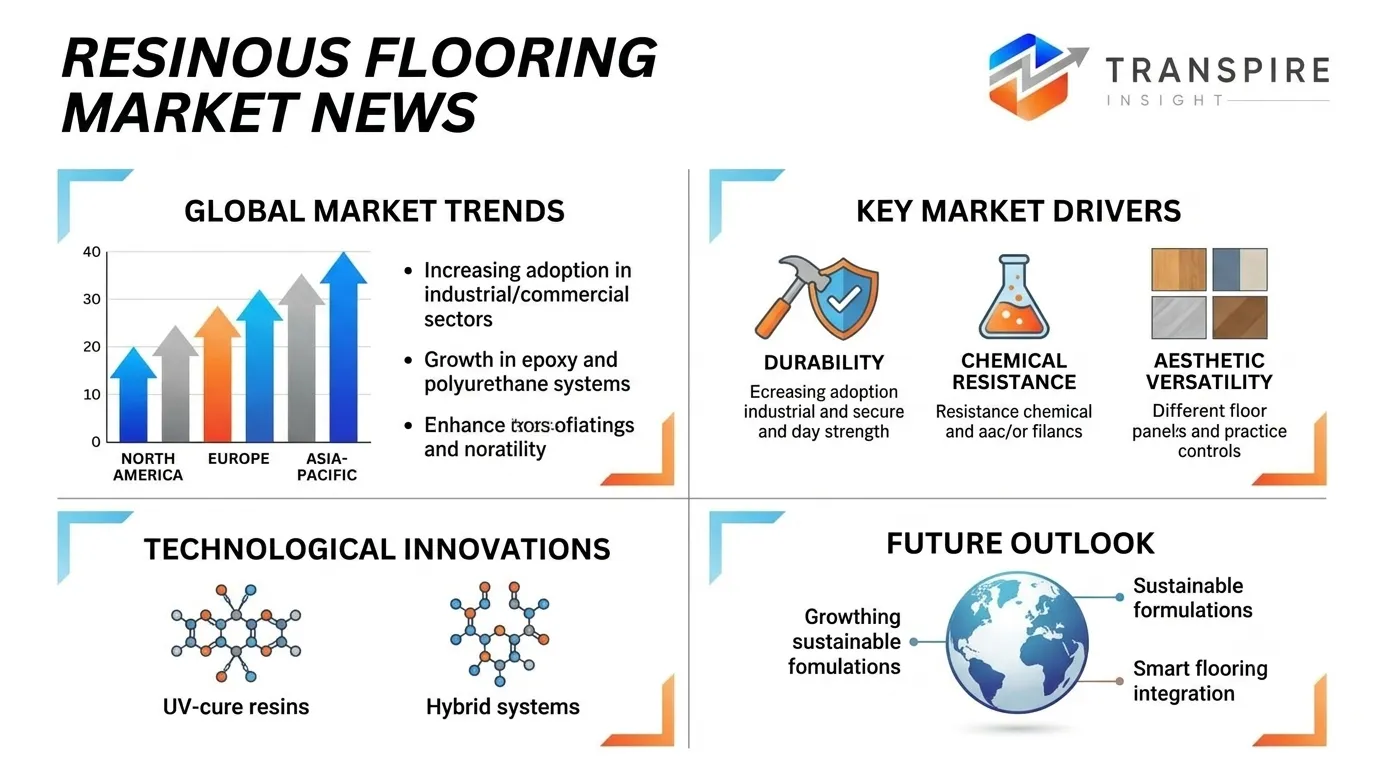
Industrial Expansion Is Increasing Demand for High-Performance Resinous Flooring
The global construction and industrial landscape is placing greater emphasis on flooring systems that perform as part of the operating infrastructure rather than simply serving as a finished surface. Resinous flooring is benefiting from this shift because epoxy, polyurethane, methyl methacrylate (MMA), polyaspartic, and related systems can provide seamless, durable, chemically resistant, and easy-to-clean surfaces across demanding environments.
Manufacturing plants, pharmaceutical facilities, food-processing units, hospitals, warehouses, laboratories, automotive facilities, retail spaces, and commercial buildings increasingly require floors that can withstand heavy traffic, chemical exposure, repeated cleaning, impact, abrasion, and operational stress.
The global resinous flooring market was valued at approximately USD 5.9 billion in 2025 and is projected to reach about USD 10.9 billion by 2032, representing a CAGR of approximately 9.1% during 2025–2032.
Another market assessment estimates global resinous flooring revenue at USD 5.4 billion in 2024 and approximately USD 6.0 billion in 2026, with the market reaching around USD 10.0 billion by 2033.
The difference between market estimates reflects variations in market definitions, segmentation, and forecasting methodologies, but both point toward sustained expansion as industrial and commercial facilities increasingly prioritize floor performance and lifecycle economics.
Flooring Is Becoming a Facility-Management Decision
For many industrial operators, flooring failure is no longer viewed as a minor maintenance issue. Cracking, delamination, chemical damage, excessive wear, moisture intrusion, or poor slip resistance can interfere with production, cleaning, material movement, and workplace safety.
This is encouraging facility owners to evaluate flooring according to its total operating contribution rather than its initial installation price.
A resinous flooring system can provide a continuous surface without conventional grout joints, making it particularly useful where hygiene and cleaning efficiency are important. The chemistry can also be selected according to the environment, with different systems addressing chemical resistance, flexibility, thermal shock, rapid curing, static control, or heavy mechanical loading.
This performance-oriented approach is particularly relevant in manufacturing and logistics environments where operational downtime can be more expensive than the flooring installation itself.
Epoxy Remains the Core Technology Behind Market Growth
Epoxy continues to represent the largest resin type within the global Resinous Flooring Market. Grand View Research estimates that epoxy accounted for 43.6% of global revenue in 2024 and expects the segment to record a 10.3% CAGR during its forecast period.
The popularity of epoxy is closely connected with its combination of durability, chemical resistance, adhesion, abrasion resistance, and ease of cleaning.
Epoxy systems are widely suited to environments such as:
However, epoxy is not universally optimal. Moisture conditions, UV exposure, curing requirements, thermal cycling, and application conditions must be evaluated before specification.
Polyurethane Is Gaining Importance in More Demanding Environments
Polyurethane flooring is becoming increasingly relevant where flexibility, abrasion resistance, thermal stability, and mechanical performance are important.
Food-processing facilities, commercial kitchens, hospitals, cold-storage areas, and industrial environments can expose floors to repeated temperature changes, water, aggressive cleaning chemicals, and mechanical stress. In such conditions, a flooring system must withstand more than conventional foot traffic.
Sika's current flooring portfolio, for example, includes polyurethane and polyurethane-cementitious technologies alongside epoxy, PMMA, acrylic, polyurea, and polyaspartic systems, reflecting the industry's movement toward application-specific resin chemistries.
This diversification is important because the future of resinous flooring is unlikely to be dominated by one chemistry. Instead, manufacturers are increasingly competing through specialized systems designed for specific operational environments.
Why Does Resinous Flooring Matter?
The importance of resinous flooring extends across several industries because floor performance can directly affect hygiene, safety, maintenance, and operational continuity.
Specialized resinous flooring is already used in automotive assembly areas, laboratories, and manufacturing environments, while ESD systems are applied in electronics manufacturing, data centers, and cleanrooms.
Warehouse Automation Is Creating a New Flooring Requirement
The rapid modernization of logistics facilities is creating another important demand driver.
Warehouses are increasingly incorporating automated storage and retrieval systems, autonomous mobile robots, automated guided vehicles, high-density pallet storage, and other technologies. These systems place repetitive mechanical stress on warehouse floors.
The flooring requirement consequently shifts from simply supporting human movement to maintaining dimensional stability and surface performance under continuous automated traffic.
Industrial flooring analysis identifies warehouses, logistics hubs, manufacturing plants, food and beverage facilities, pharmaceutical cleanrooms, and data centers as major environments where abrasion resistance, chemical resistance, slip control, and lifecycle cost are becoming increasingly important.
For resinous flooring manufacturers, this creates an opportunity to develop systems optimized for robotic traffic, impact resistance, high-frequency wheel movement, and rapid maintenance.
Healthcare and Pharmaceutical Construction Is Raising Hygiene Standards
Healthcare and pharmaceutical facilities represent another important growth opportunity.
These environments require flooring that can tolerate frequent cleaning, disinfectants, heavy foot traffic, equipment movement, and strict hygiene procedures. Seamless resinous systems can reduce areas where dirt and contaminants may accumulate compared with flooring configurations containing numerous joints.
The expansion of pharmaceutical and biotechnology manufacturing in emerging economies is particularly significant. India, for example, is projected to see its resinous flooring market grow from USD 131.7 million in 2024 to USD 256.7 million by 2033, representing a 7.8% CAGR. Epoxy was the largest resin type in the Indian market in 2024.
This relationship between industrial construction and flooring demand is likely to become increasingly visible as pharmaceutical, healthcare, food-processing, and high-technology facilities expand.
Faster Curing Is Becoming a Competitive Advantage
One of the industry's most important technological priorities is reducing installation and curing time.
For an operating factory, warehouse, hospital, or retail facility, closing an area for several days can create substantial indirect costs. Flooring manufacturers are therefore developing systems that allow faster installation and quicker return to service.
Sika highlights newer epoxy and polyurethane technologies designed to accelerate curing and potentially allow multiple flooring layers to be applied within a single day under appropriate conditions.
MMA and other fast-curing systems are also gaining attention where facilities have extremely limited shutdown windows.
The commercial implication is significant: flooring suppliers are increasingly competing not only on durability and price but also on how quickly a facility can return to normal operations.
Sustainability Is Becoming Part of Flooring Specification
Environmental performance is becoming another factor influencing resinous flooring procurement.
Historically, flooring selection was primarily driven by durability, appearance, and installation cost. Today, architects, contractors, developers, and facility owners are increasingly examining VOC emissions, indoor air quality, material efficiency, product transparency, embodied carbon, maintenance requirements, and service life.
Sika identifies indoor air quality, low VOC and odor, durability, refurbishment, and lifecycle energy demand as important elements of its flooring innovation approach.
At the same time, Stonhard's 2026 commercial flooring outlook highlights bio-based resin developments, environmental product declarations, health-product declarations, and greenhouse-gas-related metrics as emerging considerations in resinous flooring specification.
The sustainability opportunity therefore extends beyond simply replacing conventional resin ingredients. Longer floor life, reduced maintenance, faster refurbishment, lower emissions, and material transparency can all contribute to the environmental value proposition.
Resinous Flooring Is Becoming More Aesthetic
The traditional perception of industrial resin flooring as purely functional is also changing.
Commercial buildings, hospitality spaces, educational institutions, retail environments, showrooms, and other public spaces increasingly want flooring that combines durability with visual identity.
Modern resin systems can incorporate decorative aggregates, flakes, metallic effects, quartz, customized colors, and different textures. This allows architects and designers to use resinous flooring as part of the overall interior concept rather than hiding it as an industrial surface.
Sherwin-Williams' 2026 flooring color program, for example, incorporates contemporary color palettes into high-performance flooring applications, demonstrating how decorative design is becoming more closely integrated with resinous flooring systems.
This convergence of aesthetics and performance could expand resinous flooring into additional commercial and institutional applications.
Recent Industry Direction in 2026
The market's current development is increasingly centered around higher-performance chemistry, sustainability, faster installation, and application-specific systems.
In 2026, Stonhard has highlighted advanced chemistries, faster installation methods, sustainable practices, and more design-oriented resinous flooring as important commercial flooring trends.
Meanwhile, manufacturers such as Sika continue to offer multiple resin technologies, including epoxy, polyurethane, PMMA, polyaspartic, and polyurethane-cementitious systems, allowing customers to select chemistry according to operating conditions.
The competitive landscape is therefore moving toward broader technical portfolios rather than reliance on a single flagship flooring product.
Investment Opportunities in Resinous Flooring
The expansion of resinous flooring is creating opportunities across materials, formulation technologies, installation services, manufacturing, and specialized applications.
Epoxy will remain an important investment area because of its established position across manufacturing, warehousing, automotive, commercial, and institutional applications.
Opportunities are emerging around rapid-curing, low-emission, high-durability, moisture-tolerant, and decorative epoxy systems.
MMA, polyaspartic, accelerated epoxy, and specialized polyurethane systems can address facilities where minimizing downtime is a primary procurement requirement.
The ability to shorten installation windows can provide value well beyond the material itself.
Electronics manufacturing, semiconductor facilities, laboratories, data centers, and other sensitive environments require specialized control of electrostatic discharge.
This creates opportunities for conductive and dissipative flooring systems engineered for increasingly sophisticated technical facilities.
Bio-based materials, low-VOC formulations, recycled aggregates, lower-emission systems, and products supported by environmental documentation can benefit as building owners increasingly evaluate lifecycle performance.
Stonhard's current sustainability-oriented flooring discussion specifically points to bio-based chemistry and environmental documentation as areas of growing attention.
A significant opportunity exists in the replacement and refurbishment of aging floors.
Instead of waiting for complete facility reconstruction, operators can upgrade deteriorating floors through resurfacing, overlays, repair systems, and new resinous coatings.
This renovation-driven demand can provide a more resilient market opportunity because it is linked not only to new construction but also to the existing industrial building stock.
Government and Regulatory Considerations
Resinous flooring demand is increasingly influenced by building standards, workplace safety requirements, hygiene regulations, environmental rules, and sector-specific compliance requirements.
Food processing and pharmaceutical manufacturing facilities require surfaces compatible with intensive sanitation. Healthcare facilities place emphasis on hygiene and safety. Industrial sites may require slip resistance, chemical resistance, moisture protection, or ESD performance.
Environmental regulation is also encouraging manufacturers to develop lower-emission systems and provide greater transparency regarding product impacts.
As a result, regulatory compliance is increasingly becoming part of product differentiation rather than simply an obligation at the end of the procurement process.
The Market Faces Raw Material and Installation Challenges
Despite favorable demand fundamentals, the Resinous Flooring Market faces several constraints.
Resinous flooring depends on chemical raw materials whose costs can fluctuate with petrochemical markets, energy prices, and broader supply-chain conditions. This can complicate project quotations and create margin pressure for manufacturers and contractors.
Installation quality represents another critical issue. Resinous flooring performance depends heavily on substrate preparation, moisture assessment, mixing, application conditions, curing, and skilled workmanship.
A high-performance resin formulation cannot compensate for inadequate substrate preparation or poor installation practices.
Labor availability is therefore becoming an important competitive factor. Contractors with technical expertise can command greater value as facility owners increasingly prioritize reliable installation and shorter project windows.
Policy Direction Across Major End-Use Industries
The future development of resinous flooring is likely to be influenced by five primary priorities:
These factors indicate that resinous flooring is becoming increasingly integrated with the operational requirements of modern facilities.
Market Expert View
The Resinous Flooring Market is moving beyond its traditional identity as a durable coating category and becoming an important component of high-performance facility infrastructure.
Industrialization, warehouse automation, pharmaceutical manufacturing, food-processing expansion, healthcare investment, and commercial renovation are increasing the need for floors capable of supporting demanding operating conditions.
At the same time, competition is shifting toward faster curing, lower emissions, improved aesthetics, application-specific chemistry, and longer lifecycle performance.
The market's future will therefore depend less on simply selling resin-based flooring and more on solving facility-level problems such as downtime, hygiene, maintenance, safety, chemical exposure, and operational efficiency.
Current market estimates indicate strong expansion through the early 2030s, while 2026 industry activity increasingly emphasizes sustainable chemistry, rapid installation, specialized resin systems, and higher-performance commercial and industrial applications.
Conclusion
Resinous flooring is becoming an increasingly strategic component of modern industrial and commercial infrastructure.
Its combination of durability, seamless construction, chemical resistance, cleanability, customization, and specialized performance makes it particularly relevant to facilities where flooring failure can affect operations.
Epoxy will remain a core technology, but polyurethane, MMA, polyaspartic, conductive, and hybrid systems are expanding the range of applications that resinous flooring can serve.
The next stage of market development will be shaped by faster curing, sustainable formulations, automated facilities, pharmaceutical and food-processing expansion, healthcare infrastructure, and demand for lower lifecycle costs.
As facility owners increasingly evaluate flooring according to operational performance rather than initial installation price, resinous flooring is positioned to become an even more important part of the global high-performance construction materials landscape.


Send us a brief description of your challenge and we'll get back to you within 24 hours.

 inquiry@transpireinsight.com
 APAC:+91 7666513636
 Address


