
Sep 15, 2026
By Transpire Insight
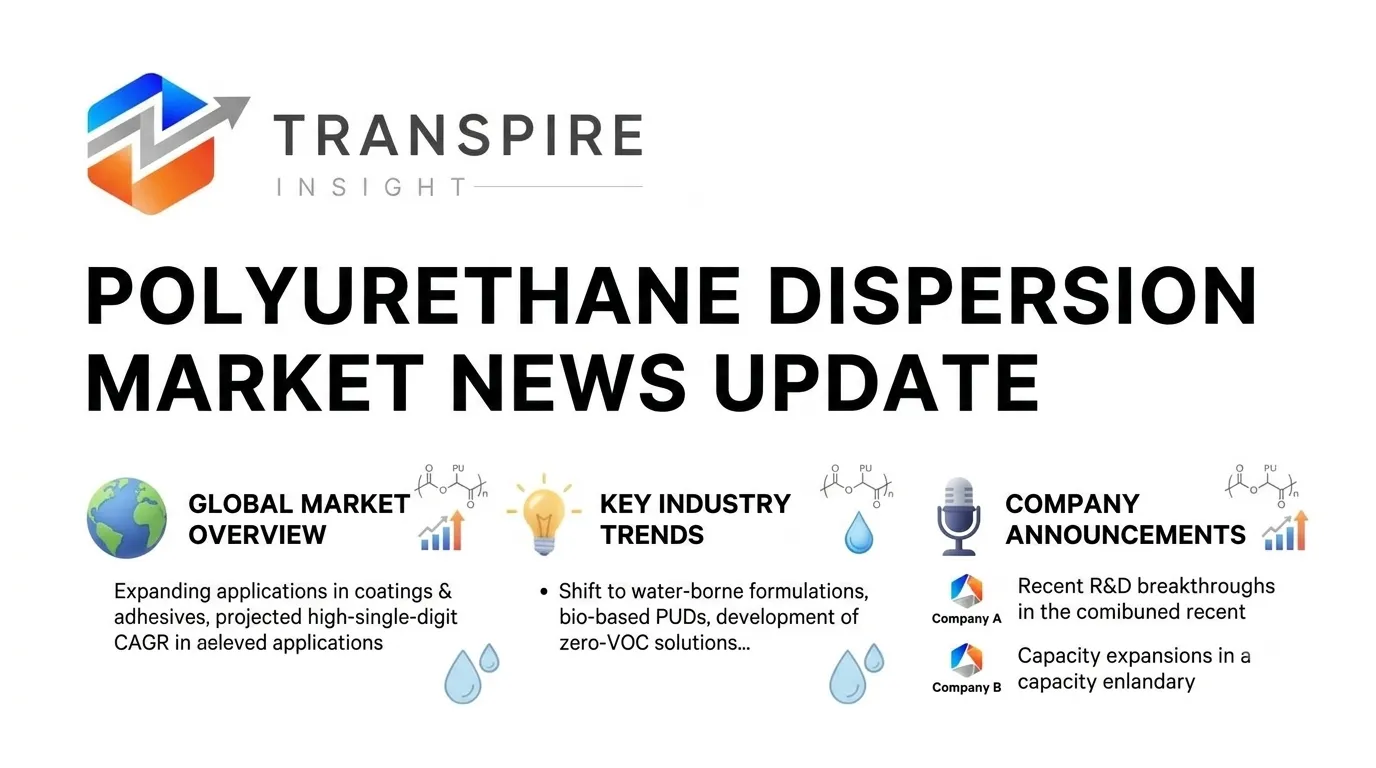
The transition away from solvent-intensive formulations is increasing demand for polyurethane dispersions, driving adoption across coatings, adhesives, leather, textiles, automotive components, packaging, and other performance-focused applications.
Stricter VOC requirements and growing demand for waterborne materials are accelerating the shift toward polyurethane dispersion technologies across global manufacturing industries.
Environmental Regulations Are Increasing Demand for Polyurethane Dispersions
The global coatings, adhesives, textile, leather, and surface-finishing industries are undergoing a significant formulation transition as manufacturers seek to reduce solvent emissions without sacrificing durability or application performance. Polyurethane dispersions (PUDs), particularly water-based systems, are gaining attention because they can combine polyurethane's flexibility, adhesion, abrasion resistance, and chemical durability with lower volatile organic compound emissions than many conventional solvent-borne systems.
This transition is being reinforced by regulatory requirements and sustainability commitments across major industrial markets. Automotive manufacturers, packaging producers, furniture companies, footwear manufacturers, and coating formulators are increasingly evaluating waterborne and solvent-free technologies as part of broader efforts to reduce emissions and improve workplace and environmental performance.
The global polyurethane dispersion market was valued at approximately USD 2.58 billion in 2025 and is projected to reach around USD 5.90 billion by 2033, representing a CAGR of approximately 9.40% during 2026–2033, according to Transpire Insight.
Recent industry research also indicates that the broader polyurethane dispersions market is being supported by increasing demand for waterborne coatings, adhesives, sealants, leather finishing, textiles, packaging, and automotive applications. Asia Pacific remains particularly important because of its large manufacturing base and expanding downstream consumption.
Waterborne Formulations Create a Growing Opportunity for PUD Manufacturers
The movement toward waterborne chemistry is one of the strongest structural trends shaping the polyurethane dispersion industry. Conventional solvent-borne polyurethane systems can provide excellent performance, but concerns regarding VOC emissions and regulatory compliance are encouraging formulators to develop alternatives with lower environmental impact.
Polyurethane dispersions allow manufacturers to retain many of the performance characteristics associated with polyurethane while using water as the primary continuous medium. This makes them particularly attractive for applications where flexibility, adhesion, abrasion resistance, chemical resistance, surface appearance, and film formation are important.
The technology is also evolving beyond simple solvent replacement. Manufacturers are developing high-solids, solvent-free, self-crosslinking, UV-resistant, chemical-resistant, soft-touch, and abrasion-resistant dispersion systems for more demanding applications.
Why Do Polyurethane Dispersions Matter?
The importance of PUD technology extends across several manufacturing industries where performance and environmental compliance increasingly need to be achieved simultaneously.
Performance Requirements Are Reshaping PUD Formulations
Environmental compliance alone is no longer sufficient to guarantee adoption. Industrial users increasingly expect polyurethane dispersions to match or exceed the performance of conventional technologies.
This is pushing manufacturers to improve drying behavior, substrate adhesion, chemical resistance, abrasion resistance, UV stability, flexibility, hardness, and surface appearance. High-performance formulations are particularly important in automotive, industrial coatings, synthetic leather, and specialty textile applications.
The industry is consequently moving toward increasingly specialized PUD chemistry. Rather than functioning solely as an environmentally preferable substitute, polyurethane dispersion is developing into a broader high-performance waterborne materials platform.
This evolution creates opportunities for suppliers that can offer application-specific formulations rather than standardized products.
Asia Pacific Creates a Major Growth Engine for the Market
Asia Pacific has become a central manufacturing and consumption hub for polyurethane dispersions. The region's large automotive, textile, footwear, construction, packaging, furniture, and synthetic-leather industries create substantial downstream demand.
Industry analysis indicates that Asia Pacific accounted for more than 49% of polyurethane dispersion revenue in 2025, while the region is expected to record growth of more than 8.5% CAGR over the forecast period in one recent market assessment.
China remains a major production and consumption center, while India, Southeast Asia, South Korea, and Japan are creating additional opportunities through manufacturing expansion and increased adoption of environmentally compliant coatings and finishing technologies.
India is particularly significant because growth in automotive manufacturing, infrastructure, textiles, packaging, furniture, and consumer products is increasing demand for advanced coating and adhesive technologies.
Government and Regulatory Initiatives Supporting Waterborne Technologies
Governments and regulatory bodies across major industrial markets are tightening environmental requirements surrounding VOC emissions and encouraging the development of lower-emission coating and adhesive technologies. These measures are strengthening the long-term position of waterborne polyurethane systems.
The United States continues to place emphasis on controlling emissions from industrial coatings and related applications. Regulatory requirements and sustainability programs are encouraging manufacturers to evaluate waterborne, high-solids, and other lower-emission technologies.
This creates an opportunity for PUD manufacturers capable of delivering comparable performance while helping industrial customers reduce solvent usage.
Europe remains one of the most regulation-driven markets for low-VOC coatings and adhesives. Environmental requirements, including frameworks associated with REACH and the EU Deco-Paint Directive, are encouraging manufacturers to reduce emissions and develop more environmentally compatible formulations.
The European market is therefore particularly favorable for high-performance waterborne polyurethane dispersions, bio-based formulations, and solvent-free systems.
China's large manufacturing base and increasing focus on environmental performance are encouraging the adoption of lower-VOC coating and adhesive technologies.
The combination of automotive production, synthetic leather manufacturing, textiles, packaging, and industrial coatings creates a broad customer base for polyurethane dispersion producers.
Japan and South Korea have strong positions in advanced automotive, electronics, textile, and industrial manufacturing. Their demand is increasingly focused on specialized materials that deliver both environmental compliance and high functional performance.
This creates opportunities for technically differentiated PUD products designed for demanding substrates and specialized coating applications.
India's expanding automotive, construction, textile, footwear, furniture, and packaging industries are increasing the need for modern coating and adhesive systems.
The country's movement toward greener manufacturing and the expansion of domestic industrial production provide a favorable environment for waterborne polyurethane technologies, particularly where manufacturers need improved environmental performance without sacrificing durability.
Policy Direction Across Major Industrial Markets
Major industrial economies are increasingly converging around several priorities: reducing VOC emissions, encouraging waterborne formulations, improving chemical safety, increasing manufacturing efficiency, and developing sustainable material technologies.
This direction is particularly relevant to polyurethane dispersions because PUDs can serve as a bridge between environmental compliance and performance requirements. The strongest opportunities are likely to occur where manufacturers are replacing solvent-based systems while simultaneously upgrading coating, adhesive, textile, leather, and surface-finishing performance.
The market is therefore being shaped not only by regulatory requirements but also by customer expectations for longer product life, improved appearance, lower emissions, and more efficient processing.
Investment Opportunities in the Polyurethane Dispersion Industry
The shift toward waterborne and low-VOC materials is creating investment opportunities throughout the polyurethane dispersion value chain, from resin manufacturing and formulation development to downstream application technologies.
Coatings represent one of the most important application areas for polyurethane dispersions. Automotive, wood, industrial, plastic, and specialty coating manufacturers are increasingly evaluating waterborne systems as alternatives to solvent-intensive technologies.
Investment in high-performance coating formulations can therefore provide opportunities in both mature markets and rapidly industrializing regions.
The packaging, automotive, construction, footwear, and furniture sectors are creating continued demand for polyurethane-based bonding technologies.
PUD-based adhesives can provide a combination of adhesion, flexibility, and environmental advantages, making advanced waterborne adhesive formulations an important area for product development.
Synthetic leather and textile applications remain major opportunities because PUDs can deliver flexibility, durability, surface protection, and desirable finishing characteristics.
Demand from footwear, automotive interiors, furniture, apparel, and technical fabrics is encouraging manufacturers to develop specialized dispersion technologies for different substrates.
Automotive manufacturers are increasingly focused on lightweight materials, improved interior aesthetics, durability, and lower-emission manufacturing processes.
Polyurethane dispersions can support selected coating and finishing applications where scratch resistance, chemical resistance, flexibility, and surface quality are required.
Solvent-free systems represent a particularly attractive development area. Recent market analysis identifies solvent-free polyurethane dispersions as one of the fastest-growing product categories as manufacturers seek to reduce solvent use without compromising performance.
Additional opportunities are emerging in UV-resistant, self-crosslinking, high-solid, bio-based, and functionalized formulations.
Market Expert View
Polyurethane dispersions are moving from being viewed primarily as environmentally preferable alternatives toward becoming strategically important performance materials for the next generation of coatings, adhesives, textile finishes, synthetic leather, and specialty surface applications.
The fundamental market opportunity is being created by the convergence of two requirements: lower environmental impact and higher technical performance. Manufacturers increasingly need materials that can meet VOC expectations while maintaining adhesion, flexibility, abrasion resistance, chemical resistance, appearance, and durability.
Asia Pacific is expected to remain a particularly important growth center because of its manufacturing scale and expanding downstream industries, while North America and Europe will continue to influence product development through environmental requirements and demand for advanced formulations.
For producers, the competitive advantage will increasingly depend on formulation specialization, technical support, manufacturing scale, raw-material efficiency, and the ability to develop products tailored to individual end-use requirements.
Conclusion
Polyurethane dispersions are becoming an increasingly important component of the global transition toward lower-emission industrial materials. Their ability to combine polyurethane performance with waterborne formulation characteristics is expanding their role across coatings, adhesives, textiles, synthetic leather, automotive applications, packaging, furniture, and other industries.
Stricter environmental requirements are providing the initial push, but performance innovation is becoming the deeper driver of long-term adoption. High-performance, solvent-free, UV-resistant, abrasion-resistant, and specialized polyurethane dispersions are opening new application opportunities while helping manufacturers address evolving sustainability expectations.
As industrial production expands across Asia Pacific and environmental requirements continue to influence material selection worldwide, polyurethane dispersions are positioned to play a growing role in the future of sustainable coatings, adhesives, and surface-finishing technologies.


Send us a brief description of your challenge and we'll get back to you within 24 hours.

 inquiry@transpireinsight.com
 APAC:+91 7666513636
 Address


