
Aug 18, 2026
By Transpire Insight
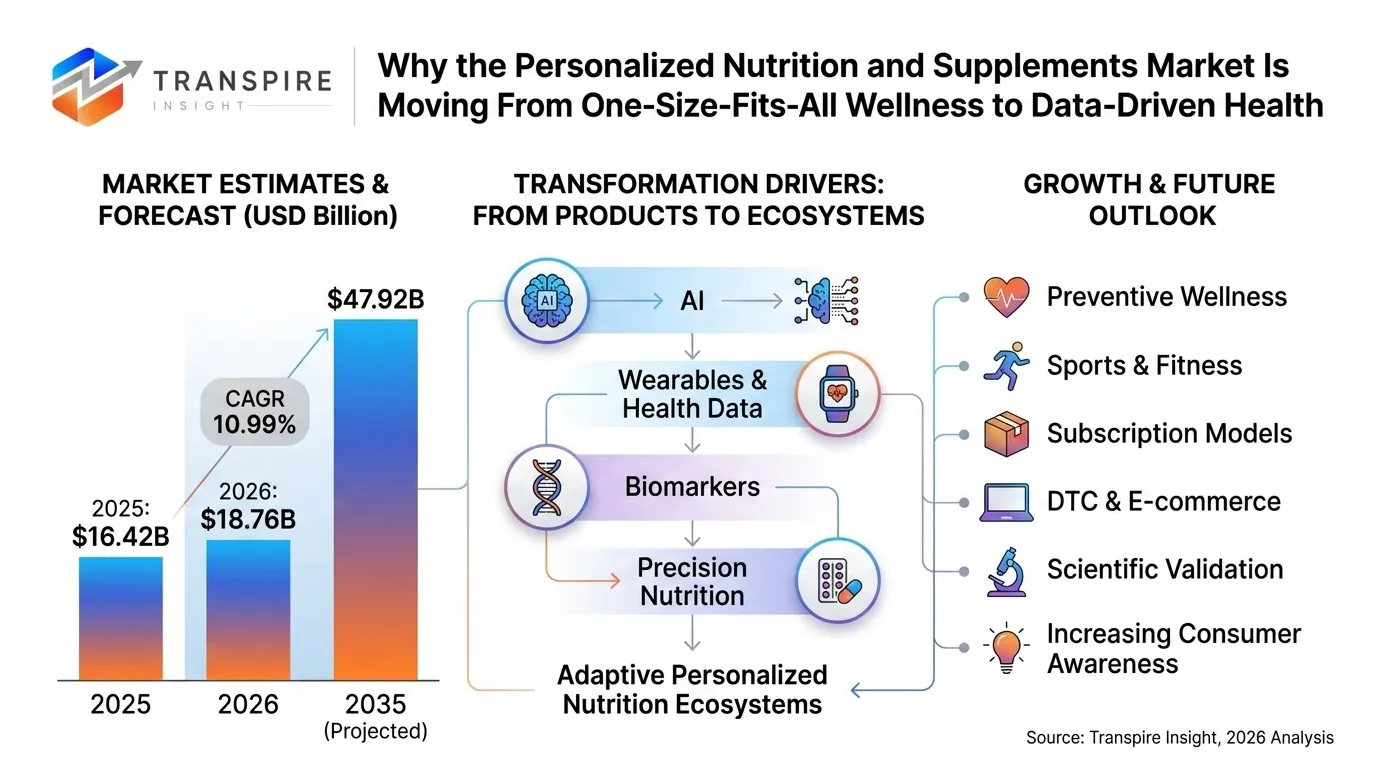
According to Transpire Insight, the global personalized nutrition and supplements market is estimated at approximately USD 16.42 billion in 2025 and is expected to reach around USD 18.76 billion in 2026. The market is projected to reach approximately USD 47.92 billion by 2035, expanding at an estimated CAGR of 10.99% during the forecast period 2026–2035.
The personalized nutrition and supplements market is entering a new phase as consumers increasingly move away from generalized wellness products toward nutrition strategies built around individual characteristics, dietary patterns, activity levels, health objectives, and lifestyle behaviors.
Personalized nutrition combines food, supplements, digital health tools, biomarker information, behavioral data, and increasingly sophisticated recommendation systems to create more individualized nutritional approaches. What was once largely a niche concept centered on questionnaires and customized vitamin packs is becoming a broader ecosystem that can incorporate wearable data, laboratory information, metabolic measurements, genetic information, dietary records, and continuously updated lifestyle inputs.
The transformation is being accelerated by the growing availability of health data. Smartwatches, activity trackers, continuous monitoring technologies, mobile health applications, digital food logs, and home testing platforms are generating information that can potentially be used to make nutritional recommendations more dynamic
Artificial intelligence is further changing the sector. Recent scientific work published in 2026 highlights the potential of AI and machine learning to integrate complex nutritional, biological, and lifestyle data, while also emphasizing continuing challenges around data quality, interpretability, validation, and causal inference.
The result is a market moving beyond the sale of supplements as individual products toward personalized nutrition ecosystems in which assessment, recommendation, formulation, delivery, monitoring, and ongoing adjustment can become interconnected.
Market Overview
Personalized nutrition and supplements encompass products and services designed to adapt dietary guidance or nutritional products to an individual's specific characteristics, preferences, nutritional requirements, health objectives, or lifestyle.
The category can include customized vitamin and mineral combinations, personalized protein and wellness formulations, tailored functional foods, nutrition powders, condition-oriented supplements, subscription-based supplement programs, digital nutrition platforms, and testing-supported nutrition services.
One of the most important developments is the growing use of data-driven personalization. Traditional supplementation generally provides the same formulation to broad consumer groups, while personalized models seek to identify differences between individuals and use those differences to influence nutrient selection, dosage, format, timing, or product combination.
Wearable technology is increasingly important to this transition. Information related to activity, sleep, exercise patterns, heart-rate behavior, and other measurable characteristics can potentially contribute to personalized nutrition recommendations. The sector is increasingly interested in moving from static assessments toward continuous feedback loops in which recommendations are updated as an individual's behavior changes. Recent industry discussion in 2026 has specifically highlighted wearables and objective data as important elements in the next stage of personalized nutrition.
Biomarker-based personalization is another important area. Blood-based measurements, metabolic indicators, nutritional assessments, and other measurable signals can provide information that is more specific than self-reported lifestyle questionnaires.
Genetic and microbiome information is also being explored as an input for personalized nutrition. However, these technologies require careful interpretation because the presence of an association does not necessarily establish that a particular supplement or dietary intervention will produce a specific health outcome.
Latest Market Statistics
The global personalized nutrition and supplements market is expected to maintain strong expansion as consumers become more comfortable with digital health tools and increasingly seek nutrition products that appear relevant to their individual circumstances.
Transpire Insight estimates that the market reached approximately USD 16.42 billion in 2025 and could rise to around USD 18.76 billion in 2026. By 2035, market value is projected to approach USD 47.92 billion as personalized supplement services, digital nutrition platforms, testing technologies, customized formulations, ad data-driven wellness programs become more widely adopted.
Market growth is being supported by several structural changes, including increasing consumer health awareness, greater interest in preventive wellness, expanding use of wearable devices, growth of e-commerce, increasing demand for specialized supplements, and the development of digital nutrition platforms.
An important change is the movement from product personalization to continuous personalization. Instead of producing one customized supplement combination and keeping it unchanged, emerging platforms increasingly aim to modify recommendations according to changing behavior, activity, dietary habits, or measurement data.
This creates a potentially more valuable recurring business model because consumers can receive ongoing recommendations rather than purchasing a one-time product.
The market is also benefiting from the convergence of nutrition and digital healthcare. Personalized supplementation can increasingly be incorporated into broader wellness programs that include exercise tracking, sleep management, dietary monitoring, health coaching, and preventive-care services.
This convergence is expanding the addressable market beyond traditional supplement consumers.
Major Growth Drivers
Increasing consumer health awareness: Consumers are becoming more interested in understanding their individual nutritional requirements and selecting products that appear more relevant to their personal health objectives.
Expansion of wearable health technology: Fitness trackers and smart devices are generating continuously updated behavioral and activity data that can support more responsive nutrition recommendations.
Growth of preventive wellness: Increasing emphasis on maintaining health before the onset of major problems is encouraging demand for individualized nutrition strategies.
Development of AI and data analytics: Artificial intelligence can analyze large volumes of nutrition and lifestyle information and potentially identify patterns that are difficult to evaluate through manual methods alone.
Expansion of direct-to-consumer nutrition: Online platforms enable consumers to complete assessments, receive recommendations, order customized products, and manage subscriptions without relying exclusively on physical retail.
Growing demand for targeted supplementation: Consumers increasingly seek products associated with objectives such as sports recovery, energy, sleep, healthy aging, digestive wellness, and general nutritional support.
Key Applications
Preventive wellness represents a major application area. Personalized nutrition platforms can help consumers structure nutritional strategies around lifestyle patterns, dietary preferences, activity levels, and broader wellness objectives.
Sports and fitness nutrition is another significant application. Athletes and active consumers can use personalized approaches to evaluate protein intake, hydration, recovery nutrition, energy requirements, and supplementation timing.
Healthy aging represents an expanding opportunity as consumers seek nutritional strategies suited to changing dietary needs, activity levels, and lifestyle requirements.
Weight-management nutrition can also incorporate personalized recommendations based on food preferences, activity, behavioral patterns, and individual objectives.
Digestive and gut-health nutrition is increasingly attracting consumer interest, encouraging development of personalized approaches involving fiber, probiotics, prebiotics, and other nutritional components where appropriate.
Women's health and life-stage nutrition provide additional opportunities, with products increasingly being developed around changing nutritional requirements across different stages of life.
Download the exclusive Personalized Nutrition And Supplements Market sample report today to uncover expert insights, emerging trends, and the opportunities defining the future of the industry.
Government Initiatives and Nutrition Modernization
Regulatory oversight is becoming increasingly important as personalized nutrition products move closer to the intersection of food, supplements, healthcare, diagnostics, and digital health.
In India, FSSAI maintains regulatory frameworks covering health supplements, nutraceuticals, foods for special dietary use, foods for special medical purposes, functional foods, and related categories. These frameworks influence product formulation, labeling, claims, ingredient use, and market authorization.
The growth of personalized nutrition also creates a need for clearer distinctions between general wellness recommendations and medically oriented nutrition guidance. When products are marketed around disease-related outcomes or individualized health conditions, scientific substantiation and appropriate professional oversight become increasingly important.
Internationally, the growth of personalized nutrition is similarly increasing attention to evidence quality, data governance, ingredient safety, and consumer protection.
The policy environment is therefore likely to evolve alongside the technology. As personalized nutrition becomes more data-intensive, companies will increasingly need to address both product regulation and information governance.
Technology and Formulation Overview
The personalized nutrition and supplements market depends on the convergence of nutritional science, digital technology, testing, formulation, and data analysis.
Customized formulation systems enable manufacturers to combine different vitamins, minerals, proteins, amino acids, botanicals, probiotics, and other ingredients according to selected customer profiles.
Precision dosing is another important area. Automated manufacturing can improve the consistency of customized formulations and support the production of different nutrient combinations at commercial scale.
Microencapsulation and delivery technologies can help improve the stability and usability of certain ingredients and may allow manufacturers to develop different release characteristics.
Digital assessment platforms are increasingly being used to collect information about dietary habits, activity, preferences, goals, and other relevant characteristics.
Biomarker testing can add another layer of personalization by providing measurable information rather than relying exclusively on questionnaires.
Subscription-based fulfillment is also important because many personalized supplementation models depend on recurring delivery. Digital systems can coordinate product recommendations, manufacturing, packaging, and shipment according to updated customer profiles.
The broader technology landscape is therefore moving toward a combination of data collection, algorithmic recommendation, precision formulation, and recurring delivery.
Future Importance
The future of the personalized nutrition and supplements market will be closely connected to precision nutrition, continuous health monitoring, AI-assisted recommendations, biomarker interpretation, individualized supplementation, and preventive wellness.
The central shift will be from static personalization toward adaptive personalization. Future systems may increasingly update nutritional recommendations as an individual's activity, dietary behavior, sleep, body composition, or other measurable characteristics change.
This could make personalized supplementation more relevant to consumers who view nutrition as an ongoing process rather than a fixed product purchase.
Scientific validation will become equally important. The long-term development of the sector will depend not just on the ability to collect more data but on whether companies can demonstrate that personalized interventions produce meaningful improvements beyond conventional nutritional approaches.
Recent scientific perspectives emphasize that AI in precision nutrition has major potential but still faces challenges involving data quality, interpretability, causal inference, and clinical validation.
The market is therefore likely to evolve toward a combination of technology-driven personalization and stronger evidence requirements.
Top Market Trends
The personalized nutrition and supplements market is evolving rapidly as digital health, nutritional science, and consumer wellness converge.
Technological Advancements
Technology is one of the strongest forces transforming personalized nutrition.
Artificial intelligence and machine learning can analyze large datasets containing dietary, behavioral, biological, and lifestyle information. These models may help identify patterns and generate individualized recommendations.
Wearable integration can provide continuous information related to physical activity, sleep, and other measurable parameters, potentially making nutritional recommendations more dynamic.
At-home testing is another significant development. Consumers can increasingly access testing approaches that provide information on selected biomarkers, creating additional inputs for personalized nutrition platforms.
Automated formulation technologies allow manufacturers to translate individual recommendations into customized supplement combinations at larger scale.
Digital manufacturing and packaging systems can support personalized labels, individualized product packs, recurring orders, and flexible product configurations.
The convergence of these technologies is creating a new model in which customization can occur throughout the customer journey rather than only at the formulation stage.
Artificial Intelligence and Personalized Nutrition
Artificial intelligence is becoming one of the most important technologies influencing the personalized nutrition market.
AI can combine information from multiple data sources and potentially identify relationships between lifestyle patterns and nutritional recommendations.
Recent 2026 research has described AI and machine learning as promising tools for precision nutrition because they can work with multimodal information while also highlighting the need for validation, interpretability, robust datasets, and clinically actionable outputs.
Generative AI is also being explored for individualized nutrition guidance, consumer interaction, meal planning, and nutrition education. Research published in 2026 emphasizes the potential of generative models while highlighting the need for scientifically grounded recommendations and appropriate safeguards.
In the future, an AI-supported personalized nutrition platform could potentially combine dietary records, wearable information, food preferences, activity patterns, and selected laboratory inputs to create an adaptive nutritional strategy.
However, AI should remain a decision-support technology rather than an unquestioned authority. Incorrect recommendations, incomplete data, model bias, privacy risks, and unsupported health claims can undermine consumer trust.
Major Applications
Preventive Wellness: Customized nutrition plans and supplements can support consumers seeking individualized approaches to general health and lifestyle management.
Sports and Fitness: Personalized protein, hydration, recovery, micronutrient, and performance strategies can support active consumers and athletes.
Healthy Aging: Nutrition products can be tailored around the changing dietary preferences and nutritional priorities associated with aging.
Weight Management: Digital assessments and personalized products can support structured nutritional approaches based on individual goals and lifestyle patterns.
Gut and Digestive Wellness: Personalized recommendations can incorporate dietary habits and selected nutrition strategies involving probiotics, prebiotics, fiber, and related products.
Women's Health: Specialized supplement combinations can be developed around specific life-stage requirements and nutritional preferences.
Investment and Growth Opportunities
The expansion of personalized nutrition is creating opportunities for supplement manufacturers, ingredient companies, diagnostics providers, digital-health platforms, wearable companies, healthcare organizations, laboratories, and specialized e-commerce businesses.
One major opportunity is the development of continuous personalization platforms that connect wearable data, customer behavior, testing, recommendations, and recurring supplement delivery.
The sports and fitness segment also provides significant potential because active consumers are already accustomed to tracking performance and purchasing specialized nutrition products.
Healthy-aging nutrition represents another attractive area as demographic changes increase demand for customized products and convenient nutritional support.
There is also substantial potential in biomarker-driven personalization, where laboratory information can help consumers and professionals move beyond broad demographic recommendations.
Emerging markets such as India and other Asia-Pacific economies offer additional opportunities as digital health adoption, e-commerce, wellness spending, and consumer familiarity with personalized products increase.
Proceed to Checkout to purchase the exclusive Personalized Nutrition And Supplements Market report and gain instant access to in-depth market intelligence, strategic analysis, and future growth opportunities.
Market Segmentation
The personalized nutrition and supplements market can be segmented based on product type, ingredient, dosage form, personalization technology, application, and distribution channel.
By product type, major categories include personalized dietary supplements, personalized functional foods, personalized beverages, meal-oriented nutritional products, and digital nutrition services.
By ingredient, the market includes vitamins, minerals, proteins and amino acids, probiotics and prebiotics, herbal and botanical ingredients, omega fatty acids, specialty nutrients, and other functional ingredients.
By dosage form, major formats include tablets, capsules, powders, liquids, gummies, bars, sachets, and customized multi-product packs.
By personalization technology, the market can be differentiated into questionnaire-based personalization, AI-supported recommendations, biomarker-based personalization, genetic-data-supported personalization, wearable-integrated personalization, and hybrid models.
By application, key areas include preventive wellness, sports nutrition, healthy aging, weight management, digestive wellness, women's health, and other targeted nutritional applications.
By distribution channel, the market includes e-commerce, direct-to-consumer platforms, specialty stores, pharmacies, healthcare channels, subscription services, and other retail formats.
Leading and Fastest-Growing Segments
The personalized dietary supplements segment is expected to remain a major component of the market because customized vitamins, minerals, proteins, and specialty formulations are comparatively straightforward to deliver through individualized product programs.
The AI-enabled personalization segment represents one of the fastest-moving areas as companies increasingly use algorithms to process consumer and health data.
The wearable-integrated segment also offers strong growth potential because continuous activity and lifestyle data can enable dynamic rather than one-time personalization.
The sports and fitness segment is expected to remain highly attractive as consumers increasingly combine performance tracking with specialized nutrition.
The subscription-based distribution segment is gaining importance because recurring delivery models can simplify personalized supplement management while strengthening customer retention.
Competitive Landscape
Competition in the personalized nutrition and supplements market is increasingly focused on recommendation quality, scientific credibility, product customization, technology integration, convenience, customer retention, and evidence.
Companies are moving beyond static vitamin packs toward broader platforms that can incorporate assessments, personalized recommendations, digital coaching, testing, wearable data, and recurring product delivery.
Data quality is becoming an important competitive factor. A company that can obtain better-quality information and interpret it more effectively may be able to provide more relevant recommendations.
Product formulation is another differentiator. Companies increasingly seek combinations of ingredients and delivery formats that can be tailored to specific customer profiles without compromising manufacturing consistency.
Trust will also become increasingly important. Consumers are likely to scrutinize how their data is collected, how recommendations are generated, and what scientific evidence supports the suggested products.
Strategic partnerships between supplement manufacturers, diagnostics companies, wearable providers, healthcare professionals, research institutions, and digital-health platforms are expected to become increasingly common.
Challenges and Restraints
Despite strong growth opportunities, the personalized nutrition and supplements market faces several challenges.
Scientific uncertainty remains a major issue. Not every individual difference translates into a clinically meaningful need for a different supplement formulation.
Data quality can also limit personalization. Wearable measurements, dietary records, self-reported information, laboratory values, and genetic data can all contain limitations or interpretation challenges.
Privacy and data security are becoming increasingly important as platforms collect highly personal health and lifestyle information.
Regulatory complexity can increase when personalized products are marketed around specific health or disease outcomes.
Cost can also restrict market penetration. Testing, data analysis, customized manufacturing, subscription services, and professional oversight can make personalized products substantially more expensive than conventional supplements.
Consumer understanding represents another challenge. Personalization can create an impression of scientific precision even where evidence supporting a particular recommendation remains limited.
Recent scientific literature continues to emphasize that data quality, interpretability, validation, and causal inference are central challenges in applying AI and personalized nutrition at scale.
Nevertheless, the combination of digital health adoption and consumer demand for individualized wellness is creating substantial opportunities.
Regional Market Outlook
The personalized nutrition and supplements market is developing across major regions as digital health, wellness consumption, e-commerce, nutrition science, and personalized healthcare capabilities expand.
North America remains an important market because of its mature supplement industry, strong consumer spending on wellness, established digital-health ecosystem, widespread wearable adoption, and increasing interest in personalized health services.
Europe represents a highly developed market supported by healthcare infrastructure, wellness consumption, nutritional science, digital services, and growing interest in preventive health. Regulatory considerations around health claims, data protection, and product safety remain particularly important.
Asia-Pacific represents a major long-term growth opportunity. Rising disposable incomes, increasing digital-health adoption, expanding e-commerce, growing fitness participation, urbanization, and greater awareness of individualized wellness are creating opportunities across China, India, Japan, South Korea, Australia, and Southeast Asia.
Latin America offers additional potential as digital commerce, wellness spending, fitness participation, and consumer awareness of nutritional products increase.
Middle East & Africa are also expected to experience growth as premium wellness consumption, healthcare modernization, digital services, sports participation, and specialized retail develop.
Future Market Opportunities
One of the strongest future opportunities lies in adaptive nutrition platforms that continuously update recommendations based on changing consumer data.
The integration of wearables and nutrition applications represents another significant opportunity. Consumers may increasingly expect nutrition recommendations to respond to changes in physical activity, sleep, recovery, and lifestyle.
Biomarker-driven supplements are also expected to gain attention because measurable data can provide more individualized inputs than broad demographic information alone.
The expansion of personalized nutrition for healthy aging represents another major opportunity as older consumers increasingly seek tailored nutritional strategies.
There is also significant potential in B2B personalized nutrition, where employers, gyms, wellness providers, clinics, sports organizations, and hospitality companies could offer individualized nutrition programs to their customers or members.
Role of Technology and Advanced Manufacturing
Technology is changing how personalized supplements are formulated, produced, distributed, and monitored
Automated dosing systems can enable manufacturers to combine multiple ingredients in individualized quantities while maintaining production consistency.
Digital manufacturing platforms can coordinate customer profiles with formulation instructions, packaging requirements, labels, and fulfillment systems.
Cloud-based systems can connect customer data with production and distribution processes, making recurring personalized orders easier to manage.
Advanced analytical systems can also support quality control by monitoring ingredient concentrations, batch consistency, and product traceability.
The next generation of personalized supplement manufacturing could increasingly use automated formulation, robotics, digital traceability, and software-controlled production to make customization commercially scalable.
Customize the exclusive Personalized Nutrition And Supplements Market report today to receive tailored insights, country-specific analysis, and business-focused market intelligence.
Personalized and Precision Nutrition
Precision nutrition is expected to become the central long-term concept within the market.
Different individuals can respond differently to similar dietary patterns, supplements, and lifestyle interventions. This variability is encouraging researchers and businesses to explore more individualized models based on genetics, metabolism, microbiome characteristics, behavior, activity, and environmental factors.
However, precision nutrition should not be interpreted as a guarantee that every individual requires a unique supplement combination. The strongest future models are likely to distinguish between meaningful personalization and personalization that exists primarily for marketing purposes.
The commercial opportunity will therefore depend on the industry's ability to demonstrate that personalized approaches provide measurable value.
This creates an important shift toward evidence-based personalization, in which customization must increasingly be supported by robust data and transparent reasoning.
Key Strategic Developments
Companies operating in the personalized nutrition and supplements market are expected to focus on:
These strategies demonstrate that competition is moving beyond customized supplement packaging toward data-driven nutritional ecosystems capable of ongoing personalization and consumer engagement.
Recent Industry Developments
Personalized nutrition is increasingly entering a more evidence-focused phase in which companies and researchers are examining whether individualized recommendations can demonstrate measurable value.
A major scientific development came on July 6, 2026, when a Nature Communications perspective examined the application of artificial intelligence and machine learning to precision nutrition. The work highlighted AI's potential to integrate complex nutritional and biological data while identifying data quality, interpretability, validation, and causal inference as major challenges that need to be addressed before widespread clinical use.
Research published in The Journal of Nutrition in July 2026 also examined AI-driven personalized dietary management and described how machine learning, predictive models, and data-driven systems could support individualized nutrition strategies using factors such as genetics, lifestyle, and biometric information.
The commercial landscape is also moving toward continuous personalization. Industry analysis published in July 2026 highlighted the increasing role of wearables and objective, continuously collected data in personalized nutrition platforms, reflecting a broader transition from questionnaire-based recommendations toward adaptive systems.
These developments indicate that personalized nutrition is moving from a relatively simple customization proposition toward a more sophisticated model based on continuous measurement, algorithmic interpretation, scientific validation, and ongoing product adjustment.
Market Expert View
From a market perspective, the personalized nutrition and supplements market is positioned for continued transformation because it sits at the intersection of nutrition, consumer wellness, digital health, artificial intelligence, diagnostics, wearable technology, and preventive healthcare.
The defining competitive question is increasingly shifting from whether a product can be personalized to whether that personalization provides meaningful additional value.
Consumers are likely to become more sophisticated as the category expands. They may increasingly ask how recommendations are generated, what data is used, what evidence supports an ingredient combination, and whether personalized intervention actually improves measurable outcomes.
This will favor companies that can combine technology with credible nutrition science.
The future competitive environment is therefore likely to reward platforms that provide a complete ecosystem covering assessment, recommendation, formulation, delivery, monitoring, and adjustment.
Another important development will be the convergence of products and services. Personalized supplements may increasingly become one component of broader digital wellness programs rather than standalone consumer goods.
Future Outlook
The future of the personalized nutrition and supplements market is expected to be shaped by AI, wearable health data, biomarker analysis, precision formulation, adaptive recommendations, digital health integration, and evidence-based personalization.
Conventional supplements will continue to represent a significant part of consumer nutrition, but personalized products are likely to gain importance as consumers become more familiar with individualized health technologies.
Wearables and digital platforms can provide continuous information that makes nutrition recommendations more dynamic.
Biomarker and testing technologies can add additional layers of personalization, while automated manufacturing can make individualized formulations more commercially scalable.
The long-term success of the market will depend on whether companies can demonstrate meaningful benefits while maintaining affordability, privacy, scientific credibility, regulatory compliance, and consumer trust.
Emerging economies are expected to provide additional opportunities as digital health infrastructure, e-commerce, fitness participation, and premium wellness spending continue to expand.
Schedule a meeting with our market experts to discuss the exclusive Personalized Nutrition And Supplements Market report and identify the best research solution for your organization.
Conclusion
The personalized nutrition and supplements market is moving the nutrition industry from standardized products toward more individualized, data-informed approaches. The growing convergence of AI, wearables, biomarkers, digital health platforms, customized formulations, and recurring supplement delivery is creating a new model of consumer nutrition.
Advances in machine learning, precision formulation, automated manufacturing, wearable integration, and digital health are expanding the ability of companies to customize nutritional recommendations and products.
At the same time, scientific validation is becoming increasingly important. Personalization alone does not establish effectiveness, and the market's long-term credibility will depend on the quality of evidence supporting individualized recommendations.
Looking ahead, the market will increasingly depend on the ability of companies to combine scientific rigor, high-quality data, intelligent personalization, product safety, privacy, affordability, convenience, and measurable consumer value. As nutrition becomes increasingly connected to digital health and continuous personal data, next-generation personalized supplements are expected to become an increasingly important component of the global wellness and precision-nutrition ecosystem.


Send us a brief description of your challenge and we'll get back to you within 24 hours.

 inquiry@transpireinsight.com
 APAC:+91 7666513636
 Address


