
Aug 18, 2026
By Transpire Insight
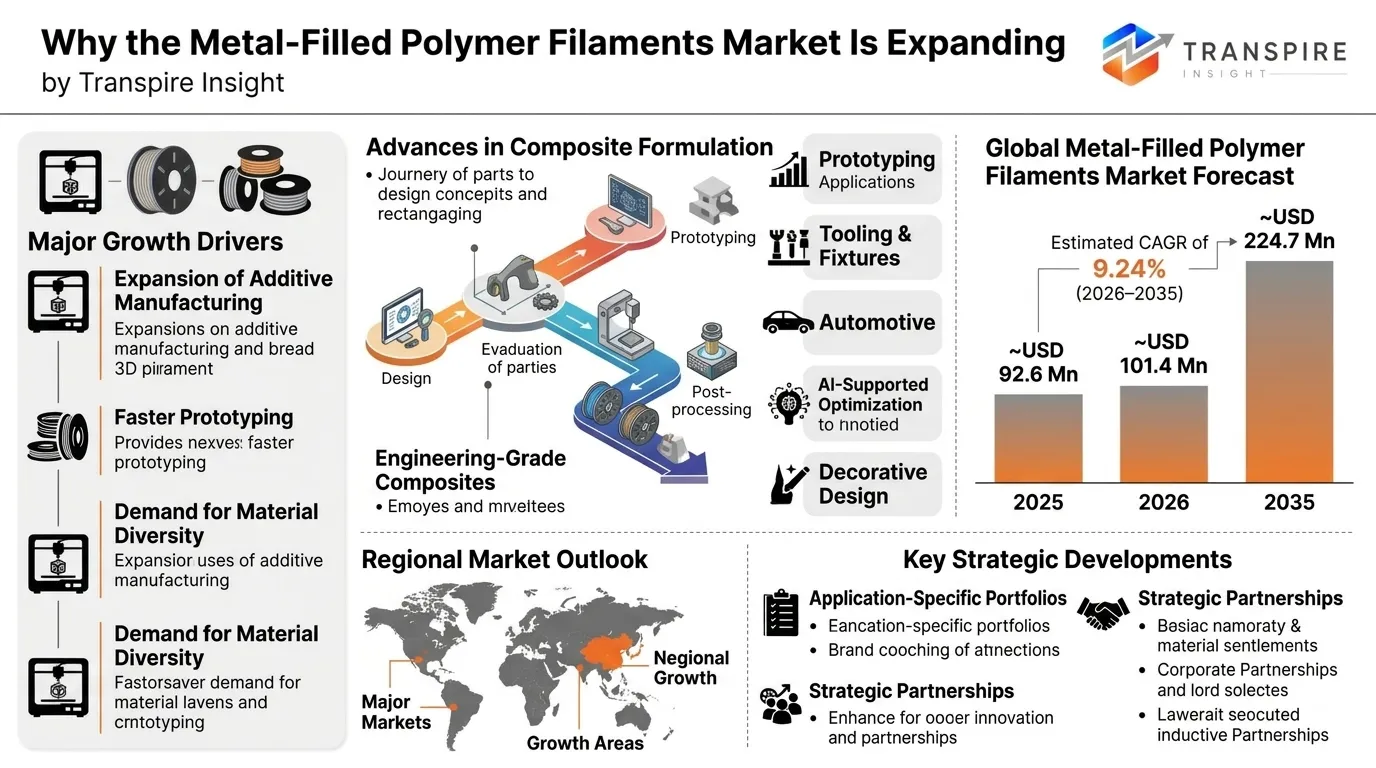
According to Transpire Insight, the global metal-filled polymer filaments market is estimated at approximately USD 92.6 million in 2025 and is expected to reach around USD 101.4 million in 2026. The market is projected to reach approximately USD 224.7 million by 2035, expanding at an estimated CAGR of 9.24% during the forecast period 2026–2035.
The metal-filled polymer filaments market is emerging as an important materials category within additive manufacturing as engineers, designers, and manufacturers look for ways to bring metallic appearance, weight, conductivity, thermal behavior, and post-processing flexibility into filament-based 3D printing workflows.
Metal-filled polymer filaments are composite materials in which metal powders, particles, flakes, or fine metallic additives are incorporated into a thermoplastic polymer matrix. These materials can be processed through selected fused-filament fabrication and material-extrusion systems while offering characteristics that differ significantly from conventional polymer-only filaments.
The market is gaining attention because it can provide a practical bridge between traditional plastics and metal-oriented additive manufacturing. For many users, the ability to print a component using familiar extrusion equipment and then apply polishing, machining, sintering, plating, or other finishing techniques can create new possibilities for prototyping and small-scale production.
The increasing adoption of additive manufacturing across automotive, aerospace, electronics, industrial machinery, consumer products, tooling, education, and research is creating a wider customer base for specialized composite filaments.
At the same time, material developers are working to improve print consistency, particle dispersion, dimensional stability, surface quality, nozzle compatibility, and post-processing performance. These developments are gradually moving metal-filled polymer filaments from primarily visual and experimental applications toward more technically demanding use cases.
Market Overview
Metal-filled polymer filaments are composite 3D-printing materials that combine a thermoplastic binder with metal-based fillers. Common metallic components can include stainless steel, bronze, copper, brass, aluminum, iron, and other metal systems depending on the intended application and processing route.
The polymer acts as the printable carrier, while the metal component provides additional material characteristics or visual effects. Depending on formulation, the final printed part may exhibit metallic appearance, increased mass, improved thermal behavior, electrical characteristics, or a surface suitable for polishing and secondary finishing.
One of the most important applications is functional prototyping. Product developers can use metal-filled filaments to create prototypes that visually and physically resemble metal components more closely than standard polymer prints. This can support early-stage design reviews, ergonomic testing, assembly visualization, and concept validation.
The technology is also becoming relevant to tooling and fixtures. Certain metal-filled formulations can provide denser or stiffer printed structures suitable for selected jigs, holders, templates, molds, and manufacturing aids.
Design and architectural applications represent another area of interest. Metallic-looking prints can provide finishes that are difficult to achieve with standard polymer materials, allowing designers to produce decorative parts, models, signage, sculpture, and interior objects.
In education and research, metal-filled filaments can provide a relatively accessible way to explore composite materials, additive manufacturing, post-processing, material science, and metal-forming concepts without immediately moving to more complex metal additive-manufacturing systems.
The market is also supported by growing interest in distributed and localized manufacturing. Filament-based systems can operate at smaller scales than many industrial metal-printing technologies, making specialized composite materials attractive for design studios, laboratories, technical workshops, and small manufacturers.
Latest Market Statistics
The global metal-filled polymer filaments market is expected to maintain a strong growth trajectory as additive manufacturing expands into increasingly specialized engineering and design applications.
Market expansion is being supported by growing adoption of material-extrusion 3D printing, rapid prototyping, small-batch manufacturing, product customization, engineering education, and the development of specialized composite formulations.
A major structural change is the movement toward application-specific filament engineering. Rather than treating metal-filled filament as one standardized product category, material developers are increasingly formulating products around specific metal content, printability, surface finish, density, conductivity, post-processing method, and intended application.
The economics of additive manufacturing are also creating opportunities. For selected low-volume applications, filament-based production can reduce tooling requirements and enable faster iteration compared with some conventional manufacturing routes.
The market is therefore developing around a combination of material innovation and workflow flexibility, rather than simply metallic appearance.
Download the exclusive Metal-filled Polymer Filaments Market sample report today to uncover expert insights, emerging trends, and the opportunities defining the future of the industry.
Major Growth Drivers
Expansion of additive manufacturing: The continued use of 3D printing across engineering, product development, manufacturing, education, and design is increasing demand for specialized filament materials.
Need for faster prototyping: Product developers increasingly require rapid design iteration. Metal-filled filaments can provide a different visual and material experience from conventional plastics during concept development.
Growing demand for material diversity: Users are moving beyond standard PLA, ABS, PETG, and engineering polymers toward composites designed for specific performance requirements.
Development of localized manufacturing: Small production runs, custom parts, and on-demand manufacturing are creating opportunities for materials that can be processed without highly complex industrial infrastructure.
Interest in metal-like finishes: Metallic appearance, polishing potential, and heavier tactile characteristics are valuable in decorative, product-design, model-making, and prototype applications.
Advances in composite formulation: Better particle dispersion, polymer compatibility, thermal behavior, and filament consistency are improving the reliability of metal-filled materials.
Key Applications
Prototyping represents a major application area. Engineers and designers can use metal-filled filaments to evaluate product form, fit, appearance, weight perception, and certain functional properties before committing to final manufacturing methods.
Tooling and fixtures is another emerging application. Selected formulations can be used to produce jigs, positioning aids, templates, and other manufacturing accessories.
Automotive applications include concept models, trim prototypes, custom components, fixtures, brackets, interior design studies, and selected low-volume parts.
Industrial manufacturing can benefit from specialized composite filaments for tooling, process aids, customized machine components, and short-run production where conventional tooling may not be economical.
Decorative and consumer-product design is also important. Bronze-, copper-, brass-, and steel-filled materials can produce distinctive surfaces after sanding, polishing, brushing, or other finishing techniques.
Education and research provide additional demand as institutions use composite filaments to demonstrate advanced additive manufacturing and materials-engineering concepts.
Government Initiatives and Additive Manufacturing Modernization
Government-supported manufacturing modernization, digital production, advanced materials research, and additive-manufacturing programs are contributing to the broader ecosystem in which specialized filaments are being developed.
In India, increasing attention to advanced manufacturing, electronics production, engineering research, industrial digitization, and localized production is expanding the potential user base for 3D-printing technologies.
Across developed manufacturing economies, additive manufacturing is increasingly being considered as part of broader digital-production strategies. The ability to produce complex geometries, customized components, prototypes, and manufacturing aids is encouraging investment in material extrusion and other additive processes.
Research programs focused on lightweighting, advanced composites, functional materials, and digital manufacturing are also supporting development of new filament systems.
As additive manufacturing becomes more integrated with engineering workflows, material consistency and application-specific performance are becoming increasingly important procurement considerations.
Material and Technology Overview
The metal-filled polymer filaments market includes a range of metallic-polymer composite formulations.
Stainless steel-filled filaments are designed to provide a metal-like appearance and, depending on composition and post-processing, can support applications requiring a denser and more industrial visual finish.
Bronze-filled filaments are commonly associated with decorative and artistic applications because the printed surfaces can be polished to create a more pronounced metallic appearance.
Copper-filled filaments can provide distinctive appearance and weight characteristics and may also be relevant to applications where certain electrical or thermal properties are considered.
Brass-filled filaments offer another metallic aesthetic and can be attractive for decorative components, models, and product-development applications.
Iron and other ferrous-filled formulations can be used when users seek heavier feel, magnetic response in suitable compositions, or specific post-processing characteristics.
The polymer matrix can also influence the performance of the composite. PLA and other thermoplastics are commonly used as carrier materials, while engineering polymers can support applications requiring higher thermal or mechanical performance.
The market is also influenced by metal loading level. Increasing metallic content can alter density, flow behavior, shrinkage, printability, and finishing requirements. Manufacturers therefore need to balance metal concentration with the mechanical and processing properties required for reliable extrusion.
Future Importance
The future of the metal-filled polymer filaments market will be closely connected to advanced materials, localized production, design freedom, rapid prototyping, digital manufacturing, and accessible composite processing.
As 3D printing moves toward broader industrial use, users are demanding materials that provide more than simple plastic geometry.
Metal-filled polymer filaments can occupy an important position between conventional polymer printing and advanced metal additive manufacturing. They can provide selected metallic characteristics while maintaining the relative accessibility of filament-based material extrusion.
The future market is therefore likely to focus increasingly on engineering-grade formulations, improved print reliability, controlled metal content, better post-processing, and application-specific performance.
Top Market Trends
The metal-filled polymer filaments market is evolving as additive-manufacturing users seek more sophisticated composite materials.
Proceed to Checkout to purchase the exclusive Metal-filled Polymer Filaments Market report and gain instant access to in-depth market intelligence, strategic analysis, and future growth opportunities.
Technological Advancements
Material science is one of the strongest forces transforming the metal-filled polymer filaments market.
Improved particle dispersion is helping manufacturers create more consistent composite materials. Uniform distribution of metal particles within the polymer can contribute to more predictable printing and surface behavior.
Filament diameter control is also critical. Consistent filament geometry supports stable feeding and extrusion, especially where composite formulations may be more sensitive to flow variation.
Nozzle and extrusion technology is evolving alongside material development. Metal-filled formulations can be more abrasive than standard polymers, creating demand for wear-resistant nozzles and improved extrusion systems.
Thermal optimization is another important area. Metal particles can influence heat transfer within the filament, potentially affecting melt behavior and cooling. Material developers must therefore optimize polymer chemistry, particle concentration, and extrusion temperature.
Post-processing technologies are becoming increasingly valuable. Controlled polishing, machining, chemical treatment, plating, and thermal processing can significantly alter the appearance and properties of metal-filled parts.
Artificial Intelligence and Digital Material Optimization
Artificial intelligence could become an important tool for improving metal-filled filament development and print reliability.
Composite materials can behave differently from conventional polymers because the metallic component influences flow, thermal transfer, density, and shrinkage. AI-based process models could potentially analyze printing parameters and identify combinations that improve dimensional consistency and surface quality.
Machine-learning systems may also support material formulation optimization, helping researchers evaluate relationships among polymer type, metal content, particle size, print temperature, speed, cooling, and post-processing.
In industrial applications, intelligent printing systems could monitor extrusion behavior, layer formation, thermal conditions, and machine performance to reduce defects.
AI could also support predictive quality control by identifying patterns associated with poor layer adhesion, inconsistent extrusion, warping, or surface imperfections.
However, material variability, limited datasets, equipment differences, and the need for process validation remain important considerations.
Major Applications
Prototyping: Metal-filled filaments can create realistic concept models, product-development components, design-review parts, and appearance prototypes.
Tooling and Fixtures: Selected materials can be used for custom jigs, templates, positioning tools, manufacturing aids, and low-volume fixtures.
Automotive: Composite filaments can support prototypes, custom parts, interior components, engineering models, and selected low-volume production applications.
Industrial Manufacturing: Specialized materials can support customized machine components, production aids, and short-run applications.
Architecture and Design: Metallic appearances can support architectural models, decorative objects, sculptures, and premium product concepts.
Education and Research: Composite filaments provide an accessible platform for teaching additive manufacturing, materials science, and digital fabrication.
Investment and Growth Opportunities
The expansion of advanced additive manufacturing is creating opportunities for filament manufacturers, polymer producers, metal-powder suppliers, 3D-printer developers, finishing technology providers, distributors, and specialized service bureaus.
One major opportunity lies in engineering-grade metal-filled filaments designed for industrial prototyping and manufacturing aids. As users demand greater reliability, premium formulations can command higher value than purely decorative materials.
The automotive and industrial tooling segment also offers strong potential. Customized fixtures and low-volume components can benefit from rapid production without the need for conventional tooling.
The decorative and premium design market provides another opportunity. Metallic composite materials can create differentiated surfaces for consumer products, art objects, architectural models, and customized designs.
Emerging manufacturing markets represent an additional growth opportunity as affordable material-extrusion systems become more accessible to engineering firms, educational institutions, workshops, and small manufacturers.
Market Segmentation
The metal-filled polymer filaments market can be segmented based on metal type, polymer matrix, application, printing technology, and end user.
By metal type, major categories include stainless steel, bronze, copper, brass, iron, aluminum, and other metallic fillers.
By polymer matrix, the market includes PLA-based, ABS-based, PETG-based, engineering-polymer-based, and other composite formulations.
By application, major areas include prototyping, tooling and fixtures, automotive, industrial manufacturing, decorative products, architecture, education, research, and other applications.
By printing technology, the market is primarily associated with material-extrusion and filament-based additive-manufacturing systems.
By end user, major groups include manufacturers, engineering companies, product designers, educational institutions, research organizations, service bureaus, hobbyist professionals, and specialized fabrication businesses.
Leading and Fastest-Growing Segments
The stainless steel-filled segment is expected to remain an important part of the market due to its industrial appearance and relevance to engineering-oriented applications.
The bronze and copper-filled segments are expected to maintain strong demand in decorative design, artistic production, product visualization, and premium consumer applications.
The PLA-based segment remains important because of its relatively accessible processing requirements and broad compatibility with filament-based 3D-printing systems.
The industrial prototyping segment represents a major growth opportunity as engineering organizations increasingly use composite materials to develop more realistic prototypes.
The automotive and tooling segment is also expected to expand as manufacturers seek customized components and production aids without the cost and lead time associated with conventional tooling.
Competitive Landscape
Competition in the metal-filled polymer filaments market is increasingly focused on material consistency, metal loading, printability, surface quality, compatibility, post-processing behavior, and application-specific performance.
Material suppliers are investing in improved particle dispersion, controlled filament geometry, polymer compatibility, and customized metal concentrations.
Printer compatibility is another important competitive factor. Users increasingly value materials that can be processed consistently across a defined range of extrusion systems and nozzle types.
Manufacturers are also differentiating products through detailed printing guidance, post-processing recommendations, surface-finishing support, and application-specific formulations.
Partnerships between filament companies, printer manufacturers, material developers, research institutes, and additive-manufacturing service providers are likely to become increasingly important.
Customize the exclusive Metal-filled Polymer Filaments Market report today to receive tailored insights, country-specific analysis, and business-focused market intelligence.
Challenges and Restraints
Despite strong growth potential, the metal-filled polymer filaments market faces several challenges.
Abrasive wear can be a concern because metallic particles can increase nozzle and extrusion-system wear compared with conventional polymers.
Higher material cost can also restrict adoption, particularly when metal-filled filaments are compared with standard commodity polymers.
Printability challenges may emerge as metallic loading increases. Higher filler concentrations can influence flow, adhesion, shrinkage, surface quality, and dimensional stability.
Post-processing requirements can add time and cost. Some applications require sanding, polishing, machining, coating, or other finishing steps before the component reaches its desired appearance.
Performance limitations are another consideration. Metal-filled polymer should not automatically be treated as equivalent to solid metal. The final component's properties depend heavily on polymer composition, metal content, printing conditions, geometry, and post-processing.
Nevertheless, the ability to produce specialized metallic-composite parts through accessible filament-based systems continues to create substantial commercial opportunities.
Regional Market Outlook
The metal-filled polymer filaments market is developing across major regions as additive manufacturing becomes increasingly integrated with engineering, manufacturing, and product design.
North America remains an important market because of its established additive-manufacturing ecosystem, advanced engineering industries, automotive activity, aerospace development, and strong adoption of digital production technologies.
Europe represents a highly developed additive-manufacturing environment supported by automotive engineering, industrial machinery, advanced materials research, product design, and manufacturing modernization.
Asia-Pacific represents a major long-term growth opportunity. Expanding electronics, automotive production, industrial manufacturing, engineering services, and 3D-printing adoption are increasing demand for specialized materials across China, Japan, South Korea, India, and Southeast Asia.
Latin America offers opportunities through manufacturing modernization, engineering education, automotive production, and growing interest in low-volume digital manufacturing.
Middle East & Africa are expected to experience gradual adoption as industrial diversification, engineering development, education, infrastructure, and digital manufacturing capabilities expand.
Future Market Opportunities
One of the strongest opportunities lies in high-metal-content engineering filaments designed to provide more substantial metallic characteristics while maintaining compatibility with controlled extrusion workflows.
The development of application-specific post-processing systems represents another important opportunity. Manufacturers can create integrated workflows that combine printing, polishing, machining, plating, coating, or thermal treatment.
Industrial tooling offers significant potential as manufacturers search for faster ways to produce customized jigs, fixtures, templates, and low-volume production aids.
There is also an opportunity for specialized conductive and thermally functional composite filaments where metallic fillers are selected not merely for appearance but to introduce useful electrical or thermal characteristics.
Research into hybrid polymers and advanced fillers could further broaden the range of applications.
Role of Automation and Advanced Manufacturing
Automation is expected to become increasingly important in the production and use of metal-filled polymer filaments.
Automated material handling, controlled extrusion, environmental monitoring, and print-quality inspection can improve manufacturing consistency.
In production environments, robotic material-extrusion systems can potentially use composite filaments to produce larger or more complex components without the need for traditional tooling.
Digital manufacturing platforms can also connect design software, material libraries, printing parameters, machine monitoring, and quality-control systems.
Future factories may therefore integrate metal-filled filaments into broader digitally managed production workflows, particularly for customized components, prototypes, and production aids.
Personalized and Precision Manufacturing
Personalization is one of the major advantages of additive manufacturing, and metal-filled filaments can extend this benefit into products where metallic appearance or physical characteristics are desirable.
Manufacturers can produce customized components in low volumes without investing in dedicated tooling.
Designers can also modify geometry quickly and produce multiple iterations without significantly changing the manufacturing process.
This flexibility is particularly relevant to customized industrial equipment, architectural models, consumer products, artistic objects, and specialized engineering applications.
As digital manufacturing becomes more accessible, personalized production could become an increasingly important demand driver.
Key Strategic Developments
Companies operating in the metal-filled polymer filaments market are expected to focus on:
Strategic partnerships with printer manufacturers and industrial users
These strategies demonstrate that competition is moving beyond metallic appearance toward functional composite materials designed for specific digital-manufacturing requirements.
Recent Industry Developments
The metal-filled polymer filament segment is increasingly moving toward a more technically differentiated material landscape.
Material developers are placing greater emphasis on controlled filler concentration, improved extrusion consistency, better printability, and predictable finishing behavior. This reflects a broader shift in additive manufacturing toward materials engineered around specific applications rather than general-purpose printing alone.
Another important development is the growing relationship between filament materials and post-processing. Users increasingly recognize that the value of a metal-filled print can depend on what happens after extrusion, including sanding, polishing, machining, surface treatment, or other finishing operations.
The market is also seeing growing interest in material systems designed for engineering applications, where the objective is not only to create a metal-like appearance but also to deliver useful combinations of density, rigidity, conductivity, thermal behavior, or surface characteristics.
These developments indicate that the category is gradually progressing from a niche decorative material toward a broader advanced-composite opportunity within additive manufacturing.
Market Expert View
From a market perspective, the metal-filled polymer filaments market is positioned for continued transformation because it sits at the intersection of additive manufacturing, advanced materials, rapid prototyping, digital production, product customization, and localized manufacturing.
The category offers a practical bridge between standard polymer printing and more complex metal additive-manufacturing processes.
Its value is therefore not limited to metallic appearance. For selected applications, metal-filled composites can provide a combination of design flexibility, material differentiation, accessible processing, and post-processing opportunities.
Another important development will be increased specialization. Customers are likely to demand filaments developed specifically for automotive prototypes, industrial fixtures, decorative components, electronics applications, research, and other use cases.
Future Outlook
The future of the metal-filled polymer filaments market is expected to be shaped by advanced composite materials, higher metal loading, improved printability, automated production, digital manufacturing, post-processing innovation, and application-specific material engineering.
Decorative metallic filaments will remain important, but future growth is likely to come increasingly from engineering-oriented products with more defined performance characteristics.
The increasing adoption of additive manufacturing across automotive, industrial machinery, electronics, design, research, and customized production is expected to broaden the addressable market.
AI-assisted process optimization and automated quality monitoring could also improve the reliability of composite printing, while advances in material science may enable higher-performing formulations.
Emerging manufacturing economies are expected to provide additional opportunities as 3D-printing capabilities expand across engineering firms, universities, workshops, service bureaus, and small manufacturers.
Schedule a meeting with our market experts to discuss the exclusive Metal-filled Polymer Filaments Market report and identify the best research solution for your organization.
Conclusion
The metal-filled polymer filaments market is expanding the capabilities of filament-based additive manufacturing by combining polymer processability with selected metallic characteristics, distinctive surface finishes, and new opportunities for rapid prototyping and localized production.
Advances in particle dispersion, filament manufacturing, extrusion technology, post-processing, material formulation, and digital process control are enabling increasingly sophisticated applications.
At the same time, the market is moving beyond decorative metallic effects toward specialized composite materials designed for tooling, automotive applications, industrial prototyping, customized manufacturing, and advanced product development.
Looking ahead, the market will increasingly depend on the ability of material developers to combine printability, material consistency, metal content, functional performance, surface quality, post-processing efficiency, and application-specific engineering. As additive manufacturing continues to move deeper into industrial workflows, metal-filled polymer filaments are expected to become an increasingly important category within the next generation of advanced printable materials.


Send us a brief description of your challenge and we'll get back to you within 24 hours.

 inquiry@transpireinsight.com
 APAC:+91 7666513636
 Address


