
Aug 18, 2026
By Transpire Insight
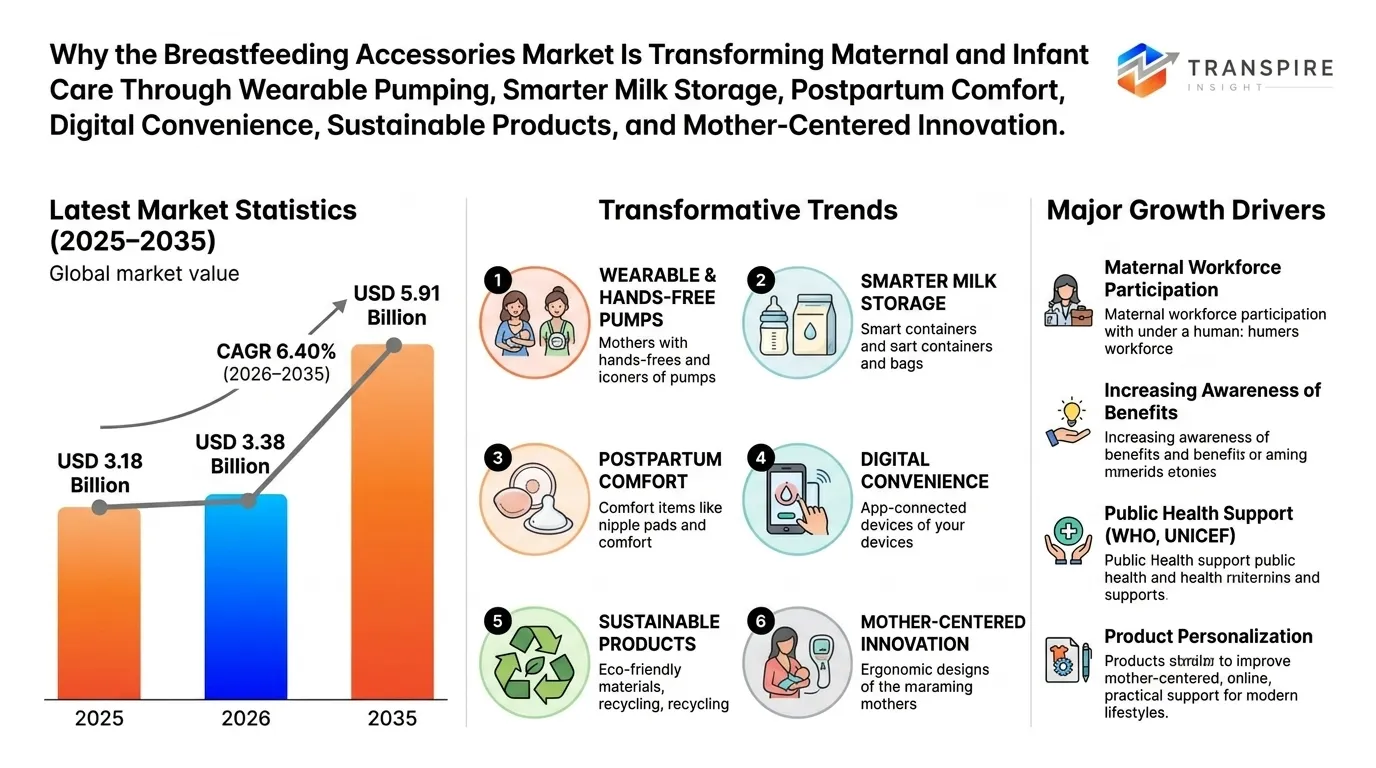
According to Transpire Insight, the global breastfeeding accessories market is estimated at approximately USD 3.18 billion in 2025 and is expected to reach around USD 3.38 billion in 2026. The market is projected to reach approximately USD 5.91 billion by 2035, expanding at an estimated CAGR of 6.40% during the forecast period 2026–2035.
The breastfeeding accessories market is becoming an increasingly important part of maternal and infant-care products as families seek greater flexibility, comfort, hygiene, mobility, and practical support throughout the breastfeeding journey. The category includes products such as breast pumps, milk-storage containers and bags, nursing pads, nipple shields, breast shells, nursing pillows, milk-collection devices, cleaning and sterilization products, lactation accessories, nursing apparel, pumping bags, and other products designed to support breastfeeding and expressed-milk management.
The market is changing alongside the way breastfeeding takes place in modern households. Mothers may breastfeed directly, express milk at home or at work, combine direct feeding with pumping, or store expressed milk for later use. This range of feeding patterns is creating demand for accessories that are easier to carry, clean, organize, store, and use across different environments.
The growth of maternal employment is particularly influencing product design. Accessories that reduce the time and physical effort associated with pumping, cleaning, transporting, and storing breast milk are gaining importance among mothers returning to work or managing demanding daily schedules.
Technology is also redefining the category. Wearable and hands-free pumping systems, compact rechargeable devices, app-connected products, improved breast shields, insulated storage solutions, and redesigned nursing accessories are shifting the market toward greater portability and usability.
At the same time, the broader public-health environment continues to reinforce the importance of breastfeeding support. WHO and UNICEF recommend initiating breastfeeding within the first hour after birth, exclusive breastfeeding for the first six months, and continued breastfeeding with complementary foods for up to two years or beyond.
The market is therefore developing around a broader principle: breastfeeding accessories are increasingly being designed not simply as products, but as tools that can make breastfeeding more manageable within modern maternal lifestyles.
Market Overview
Breastfeeding accessories are products designed to support breastfeeding, milk expression, breast-milk storage, maternal comfort, infant feeding, hygiene, and daily breastfeeding management.
The category includes both simple products and technology-enabled equipment. Basic accessories can include reusable breast pads, nursing pillows, breast shells, nipple-care products, milk-storage bags, and cleaning tools, while advanced products include electric and wearable breast pumps, rechargeable systems, app-enabled devices, insulated storage solutions, and integrated pumping accessories.
One of the most important areas is breast-milk expression. Breast pumps can help mothers express milk when they are separated from their infants, need to maintain milk supply, or choose to feed expressed milk at particular times.
The importance of expressing milk is also recognized in maternal-health guidance. WHO's maternal-health recommendations include practical support for mothers to express breast milk when temporary separation from their infants occurs.
Milk storage and feeding accessories represent another major category. Containers, storage bags, cooling solutions, bottles, labels, and organization systems can help mothers manage expressed milk across home, work, travel, and childcare settings.
Maternal comfort products are also increasingly significant. Nursing pads, breast shells, warm and cool products, nipple-care accessories, supportive nursing pillows, and other postpartum items can help mothers manage common physical and practical challenges.
WHO's 2025 maternal-health recommendations emphasize counseling and support around responsive breastfeeding, positioning and attachment, hand expression, and the use of warm or cold compresses according to individual preference in the management of common postpartum breastfeeding issues.
The market is therefore becoming increasingly comprehensive, addressing not only milk expression but the wider breastfeeding experience.
Latest Market Statistics
The global breastfeeding accessories market is expected to maintain steady growth as breastfeeding support becomes increasingly integrated with modern healthcare, maternal employment, homecare, e-commerce, and consumer-focused product design.
Transpire Insight estimates that the market stood at approximately USD 3.18 billion in 2025 and could increase to around USD 3.38 billion in 2026. By 2035, market value is projected to approach USD 5.91 billion as demand expands for pumping systems, milk-storage solutions, maternal-comfort products, hygiene accessories, and portable breastfeeding technologies.
Market growth is being supported by several structural trends, including increasing maternal workforce participation, greater awareness of breastfeeding support, expansion of postpartum care, growing access to specialized baby-care products, and increasing preference for convenient home and mobile solutions.
An important structural change is the movement from basic breastfeeding accessories to integrated breastfeeding-support ecosystems. Consumers increasingly want products that work together, from pumping and storage to cleaning, transport, feeding, and organization.
This is encouraging manufacturers to create coordinated product portfolios rather than isolated items.
Another important change is the increasing importance of convenience. A product that can reduce setup time, simplify cleaning, improve portability, or make pumping more discreet can provide significant value to mothers managing breastfeeding alongside work, travel, childcare, and household responsibilities.
The market is consequently becoming more focused on time efficiency, comfort, mobility, hygiene, and ease of use.
Major Growth Drivers
Growing need for breastfeeding support: Public-health initiatives continue to emphasize breastfeeding support, creating a broader environment for products that can help mothers initiate and maintain breastfeeding.
Increasing maternal workforce participation: Mothers returning to work can require practical solutions for expressing, storing, transporting, and managing breast milk during the day.
Expansion of wearable and portable pumping: Compact and hands-free devices can provide greater mobility than traditional pumping systems and are becoming increasingly attractive for modern lifestyles.
Growing emphasis on postpartum comfort: Greater awareness of maternal wellbeing is expanding demand for products that address comfort, breast care, feeding ergonomics, and postpartum recovery.
Growth of e-commerce: Online retail is making specialized breastfeeding products accessible to consumers beyond traditional maternity and baby-product stores.
Product innovation and personalization: Manufacturers are increasingly developing different flange sizes, breast shields, pumping modes, storage formats, nursing accessories, and ergonomic solutions to address individual preferences.
Key Applications
Breast-milk expression represents a major application area. Electric, manual, wearable, and hands-free pumps can support mothers who need or prefer to express milk.
Milk storage and transport is another critical application. Storage bags, containers, insulated carriers, cooling systems, and organization accessories help manage expressed milk across different settings.
Maternal comfort and breast care includes nursing pads, breast shells, nipple-care products, warm and cool accessories, and related postpartum-support products.
Infant feeding represents an important application for products associated with expressed breast milk, including bottles and feeding accessories where these are appropriate for the family and infant's circumstances.
Hygiene and cleaning is becoming increasingly important as mothers seek efficient ways to clean pump components, feeding products, storage containers, and other accessories.
Travel and workplace use is another growing application as portable pumps, discreet storage solutions, insulated bags, and compact cleaning systems support breastfeeding outside the home.
Download the exclusive Breastfeeding Accessories Market sample report today to uncover expert insights, emerging trends, and the opportunities defining the future of the industry.
Government Initiatives and Maternal-Health Modernization
Government and public-health initiatives are playing an important role in shaping the breastfeeding-support environment.
WHO and UNICEF continue to promote breastfeeding as an important part of infant nutrition and recommend exclusive breastfeeding during the first six months, followed by continued breastfeeding alongside complementary foods.
WHO's 2025 maternal-health guidance also emphasizes practical breastfeeding support in healthcare settings, including assistance with breastfeeding initiation and management of common difficulties.
The 2025 World Breastfeeding Week messaging further emphasized the need for governments to invest in breastfeeding support and ensure mothers have access to skilled assistance in hospitals and after returning home, alongside stronger maternity protections.
These policy priorities create a supportive environment for products that help mothers manage breastfeeding in daily life, although accessories are not a substitute for skilled breastfeeding support or healthcare advice.
In India, maternal and infant-health programs, expanding healthcare infrastructure, increasing awareness of breastfeeding benefits, urban employment, and broader access to organized baby-care retail are helping create a larger market for breastfeeding-support products.
The growing emphasis on maternal wellbeing is also encouraging more comprehensive postpartum-care models that consider physical comfort, practical support, mental wellbeing, nutrition, and infant feeding together.
Technology and Product Innovation Overview
The breastfeeding accessories market increasingly combines traditional maternal-care products with advanced consumer technology.
Electric breast pumps remain a major technology category. Improvements in motor efficiency, suction control, battery systems, noise reduction, and pumping modes are making products more convenient for regular use.
Wearable breast pumps are one of the most visible areas of innovation. Compact designs that fit inside a bra or wearable support structure can offer greater mobility and discretion.
Rechargeable systems are also becoming increasingly relevant. Battery-powered pumps can eliminate the need for continuous access to electrical outlets, making them more suitable for travel and workplace environments.
Smart connectivity is emerging in selected premium products. Connected systems can potentially record pumping sessions, monitor duration, track usage patterns, and support personalized settings.
Improved milk-storage solutions are another area of product development. Manufacturers are focusing on leak resistance, space-efficient shapes, temperature management, labeling, and organization.
Cleaning and sterilization technology is also evolving as manufacturers seek to simplify the repeated cleaning process associated with pumping and infant feeding equipment.
The market is therefore shifting toward portable, ergonomic, digitally enabled, and workflow-oriented products.
Future Importance
The future of the breastfeeding accessories market will be closely connected to maternal mobility, wearable technology, postpartum comfort, smart product design, sustainability, and personalized breastfeeding support.
The most important change is likely to be the continued reduction of the practical burden associated with pumping and expressed-milk management.
Products that require fewer components, simpler cleaning, quieter operation, improved battery life, and more comfortable fit can potentially improve user experience.
The market is also likely to become more integrated. A mother may increasingly use one connected ecosystem covering pumping, storage, cleaning, tracking, transport, and feeding.
Sustainability will become another major consideration. Reusable accessories, durable components, refillable cleaning products, recyclable packaging, and longer-lasting devices may become more attractive as consumers become more environmentally conscious.
Top Market Trends
The breastfeeding accessories market is evolving rapidly as consumers seek greater convenience, comfort, portability, and practical support.
Technological Advancements
Technology is one of the strongest forces transforming the breastfeeding accessories market.
Pump motor engineering continues to improve through better suction control, multiple pumping modes, reduced noise, and more efficient power consumption.
Wearable miniaturization is enabling manufacturers to reduce device size while retaining key pumping functions.
Battery technology is also important. Better rechargeable systems can increase the number of pumping sessions supported between charges, improving portability.
Sensor technology could eventually support more detailed measurement of pumping characteristics, although the usefulness of additional data will depend on accuracy and consumer need.
Mobile connectivity is another emerging development. Connected products could potentially allow users to track pumping duration, frequency, device usage, and personalized settings.
Advanced material design is improving softness, flexibility, heat resistance, durability, and cleaning compatibility for components that come into repeated contact with the body or breast milk.
These developments are gradually turning breastfeeding accessories into more ergonomic and technology-enabled maternal-care products.
Artificial Intelligence and Personalized Breastfeeding Support
Artificial intelligence could eventually influence breastfeeding accessories through product personalization, usage guidance, maintenance alerts, and digital support.
AI-enabled applications could potentially analyze pumping schedules, user-entered information, and selected device data to provide more individualized recommendations regarding routine organization.
Intelligent systems could also help users identify potential equipment-maintenance issues, such as abnormal pump performance, component replacement intervals, or cleaning schedules.
AI could support customer-service systems by helping mothers identify relevant product information more quickly.
However, breastfeeding is highly individual, and AI should not replace qualified lactation professionals or healthcare providers. Questions involving infant feeding difficulties, pain, low milk supply, mastitis, premature infants, or maternal health require appropriate professional evaluation.
The strongest future role for AI is therefore likely to be supportive and organizational rather than diagnostic.
Major Applications
Breast-Milk Expression: Electric, manual, wearable, and hands-free pumps support mothers who express milk for different personal or practical reasons.
Milk Storage: Bags, containers, cooling accessories, labels, and transport systems help organize expressed milk.
Maternal Comfort: Nursing pads, breast shells, care products, pillows, warm and cool accessories, and other products support comfort throughout breastfeeding.
Infant Feeding: Selected feeding accessories can support the use of expressed breast milk when direct breastfeeding is not occurring at a particular time.
Cleaning and Sterilization: Specialized cleaning, drying, and sterilization tools help manage reusable breastfeeding equipment.
Travel and Workplace: Portable pumps, insulated storage, battery systems, pumping bags, and compact accessories help mothers manage breastfeeding away from home.
Investment and Growth Opportunities
The expansion of breastfeeding support is creating opportunities for medical-device manufacturers, maternal-care brands, consumer-health companies, baby-product manufacturers, digital-health businesses, packaging companies, and specialty retailers.
One major opportunity is the development of next-generation wearable pumping systems that combine comfort, quiet operation, battery efficiency, easy cleaning, and reliable performance.
The milk-storage and transport segment also provides significant potential as mothers increasingly seek convenient solutions for work, travel, childcare, and daily mobility.
There is also a growing opportunity in postpartum comfort ecosystems that combine breastfeeding products with broader maternal-care solutions.
Another important area is smart breastfeeding technology, where pumps, mobile applications, storage systems, and reminders can be connected through a common platform.
Emerging markets represent additional growth opportunities as organized retail, e-commerce, maternal-health awareness, and access to specialized baby-care products expand.
Market Segmentation
The breastfeeding accessories market can be segmented based on product type, technology, application, end user, and distribution channel.
By product type, the market includes breast pumps, milk-storage products, nursing pads, nipple-care products, breast shells and shields, breastfeeding pillows, feeding accessories, cleaning and sterilization products, lactation-massage products, nursing apparel, and other breastfeeding-support accessories.
By technology, major categories include manual products, electric products, battery-powered products, wearable products, and connected or smart products.
By application, the market includes breast-milk expression, milk storage and transport, maternal comfort, infant feeding, hygiene and cleaning, postpartum care, and travel or workplace use.
By end user, the market includes mothers, hospitals and maternity facilities, lactation-support centers, postpartum-care providers, childcare environments, and other users.
By distribution channel, the market includes pharmacies, maternity and baby-specialty stores, supermarkets, hospitals, direct-to-consumer websites, e-commerce platforms, and other retail channels.
Proceed to Checkout to purchase the exclusive Breastfeeding Accessories Market report and gain instant access to in-depth market intelligence, strategic analysis, and future growth opportunities.
Leading and Fastest-Growing Segments
The breast-milk storage and feeding segment is expected to remain a major part of the market because storage is essential for mothers who express milk and need to manage it across different settings.
The wearable breast pump segment represents one of the strongest growth opportunities as product design increasingly focuses on mobility and hands-free use.
The postpartum comfort segment is also expected to gain importance as consumers and healthcare systems place greater emphasis on maternal wellbeing.
The online distribution segment is likely to continue expanding because specialized breastfeeding products benefit from detailed product comparisons, consumer reviews, educational content, and convenient home delivery.
The smart and connected accessory segment represents a developing opportunity as manufacturers explore digital features that can enhance product usability.
Competitive Landscape
Competition in the breastfeeding accessories market is increasingly focused on comfort, pumping performance, portability, hygiene, ergonomics, durability, ease of cleaning, battery life, design, and consumer trust.
In breast pumps, product differentiation includes suction control, noise level, portability, breast-shield design, battery life, cleaning complexity, and pumping experience.
In storage products, manufacturers compete around leak resistance, temperature handling, organization, material safety, compact storage, and convenience.
For maternal-comfort products, softness, fit, reusability, skin compatibility, ease of use, and product effectiveness are important differentiators.
The market is also becoming increasingly experience-driven. Consumers expect products to be easy to understand, easy to clean, comfortable to use, and supported by clear instructions.
Digital engagement is becoming another competitive factor, particularly among premium products. Brands can build stronger consumer relationships through educational content, product-support applications, personalized settings, and after-sales assistance.
Challenges and Restraints
Despite positive growth prospects, the breastfeeding accessories market faces several challenges.
Product safety remains critical because many accessories come into contact with mothers or expressed milk. Materials, cleaning requirements, product durability, and manufacturing quality must be carefully managed.
Ease of cleaning can significantly influence user experience. Products with multiple small components can increase the time and effort required for routine maintenance.
Fit and comfort are also important challenges, particularly for breast pumps and breast shields. Differences in anatomy mean that one design may not work equally well for every user.
High upfront cost can limit adoption of advanced wearable or connected pumping systems, especially in price-sensitive markets.
Battery and connectivity limitations can also reduce the usefulness of technology-enabled products if charging, application compatibility, or wireless reliability is inadequate.
Information quality presents another challenge. Consumers may encounter extensive online advice about breastfeeding products, but not all information is reliable or appropriate for individual circumstances.
WHO guidance continues to emphasize skilled breastfeeding support and practical counseling, reinforcing that accessories should complement—not replace—appropriate maternal and infant-care support.
Nevertheless, product innovation and improved consumer education continue to create opportunities for the industry.
Regional Market Outlook
The breastfeeding accessories market is expanding across major regions as maternal healthcare, employment patterns, e-commerce, and consumer awareness develop.
North America remains an important market because of established maternal-care infrastructure, relatively high consumer awareness of pumping and milk-storage products, strong e-commerce penetration, and broad availability of premium breastfeeding technologies.
Europe represents a mature market supported by maternal healthcare systems, established baby-care retail, workplace and family-support policies, and increasing attention to sustainable consumer products.
Asia-Pacific represents a major long-term growth opportunity. Large birth cohorts in several countries, expanding healthcare access, increasing urban employment among women, growing middle-income consumer groups, e-commerce development, and rising awareness of specialized maternal and infant products are supporting demand across India, China, Japan, South Korea, Australia, and Southeast Asia.
Latin America offers additional opportunities through expanding maternal-health services, rising urbanization, retail development, and increasing consumer access to specialized baby-care products.
Middle East & Africa are also expected to see gradual market development as maternal healthcare infrastructure, urban populations, private healthcare investment, organized retail, and awareness of breastfeeding-support products expand.
Future Market Opportunities
One of the strongest opportunities lies in advanced wearable pumping ecosystems. The combination of compact design, hands-free operation, quiet performance, improved battery life, and simple cleaning could make these products increasingly attractive.
The development of smart milk-management systems represents another important opportunity. Digital labeling, storage tracking, reminders, temperature monitoring, and mobile organization tools could help simplify expressed-milk management.
Postpartum-care integration also offers significant potential. Manufacturers can develop product portfolios that connect breastfeeding support with maternal comfort, recovery, hygiene, and daily-care needs.
There is also growing potential for sustainable breastfeeding accessories, including reusable storage options, durable pump components, recyclable materials, replaceable parts, and lower-packaging product formats.
The workplace and travel segment provides additional opportunities as mothers seek compact solutions that can be used discreetly in different environments.
Role of Automation and Advanced Manufacturing
Automation is influencing both the production and functionality of breastfeeding accessories.
Precision manufacturing can improve the consistency of pump components, valves, breast shields, storage containers, seals, and other products.
Automated quality-control systems can inspect components for dimensional accuracy, material defects, and assembly issues.
Advanced plastics and silicone-processing technologies can create softer, more flexible, durable, and ergonomically shaped components.
Digital manufacturing can also support multiple product sizes and designs, which is important when products need to accommodate different body shapes and individual preferences.
Future manufacturing systems may increasingly combine precision molding, automated assembly, digital inspection, material traceability, and flexible production.
Personalized and Precision Breastfeeding Support
Personalization is expected to become increasingly important in breastfeeding accessories because maternal needs can differ substantially.
Breast-shield fit, pumping preferences, frequency of expression, storage habits, mobility requirements, and comfort needs can all influence product selection.
Manufacturers are therefore increasingly developing multiple sizes, adjustable settings, interchangeable components, and modular designs.
Digital tools couldfurther personalize product use by remembering individual settings or providing maintenance and usage reminders.
In the future, customers may increasingly expect breastfeeding accessories to be selected around their own requirements rather than purchasing a single standardized product.
This could encourage a shift toward custom-fit, configurable, and modular breastfeeding-support systems.
Key Strategic Developments
Companies operating in the breastfeeding accessories market are expected to focus on:
These strategies demonstrate that competition is moving beyond basic breastfeeding equipment toward integrated, personalized, portable, and mother-centered care ecosystems.
Customize the exclusive Breastfeeding Accessories Market report today to receive tailored insights, country-specific analysis, and business-focused market intelligence.
Recent Industry Developments
The breastfeeding-support environment continues to evolve as public-health organizations place greater emphasis on practical assistance for mothers throughout the breastfeeding journey.
WHO and UNICEF continue to promote early initiation and exclusive breastfeeding for the first six months, while encouraging continued breastfeeding alongside complementary foods thereafter.
WHO's maternal-health guidance published in 2025 also strengthened the emphasis on practical breastfeeding support, including assistance with positioning, attachment, hand expression, and management of common breastfeeding difficulties.
During World Breastfeeding Week 2025, WHO and UNICEF highlighted the need for governments to invest in breastfeeding support, including access to skilled assistance both in healthcare facilities and after mothers return home. The messaging also emphasized maternity protections such as paid leave.
These policy developments are significant for the accessories industry because they reinforce the importance of building an environment in which mothers can practically continue breastfeeding. The strongest commercial opportunities are likely to be found in products that solve real logistical challenges without positioning accessories as replacements for skilled breastfeeding care.
The market is also moving toward greater product sophistication, with wearable pumping, portable storage, ergonomic accessories, simplified cleaning, and digital support becoming increasingly central to product-development strategies.
Market Expert View
From a market perspective, the breastfeeding accessories market is positioned for continued transformation because it sits at the intersection of maternal healthcare, infant nutrition, consumer technology, postpartum wellness, e-commerce, workplace mobility, and family lifestyle management.
The most important change is the shift from viewing breastfeeding accessories as optional baby products toward recognizing them as practical tools that can help mothers manage breastfeeding within modern daily routines.
Convenience is likely to remain one of the strongest competitive factors. Products that reduce cleaning time, improve portability, simplify storage, minimize noise, or increase comfort can provide meaningful value.
The future competitive environment is also likely to favor brands that understand the complete maternal journey rather than focusing on a single product.
Companies that can connect pumping, storage, maternal comfort, cleaning, transport, and digital support may be able to build stronger customer relationships than manufacturers of isolated products.
Another important shift will be toward greater personalization. As manufacturers offer different sizes, configurations, settings, and modular components, consumers will increasingly expect products that accommodate individual needs.
Future Outlook
The future of the breastfeeding accessories market is expected to be shaped by wearable technology, portability, personalization, maternal comfort, smart product design, sustainability, and integrated postpartum support.
Traditional accessories such as nursing pads, storage containers, breast shields, pillows, and cleaning products will remain important, while electric and wearable pumping systems are expected to drive a significant share of product innovation.
Smart technology could increasingly support tracking, maintenance, personalization, and product management, although clinical and nutritional decisions will continue to require appropriate healthcare or lactation expertise.
Sustainable products are also likely to become more important as consumers evaluate material durability, reusability, packaging, and product lifecycles.
Emerging markets are expected to provide additional opportunities as maternal healthcare, urban employment, e-commerce, and access to specialized baby-care products continue to develop.
Schedule a meeting with our market experts to discuss the exclusive Breastfeeding Accessories Market report and identify the best research solution for your organization.
Conclusion
The breastfeeding accessories market is transforming maternal and infant care by making breastfeeding, pumping, milk storage, postpartum comfort, and daily feeding management more adaptable to modern lifestyles.
Advances in wearable pumps, rechargeable systems, milk-storage solutions, ergonomic accessories, cleaning technologies, smart connectivity, and sustainable product design are expanding the capabilities of the category.
At the same time, the broader healthcare environment continues to emphasize practical breastfeeding support. WHO and UNICEF recommend early initiation, exclusive breastfeeding for the first six months, and continued breastfeeding alongside complementary foods, while WHO maternal-health guidance highlights practical support for breastfeeding initiation, positioning, attachment, expression, and common challenges.
Looking ahead, the market will increasingly depend on the ability of manufacturers to combine comfort, safety, portability, hygiene, personalization, durability, convenience, and thoughtful technology integration. As breastfeeding support becomes increasingly connected to modern maternal lifestyles, next-generation breastfeeding accessories are expected to become an increasingly important component of the global maternal and infant-care ecosystem.


Send us a brief description of your challenge and we'll get back to you within 24 hours.

 inquiry@transpireinsight.com
 APAC:+91 7666513636
 Address


