
Aug 18, 2026
By Transpire Insight
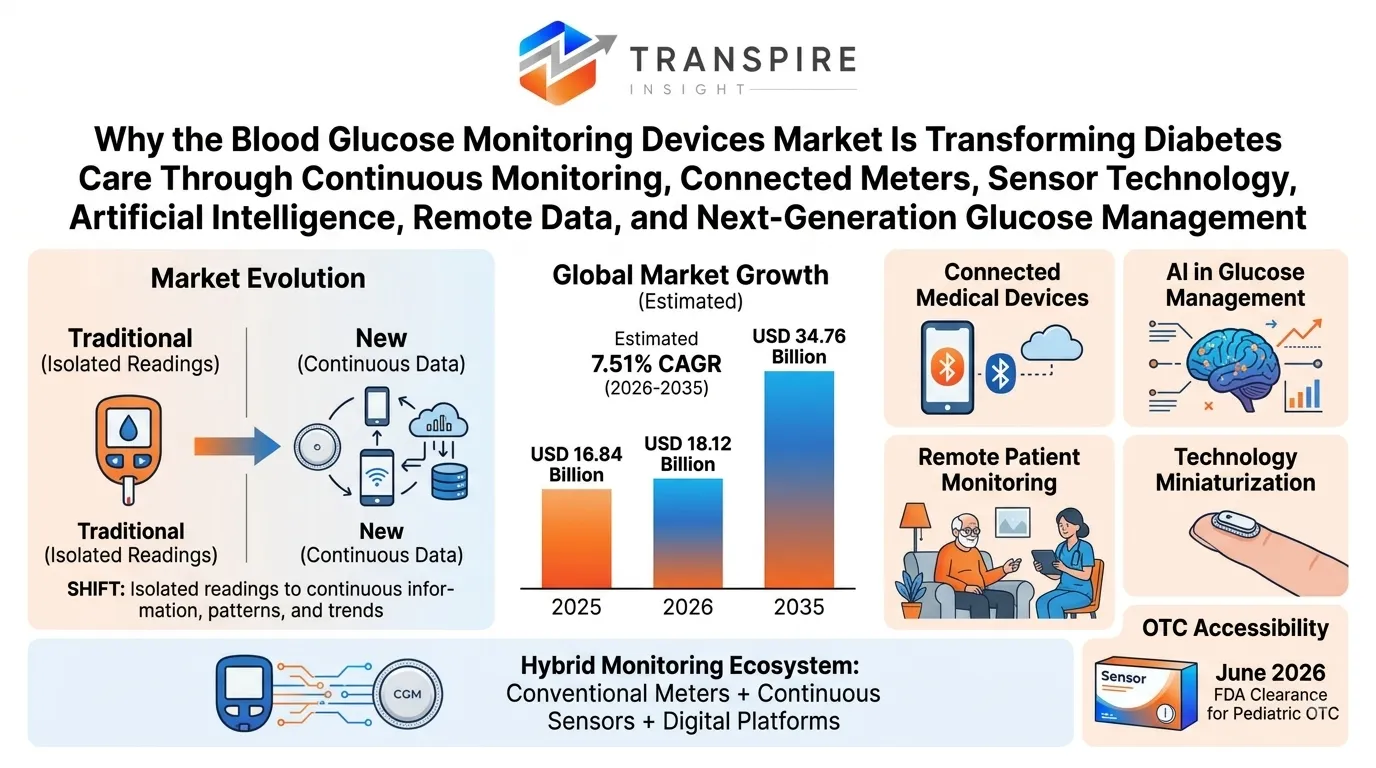
According to Transpire Insight, the global blood glucose monitoring devices market is estimated at approximately USD 16.84 billion in 2025 and is expected to reach around USD 18.12 billion in 2026. The market is projected to reach approximately USD 34.76 billion by 2035, expanding at an estimated CAGR of 7.51% during the forecast period 2026–2035.
The blood glucose monitoring devices market is entering a significant period of transformation as diabetes management increasingly moves from periodic measurement toward continuous, connected, and data-driven glucose monitoring. Blood glucose monitoring devices include traditional blood glucose meters, test strips, lancets, continuous glucose monitoring systems, sensors, transmitters, readers, and connected digital platforms used to measure and interpret glucose levels.
The market is being reshaped by the growing importance of real-time information. Conventional finger-stick testing can provide an individual glucose measurement at a specific point in time, while continuous glucose monitoring can provide a more detailed picture of glucose patterns and changes. The American Diabetes Association's 2026 Standards of Care recognizes both blood glucose monitoring and continuous glucose monitoring as key components of diabetes technology and glycemic assessment.
The transformation is particularly visible in the rapid development of wearable sensor technology. Smaller sensors, improved connectivity, mobile applications, cloud-based data sharing, and increasingly automated analysis are changing how glucose information is collected and consumed.
At the same time, traditional blood glucose meters remain important. The 2026 ADA guidance continues to emphasize access to blood glucose monitoring for people using CGM and highlights the importance of validated devices, appropriate training, and confirmatory blood glucose measurements in relevant situations.
The market is therefore developing around a hybrid glucose-monitoring ecosystem, where conventional meters, continuous sensors, software, connected devices, and clinical decision-support technologies increasingly work together.
Market Overview
Blood glucose monitoring devices are medical technologies used to measure glucose concentrations in blood or interstitial fluid for diabetes management and related monitoring applications.
Traditional blood glucose monitoring systems generally involve a meter, disposable test strips, and a lancing device. A small blood sample is applied to a test strip, after which the meter provides a numerical glucose reading.
These systems remain important because they can provide rapid point-of-care information and can be used in homes, outpatient settings, pharmacies, clinics, and hospitals. The ADA's 2026 recommendations continue to recognize blood glucose monitoring as an essential component of diabetes technology and emphasize the need for appropriately validated devices.
The market is increasingly being influenced by continuous glucose monitoring, in which a wearable sensor measures glucose levels at frequent intervals and transmits information to a receiver, smartphone, or compatible digital system.
CGM provides information that can extend beyond an individual reading by showing glucose trends, fluctuations, time in range, time above range, and time below range. The 2026 ADA standards identify these CGM metrics as important components of glycemic assessment.
Home-based monitoring remains one of the largest practical applications. People can perform regular measurements outside hospitals and share selected information with healthcare professionals or caregivers when appropriate.
Hospital and clinical monitoring is another major application. Point-of-care glucose monitoring supports treatment decisions in inpatient environments, while CGM is increasingly being evaluated and used under institutional protocols. The 2026 ADA hospital guidance continues to recommend appropriate POC confirmation for certain insulin-dosing and hypoglycemia decisions when patients are using personal CGM systems.
Remote patient monitoring is also expanding. Connected glucose meters and CGM systems can transmit information to digital platforms, enabling healthcare teams or caregivers to review data without requiring every measurement to be collected during an in-person appointment.
Latest Market Statistics
The global blood glucose monitoring devices market is expected to maintain a strong growth trajectory as diabetes management becomes increasingly technology-enabled and patients seek more convenient methods for monitoring glucose.
Transpire Insight estimates that the market reached approximately USD 16.84 billion in 2025 and could rise to around USD 18.12 billion in 2026. By 2035, the market is projected to approach USD 34.76 billion as CGM adoption, connected meters, sensor innovation, remote monitoring, and digital diabetes-management platforms become more widely integrated.
Market expansion is being supported by the increasing need for glucose monitoring across diabetes care, growing interest in continuous data, wider availability of connected devices, improving sensor design, increasing healthcare digitization, and demand for home-based care.
An important structural change is the movement from isolated readings toward continuous glucose information. Traditional meters provide valuable point measurements, while CGM systems can provide trend information that helps users and healthcare professionals understand changes over time.
This shift is increasing demand for devices that are smaller, easier to use, more comfortable, more connected, and capable of storing or transmitting larger volumes of data.
Another important change is the growing importance of interoperability. Glucose data can increasingly be connected with smartphones, health applications, electronic health records, insulin-management systems, and remote-care platforms.
The market is therefore expanding from a device category into a broader digital health ecosystem.
Major Growth Drivers
Increasing diabetes burden: The number of people requiring ongoing glucose management continues to create a large underlying need for monitoring technologies.
Growth of continuous glucose monitoring: CGM is expanding the role of glucose measurement from periodic testing toward continuous assessment and trend analysis. The ADA's 2026 recommendations support CGM use in several diabetes-management situations and emphasize individual circumstances and preferences when selecting technology.
Expansion of home healthcare: Patients increasingly manage chronic conditions outside traditional clinical settings, creating demand for convenient home-based monitoring.
Growth of connected medical devices: Bluetooth, smartphones, cloud platforms, and digital health applications are allowing glucose data to move more efficiently between devices and users.
Technology miniaturization: Smaller sensors, compact meters, improved batteries, and more integrated electronics are increasing convenience and user acceptance.
Increasing emphasis on data-driven diabetes management: Healthcare professionals and patients are increasingly interested in glucose trends, variability, and time-based metrics rather than relying exclusively on isolated measurements.
Key Applications
Self-monitoring of blood glucose remains a major application. Individuals can perform point-of-care testing at home or in other nonclinical environments.
Continuous glucose monitoring is becoming increasingly important for people who benefit from understanding glucose trends throughout the day and night.
Hospital and inpatient monitoring is another important application. Point-of-care systems are used to provide rapid glucose measurements in clinical workflows. The ADA's 2026 hospital guidance highlights the continuing role of FDA-approved point-of-care systems and the importance of accuracy, reliability, and quality control.
Remote patient monitoring is growing as connected devices enable glucose information to be transmitted outside conventional clinical appointments.
Diabetes education and self-management also represent important applications because glucose data can help patients and clinicians understand relationships between treatment, food intake, physical activity, and glucose patterns.
Download the exclusive Blood Glucose Monitoring Devices Market sample report today to uncover expert insights, emerging trends, and the opportunities defining the future of the industry.
Government Initiatives and Healthcare Modernization
Government health systems are increasingly emphasizing chronic-disease management, digital health, home-based care, and improved access to diabetes technologies.
In the United States, the regulatory landscape continues to evolve as glucose monitoring technologies move toward more accessible and connected formats. The FDA's device databases show continuing authorizations and clearances for both traditional blood glucose monitoring systems and CGM technologies.
A notable recent development occurred on June 12, 2026, when the FDA cleared the first over-the-counter continuous glucose monitor for children. The authorization expanded the labeled population for the Stelo Glucose Biosensor System to people aged two years and older who do not use insulin.
The broader healthcare environment is also moving toward digital monitoring. The FDA's sensor-based digital health device resources include authorized wearable and minimally invasive technologies capable of continuous or spot monitoring in nonclinical environments.
In India and other emerging healthcare markets, expansion of diabetes screening, hospital infrastructure, digital health services, homecare, pharmacy networks, and remote consultation is creating an increasingly favorable environment for accessible glucose monitoring technologies.
The growing importance of affordability is also likely to influence future market development. Advanced technologies can expand monitoring capabilities, but sustainable adoption requires devices, sensors, test strips, and associated services to remain accessible to patients and healthcare systems.
Technology Overview
The blood glucose monitoring devices market includes several important technology categories.
Traditional blood glucose meters use disposable test strips and a small blood sample to generate a glucose reading. Their advantages include portability, relatively rapid measurement, established clinical workflows, and broad application.
Continuous glucose monitoring systems use sensors placed on or under the skin to estimate glucose levels at regular intervals. Data can be transmitted to a receiver or compatible mobile device, depending on the system.
Flash and intermittently scanned monitoring systems can provide glucose information through sensor-based technologies with user interaction patterns that differ from conventional finger-stick testing.
Connected blood glucose meters incorporate Bluetooth or other connectivity features that allow readings to be transferred to mobile applications or digital records.
Professional CGM systems can be used by healthcare professionals to obtain glucose data over a defined monitoring period for selected clinical assessments.
The market is also moving toward integrated diabetes technology, where glucose sensors can communicate with insulin-delivery systems or broader digital management platforms.
Sensor miniaturization is another major area of innovation. Smaller components can improve comfort and potentially support longer wear periods, easier insertion, and more discreet use.
Future Importance
The future of the blood glucose monitoring devices market will be closely connected to continuous monitoring, interoperability, automation, personalized diabetes management, remote healthcare, and intelligent data analysis.
The central shift is likely to be from measuring glucose as an isolated parameter toward creating a continuous understanding of glucose behavior.
As CGM data becomes increasingly available, the value of a device will depend not only on measurement but also on how information is displayed, interpreted, shared, and incorporated into treatment decisions.
This is likely to increase the importance of software, algorithms, mobile applications, cloud systems, and clinical data-management platforms.
The future market is therefore likely to involve a combination of sensors, meters, mobile technology, analytics, and therapeutic systems rather than standalone glucose-measurement devices.
Top Market Trends
The blood glucose monitoring devices market is evolving rapidly as healthcare providers and users seek more accessible, connected, and continuous glucose information.
Technological Advancements
Technology is one of the strongest forces transforming the blood glucose monitoring devices market.
Improved sensor accuracy is a major area of development because consistent performance is critical when glucose information influences treatment decisions.
Longer sensor duration is another important objective. Longer-wear systems can reduce the frequency of sensor replacement and potentially improve convenience.
Smaller sensor designs are improving comfort and discretion, particularly as CGM moves into broader consumer populations.
Bluetooth and wireless communication are allowing glucose information to move from meters and sensors to smartphones, readers, cloud platforms, and other connected systems.
Data analytics is also becoming increasingly important. Modern systems can display trends and time-based patterns rather than only individual numbers.
The ADA's 2026 standards identify metrics such as time in range, time above range, time below range, glucose management indicator, coefficient of variation, and mean glucose as components of CGM-based glycemic assessment.
This evolution is transforming glucose monitoring from a simple measurement activity into a more comprehensive data-management process.
Artificial Intelligence and Digital Glucose Management
Artificial intelligence could become one of the most significant technologies shaping next-generation glucose monitoring.
AI systems can analyze large amounts of glucose data and potentially identify patterns related to meals, exercise, sleep, medication timing, or recurring glucose fluctuations.
Predictive models could eventually help identify elevated risk of hypoglycemia or hyperglycemia and provide alerts based on individualized data patterns.
AI can also assist clinicians by summarizing large datasets and highlighting unusual trends that may otherwise be difficult to identify manually.
The technology is particularly relevant to automated insulin delivery. Since automated systems depend on glucose information to adjust therapy, sensor quality, data continuity, and algorithmic performance are critical.
However, AI-assisted glucose management requires careful clinical validation. Incorrect predictions or inappropriate recommendations could have serious consequences, meaning regulatory oversight, algorithm transparency, data quality, cybersecurity, and healthcare-professional involvement remain essential.
Major Applications
Self-Monitoring of Blood Glucose: Finger-stick meters remain important for home-based glucose assessment and situations where confirmatory blood glucose measurements are appropriate.
Continuous Glucose Monitoring: Wearable sensors provide frequent glucose data and trend information for selected users.
Hospital Monitoring: Point-of-care systems provide rapid glucose measurements in inpatient settings, while CGM may be used under appropriate clinical protocols.
Remote Patient Monitoring: Connected systems can transmit glucose information for review outside conventional clinical settings.
Automated Insulin Delivery: CGM provides an important data input for automated insulin-delivery technologies and related diabetes-management systems.
Diabetes Education and Self-Management: Digital glucose information can support understanding of patterns associated with food, activity, medication, and daily routines.
Investment and Growth Opportunities
The expansion of digital glucose monitoring is creating opportunities for medical-device manufacturers, sensor developers, digital-health platforms, data-analytics companies, healthcare providers, and specialized software developers.
One major opportunity is the development of longer-duration CGM systems designed to reduce replacement frequency while maintaining reliable performance.
The connected blood glucose meter segment also provides substantial potential, particularly in markets where traditional BGM remains widely used and can benefit from digital connectivity.
Another important opportunity lies in integrated diabetes platforms combining glucose sensing, insulin delivery, mobile software, remote monitoring, and patient education.
The hospital and healthcare-network segment offers additional growth potential as institutions explore ways to connect glucose data with electronic records and broader clinical workflows.
Emerging markets represent a particularly important opportunity because the installed base of conventional meters creates a large potential customer population for progressively connected technologies.
Proceed to Checkout to purchase the exclusive Blood Glucose Monitoring Devices Market report and gain instant access to in-depth market intelligence, strategic analysis, and future growth opportunities.
Market Segmentation
The blood glucose monitoring devices market can be segmented based on product type, technology, application, end user, and distribution channel.
By product type, the market includes blood glucose meters, test strips, lancets, continuous glucose monitoring systems, CGM sensors, readers, transmitters, and related accessories.
By technology, major categories include self-monitoring blood glucose systems, continuous glucose monitoring, intermittently scanned monitoring, connected glucose meters, and integrated glucose-monitoring platforms.
By application, key areas include diabetes self-management, hospital monitoring, remote patient monitoring, diabetes education, research, and automated therapy systems.
By end user, the market includes hospitals, clinics, diagnostic centers, home users, pharmacies, laboratories, long-term care facilities, and other healthcare organizations.
By distribution channel, products are distributed through hospitals and clinics, pharmacies, medical-device distributors, retail channels, direct-to-consumer platforms, and e-commerce.
Leading and Fastest-Growing Segments
The continuous glucose monitoring segment is expected to represent one of the strongest growth areas because users increasingly seek continuous data and trend visibility rather than periodic readings alone.
The blood glucose meter segment will remain strategically important because finger-stick systems continue to provide a widely used and complementary monitoring approach. The ADA continues to emphasize that people using CGM should also have access to blood glucose monitoring under appropriate circumstances.
The connected monitoring segment is expected to gain momentum as smartphones and cloud platforms become more deeply integrated with medical devices.
The wearable sensor segment represents a major innovation opportunity as manufacturers focus on smaller size, improved wearability, longer duration, data connectivity, and greater user convenience.
The homecare and remote-monitoring segment is also expected to expand as chronic disease management increasingly moves outside traditional hospital environments.
Competitive Landscape
Competition in the blood glucose monitoring devices market is increasingly focused on accuracy, sensor performance, wear duration, usability, connectivity, comfort, safety, data management, and affordability.
Manufacturers are increasingly developing broader technology ecosystems rather than standalone meters.
In the traditional BGM category, companies compete through meter accuracy, test-strip efficiency, small blood-volume requirements, speed, user interface, connectivity, and overall cost.
In CGM, competitive differentiation increasingly involves sensor duration, size, accuracy, insertion experience, alarm performance, mobile connectivity, data-sharing capabilities, and integration with other diabetes technologies.
The market is also becoming more software-driven. Applications that make glucose information easier to interpret, visualize, share, and integrate into treatment workflows can increase the practical value of the underlying device.
Regulatory performance and reliability remain central competitive requirements because glucose-monitoring errors can affect clinical decisions.
Challenges and Restraints
Despite strong growth prospects, the blood glucose monitoring devices market faces several challenges.
Device accuracy remains one of the most important concerns. Small measurement discrepancies can become clinically relevant in certain circumstances, making quality assurance and appropriate device selection essential. The ADA's 2026 guidance emphasizes validated devices and quality considerations for blood glucose monitoring.
Cost and reimbursement can limit adoption, especially for advanced CGM systems and recurring sensor supplies.
Sensor wearability can also influence user acceptance. Skin irritation, insertion discomfort, adhesive performance, sensor visibility, and replacement requirements can affect long-term use.
Data overload is another emerging issue. Continuous monitoring can generate very large quantities of information, potentially overwhelming users or healthcare professionals if data are not presented effectively.
Interoperability can remain challenging when devices use different software environments or data standards.
Cybersecurity and privacy are increasingly important as glucose data is transmitted through smartphones, cloud systems, and remote-care platforms.
There are also situations where confirmatory testing remains important. The ADA's 2026 hospital guidance recommends appropriate POC confirmation for selected insulin-dosing and hypoglycemia decisions involving CGM.
Nevertheless, continuing innovation in sensors, software, connectivity, and manufacturing is creating opportunities to address these barriers.
Regional Market Outlook
The blood glucose monitoring devices market is expanding across major regions as diabetes care, medical technology, home healthcare, and digital health capabilities develop.
North America remains an important market because of advanced healthcare infrastructure, established diabetes-management systems, high adoption of connected health technologies, strong medical-device ecosystems, and increasing availability of CGM products.
Recent regulatory actions also show continued expansion in the accessible monitoring landscape. In June 2026, the FDA cleared an OTC CGM indication for children aged two years and older who do not use insulin, broadening access to wearable glucose monitoring technology.
Europe represents a mature market supported by healthcare infrastructure, diabetes-management programs, digital health adoption, medical-device innovation, and increasing interest in remote monitoring.
Asia-Pacific represents a major long-term growth opportunity. Rising diabetes prevalence, expanding healthcare infrastructure, increasing digital-health adoption, growing middle-class populations, and broader availability of medical devices are supporting demand across China, India, Japan, South Korea, Australia, and Southeast Asia.
Latin America offers additional opportunities through expanding healthcare access, diabetes awareness, pharmacy networks, homecare services, and increasing demand for convenient monitoring tools.
Middle East & Africa are also expected to provide further growth opportunities as healthcare modernization, diabetes-management initiatives, private healthcare investment, and digital monitoring capabilities expand.
Future Market Opportunities
One of the strongest future opportunities lies in long-duration and minimally intrusive CGM systems. Longer sensor life and improved comfort could encourage broader adoption among users who are sensitive to replacement frequency or device burden.
The development of interoperable glucose ecosystems represents another major opportunity. Devices that can communicate effectively with insulin pumps, automated insulin-delivery systems, smartphones, electronic records, and remote-care platforms can provide greater value than isolated devices.
AI-assisted glucose interpretation is also expected to create opportunities. Intelligent systems could help convert large amounts of continuous data into clearer trends and alerts.
The OTC glucose-monitoring market may provide additional expansion potential as regulatory pathways evolve and manufacturers develop products for broader populations.
There is also significant opportunity in emerging markets, where affordable connected meters and simplified CGM solutions could help expand access to modern glucose-management technologies.
Role of Automation and Advanced Manufacturing
Automation is changing both the manufacturing and operation of glucose-monitoring devices.
Advanced manufacturing systems can improve sensor consistency, electronics assembly, packaging, and quality control.
Automated inspection can support the identification of manufacturing defects before products enter clinical or consumer markets.
Digital production systems can also improve traceability by linking components, batches, testing information, and distribution records.
Within healthcare environments, automation is increasingly relevant to data management. Connected glucose devices can automatically transfer readings into digital systems, reducing manual transcription.
Future manufacturing platforms may increasingly combine microfabrication, sensor engineering, automated quality control, software validation, and digital traceability.
Personalized and Precision Glucose Monitoring
The shift toward personalized diabetes management is expected to influence the future of glucose monitoring.
Not every person requires the same frequency of measurement, device type, alarm configuration, or data-management approach.
Some individuals may rely primarily on finger-stick monitoring, while others may benefit from continuous sensing depending on their treatment, circumstances, preferences, access, and clinical needs
The ADA's 2026 standards explicitly emphasize individualized selection of glucose-monitoring technology and recognize the importance of matching devices to individual circumstances and treatment requirements.
Future systems may therefore become increasingly configurable, allowing users and healthcare professionals to tailor alert thresholds, data displays, sharing permissions, monitoring schedules, and integration settings.
This could create a broader shift toward patient-centered glucose technology rather than standardized device experiences.
Customize the exclusive Blood Glucose Monitoring Devices Market report today to receive tailored insights, country-specific analysis, and business-focused market intelligence.
Key Strategic Developments
Companies operating in the blood glucose monitoring devices market are expected to focus on:
These strategies demonstrate that competition is moving beyond basic glucose measurement toward connected, continuous, personalized, and increasingly intelligent glucose-management ecosystems.
Recent Industry Developments
The blood glucose monitoring industry has experienced several important regulatory and technology developments during 2026.
On February 3, 2026, the FDA recorded a clearance for the Dexcom G7 Continuous Glucose Monitoring System and its 15-day version, reflecting continued development of the CGM category toward longer-duration wearable monitoring. The FDA device database also records a further G7-related clearance on June 8, 2026.
On June 12, 2026, the FDA cleared the first OTC continuous glucose monitor for children. The expanded authorization applies to individuals aged two years and older who do not use insulin and represents an important development in the accessibility of wearable glucose-monitoring technology.
The traditional blood glucose monitoring category also continues to develop. FDA records show 2026 clearances and regulatory updates for several home-use glucose monitoring systems, demonstrating ongoing activity in the conventional BGM segment alongside the rapid growth of CGM.
Safety and quality remain equally important. On April 28, 2026, the FDA issued a safety communication concerning TRUE METRIX blood glucose monitoring systems, following a recall and recommendations for affected users to transition to alternative testing methods when possible.
These developments show that the market is progressing in two directions simultaneously: expanding access to advanced continuous monitoring while maintaining strong regulatory attention to the safety, accuracy, and reliability of conventional glucose-monitoring devices.
Market Expert View
From a market perspective, the blood glucose monitoring devices market is positioned for continued transformation because it sits at the intersection of diabetes care, medical devices, digital health, wearable technology, remote monitoring, artificial intelligence, and connected healthcare.
The most important competitive shift is the transition from isolated glucose readings toward continuous data ecosystems.
This does not eliminate traditional blood glucose meters. Instead, the market is increasingly becoming complementary, with BGM and CGM serving different needs and circumstances.
The strongest companies are likely to be those that can provide reliable sensing hardware while also delivering strong software, interoperability, data-sharing capabilities, user education, and clinical integration.
Another major development will be the growing importance of access. As advanced monitoring becomes more widely available, affordability, reimbursement, device simplicity, and ease of use will increasingly influence adoption alongside technological performance.
The future market will therefore be shaped not simply by who can measure glucose more frequently, but by who can make glucose data more accurate, more actionable, more accessible, and easier to integrate into everyday diabetes management.
Future Outlook
The future of the blood glucose monitoring devices market is expected to be shaped by continuous sensing, miniaturized wearables, connected meters, artificial intelligence, interoperability, remote healthcare, automated treatment, and personalized glucose management.
Traditional blood glucose meters and test strips will continue to serve a critical role, particularly where point-of-care confirmation, affordability, or specific monitoring situations make finger-stick testing valuable.
At the same time, CGM is expected to continue expanding as sensors become smaller, longer-lasting, more connected, and potentially more accessible to broader populations.
AI and advanced analytics could transform the way continuous glucose information is interpreted, helping users and clinicians focus on clinically meaningful patterns rather than raw data volume.
Connected platforms could also increasingly link glucose monitoring with insulin delivery, nutrition tracking, physical activity, sleep information, and broader digital health systems.
Emerging economies are expected to provide additional opportunities as diabetes care expands, healthcare infrastructure improves, and connected medical technologies become more accessible.
Schedule a meeting with our market experts to discuss the exclusive Blood Glucose Monitoring Devices Market report and identify the best research solution for your organization.
Conclusion
The blood glucose monitoring devices market is transforming diabetes management by moving glucose measurement from periodic, isolated readings toward increasingly continuous, connected, and data-driven monitoring.
Advances in CGM sensors, connected blood glucose meters, wearable technology, wireless communication, cloud platforms, artificial intelligence, and automated insulin-delivery integration are expanding the capabilities of modern glucose-monitoring systems.
At the same time, conventional blood glucose monitoring remains an important part of the ecosystem, with clinical guidelines continuing to emphasize access to validated blood glucose measurement even for people using CGM.
The market's future will increasingly depend on the ability of manufacturers and digital-health providers to combine accuracy, safety, comfort, affordability, interoperability, intelligent analytics, and patient-centered design.
As diabetes management becomes more connected and increasingly personalized, next-generation blood glucose monitoring technologies are expected to become an even more important foundation of home healthcare, clinical decision-making, remote monitoring, and digitally enabled chronic-disease management.


Send us a brief description of your challenge and we'll get back to you within 24 hours.

 inquiry@transpireinsight.com
 APAC:+91 7666513636
 Address


