
Sep 17, 2026
By Transpire Insight
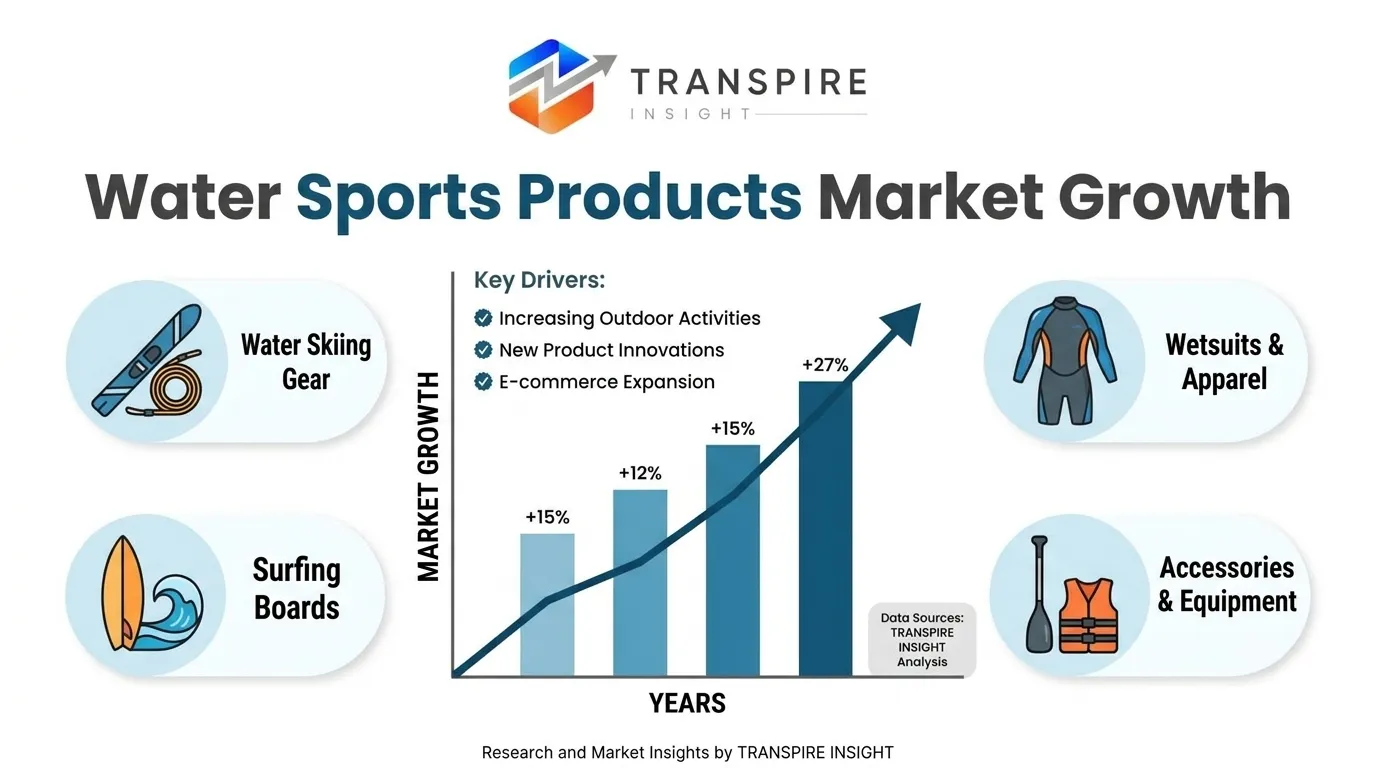
As participation in recreational water activities expands, consumers are spending more on equipment, safety products and performance gear, creating new opportunities for manufacturers to innovate across water sports categories.
For years, water sports products were largely associated with professional athletes, specialist enthusiasts and consumers living close to established coastal recreation markets. Equipment such as surfboards, kayaks, water skis, paddleboards, diving gear and safety products was often considered a niche segment within the broader sporting-goods industry.
That equation is changing.
Water sports are becoming increasingly connected with outdoor recreation, adventure tourism, health and wellness and experience-driven leisure. Consumers are showing greater interest in activities such as swimming, surfing, kayaking, paddleboarding, scuba diving and water skiing, while tourism destinations are expanding their water-based recreational offerings.
The global water sports products market was valued at approximately USD 42.5 billion in 2025 and is projected to reach around USD 81.1 billion by 2035, expanding at a CAGR of 6.7% during 2026–2035. The market is being supported by rising participation in recreational water sports, growing outdoor-tourism activity, product innovation and increasing consumer interest in environmentally responsible equipment.
The opportunity is also becoming increasingly relevant to Asia-Pacific markets, where rising disposable incomes, expanding tourism infrastructure and growing interest in adventure activities are supporting demand for water sports products. India is one example of this emerging opportunity. India's surface water sports equipment market generated approximately USD 312.6 million in revenue in 2024 and is projected to reach USD 469.2 million by 2030, growing at a CAGR of 6.9% from 2025 to 2030.
For sports-equipment companies, these developments point to a market that is becoming increasingly difficult to overlook. The opportunity extends beyond specialist equipment to safety products, accessories, performance gear, rental equipment and digitally enabled products.
Water Sports Demand Is Becoming a Bigger Growth Story
The scale of participation in water-based recreation is creating a broader market opportunity for manufacturers.
Water sports products cover a wide range of categories, including surfboards, paddleboards, kayaks, water skis, wakeboards, diving equipment, snorkeling gear, swimming equipment and safety products. This diversity allows companies to address consumers across recreational, professional and adventure-oriented activities.
The growth is being supported by a wider shift toward outdoor and experience-driven leisure. Consumers are increasingly looking for recreational activities that combine physical activity, travel and social experiences.
Health and wellness are also contributing to the trend. Swimming, paddleboarding, kayaking and other water activities offer consumers opportunities for exercise and recreation, while adventure tourism is creating new demand for specialised equipment.
The result is a market where consumers are not simply purchasing products for occasional use. Enthusiasts and experienced participants can upgrade equipment as their skills improve, while first-time users create demand for affordable entry-level products.
This creates a dual opportunity for manufacturers: attract new participants with accessible products while encouraging existing users to trade up to higher-performance equipment.
The Water Sports Shopping Basket Is Changing
The water sports product category is becoming increasingly diverse.
Traditional equipment remains important, but consumers are also spending on accessories, protective products, safety equipment and specialised gear designed for particular activities.
Surfing and paddle sports are creating demand for boards and paddles. Kayaking requires boats, paddles and safety equipment. Diving and snorkeling create opportunities for masks, fins, regulators, buoyancy equipment and related accessories.
Safety is another important part of the product ecosystem. Life jackets, buoyancy aids, helmets and other protective equipment are increasingly important as participation expands and water sports operators place greater emphasis on safety.
At the same time, consumers are becoming more willing to pay for products that offer better performance, durability, comfort and design.
This is creating an opportunity for premiumisation.
Water sports consumers are not necessarily looking only for the cheapest products. Experienced participants can be willing to invest in lighter materials, improved construction, better ergonomics and equipment designed for specific performance requirements.
For manufacturers, this creates two parallel opportunities: bringing new participants into the category through affordable products and increasing spending among established users through premium equipment.
Market Size and Statistics
How Technology Is Changing Water Sports Products
Technology is transforming the way water sports products are designed, manufactured and used.
Manufacturers are increasingly focusing on lighter materials, improved durability, enhanced ergonomics and equipment that delivers better performance without significantly increasing weight.
Technology is also supporting the development of specialised equipment. Sensors and connected electronics can increasingly be incorporated into sports and safety products, while advanced materials can improve buoyancy, flexibility, strength and resistance to environmental conditions.
Product innovation is particularly important in competitive and performance-oriented segments, where relatively small improvements in weight, stability, control or hydrodynamics can influence the overall user experience.
The industry is also seeing greater attention to sustainability.
Consumers and brands are increasingly considering the environmental impact of equipment, from the materials used in manufacturing to product durability and end-of-life disposal. Industry research indicates that environmental responsibility is reshaping purchasing decisions, with manufacturers investing in alternative materials, more efficient production and longer-lasting designs.
This creates another competitive dimension for companies: products need to deliver performance while also addressing growing environmental expectations.
Adventure Tourism Is Expanding the Opportunity
The growth of water-based tourism is creating an additional route for market expansion.
Destinations with coastlines, lakes, rivers and other water resources are increasingly developing recreational activities around surfing, scuba diving, kayaking, rafting, parasailing and other water sports.
India provides an example of this development.
In March 2026, India's Ministry of Tourism stated that the National Institute of Water Sports under IITTM conducts training and certification related to scuba diving, surfing, parasailing, canoeing and other water sports. The ministry also said that Andaman & Nicobar Islands, Gujarat and Odisha had approached the institute regarding satellite centres for water-sports training and capacity building.
This type of infrastructure development can support the broader water sports ecosystem because trained operators, safer facilities and increased consumer awareness can encourage participation.
For product manufacturers, tourism creates both direct and indirect opportunities.
Tourists may purchase equipment for personal use, while resorts, water-sports operators and rental businesses require fleets of equipment, safety products and replacement gear.
How Water Sports Companies Are Fighting for a Share of the Market
For water sports companies, the opportunity is no longer simply about producing equipment. As participation expands and competition increases, companies need to combine product performance, affordability, safety, sustainability and distribution.
The first battleground is product performance.
Consumers participating in surfing, diving, kayaking, paddleboarding and other activities often look for equipment that improves control, durability and overall experience. Manufacturers are therefore investing in materials and designs that can differentiate their products.
Then comes affordability.
New participants may be reluctant to make large investments before developing an interest in a particular activity. Companies are therefore offering entry-level products alongside premium equipment, allowing consumers to enter the category at different price points.
The next advantage is safety.
As participation grows, demand for life jackets, buoyancy aids, helmets, protective equipment and other safety products can increase. Safety is particularly important for recreational users and tourism operators.
Technology is another competitive factor.
Manufacturers are exploring improved materials, product designs and connected technologies that can enhance performance, convenience and monitoring.
Finally, companies are competing on sustainability.
Longer-lasting products, alternative materials and more environmentally responsible manufacturing can help brands respond to consumers who increasingly consider ecological impact when making purchasing decisions.
Ultimately, the competition is becoming a race across five fronts: performance, affordability, safety, technology and sustainability.
The companies that combine these elements effectively will be better positioned to convert increasing participation in water sports into lasting market share.
The Risk: Water Sports Demand Depends on Participation, Tourism and Weather
The water sports products opportunity is substantial, but it is also exposed to several risks.
Participation can be influenced by disposable income, tourism activity, weather conditions and access to suitable recreational facilities. Water sports are also more seasonal than many other sporting-goods categories, creating potential fluctuations in demand.
Safety and regulation represent another challenge.
Governments and tourism operators increasingly focus on training, certification and safe operating practices. In March 2026, India's Ministry of Tourism described NIWS-IITTM as the country's nodal government institution for training, certification and capacity building in water sports.
Environmental conditions can also affect the industry.
Water quality, coastal conditions, extreme weather events and environmental degradation can influence where and when certain activities can take place.
Manufacturers also face increasing pressure to manage material costs and sustainability requirements.
This creates a difficult equation for companies:
Consumers want high-performance products → equipment needs to remain affordable → manufacturers face material, production and sustainability pressures.
How companies balance these three pressures could determine how much of the water sports opportunity becomes profitable growth.
Top 5 Markets Benefiting From the Water Sports Products Boom
Surfing, stand-up paddleboarding and related board sports are among the key areas benefiting from increasing participation in outdoor recreation.
Demand is being supported by coastal tourism, recreational participation and product innovation. Manufacturers are developing boards and accessories for both beginners and experienced participants.
Companies such as Naish International, O'Neill, Hurley, Body Glove and Hobie Cat Company operate across relevant parts of the water sports ecosystem.
Swimming remains one of the most accessible water-based activities, supporting demand for training and recreational equipment.
The broader water sports equipment market includes swimming-related equipment alongside surfing, kayaking, diving and other activities. Increasing awareness of health benefits and participation in recreational water activities are identified as key market growth drivers.
Companies such as Speedo International, Arena and Decathlon are positioned to benefit from continued consumer participation and product innovation.
Scuba diving and snorkeling are benefiting from the expansion of marine tourism and adventure travel.
Consumers require specialised equipment including masks, fins, snorkels, diving systems and safety products. Professional and recreational users can also create demand for higher-value equipment as experience increases.
Companies including Aqua Lung International, Cressi, Scubapro, Mares and Beuchat have established positions across the diving equipment ecosystem.
Kayaking and canoeing are gaining visibility as recreational and adventure activities.
These categories benefit from the growing popularity of outdoor experiences, inland-water recreation and adventure tourism. Demand extends beyond boats to paddles, safety products, storage equipment and accessories.
As more destinations develop water-based tourism activities, rental operators and adventure-tourism companies can become important channels for equipment manufacturers.
Safety equipment represents an essential part of the water sports ecosystem.
Life jackets, buoyancy aids, helmets and other protective products are required across multiple activities, from recreational boating and kayaking to organised water sports.
Growing participation can therefore create demand not only for performance equipment but also for products designed to reduce risk and improve safety.
For manufacturers, this segment offers an opportunity to combine regulatory compliance, product reliability and innovation.
Conclusion
The growing participation in water sports is creating a significant opportunity for manufacturers of equipment, accessories and safety products.
The global water sports products market is projected to expand from approximately USD 42.5 billion in 2025 to USD 81.1 billion by 2035, while India's surface water sports equipment market is expected to grow from USD 312.6 million in 2024 to USD 469.2 million by 2030.
Rising interest in outdoor recreation, adventure tourism, health and wellness, product premiumisation and sustainable equipment is broadening the market beyond traditional professional users.
However, seasonality, weather conditions, safety requirements, environmental concerns and input costs will continue to create challenges.
The companies that can combine performance, affordability, safety, innovation and sustainability will be better positioned to convert rising participation in water sports into sustainable market share and profitable growth.


Send us a brief description of your challenge and we'll get back to you within 24 hours.

 inquiry@transpireinsight.com
 APAC:+91 7666513636
 Address


