
Oct 10, 2026
By Transpire Insight
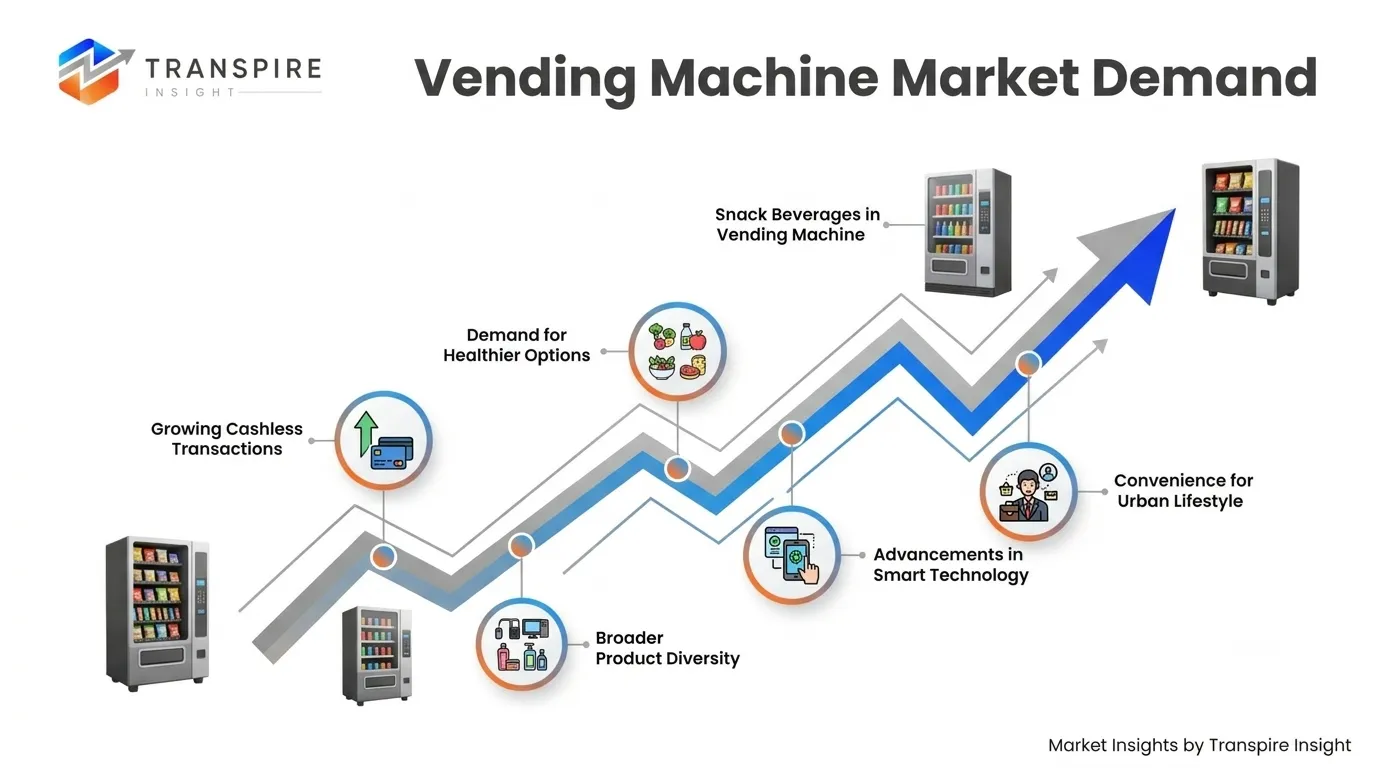
The Vending Machine Market is evolving from traditional coin-operated equipment into a connected unattended-retail ecosystem. Cashless payments, telemetry, smart coolers, AI-enabled inventory management, remote monitoring, and healthier product categories are creating new commercial models across offices, transportation hubs, schools, factories, hospitals, and public spaces.
Vending Machine Market Overview
The Vending Machine Market includes automated retail equipment used to sell beverages, snacks, food, personal-care products, electronics, medicines, and other consumer goods.
Modern vending formats include:
Transpire Insights estimates the global Vending Machine Market at approximately USD 73.85 billion in 2025, rising to around USD 76.70 billion in 2026 and reaching nearly USD 101.95 billion by 2033, representing a CAGR of approximately 4.12%.
Latest Global Market Developments
The 2026 U.S. vending and micro-market industry report estimated industry revenue at USD 40.04 billion in 2025, up 18.3% year over year, while smart coolers increasingly became a mainstream operating format.
By the end of 2025, approximately 8.1 million of the world's 14 million vending machines were connected, according to data cited from Berg Insight.
Smart coolers can provide a middle ground between conventional vending machines and full micro-markets, especially in locations where space or security limits larger installations.
Contactless cards, mobile wallets, QR payments, and digital payment terminals are reducing dependence on cash.
Connected machines allow operators to monitor inventory, sales, machine faults, temperature, and maintenance remotely.
Operators increasingly use vending for fresh foods, healthy snacks, electronics, personal-care items, and specialty products.
Rather than completely replacing vending machines, micro-markets and smart coolers are creating additional unattended-retail formats.
Machine-level sales and inventory data can help operators optimize product selection, pricing, replenishment, and location strategy.
Why Vending Machines Matter?
Vending provides consumers with access to products without requiring permanent retail staffing.
Key advantages include:
Key Factors Driving the Market
1. Labor-Cost Pressure
Automated retail can reduce dependence on continuous staffing.
2. Cashless Payments
Digital payment infrastructure makes vending faster and more convenient.
3. Connected Equipment
IoT connectivity allows remote management and predictive maintenance.
4. Convenience Culture
Consumers increasingly value immediate access to food, beverages, and everyday products.
5. Smart Retail
AI, computer vision, telemetry, and digital pricing are transforming unattended retail.
Five High-Potential Markets
1. United States
The U.S. remains a major vending market, supported by workplaces, factories, schools, hospitals, transportation facilities, and convenience services.
2. Japan
Japan has one of the world's most developed vending ecosystems, supported by high machine density and consumer familiarity.
3. China
China offers substantial growth potential through smart retail, cashless payments, and connected commerce.
4. South Korea
South Korea combines advanced digital-payment infrastructure with strong consumer adoption of automated retail technologies.
5. India
India offers opportunities in offices, metro stations, airports, hospitals, colleges, factories, and residential developments as digital payments continue expanding.
Competitive Landscape
Top 5 Companies
Opportunities for Small Investors
Challenges & Restraints
Equipment costs, vandalism, theft, location quality, maintenance, electricity consumption, product spoilage, payment-system failures, and inventory logistics can affect profitability.
Smart equipment also requires greater technical expertise than traditional machines.
Conclusion
The Vending Machine Market is increasingly becoming part of a wider unattended-retail ecosystem.
The 2026 industry data show that smart coolers and connected machines are moving toward mainstream adoption, while the connected installed base already represents a substantial portion of global vending equipment.
The next phase of market growth will likely focus on cashless transactions, computer vision, smart coolers, predictive maintenance, fresh food, and data-driven location management.


Send us a brief description of your challenge and we'll get back to you within 24 hours.

 inquiry@transpireinsight.com
 APAC:+91 7666513636
 Address


