
Oct 07, 2026
By Transpire Insight
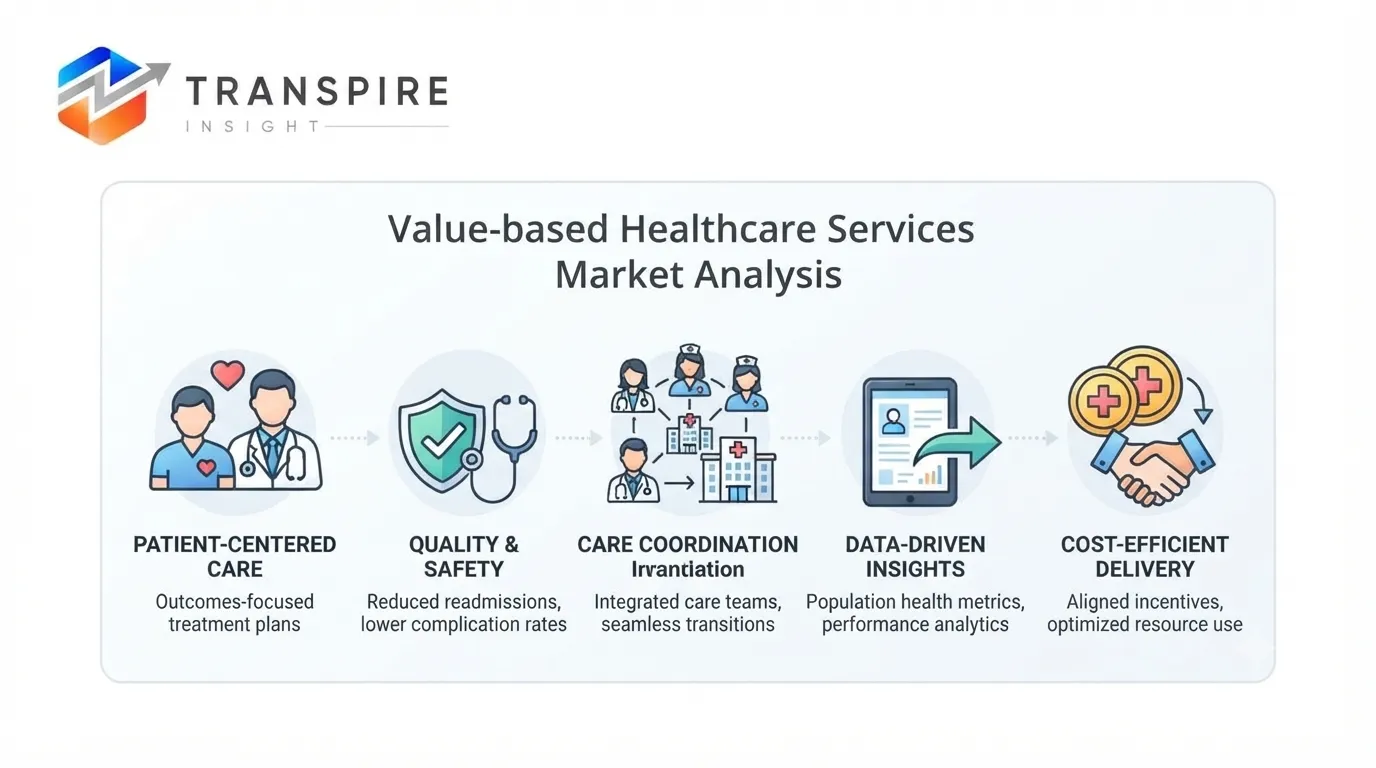
Value-based healthcare services are transforming the way healthcare organizations approach patient care, reimbursement, prevention, and long-term health management. Instead of emphasizing the volume of consultations, procedures, and hospital services delivered, value-based models place greater importance on measurable outcomes, quality, patient experience, coordinated care, and the efficient management of healthcare resources.
The expansion of population health management, remote monitoring, artificial intelligence, digital health platforms, accountable care organizations, bundled payments, and risk-based reimbursement is creating a broader ecosystem for value-based healthcare services. Providers, payers, technology companies, and government organizations are increasingly using data and coordinated care models to identify health risks earlier and manage patients across the complete care journey.
Market Size
According to Transpire Insight, the global Value-based Healthcare Services Market was valued at approximately USD 1.92 trillion in 2025 and is projected to reach approximately USD 4.143 trillion by 2033, expanding at a CAGR of 9.02% from 2026 to 2033. The market encompasses integrated care services, population health management, pay-for-performance models, telehealth services, AI-based care management, and related value-oriented healthcare delivery solutions.
The expansion of the market is supported by rising healthcare expenditure, increasing chronic disease prevalence, demand for preventive healthcare, pressure to improve clinical outcomes, growing digitalization, and the movement toward reimbursement structures that connect provider performance with quality and cost outcomes.
Value-based Healthcare Is Shifting the Focus From Volume to Outcomes
Traditional fee-for-service healthcare generally reimburses providers according to the services delivered. Value-based healthcare changes this structure by placing greater emphasis on whether those services contribute to better health outcomes and patient experience.
CMS describes value-based care as healthcare designed around quality of care, provider performance, and patient experience. Its approach also emphasizes coordination between providers and consideration of patients' broader health needs.
This transition creates demand for services that can measure outcomes, identify care gaps, coordinate providers, manage chronic diseases, and support patients outside traditional clinical settings.
Value-based healthcare therefore extends beyond payment methodology. It increasingly incorporates care-management services, analytics, digital platforms, remote monitoring, preventive interventions, and patient-engagement programs.
Population Health Management Is Becoming a Core Service
Population health management is one of the central components of value-based healthcare.
Instead of treating each patient encounter independently, healthcare organizations analyze groups of patients to identify patterns, risks, care gaps, and opportunities for intervention.
Population health platforms can help providers identify patients who have missed preventive screenings, require medication-management support, have poorly controlled chronic conditions, or face elevated hospitalization risks.
The ability to combine clinical information with claims, demographic, behavioral, and social data is becoming increasingly important.
AI and machine learning are also expanding the capabilities of population health management. Predictive models can help organizations identify high-risk populations and prioritize interventions.
Optum, for example, launched its Value Connect platform in 2026, describing it as an AI-powered system that combines clinical, operational, and financial information to help payers and providers understand patient populations and prioritize interventions.
Chronic Disease Management Is Driving Demand
Chronic conditions are an important driver of value-based healthcare adoption because they often require continuous management rather than isolated treatment.
Diabetes, cardiovascular disease, kidney disease, respiratory conditions, and multiple chronic illnesses can require regular monitoring, medication adherence, lifestyle management, specialist coordination, and preventive intervention.
Value-based models encourage providers to manage these conditions proactively.
Humana describes its value-based approach as emphasizing prevention, chronic-condition management, coordinated care, and long-term wellness rather than simply increasing service volume.
For healthcare providers and payers, effective chronic-care management can also help identify deterioration earlier and reduce avoidable utilization.
Preventive Care Is Becoming More Important
Prevention represents a major area of value-based healthcare.
Traditional care can become heavily concentrated around treatment after illness occurs. Value-based models encourage healthcare organizations to identify health risks earlier through screenings, wellness visits, vaccination, lifestyle programs, and chronic-disease monitoring.
CMS value-based programs are designed around better care for individuals, improved population health, and lower healthcare costs.
The emphasis on prevention creates opportunities for healthcare service providers offering health assessments, remote monitoring, patient education, behavioral-health support, and care-navigation programs.
Accountable Care Organizations Are Expanding the Ecosystem
Accountable Care Organizations, or ACOs, are an important component of value-based healthcare.
An ACO brings together healthcare professionals and organizations that agree to coordinate care for a defined population while being accountable for quality and, in some models, healthcare spending.
CMS describes accountable care as a model in which care teams take responsibility for improving outcomes and coordinating care while reducing fragmentation and unnecessary costs.
ACO models require sophisticated data management, quality measurement, care coordination, patient outreach, and financial analytics.
This creates opportunities for companies providing population-health platforms, clinical decision support, risk-management tools, analytics, and care-management services.
Agilon Health is an example of a company built around value-based primary care. Its Total Care Model works with physician groups to support comprehensive care for senior populations.
Pay-for-Performance Models Are Encouraging Quality Measurement
Pay-for-performance models connect a portion of provider reimbursement to predefined quality measures.
These measures can include preventive screening, hospital readmissions, patient safety, chronic-disease management, patient experience, and other clinical outcomes.
CMS's Hospital Value-Based Purchasing Program, for example, links Medicare hospital payments to measures including mortality and complications, healthcare-associated infections, patient safety, patient experience, and efficiency.
The growing use of quality-linked reimbursement increases demand for systems capable of collecting, validating, analyzing, and reporting performance information.
Healthcare organizations must therefore build infrastructure capable of translating clinical activity into measurable outcomes.
Bundled Payments Are Encouraging Coordinated Care
Bundled payment models combine multiple services associated with a particular treatment or episode of care into a coordinated payment arrangement.
Instead of evaluating each service independently, providers may be assessed based on the overall cost and quality of a defined episode.
This approach can encourage hospitals, physicians, rehabilitation providers, and other participants to coordinate care.
The growth of bundled payment arrangements is increasing demand for claims analytics, episode management, care coordination, utilization management, and outcome measurement.
It also requires healthcare organizations to understand where unnecessary costs occur across the patient journey.
Telehealth Is Supporting Continuous Care
Telehealth has become an important component of value-based healthcare because it can extend clinical support beyond traditional healthcare facilities.
Virtual consultations can help patients receive follow-up care, chronic-disease management, behavioral-health services, and specialist consultations without always requiring an in-person visit.
CMS highlights coordinated communication and expanded options for how patients receive care as features of value-based models.
Remote care can also support populations that have transportation difficulties or limited access to specialized healthcare.
The integration of telehealth with electronic health records, remote patient monitoring, wearable devices, and population-health platforms can create a more continuous care environment.
Remote Patient Monitoring Is Increasingly Relevant
Remote patient monitoring allows healthcare providers to collect information from patients outside clinical facilities.
Connected blood-pressure monitors, glucose devices, pulse oximeters, wearable sensors, connected scales, and other devices can provide healthcare teams with more frequent information about patient conditions.
For value-based organizations, these technologies can support earlier interventions and ongoing chronic-care management.
The combination of remote monitoring and predictive analytics can also help healthcare teams identify changes that may require attention.
This is particularly relevant for older populations and patients with chronic conditions requiring frequent monitoring.
Artificial Intelligence Is Changing Care Management
Artificial intelligence is becoming an important technology layer within value-based healthcare services.
AI can analyze large datasets, identify patterns, segment patient populations, support risk stratification, automate administrative workflows, and assist healthcare professionals in identifying care opportunities.
Optum's 2026 Value Connect initiative illustrates the growing use of AI to connect clinical, operational, and financial information for value-based care management.
AI can also support predictive analytics for hospital readmission risk, medication adherence, disease progression, and care-gap identification.
However, the effectiveness of AI depends heavily on data quality, interoperability, clinical validation, privacy controls, and appropriate human oversight.
Interoperability Is Critical for Value-based Care
Value-based healthcare requires information to move across providers, payers, laboratories, pharmacies, hospitals, and other organizations.
Fragmented data can make it difficult to establish a complete picture of a patient's health.
Interoperable electronic health records, claims databases, health information exchanges, application programming interfaces, and standardized data formats can improve information availability.
The objective is to give healthcare teams access to relevant information at the point when decisions are being made.
As healthcare organizations adopt increasingly complex value-based contracts, interoperability will become an even more important requirement.
Patient Engagement Is Moving to the Center of Care
Patient engagement is another important component of value-based healthcare.
Patients may receive educational materials, digital reminders, wellness programs, care-navigation services, remote consultations, and personalized health-management support.
CMS describes person-centered care as an approach that responds to individual goals, preferences, needs, and circumstances.
Healthcare organizations are therefore moving toward models that involve patients more actively in care decisions.
Mobile applications and digital communication platforms can support appointment reminders, medication adherence, health education, symptom tracking, and communication with care teams.
Home Healthcare Is Expanding
Value-based healthcare is increasingly extending outside hospitals.
Home-based care can include skilled nursing, chronic-disease monitoring, rehabilitation, behavioral-health support, remote consultations, and other services.
The objective is to deliver appropriate care in the setting that best supports patient needs while maintaining coordination with clinical teams.
For older adults and individuals with mobility challenges, home-based models can provide an alternative to repeated facility-based visits.
The development of connected medical devices and telehealth platforms is making home healthcare more compatible with value-based care programs.
Health Equity Is Becoming a Strategic Consideration
Value-based healthcare also places greater emphasis on identifying differences in outcomes between patient populations.
Social determinants such as transportation, housing, food access, digital connectivity, and socioeconomic conditions can influence healthcare outcomes.
CMS notes that person-centered and integrated care can include attention to nonmedical barriers that affect health.
Elevance Health similarly describes value-based contracts as mechanisms that can address health equity alongside individual health outcomes.
Healthcare organizations are consequently developing programs designed to identify care barriers and connect patients with appropriate community and social resources.
Regional Outlook
North America
North America represents a major center for value-based healthcare adoption, particularly because of extensive payer-provider contracting, Medicare and Medicaid programs, accountable care organizations, and healthcare analytics infrastructure.
The United States has developed multiple federal value-based programs through CMS, including hospital purchasing, readmission reduction, skilled nursing, and home-health initiatives.
Large healthcare organizations are also expanding value-based arrangements across Medicare Advantage and other payer markets.
Humana reported that 71% of its Medicare Advantage members were in value-based arrangements according to its current provider-facing information.
Europe
Europe is developing value-based healthcare through healthcare-system modernization, integrated care, outcome measurement, digital health, and efforts to improve healthcare efficiency.
Different countries use different reimbursement and healthcare structures, so adoption patterns vary significantly across the region.
The growing use of electronic health records, digital health tools, remote monitoring, and integrated care programs is supporting the broader development of outcome-focused healthcare.
Asia Pacific
Asia Pacific represents an expanding opportunity because of increasing healthcare expenditure, aging populations, rising chronic disease prevalence, healthcare digitalization, and growing interest in efficient care delivery.
Countries including Japan, China, India, Australia, Singapore, and South Korea are investing in digital health infrastructure and healthcare modernization.
India's large population and expanding digital-health ecosystem provide opportunities for population-health management, telemedicine, preventive healthcare, and technology-enabled care coordination.
Latin America
Latin America is gradually adopting value-based approaches as healthcare systems address chronic diseases, healthcare access, cost pressures, and the need for improved care coordination.
Digital healthcare platforms can support providers in regions where conventional healthcare infrastructure is unevenly distributed.
Telehealth, mobile health services, and data analytics can contribute to more coordinated models of care.
Middle East & Africa
The Middle East and Africa represent emerging opportunities for value-based healthcare services.
Healthcare modernization programs, hospital investments, digital transformation, and increasing demand for high-quality healthcare are encouraging organizations to evaluate outcome-based delivery models.
The expansion of digital infrastructure and healthcare information systems is expected to improve the ability of providers and payers to implement measurable care models.
Competitive Landscape
The Value-based Healthcare Services Market includes health insurers, healthcare delivery organizations, technology providers, primary-care platforms, analytics companies, and integrated healthcare groups.
Competition is increasingly centered around the ability to combine clinical services with data analytics, care management, provider networks, patient engagement, and financial-risk management.
Large organizations are also investing in technology platforms that allow healthcare providers and payers to share information and monitor performance.
UnitedHealth Group and its Optum business are focused on accelerating the transition from fee-for-service to value-based care.
CVS Health's Aetna is expanding value-based arrangements, particularly within Medicare Advantage. CVS Health stated that 80% of Aetna's Medicare Advantage healthcare spending was through value-based care arrangements.
The competitive landscape is therefore moving toward integrated ecosystems rather than isolated healthcare services.
Top 10 Companies in the Value-based Healthcare Services Market
Company Profiles
1. UnitedHealth Group / Optum
UnitedHealth Group is a major participant in value-based healthcare through its UnitedHealthcare and Optum businesses.
The company states that its combined capabilities are being used to accelerate the transition from fee-for-service toward value-based care, with emphasis on preventive care, whole-person health, provider support, and healthcare affordability.
Optum is also developing AI-based infrastructure for value-based care. Its Value Connect platform combines clinical, operational, and financial information to help organizations manage populations and prioritize interventions.
2. Humana
Humana has developed an extensive value-based care ecosystem, particularly around Medicare Advantage and senior populations.
The company describes value-based care as a model emphasizing prevention, chronic-condition management, care coordination, and long-term wellness.
Humana's 2026 reporting also highlighted differences in hospital and emergency-department utilization among its value-based care populations compared with specified comparison groups. These figures are company-reported results and should be interpreted within the populations and methodology described by Humana.
3. CVS Health / Aetna
CVS Health uses Aetna, Oak Street Health, and other businesses to participate in value-based healthcare.
Aetna has expanded provider agreements that link care delivery with quality and patient outcomes, with a particular focus on Medicare Advantage.
CVS Health also reported that Aetna's Medicare Advantage spending through value-based arrangements reached 80%, demonstrating the scale of the company's involvement in outcome-oriented healthcare models.
4. Elevance Health
Elevance Health is expanding value-based arrangements across its healthcare ecosystem.
The company describes value-based care as a model that emphasizes quality, health outcomes, prevention, and cost management rather than service volume.
Elevance has also highlighted the potential of value-based contracts to address health equity and improve care coordination.
5. Kaiser Permanente
Kaiser Permanente has operated an integrated healthcare model in which healthcare delivery and financing are closely connected.
The organization describes value-based care as an approach extending beyond hospital treatment to include community health and social factors affecting health. Its model places emphasis on quality measurement and monitoring health outcomes.
Its integrated structure provides a platform for coordinating primary care, specialty care, preventive services, and population-health programs.
6. Cigna Group / Evernorth
Cigna Group's Evernorth business operates across health services, pharmacy, behavioral health, care coordination, and healthcare benefit management.
The organization's broader healthcare-services capabilities provide opportunities to support payer-provider coordination, chronic-care management, pharmacy services, and outcome-focused care arrangements.
As value-based healthcare becomes increasingly integrated with pharmacy, behavioral health, and specialty care, organizations with multiple healthcare service capabilities can participate across several stages of the patient journey.
7. agilon health
agilon health focuses specifically on transforming primary care for senior populations through value-based models.
Its Total Care Model is designed to support independent physician practices with infrastructure, data, care-management capabilities, and financial models associated with value-based healthcare.
The company reported that its ACO REACH organizations achieved $229 million in gross savings during the 2024 performance year, alongside a 96% quality score. These are company-reported program results.
8. Aledade
Aledade works with independent primary-care physicians to support value-based care and accountable-care models.
Its technology and physician-support approach focuses on enabling primary-care practices to manage patient populations, identify care opportunities, and participate in value-based contracts.
The company's model illustrates the growing role of technology-enabled physician networks in moving smaller and independent practices toward outcome-based reimbursement.
9. Signify Health
Signify Health operates in home-based healthcare and technology-enabled services.
Its capabilities have included in-home health assessments, analytics, care coordination, and clinical services designed to support health plans and healthcare organizations.
The company's position within the CVS Health ecosystem connects home-based services with broader value-based healthcare capabilities.
10. Carelon
Carelon, part of Elevance Health, operates across healthcare services including behavioral health, pharmacy-related services, care delivery support, and healthcare management.
Its role reflects the increasing integration of specialized services into broader value-based healthcare models.
Carelon's capabilities can support coordinated approaches where behavioral health, specialty care, pharmacy, and other healthcare services need to work together around patient outcomes.
Key Challenges Facing the Value-based Healthcare Services Market
Despite significant opportunities, value-based healthcare faces several implementation challenges.
Data fragmentation remains a major barrier. Healthcare information is often distributed across hospitals, physician practices, insurers, laboratories, pharmacies, and digital platforms.
Measurement complexity is another challenge. Healthcare outcomes can vary because of patient characteristics, disease severity, socioeconomic conditions, and differences in care environments.
Provider readiness also affects adoption. Smaller practices may not have sufficient analytics, staffing, technology, or financial resources to accept complex risk arrangements.
Financial risk can increase when providers move from fee-for-service toward shared-risk or capitated models. Organizations must understand population health, utilization patterns, and cost structures before taking on additional responsibility.
Interoperability and cybersecurity are becoming increasingly important as more healthcare data is exchanged across organizations.
Patient engagement can also influence results. Value-based models depend on patients participating in preventive care, chronic-condition management, medication adherence, and follow-up programs.
Future Outlook
The future of the Value-based Healthcare Services Market will be increasingly connected to artificial intelligence, predictive analytics, remote monitoring, digital health, home-based care, and interoperable healthcare infrastructure.
Healthcare organizations are moving toward systems that can identify risk before acute events occur. This will increase demand for predictive population-health platforms capable of analyzing clinical, claims, behavioral, and socioeconomic information.
AI is likely to become a major technology layer, particularly in risk stratification, care-gap identification, clinical workflow support, patient outreach, and administrative automation.
Home-based care will also gain importance as healthcare organizations look for ways to provide appropriate services outside hospitals.
At the same time, value-based contracts are expected to become more sophisticated. Instead of relying on a small number of quality measures, contracts can increasingly incorporate multiple dimensions of performance, including clinical outcomes, patient experience, healthcare utilization, preventive care, and equity-related measures.
The healthcare industry is therefore moving toward a model in which providers, payers, technology companies, and patients participate in a connected ecosystem centered on measurable health outcomes.
The Value-based Healthcare Services Market is consequently evolving from a reimbursement concept into a broad healthcare-delivery framework. Continued investment in data infrastructure, AI, care coordination, digital health, remote monitoring, and patient-centered services is expected to support the market's expansion through 2033.


Send us a brief description of your challenge and we'll get back to you within 24 hours.

 inquiry@transpireinsight.com
 APAC:+91 7666513636
 Address


