
Aug 13, 2026
By Transpire Insight
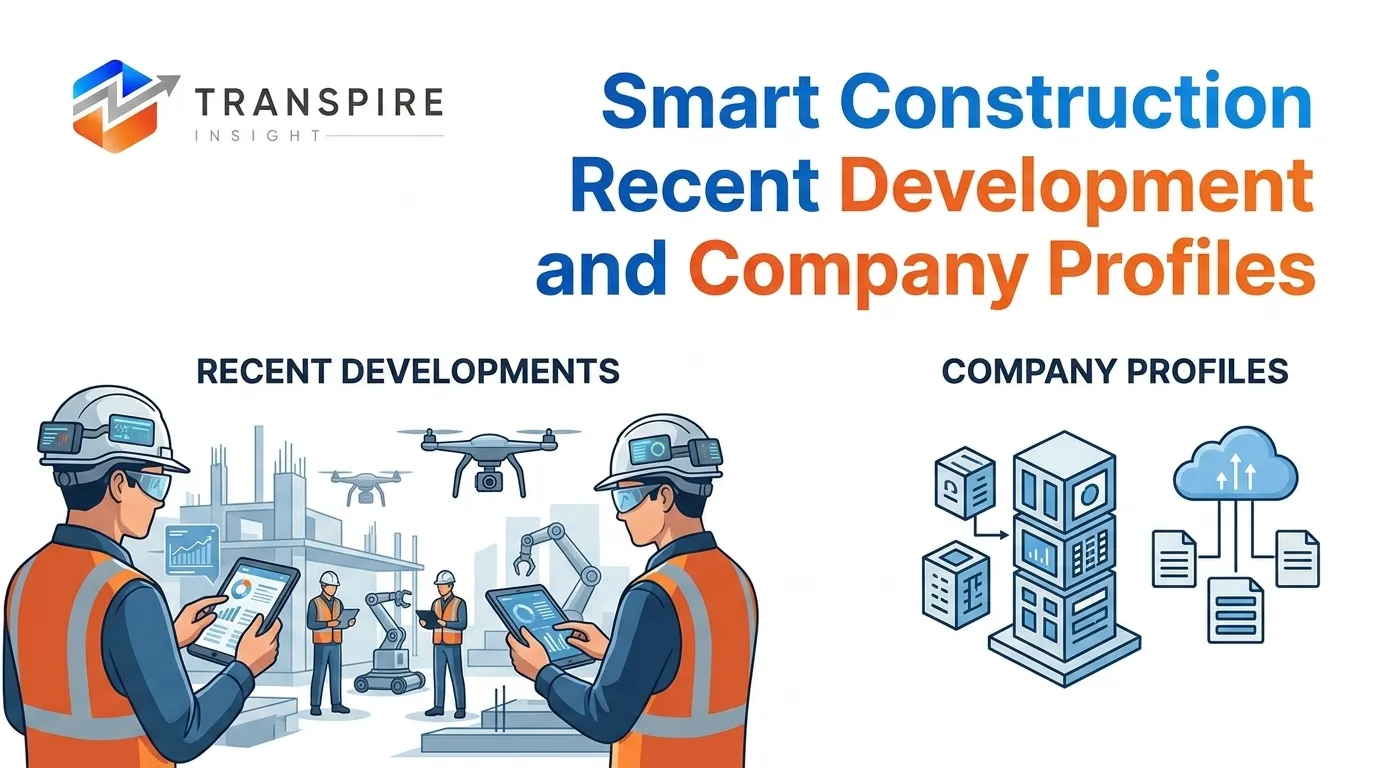
Description
According to a research report published by Transpire Insight, The Smart Construction Market size is projected to Grow from USD 44562.5 Million in 2025 to USD 80102.02 Million by 2035, at a CAGR of 12.55% during the forecast period 2026-2035. The market is picking up pace as more and more construction firms start using BIM, AI, IoT, digital twins, drones, robotics, cloud computing technology, and connected construction machinery to enhance efficiency, project visibility, safety, and resource management. The growth in infrastructure construction, urbanization, scarcity of skilled labor, higher construction cost, and rising demand for energy-efficient buildings are adding impetus to the use of smart construction technologies.
Introduction
The Smart Construction Market is an umbrella for technology-based solutions and systems that facilitate connectivity, automation, and data analytics in construction activities throughout the project lifecycle from planning and designing to construction, monitoring, and asset management. It leverages Building Information Modeling (BIM), artificial intelligence, Internet of Things (IoT), digital twin technology, drone, robotics, cloud platform, sensors, and augmented reality to assist construction companies in coordinating activities, monitoring site conditions, assessing risks, managing resources, and making decisions. The market is shifting away from traditional methods of construction as companies involved in contracting, development, and operation of infrastructures look for productivity improvement, increased safety, minimized waste, improved cost control, and sustainable projects using a smart construction environment.
Recent Development News
Stay Ahead of Emerging Opportunities with Expert Market Insights by Transpire Insight
The insights that have been shared through this blog are based on intensive market research carried out by Transpire Insight, an advisor that works with many organizations. Thanks to the analysis of extensive data, forecasts made by our specialists, and industry intelligence, our reports allow clients to find strategic growth opportunities in dynamically developing industries. For all those who would like to get more detailed information regarding market segmentation, competitive analysis, regional outlooks, and future investment tendencies, there is no doubt that our full report will be of great value.
Download the exclusive Smart Construction Market sample report today to uncover expert insights, emerging trends, and the opportunities defining the future of the industry.
Smart Construction Market Size & Statistics
Regional Growth and Demand Analysis by Transpire Insight:
North America will continue being the leader in the Smart Construction Market due to its advanced construction technology ecosystem, high adoption of digital construction technology platforms, heavy investments in infrastructure and early adoption of technologies like Building Information Modeling (BIM), Internet of Things (IoT), Artificial Intelligence (AI), cloud computing, digital twin, drones and connected construction equipment. The US is the main contributor because construction firms are using technology more often for effective coordination, dealing with labor shortages, avoiding delays and increasing efficiency.
Asia Pacific will experience the fastest growth due to its rapid urbanization, major infrastructure development, smart city initiatives and construction activities in countries like China and India. North America continues to lead when it comes to market maturity and adoption of technology whereas the future potential of the APAC region is very high.
Top 15 Trends in the Smart Construction Market
Proceed to Checkout to purchase the exclusive Smart Construction Market report and gain instant access to in-depth market intelligence, strategic analysis, and future growth opportunities.
Construction management is incorporating AI more frequently to enhance scheduling, estimating costs, allocating resources, assessing risks, and decision making. An AI-based system can process huge amounts of data in a project and detect any possible delays, cost overruns, and risks to project safety before they adversely affect the results of the project. The technology allows contractors to transition from reactive project management to predictive construction management.
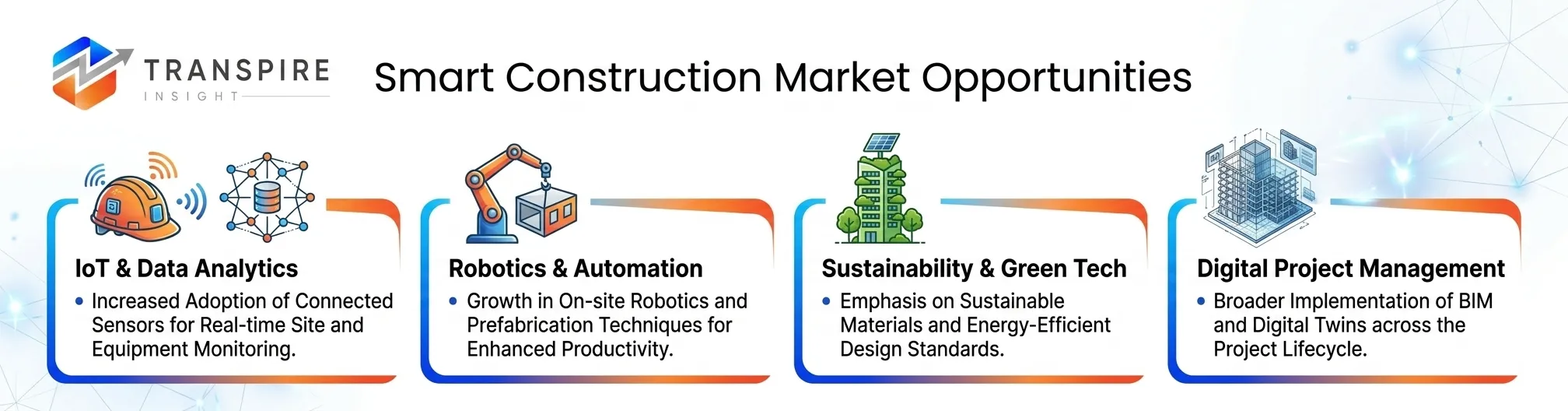
The use of BIM as an indispensable technology is gaining popularity for coordination of construction projects through creation of digital models of buildings and infrastructure. Architects, engineers, constructors, and owners will be able to detect discrepancies in designs, calculate material needs, manage project phases, and communicate using shared models. The increasing integration of BIM with cloud-based technologies, artificial intelligence, digital twins, and construction management systems makes BIM more and more important.
The adoption of digital twins is growing as companies within the construction industry and asset managers look for ways to gain real-time insights on physical assets and facilities. Using digital models and sensors to gather information, digital twins can be used to mimic the asset and help monitor its performance, conduct predictive maintenance and optimize its lifecycle.
The Internet of Things technology is making it possible for construction sites to be more connected with equipment, tools, materials, environment sensors, and safety gear for workers. The real-time data could be useful for monitoring equipment usage, material tracking, assessing the conditions on the site, and detecting any hazardous situations.
Robotics in construction is growing because contractors seek methods to automate laborious and dangerous tasks. More robotic systems are being considered to automate processes such as bricklaying, concrete finishing, demolition, surveying, drilling, and material handling. Labor shortage, coupled with the requirement for quality and rapid completion of projects, is motivating construction firms to adopt robotics at construction sites.
Drones have become a very useful tool in surveying, mapping, inspection, and monitoring of construction work since they enable faster collection of site information while at the same time minimizing the requirement for physical inspection of the construction site. The high resolution cameras, LiDAR, GPS technology and analytics software have enabled contractors to make accurate site maps and compare progress made against the design.
Top 25 Companies Leading the Smart Construction Market
Customize the exclusive Smart Construction Market report today to receive tailored insights, country-specific analysis, and business-focused market intelligence.
1. Autodesk, Inc.
Autodesk is a leading software company providing digital design, engineering, construction, and manufacturing solutions. Its construction technologies help project stakeholders connect design, planning, construction, and operations through cloud-based and AI-enabled workflows.
Founded: 1982 | Headquarters: San Francisco, California, USA
Why It Ranks: Autodesk ranks highly because of its strong position in BIM, construction design software, cloud collaboration, and increasingly AI-native construction workflows.
Regional Dominance: Autodesk has a broad presence, with strong adoption across North America, Europe, and Asia-Pacific.
Product Line: Its portfolio includes Autodesk Forma, Revit, AutoCAD, Civil 3D, Navisworks, BIM Collaborate, and Autodesk Construction Cloud capabilities.
Recent Development: In March 2026, Autodesk Construction Cloud became part of Autodesk Forma, bringing construction workflows into its end-to-end, cloud-based, AI-native platform.
2. Trimble Inc.
Trimble is a technology company developing solutions that connect the physical and digital worlds across construction, infrastructure, geospatial, and transportation industries.
Founded: 1978 | Headquarters: Westminster, Colorado, USA
Why It Ranks: Trimble ranks among the leading smart construction companies because of its expertise in positioning technologies, construction software, BIM, field data, and connected workflows.
Regional Dominance: Trimble operates globally, with more than 11,000 employees across 40+ countries and a network of more than 150 locations.
Product Line: Its product portfolio includes Tekla software, Trimble Connect, construction positioning systems, surveying technologies, machine control, project management, and field solutions.
Recent Development: Trimble continues to expand connected construction solutions that integrate positioning, modeling, data analytics, and field technologies to connect physical construction activities with digital project environments.
3. Bentley Systems, Incorporated
Bentley Systems develops infrastructure engineering software used for designing, constructing, and managing roads, bridges, buildings, utilities, railways, and other critical infrastructure.
Founded: 1984 | Headquarters: Exton, Pennsylvania, USA
Why It Ranks: Bentley ranks highly because of its strong capabilities in infrastructure digital twins, BIM, engineering software, reality modeling, and asset lifecycle management.
Regional Dominance: The company has a strong footprint across North America, Europe, and Asia-Pacific, serving major infrastructure and engineering organizations.
Product Line: Its portfolio includes iTwin, MicroStation, OpenBuildings, OpenRoads, ProjectWise, SYNCHRO, and infrastructure digital-twin solutions.
Recent Development: In May 2026, Bentley opened its first technology hub in Québec City dedicated to applied AI for infrastructure, while in July 2026 it expanded its Tokyo operations to support Japan's digital construction initiatives.
4. Procore Technologies, Inc.
Procore is a construction technology company providing cloud-based construction management software that connects project owners, contractors, engineers, and other stakeholders throughout the construction lifecycle.
Founded: 2002 | Headquarters: Carpinteria, California, USA
Why It Ranks: Procore ranks strongly because its platform is purpose-built for construction and increasingly incorporates AI, predictive analytics, automated workflows, and connected project data.
Regional Dominance: Procore operates internationally and serves customers in 160+ countries, giving it substantial reach.
Product Line: Its portfolio includes project management, financial management, quality & safety, BIM, construction analytics, Procore AI, and connected project-management tools.
Recent Development: In July 2026, Procore introduced Digital Coworker packages and 20 new pre-built AI agents designed to automate construction workflows such as RFI management, submittal review, daily logs, and contract review.
5. Oracle Corporation
Oracle is a technology company offering cloud infrastructure, enterprise software, databases, analytics, and industry-specific solutions. Its construction and engineering technologies support project management, financial control, collaboration, and data-driven decision-making.
Founded: 1977 | Headquarters: Austin, Texas, USA
Why It Ranks: Oracle ranks among major smart construction technology providers because of its enterprise cloud infrastructure, construction management capabilities, analytics, and ability to connect project and financial information.
Regional Dominance: Oracle has a presence across North America, Europe, Asia-Pacific, Latin America, and the Middle East.
Product Line: Its relevant portfolio includes Oracle Construction and Engineering, Primavera Cloud, Primavera P6, Oracle Cloud Infrastructure, Oracle Analytics, and enterprise cloud applications.
Recent Development: In March 2026, Oracle expanded its Nashville footprint to support continued growth in cloud and AI operations, highlighting its ongoing investment in cloud infrastructure and AI capabilities.
6. Hexagon AB
About Company: Hexagon is a technology company specializing in digital reality, measurement technologies, positioning, geospatial solutions, and industrial software used across construction and infrastructure applications.
Founded: 1975 | Headquarters: Stockholm, Sweden
Why It Ranks: Hexagon ranks highly because its technologies connect reality capture, surveying, positioning, digital construction, machine control, and data analytics, helping construction companies create more accurate digital representations of physical sites.
Regional Dominance: Hexagon has a broad presence across Europe, North America, Asia-Pacific, and other major construction markets.
Product Line: Its construction-related portfolio includes reality capture systems, surveying equipment, machine control, geospatial technologies, digital reality platforms, construction software, and positioning solutions.
Recent Development: Hexagon continues advancing the integration of digital reality, AI, autonomous technologies, and connected construction workflows to improve surveying, site monitoring, productivity, and construction accuracy.
7. Siemens AG
Siemens is a technology company providing industrial automation, smart infrastructure, building technologies, digitalization, and energy-management solutions. Its technologies support intelligent buildings and digitally connected infrastructure.
Founded: 1847 | Headquarters: Munich, Germany
Why It Ranks: Siemens ranks among major smart construction technology providers because of its combination of building automation, digital twins, IoT, energy management, industrial software, and smart infrastructure capabilities.
Regional Dominance: Siemens has a strong presence across Europe, North America, Asia-Pacific, and infrastructure markets.
Product Line: Its relevant solutions include building automation, smart building management systems, digital twins, IoT platforms, building energy management, fire safety, security, and industrial digitalization technologies.
Recent Development: In July 2026, Siemens completed its major Erlangen campus transformation, a project involving approximately €1 billion in investment and designed around sustainable urban development and modern digital infrastructure.
8. Schneider Electric SE
Schneider Electric is a energy-management and automation company providing technologies for smart buildings, electrical infrastructure, industrial automation, and energy efficiency.
Founded: 1836 | Headquarters: Rueil-Malmaison, France
Why It Ranks: Schneider Electric ranks strongly in smart construction because its solutions combine building automation, connected electrical systems, energy management, IoT, and digital platforms to create intelligent and energy-efficient buildings.
Regional Dominance: The company has a broad international presence across Europe, North America, Asia-Pacific, and emerging construction markets.
Product Line: Its portfolio includes EcoStruxure Building, building management systems, connected electrical equipment, energy-management software, automation systems, sensors, and digital building solutions.
Recent Development: Schneider Electric continues expanding AI-enabled energy management, connected building systems, and digital infrastructure solutions to help buildings improve energy efficiency, resilience, and operational performance.
9. Hilti Group
Hilti Group is a provider of construction products, tools, software, services, and fastening systems designed for professional construction and infrastructure applications.
Founded: 1941 | Headquarters: Schaan, Liechtenstein
Why It Ranks: Hilti ranks among smart construction leaders because it combines construction hardware with digital planning, connected tools, asset management, robotics, and software, helping contractors digitize field operations.
Regional Dominance: Hilti has a strong worldwide presence across Europe, North America, Asia-Pacific, the Middle East, and other construction markets.
Product Line: Its portfolio includes power tools, fastening systems, construction chemicals, measuring systems, software, connected tools, asset management, BIM solutions, and construction robotics.
Recent Development: Hilti continues to develop connected construction tools, digital workflows, robotics, and software solutions aimed at increasing productivity and reducing manual work on construction sites.
10. Caterpillar Inc.
Caterpillar is a leading manufacturer of construction and mining equipment, engines, and related technologies. The company is increasingly integrating automation, connectivity, AI, and autonomy into construction machinery.
Founded: 1925 | Headquarters: Irving, Texas, USA
Why It Ranks: Caterpillar ranks highly because of its extensive construction equipment portfolio and growing integration of AI, autonomous operation, machine control, telematics, and connected fleet technologies.
Regional Dominance: Caterpillar maintains a substantial presence across North America, Latin America, Europe, Asia-Pacific, and other construction markets.
Product Line: Its portfolio includes excavators, bulldozers, loaders, motor graders, compactors, autonomous equipment, machine-control technologies, connected fleet solutions, and digital services.
Recent Development: In March 2026, Caterpillar showcased expanded AI and autonomy capabilities, digital fleet solutions, and connected technologies at CONEXPO-CON/AGG 2026. Earlier in January, it also announced intelligent autonomous excavators and loaders designed to automate construction tasks.
Schedule a meeting with our market experts to discuss the exclusive Smart Construction Market report and identify the best research solution for your organization.
Conclusion
The Smart Construction Market is experiencing significant changes as construction firms become more inclined towards automation, connectivity, and data-driven processes. Some of the market players like Autodesk, Trimble, Bentley Systems, Procore Technologies, Oracle, Hexagon, Siemens, Schneider Electric, Hilti, and Caterpillar are driving the market by using BIM, AI, digital twins, IoT, cloud platforms, connected machinery, robotics, and advanced construction management tools. Rising demands for enhanced efficiency, decreased project cost and time, skilled-labor shortage, increased safety, and sustainable construction results are boosting technology adoption in the market around the world. North America is among the leading regions for the adoption of technologies, whereas the Asia-Pacific region presents great potential for future growth owing to urbanization and infrastructure development. In the coming years, construction management using AI, autonomous machinery, digital twins, robotics, connected sites, and sustainable building technologies are some of the technologies that will continue to drive the market.


Send us a brief description of your challenge and we'll get back to you within 24 hours.

 inquiry@transpireinsight.com
 APAC:+91 7666513636
 Address


