
Aug 12, 2026
By Transpire Insight
Description
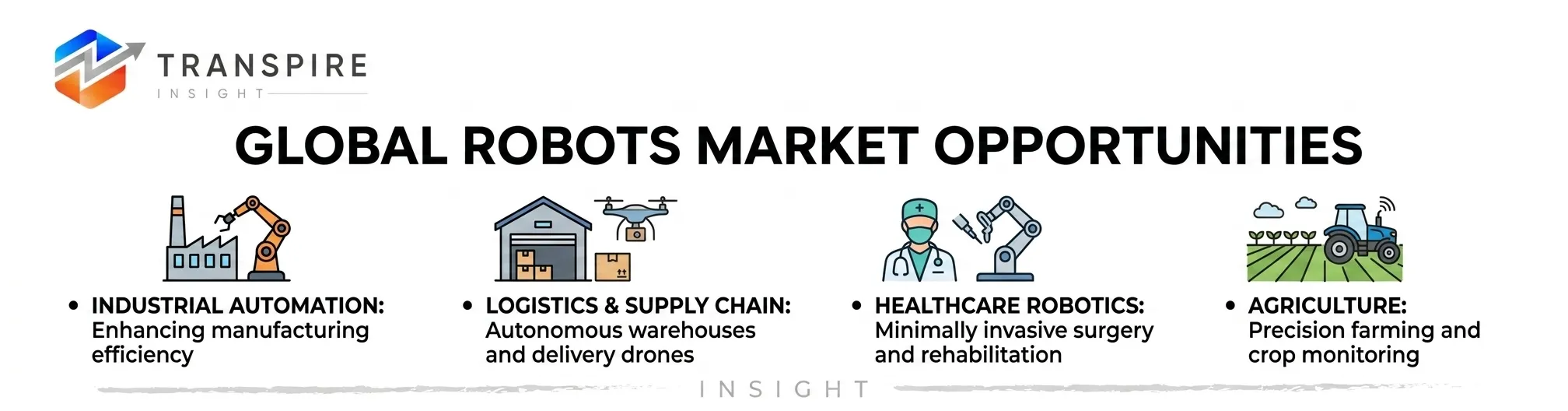
According to a research report published by Transpire Insight, The Robots Market Size is projected to Grow from USD 167.2 Million in 2025 to USD 230.5 Million by 2035, at a CAGR of 9.2% during the forecast period 2026-2035. The market is being fueled by rising automation through industrial automation, AI-based robotics, collaborative robots, autonomous mobile robots, automated warehouses, and smart manufacturing. The cost of labor and labor shortage issues are leading organizations to invest more in automation in order to replace repetitive and dangerous jobs, whereas investment in e-commerce logistics, automotive manufacturing, electronics, healthcare, agriculture, and other sectors is resulting in increased demand for robotics.
Introduction
The Robots Market includes research, manufacturing, and application of robots that are used for performing specific actions with different degrees of automation, precision, and autonomy. Robots include mechanics, sensors, control systems, software, and increasingly artificial intelligence and are used to perform tasks including assembling, material handling, welding, inspecting, packing, moving, surgical operations, and serving customers. The market is transforming from traditional factory robots into collaborative robots, autonomous mobile robots, intelligent robots, surgical robots, agricultural robots, and even humanoid robots, thus allowing companies to automate complicated processes and increase productivity and efficiency.
Recent Development News
Stay Ahead of Emerging Opportunities with Expert Market Insights by Transpire Insight
The insights that have been shared through this blog are based on intensive market research carried out by Transpire Insight, an advisor that works with many organizations. Thanks to the analysis of extensive data, forecasts made by our specialists, and industry intelligence, our reports allow clients to find strategic growth opportunities in dynamically developing industries. For all those who would like to get more detailed information regarding market segmentation, competitive analysis, regional outlooks, and future investment tendencies, there is no doubt that our full report will be of great value.
Download the exclusive Robots Market sample report today to uncover expert insights, emerging trends, and the opportunities defining the future of the industry.
Robots Market Size & Statistics
Regional Growth and Demand Analysis by Transpire Insight:
The Asia-Pacific is anticipated to continue dominating the Robots Market in the coming years, due to the presence of robust manufacturing sector, quick industrialization, lack of labor force, as well as considerable spending on artificial intelligence, smart factories, and robotic technologies in the region. In particular, China, Japan, South Korea, and India contribute to the dominance, due to extensive use of various types of robots including industrial, collaborative, autonomous mobile, and AI robots in the automotive, electronics, semiconductor, logistics, health care, and consumer goods industries. Manufacturing capabilities, government programs aimed at increasing the level of automation, development of the e-commerce industry, and demand for efficiency and flexibility in the production processes further fuel the market growth.
North America is also set for notable growth due to the investments in AI-powered robots, robotics in warehouses, healthcare robots, and advanced manufacturing. The United States will be the key technological and innovation hub in the region. However, the Asia-Pacific will continue leading the market due to its manufacturing capacity, technology adoption, robotics manufacturing capabilities, and industrial automation investments.
Top 15 Trends in the Robots Market
Proceed to Checkout to purchase the exclusive Robots Market report and gain instant access to in-depth market intelligence, strategic analysis, and future growth opportunities.
AI is revolutionizing robots from mere programmed entities to intelligent machines that can analyze their environment, identify objects, adapt to new situations, and make decisions with minimal human involvement. Machine learning, generative AI, and other algorithms are making robotic systems more flexible and able to handle complicated tasks.
Collaborative robots are becoming increasingly popular because they are able to work in conjunction with human workers during tasks that involve repetition, precision, and physical demands. The small size, easy-to-program nature, and relative ease of installation of these robots are making automation in manufacturing more popular, especially among smaller businesses.
AMRs are becoming more common in warehouse facilities, manufacturing plants, hospitals, and distribution centers for moving goods, parts, inventory, and finished products. With improvements in the areas of navigation, mapping, sensor technology, and AI, these robots can dynamically determine paths based on changing environmental factors.
It has become vital for contemporary robots to be equipped with machine vision systems since such systems allow robots to recognize objects, examine the products, find out their location, and handle them. The combination of cameras with high resolution, three-dimensional vision, AI-driven image recognition, and robotics has widened application areas for such technologies.
As a result of the transition to smart manufacturing, robotics are becoming more integrated with IoT in the industry, cloud computing, digital twins, sensors, and real-time analysis. Connected robots can provide information on performance, maintenance needs, optimization of production, and automation of equipment in the factory.
Because of the fast growth of e-commerce, and the higher demands made on fulfilling orders, there is an increasing use of robots for the tasks of picking, sorting, palletizing, transportation, and inventory management. Operators of logistics facilities use robotics for increasing throughput and decreasing processing time and are using robotics for order accuracy and staffing issues.
Top 25 Companies Leading the Robots Market
Customize the exclusive Robots Market report today to receive tailored insights, country-specific analysis, and business-focused market intelligence.
1. ABB Ltd.
ABB Ltd. is a technology company specializing in electrification, automation, motion, and robotics. Its robotics business provides industrial robots, collaborative robots, autonomous solutions, and software for manufacturing, logistics, automotive, electronics, and other industries.
Founded: 1988 | Headquarters: Zurich, Switzerland
Why It Ranks: ABB ranks among the leading robotics companies due to its broad industrial robot portfolio, strong automation capabilities, customer base, and investments in AI-enabled robotics and software.
Regional Dominance: ABB has a strong presence across Europe, North America, Asia-Pacific, and other industrial markets, with particularly significant adoption in automotive, electronics, manufacturing, and logistics.
Product Line: ABB's robotics portfolio includes industrial robots, collaborative robots, autonomous mobile robots, robotic cells, machine vision systems, robotic software, and automation solutions.
Recent Development: In 2025, ABB introduced new AI-powered robotics capabilities and expanded its RobotStudio simulation platform, including generative-AI-supported programming features designed to simplify robot programming and accelerate automation deployment.
2. FANUC Corporation
FANUC Corporation is a Japanese manufacturer specializing in industrial automation, CNC systems, industrial robots, and factory automation technologies. The company is one of the world's major industrial robotics suppliers.
Founded: 1956 | Headquarters: Oshino, Yamanashi, Japan
Why It Ranks: FANUC ranks highly because of its extensive industrial robot portfolio, strong expertise in factory automation, high reliability, and widespread adoption in automotive, electronics, metalworking, and manufacturing.
Regional Dominance: FANUC maintains a significant presence across Asia-Pacific, North America, Europe, and other manufacturing markets, with Japan, China, and the United States representing important markets.
Product Line: Its portfolio includes industrial robots, collaborative robots, SCARA robots, delta robots, articulated robots, CNC systems, ROBODRILL machines, machine vision, and factory automation software.
Recent Development: FANUC has continued expanding AI, machine vision, digitalization, and intelligent factory automation capabilities to make robotic systems more adaptive and connected for next-generation manufacturing.
3. Yaskawa Electric Corporation
Yaskawa Electric Corporation is a Japanese manufacturer specializing in motion control, robotics, drives, and industrial automation. Its Motoman robotics business serves automotive, welding, material handling, assembly, painting, and logistics applications.
Founded: 1915 | Headquarters: Kitakyushu, Fukuoka, Japan
Why It Ranks: Yaskawa ranks among leading robotics companies due to its strong Motoman brand, extensive industrial robot portfolio, motion-control expertise, and manufacturing customer base.
Regional Dominance: Yaskawa has a strong footprint across Japan, China, North America, Europe, and Southeast Asia, supporting manufacturers across automotive, electronics, semiconductor, and general industrial sectors.
Product Line: Its portfolio includes MOTOMAN industrial robots, collaborative robots, welding robots, handling robots, painting robots, robot controllers, servo drives, motion-control systems, and automation software.
Recent Development: Yaskawa has been expanding AI-enabled robotics, machine vision, digital engineering, and advanced motion-control technologies to support more flexible and intelligent production environments.
4. KUKA AG
KUKA AG is a German robotics and automation company providing industrial robots, collaborative robots, automated production systems, and software. Its solutions are widely used in automotive, electronics, healthcare, logistics, and general manufacturing.
Founded: 1898 | Headquarters: Augsburg, Germany
Why It Ranks: KUKA is a major robotics supplier because of its strong industrial automation expertise, advanced robotic arms, flexible production solutions, and presence in highly automated manufacturing environments.
Regional Dominance: KUKA has strong operations across Europe, China, North America, and other international manufacturing markets, with particularly important positions in automotive and industrial production.
Product Line: Its portfolio includes industrial robots, collaborative robots, mobile robots, palletizing robots, welding systems, robotic cells, automated production systems, and robotics software.
Recent Development: KUKA has increasingly focused on AI-supported robotics, digital production, mobile robotics, and flexible automation, targeting applications that require greater autonomy and adaptability.
5. Kawasaki Heavy Industries, Ltd.
Kawasaki Heavy Industries is a diversified Japanese industrial company with a major robotics business. Its robotics division develops industrial robots for manufacturing, logistics, healthcare, and other specialized applications.
Founded: 1896 | Headquarters: Tokyo, Japan
Why It Ranks: Kawasaki ranks among the leading robotics companies because of its extensive experience in industrial automation and its ability to provide robots for welding, assembly, material handling, palletizing, and specialized applications.
Regional Dominance: Kawasaki has a strong presence in Japan and Asia-Pacific, while its robotics products are also deployed in North America, Europe, and other industrial markets.
Product Line: Its robotics portfolio includes industrial robots, collaborative robots, palletizing robots, welding robots, SCARA robots, clean robots, pharmaceutical robots, and robotic automation systems.
Recent Development: Kawasaki has continued developing AI-enabled robotic systems, collaborative robotics, automated logistics solutions, and specialized robots for applications beyond conventional factory automation.
6. Mitsubishi Electric Corporation
Mitsubishi Electric is a Japanese technology company offering industrial automation, factory automation, electrical equipment, and robotics solutions. Its robots are integrated with broader automation and control systems.
Founded: 1921 | Headquarters: Tokyo, Japan
Why It Ranks: Mitsubishi Electric ranks strongly because of its integrated automation ecosystem, extensive manufacturing customer base, and ability to combine robots with PLCs, servo systems, industrial networks, and factory automation software.
Regional Dominance: The company has significant market penetration in Japan, China, Southeast Asia, Europe, and North America, with strong adoption in electronics, automotive, food, and general manufacturing.
Product Line: Its robotics portfolio includes MELFA industrial robots, SCARA robots, articulated robots, collaborative robots, robot controllers, servo systems, PLCs, machine vision, and factory automation software.
Recent Development: Mitsubishi Electric has continued integrating AI, digital twins, machine vision, and advanced industrial automation into its robotics ecosystem to support smart manufacturing and more efficient production processes.
7. Omron Corporation
Omron Corporation is a Japanese technology company specializing in industrial automation, sensing, control, healthcare, and robotics. Its robotics portfolio emphasizes flexible production and human-machine collaboration.
Founded: 1933 | Headquarters: Kyoto, Japan
Why It Ranks: Omron ranks among major robotics companies due to its combination of robots, machine vision, sensors, controllers, and automation software, allowing customers to deploy integrated factory automation solutions.
Regional Dominance: Omron has a broad presence across Asia-Pacific, North America, Europe, and other industrial markets, with strong demand from electronics, automotive, food, pharmaceuticals, and logistics.
Product Line: Its portfolio includes mobile robots, collaborative robots, SCARA robots, parallel robots, machine vision systems, sensors, controllers, and integrated automation platforms.
Recent Development: Omron has continued developing AI-enabled mobile robotics and intelligent automation solutions, with an emphasis on autonomous material movement, machine vision, and connected production environments.
8. DENSO Corporation
DENSO Corporation is a Japanese automotive technology supplier and robotics manufacturer. The company develops compact industrial robots and automation technologies used in manufacturing, particularly in automotive and electronics production.
Founded: 1949 | Headquarters: Kariya, Aichi, Japan
Why It Ranks: DENSO ranks among important robotics companies because of its extensive experience in precision automation, compact robots, and high-speed manufacturing applications.
Regional Dominance: DENSO has a strong presence across Japan, North America, Europe, China, and Southeast Asia, supported by its large automotive and manufacturing customer base.
Product Line: Its robotics portfolio includes articulated robots, SCARA robots, 4-axis robots, 6-axis robots, collaborative robots, robot controllers, and automation solutions.
Recent Development: DENSO has been advancing high-speed, high-precision robotics and automation technologies, while increasingly integrating robotics with advanced manufacturing and digital production systems.
9. Nachi-Fujikoshi Corporation
Nachi-Fujikoshi is a Japanese industrial technology company producing robotics, bearings, cutting tools, hydraulic equipment, and industrial machinery. Its robotics business focuses heavily on manufacturing automation.
Founded: 1928 | Headquarters: Toyama, Japan
Why It Ranks: Nachi-Fujikoshi ranks among leading robotics suppliers because of its strong presence in welding, handling, assembly, and automotive manufacturing applications, combined with expertise in precision machinery.
Regional Dominance: The company has a strong presence in Japan and Asia-Pacific, with established operations and customers in North America and Europe.
Product Line: Its robotics portfolio includes articulated robots, collaborative robots, palletizing robots, welding robots, handling robots, spot-welding systems, and robot controllers.
Recent Development: Nachi-Fujikoshi has continued expanding its robotics offerings with higher-speed, higher-payload, and more flexible robot platforms, targeting automotive, logistics, welding, and general manufacturing applications.
10. Stäubli International AG
Stäubli International is a Swiss technology company specializing in robotics, textile machinery, and connectors. Its robotics division provides high-precision robotic systems for industrial, pharmaceutical, food, electronics, and cleanroom applications.
Founded: 1892 | Headquarters: Pfäffikon, Switzerland
Why It Ranks: Stäubli ranks strongly due to its expertise in high-speed, high-precision, cleanroom, and specialized robotics, making its systems particularly valuable in demanding manufacturing environments.
Regional Dominance: Stäubli has a strong presence across Europe, North America, and Asia-Pacific, serving customers in electronics, pharmaceuticals, food, automotive, and other precision industries.
Product Line: Its robotics portfolio includes SCARA robots, six-axis robots, delta robots, collaborative robots, cleanroom robots, mobile robots, robot controllers, and robotic software.
Recent Development: Stäubli has continued expanding high-speed robotics, mobile robotics, cleanroom automation, and intelligent robotic solutions, with increasing focus on flexible automation for electronics, life sciences, food, and advanced manufacturing applications.
Schedule a meeting with our market experts to discuss the exclusive Robots Market report and identify the best research solution for your organization.
Conclusion
The Robots Market is seeing fast-paced developments with the increasing adoption of automation, artificial intelligence, machine vision, collaborative robots, autonomous mobile robots, and robotic connectivity solutions. Major industry players like ABB Ltd., FANUC Corporation, Yaskawa Electric Corporation, KUKA AG, Kawasaki Heavy Industries, Mitsubishi Electric, Omron, DENSO, Nachi-Fujikoshi, and Stäubli International are leveraging innovations in terms of precision, flexibility, intelligent controls, and autonomy. Rising demand to overcome labor shortage, boost production efficiency, ensure workplace safety, and meet smart factory requirements are some of the key factors that will continue driving demand from automotive, electronics, logistics, healthcare, food & beverage, and other sectors. In the future, AI-enabled robots, humanoid robots, collaborative automation, autonomous mobile robots, robotics-as-a-service, and cloud connectivity solutions are expected to create numerous growth prospects for the market participants.


Send us a brief description of your challenge and we'll get back to you within 24 hours.

 inquiry@transpireinsight.com
 APAC:+91 7666513636
 Address


