
Sep 03, 2026
By Transpire Insight
Description
According to a research report published by Transpire Insight, the recreational marine scrubber systems market size is projected to grow from USD 2.35 billion in 2026 to USD 5.9 billion by 2035, at a CAGR of 15.6% during the forecast period 2027-2035. The recreational marine scrubber systems market is expanding as luxury yachts and leisure craft adopt compact, eco-friendly exhaust-cleaning technology to meet strict IMO maritime emissions limits while preserving engine efficiency and optimizing high-sulfur fuel costs globally.
Introduction
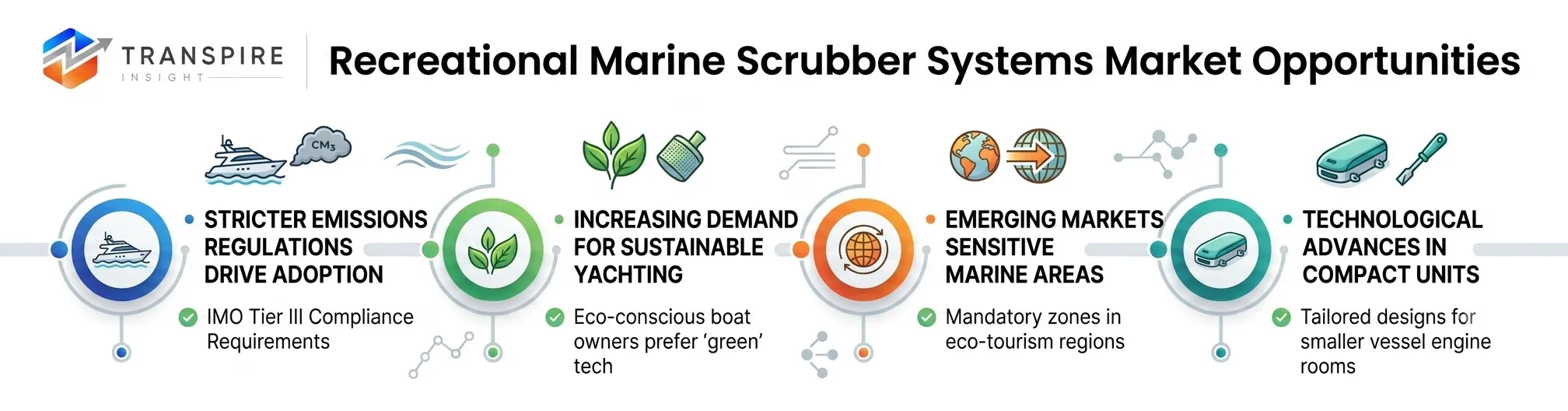
The recreational marine scrubber systems market is experiencing rapid transformation driven by evolving maritime environmental regulations and a heightened focus on eco-friendly leisure boating. As regional Emission Control Areas (ECAs) expand across popular yachting routes, recreational vessel owners increasingly rely on compact exhaust gas cleaning systems (EGCS). These specialized scrubbers remove sulfur oxides (SOx) and particulate matter from exhaust streams, allowing superyachts and motor craft to operate efficiently while remaining compliant without relying solely on expensive low-sulfur fuels.
Recent Development News
Stay Ahead of Emerging Opportunities with Expert Market Insights by Transpire Insight
Transpire Insight provides comprehensive, data-driven market intelligence to support smarter business decisions. Our research is rooted in comprehensive analysis, authoritative predictions, and industry expertise, enabling organizations to make informed decisions in rapidly evolving markets. In-depth analysis of market segmentation, competitive positioning, regional trends, and emerging investment opportunities in high-growth areas. We blend accuracy with actionable intelligence, empowering companies to uncover new avenues for growth, bolster strategic decision-making, and stay ahead in a dynamic market.
Recreational Marine Scrubber Systems Market Size & Statistics
Regional Growth and Demand Analysis by Transpire Insight
North America's dominance rests on a mature retrofit ecosystem: US recreational boat owners, particularly in Emission Control Area zones along both coasts, are increasingly fitting older vessels with scrubber systems instead of replacing them outright, a trend reinforced by California and Pacific Northwest state-level restrictions that are pushing hybrid systems ahead of pure open-loop configurations. Damen Shipyards Group continues integrating scrubber systems directly into new builds and retrofit projects for the US leisure market, while Wärtsilä's compact, yacht-focused exhaust gas cleaning portfolio is gaining traction among charter and luxury vessel owners looking to meet EPA compliance without sacrificing cabin space. Canada's inland and coastal waterway operators are following a similar, smaller-scale sustainability push.
Asia Pacific's momentum tells a different story, built more on new demand than replacement demand. China's expanding middle class is fueling a surge in first-time recreational boat ownership, and government sustainability priorities are steering buyers toward emission-compliant vessels from the outset. Singapore's ban on open-loop scrubbers has meaningfully accelerated dry-scrubber adoption across the region, while Japanese and Australian shipyards are folding scrubber systems into newbuild leisure craft rather than treating them as an aftermarket add-on. Europe, meanwhile, holds a steady middle position: Mediterranean, Baltic, and North Sea demand is shaped by EU port discharge bans on open-loop systems, sustaining a mature aftermarket for closed-loop maintenance and chemical reagents, while Latin America and Africa remain nascent but are gradually adopting technology-driven compliance solutions as sustainability norms spread.
Top 15 Trends in the Recreational Marine Scrubber Systems Market
Hybrid scrubbers, switching between open-loop and closed-loop operation based on local discharge rules, are becoming the preferred choice for recreational boat owners crossing varied jurisdictions.
Port-level bans on open-loop discharge, particularly across the Baltic Sea, Mediterranean, and Singapore waters, are pushing recreational vessel owners toward closed-loop systems that retain washwater.
Dry scrubber technology is gaining traction because it eliminates liquid effluent discharge, appealing to environmentally cautious marina operators and regulators wary of washwater contamination.
Owners of older recreational vessels are retrofitting existing engines with scrubber systems rather than replacing boats outright, extending vessel lifespans while meeting tightening emission standards.
Marinas are introducing shared scrubber facilities that let occasional boaters access emission-control equipment without individual installation costs, making compliance more accessible for smaller, budget-conscious owners.
Shipyards across China, Japan, and Australia are integrating scrubber systems directly into newbuild recreational vessels, reflecting strong regional government support for clean marine technology adoption.
List of Top 25 Companies Leading the Recreational Marine Scrubber Systems Market
1. Alfa Laval
Delivers market-leading compact maritime exhaust gas cleaning systems for marine craft.
Founded: 1883 | HQ: Lund, Sweden.
Why It Ranks: Commands top market share through extensive marine emissions technology innovation.
Regional Dominance: Holds massive market share across key European shipyards and expanding Asia-Pacific shipping hubs.
Product Line: PureSOx main engines, hybrid scrubbers, and compact marine inline systems.
2. Wärtsilä
Engineering pioneer offering modular emissions abatement and integrated maritime energy solutions.
Founded: 1834 | HQ: Helsinki, Finland.
Why It Ranks: Drives industry standards via advanced automated open- and closed-loop scrubbers.
Regional Dominance: Dominates Northern European marine routes with broad presence across major East Asian ports.
Product Line: Hybrid EGCS, venture scrubbers, and automated maritime water treatment units.
3. Yara Marine Technologies
Specializes in tailor-made emissions reduction platforms for diverse seagoing vessels.
Founded: 2014 | HQ: Oslo, Norway.
Why It Ranks: High reputation for lightweight inline scrubbers suitable for tight vessel spaces.
Regional Dominance: Leads Scandinavian leisure vessel retrofits while rapidly growing market footprint in East Asia.
Product Line: Inline hybrid scrubbers, SOx control systems, and vessel optimization software.
4. Clean Marine AS
Delivers multi-stream exhaust gas cleaning designs tailored for high-efficiency marine applications.
Founded: 2006 | HQ: Lysaker, Norway.
Why It Ranks: Known for single-unit scrubbers capable of handling multiple onboard exhaust streams.
Regional Dominance: Strong operational coverage across Nordic coastal waters and major Mediterranean yachting routes.
Product Line: All-in-one EGCS, stream-cleaning scrubbers, and hybrid marine exhaust systems.
5. ANDRITZ AG
International technology group manufacturing custom industrial and maritime environmental control equipment.
Founded: 1852 | HQ: Graz, Austria.
Why It Ranks: Strong engineering background in high-capacity sea-water scrubbing systems.
Regional Dominance: Established market footprint spanning Central European manufacturing bases and North American ports.
Product Line: Sea-water scrubbers, SeaSOx technology, and exhaust gas purification plants.
6. CR Ocean Engineering
US-based leader engineering specialized exhaust gas cleaning solutions for maritime fleets.
Founded: 1917 | HQ: Parsippany, New Jersey, USA.
Why It Ranks: Decades of scrubbing expertise translated into versatile yacht and ship designs.
Regional Dominance: Dominates North American coastal trade routes with increasing deployments across transatlantic fleets.
Product Line: Open-loop scrubbers, closed-loop scrubbers, and custom retrofit scrubber units.
7. Fuji Electric Co., Ltd.
Japanese electrical technology giant producing compact marine exhaust cleaning equipment.
Founded: 1923 | HQ: Tokyo, Japan.
Why It Ranks: Pioneer of cyclone-technology marine scrubbers designed for space-constrained engine rooms.
Regional Dominance: Leads Japanese shipbuilding supply chains and holds strong presence in Southeast Asia.
Product Line: Cyclone EGCS, compact SOx scrubbers, and automated emissions sensors.
8. Mitsubishi Heavy Industries (MHI)
Engineering giant manufacturing comprehensive propulsion and environmental systems for sea craft.
Founded: 1884 | HQ: Tokyo, Japan.
Why It Ranks: Leverages massive R&D capabilities for advanced maritime exhaust gas abatement.
Regional Dominance: Commands huge market authority in the Asia-Pacific maritime construction and equipment sector.
Product Line: Advanced marine EGCS, rectangular scrubbers, and vessel efficiency systems.
9. Valmet Corporation
Develops sustainable technology solutions for process industries and maritime emissions control.
Founded: 1951 | HQ: Espoo, Finland.
Why It Ranks: Highly trusted automation and wet scrubbing systems across European maritime routes.
Regional Dominance: Highly influential across Baltic Sea marine sectors and Western European luxury ports.
Product Line: Valmet Marine Scrubber, automated water treatment, and exhaust control systems.
10. Pacific Green Technologies
Specializes in innovative cleantech solutions including scalable exhaust gas scrubbers.
Founded: 2012 | HQ: Dover, Delaware, USA.
Why It Ranks: Popular for its ENVI-Marine patented system offering high SOx removal.
Regional Dominance: Robust commercial footprint across North American shipyards and European luxury vessel hubs.
Product Line: ENVI-Marine systems, hybrid sea scrubbers, and particulate filtration units.
Conclusion
The recreational marine scrubber systems market is poised for robust expansion as leisure vessel operators navigate increasingly strict environmental standards. Key players are continuously advancing compact, lightweight, and automated hybrid systems tailored to the structural constraints of luxury craft. With digital integration and real-time monitoring becoming market norms, these technologies ensure seamless compliance across changing regulatory zones. Ultimately, marine scrubbers represent a vital bridge technology, balancing sustainability goals with economic viability for the future of recreational maritime travel.


Send us a brief description of your challenge and we'll get back to you within 24 hours.

 inquiry@transpireinsight.com
 APAC:+91 7666513636
 Address


