
Aug 01, 2026
By Transpire Insight
Description
According to a research report published by Transpire Insight, The Radiation-resistant Fibers Market Size is projected to Grow from USD 616 Million in 2025 to USD 1250.1 Million by 2035, at a CAGR of 9% during the forecast period 2026-2035. The market is likely to experience growth due to the growing investments being made in nuclear energy facilities, space explorations activities, defense modernizations projects, and radiation-hardened sensing and communication devices. The developments in the technology of radiation-tolerant optical components, the increasing requirements for fiber optics sensors, and research into fusion energy and high energy physics are some factors that are likely to contribute to the market growth. Innovation in the technology of radiation-hardened optical components and their increasing adoption in various industries are some key factors expected to present growth opportunities in the coming years.
Introduction
The Radiation Resistant Fibers Market consists of a special kind of optical fibers that can perform in a stable manner in harsh environments that are highly radioactive. This is because these optical fibers resist damage from high ionizing radiations. Therefore, such optical fibers are critical components in areas such as nuclear power plants, aerospace applications, defense applications, medical radiation equipment, particle accelerators, research facilities of fusion, oil and gas exploration, and space technology.
Recent Development News
June 2026: Selected by the ITER Organization for providing 12 km of radiation-hardened aluminum-clad optical fibers for monitoring purposes in the ITER fusion reactor blanket and divertor systems.
March 2026: Invented the packaging method of a photonic chip to ensure the reliability of optical fiber connections under high levels of radiation, cryogenic environment, vacuum, and thermal cycling.
Stay Ahead of Emerging Opportunities with Expert Market Insights by Transpire Insight
The insights that have been shared through this blog are based on intensive market research carried out by Transpire Insight, an advisor that works with many organizations. Thanks to the analysis of extensive data, forecasts made by our specialists, and industry intelligence, our reports allow clients to find strategic growth opportunities in dynamically developing industries. For all those who would like to get more detailed information regarding market segmentation, competitive analysis, regional outlooks, and future investment tendencies, there is no doubt that our full report will be of great value.
Download the exclusive Radiation-resistant Fibers Market sample report today to uncover expert insights, emerging trends, and the opportunities defining the future of the industry.
Radiation-resistant Fibers Market Size & Statistics
Market Size of the Radiation-resistant Fibers Market was projected to be USD 616 Million in 2025. The Market Size is Expected to Grow at a CAGR of 9% from 2026 to 2035. The Market Size of the Radiation-resistant Fibers Market Size is expected to be USD 1250.1 Million in 2035.
The largest demand is expected to be seen from North America, which will account for an estimated 38% share in the Radiation-resistant Fibers Market owing to huge investments in nuclear power upgrades, defense initiatives, space exploration, research on particle physics, and radiation resistant communication networks.
The fastest growth is likely to be observed in Asia Pacific, which will contribute an estimated 34% share in the growth of the Radiation-resistant Fibers Market due to increasing nuclear energy ventures, increasing space expeditions, fast growing scientific research infrastructure, defense upgrades, and increased investment in radiation resistant sensors in China, Japan, South Korea, and India.
Regional Growth and Demand Analysis by Transpire Insight:
North America holds the leading position in the Radiation-resistant Fibers Market with almost 38% market share of the market. The reason why North America dominates the Radiation-resistant Fibers Market is due to the large-scale investments made by the region in nuclear power infrastructures, aerospace & defense industry, space exploration and high energy science. Being home to several government agencies, national labs and defense forces which need radiation-resistant optical fiber solutions for critical missions keeps the region dominant. Large investments in nuclear reactor upgrades, particle accelerators, satellite communications, radiation monitoring systems and also the presence of leading specialty fiber manufacturers and research institutes add strength to the dominant position of North America. Innovation in radiation resistant optical technology and rising demand for reliable sensing and communication systems in extreme conditions is helping the region dominate the market.
Fastest growing region: Asia-Pacific is anticipated to be the fastest growing region during the forecast period on account of expansion of nuclear power projects, space exploration, defense modernization, fusion energy research, and scientific infrastructure development in China, Japan, South Korea and India. Increased investments in optical sensing and radiation resistant communication systems are driving the market growth in the region.
Top 15 Trends in the Radiation-resistant Fibers Market
Proceed to Checkout to purchase the exclusive Radiation-resistant Fibers Market report and gain instant access to in-depth market intelligence, strategic analysis, and future growth opportunities.
1. Growing Adoption of Radiation-Hardened Optical Fibers
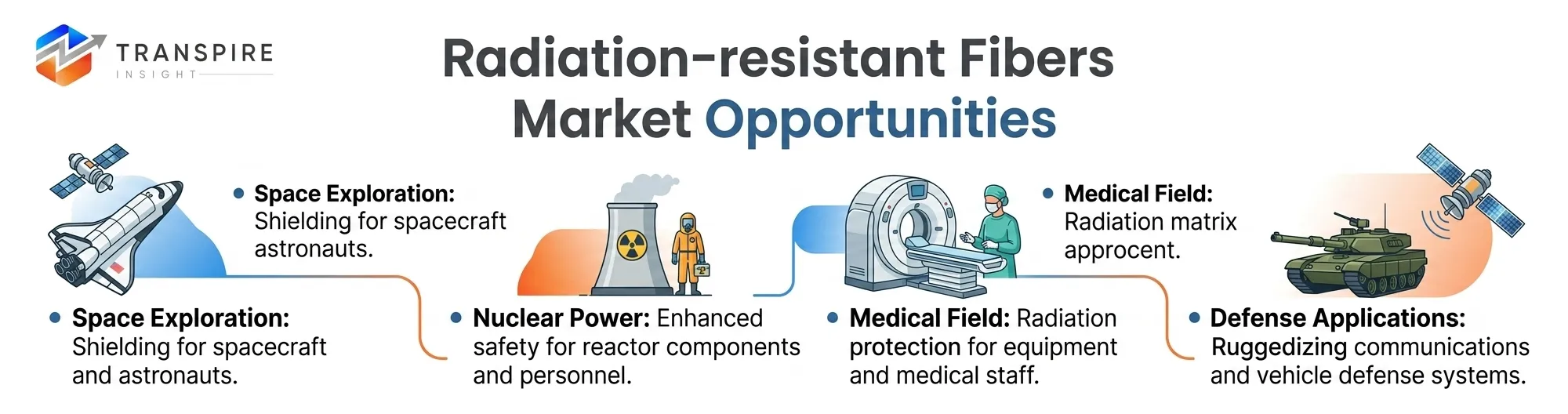
In industries where there is high radiation exposure, the use of radiation-hardened optical fibers is becoming very common due to many advantages associated with it. These advantages include reliable signal transmission, minimal radiation-induced signal loss, increased longevity, higher system safety, increased deployment in critical systems, and increasing demand for reliable communication networks.
2. Expansion of Nuclear Power Infrastructure
Modernization of the existing nuclear facilities along with the construction of new reactors is resulting in the generation of high demands for radiation-resistant fiber optics. Increased capital expenditure on nuclear energy, better reactor safety, effective connection of sensors, operational stability, increasing applications of nuclear monitoring, and stringent safety norms are aiding the growth of this market.
3. Increasing Demand from Space Exploration Programs
Space agencies and commercial aerospace companies are employing radiation-resistant fibers in satellites and spacecraft where there is exposure to cosmic rays. The increasing number of satellite launches, improved communication capabilities, increased resilience of missions, decreased equipment wear and tear, increased spending on space exploration, and growing commercial space activities are driving the adoption rate of such technologies.
4. Rising Integration in Defense Communication Systems
Military equipment used in today’s warfare is needed to have radiation-resilient optical communications systems that can operate under demanding conditions. Factors like better communication security of the defense force, increased system robustness, battlefield data transmission, surveillance systems, military modernization, and increased spending on strategic defense systems are fueling this trend.
5. Growth of Fiber Optic Radiation Monitoring Solutions
Radiation resistant fibers are becoming popular in distributed sensing applications to measure radiation level, temperature, and structural health of buildings. Improved real-time monitoring, increased operational safety, decreased maintenance cost, consistent environmental monitoring, accurate radiation measurement, and widespread use in important sectors are among key factors driving growth in the market.
6. Development of Low-Attenuation Radiation-Resistant Fibers
Manufacturers are designing advanced specialty glass formulations which provide a marked reduction in signal losses in optical fibers even after long exposure to radiation. Enhanced optical performance, transmission efficiency, longer life span, improved durability in tough conditions, research into specialty fibers, and radiation hardening technologies are increasing the demand for these products.
Top 25 Companies Leading the Radiation-resistant Fibers Market
Customize the exclusive Radiation-resistant Fibers Market report today to receive tailored insights, country-specific analysis, and business-focused market intelligence.
1. Corning Incorporated
Corning Incorporated is a materials science company specializing in optical communications, specialty glass, ceramics, and advanced optical technologies.
Founded:1851 | Headquarters: Corning, New York, USA
Why It Ranks: Leading manufacturer of specialty optical fibers for harsh and radiation-intensive environments.
Regional Dominance: Strong presence across North America, Europe, and Asia-Pacific.
Product Line: Radiation-resistant Optical Fibers, Specialty Optical Fibers, Fiber Optic Cables, Optical Connectivity Solutions, and Photonic Components.
Recent Development: Expanded advanced optical fiber technologies supporting high-performance scientific and industrial applications.
2. YOEC (Yangtze Optical Electronic Company Ltd.)
YOEC is a leading Chinese manufacturer of optical fibers, fiber optic cables, and integrated communication solutions.
Founded:1988 | Headquarters: Wuhan, China
Why It Ranks: Major supplier of specialty optical fibers, including radiation-resistant fiber solutions.
Regional Dominance: Strong presence across Asia-Pacific, with expanding operations.
Product Line: Radiation-resistant Optical Fibers, Optical Fibers, Fiber Optic Cables, Optical Modules, and Communication Solutions.
Recent Development: Expanded production of radiation-resistant optical fibers for nuclear and aerospace applications.
3. Prysmian S.p.A.
Prysmian is a leader in energy and telecommunications cable systems, serving infrastructure, industrial, and specialty markets.
Founded:1879 | Headquarters: Milan, Italy
Why It Ranks: Strong expertise in specialty optical fiber technologies for demanding environments.
Regional Dominance: Strong presence across Europe, North America, Asia-Pacific, and Latin America.
Product Line: Radiation-resistant Optical Fibers, Fiber Optic Cables, Specialty Cables, Telecom Solutions, and Industrial Connectivity Products.
Recent Development: Expanded specialty optical cable portfolio for critical infrastructure projects.
4. Fujikura Ltd.
Fujikura manufactures optical fibers, communication components, electronic products, and automotive systems.
Founded:1885 | Headquarters: Tokyo, Japan
Why It Ranks: leader in high-performance specialty optical fiber manufacturing.
Regional Dominance: Strong presence across Asia-Pacific, North America, and Europe.
Product Line: Radiation-resistant Optical Fibers, Optical Fibers, Fusion Splicers, Fiber Optic Components, and Communication Systems.
Recent Development: Strengthened specialty optical fiber technologies for harsh operating environments.
5. Sumitomo Electric Industries, Ltd.
Sumitomo Electric is a diversified technology company specializing in optical communication, automotive, electronics, and industrial materials.
Founded:1897 | Headquarters: Osaka, Japan
Why It Ranks: Major supplier of advanced optical fibers for scientific, aerospace, and industrial applications.
Regional Dominance: Strong presence across Asia-Pacific, Europe, and North America.
Product Line: Radiation-resistant Optical Fibers, Optical Fibers, Fiber Optic Cables, Optical Devices, and Communication Systems.
Recent Development: Expanded specialty optical fiber production for high-radiation environments.
6. OFS Fitel, LLC
OFS develops optical fiber, cable, and connectivity products for telecommunications, industrial, aerospace, and defense sectors.
Founded:2001 | Headquarters: Norcross, Georgia, USA
Why It Ranks: Recognized supplier of specialty optical fibers for harsh environments.
Regional Dominance: Strong presence across North America, Europe, and Asia-Pacific.
Product Line: Radiation-resistant Optical Fibers, Specialty Fibers, Optical Cables, Fiber Connectivity Products, and Photonic Solutions.
Recent Development: Expanded specialty optical fiber solutions for defense and industrial applications.
7. Leoni AG
Leoni develops wiring systems, optical fibers, and connectivity technologies for automotive, industrial, healthcare, and communication industries.
Founded:1917 | Headquarters: Nuremberg, Germany
Why It Ranks: Strong expertise in specialty fiber optic technologies.
Regional Dominance: Strong presence across Europe, North America, and Asia-Pacific.
Product Line: Radiation-resistant Optical Fibers, Fiber Optic Cables, Wiring Systems, Industrial Connectivity Products, and Optical Components.
Recent Development: Expanded specialty fiber solutions for industrial automation and harsh environments.
8. HUBER+SUHNER AG
HUBER+SUHNER manufactures electrical and optical connectivity solutions for communication, transportation, aerospace, and industrial applications.
Founded:1969 | Headquarters: Herisau, Switzerland
Why It Ranks: Leading supplier of high-reliability fiber optic interconnect technologies.
Regional Dominance: Strong presence across Europe, North America, and Asia-Pacific.
Product Line: Radiation-resistant Optical Fibers, Fiber Optic Connectivity Solutions, RF Components, and High-Speed Communication Systems.
Recent Development: Expanded ruggedized optical connectivity products for defense and aerospace markets.
9. Fibercore Limited
Fibercore specializes in the development and production of specialty optical fibers for sensing, aerospace, defense, and scientific applications.
Founded:1982 | Headquarters: Southampton, United Kingdom
Why It Ranks: Renowned for high-performance specialty fiber technologies.
Regional Dominance: Strong presence across Europe, North America, and Asia-Pacific.
Product Line: Radiation-resistant Optical Fibers, Specialty Fibers, Polarization-Maintaining Fibers, and Fiber Optic Sensing Products.
Recent Development: Expanded specialty fiber portfolio for advanced sensing and harsh-environment applications.
10. Exail
Exail develops advanced navigation, maritime, aerospace, and photonics technologies, including specialty optical fiber solutions.
Founded:2022 (formed through the merger of iXblue and ECA Group) | Headquarters: Paris, France
Why It Ranks: Leading provider of radiation-resistant optical fibers for fusion energy and scientific research.
Regional Dominance: Strong presence across Europe, North America, and Asia-Pacific.
Product Line: Radiation-resistant Optical Fibers, Specialty Photonic Fibers, Fiber Optic Sensors, Navigation Systems, and Photonics Solutions.
Recent Development: Selected by the ITER Organization to supply radiation-resistant optical fibers for fusion reactor diagnostics.
Schedule a meeting with our market experts to discuss the exclusive Radiation-resistant Fibers Market report and identify the best research solution for your organization.
Conclusion
The Radiation Resistant Fibers Market is expected to witness significant growth in the coming years due to the growing demand for dependable optical communication and sensing systems that can withstand radiation in extreme environments. Constant innovation in optical material technology, low attenuation fibers, and advanced sensing systems has contributed towards improved performance and efficiency in difficult conditions. Some of the key companies in the market include Corning Incorporated, YOEC (Yangtze Optical Electronic Company Ltd.), Prysmian S.p.A., Fujikura Ltd., Sumitomo Electric Industries, Ltd., OFS Fitel, LLC, Leoni AG, HUBER+SUHNER AG, Fibercore Limited, and Exail. Owing to the increase in investments in nuclear modernization, fusion energy technologies, defense systems, and deep space exploration missions around the world, the market is expected to witness substantial growth in the years to come.


Send us a brief description of your challenge and we'll get back to you within 24 hours.

 inquiry@transpireinsight.com
 APAC:+91 7666513636
 Address


