
Aug 04, 2026
By Transpire Insight
Description
According to a research report published by Transpire Insight, the process separation spiral membrane market size is projected to grow from USD 6925.06 million in 2026 to USD 7924.12 million by 2035, at a CAGR of 11.24% during the forecast period 2026-2035. Rising water scarcity and stricter discharge norms drive adoption. Increasing demand for protein fractionation in food processing, high-flux energy savings, and bioprocessing hot-sanitizable systems further accelerate market expansion across various industrial sectors globally.
Introduction
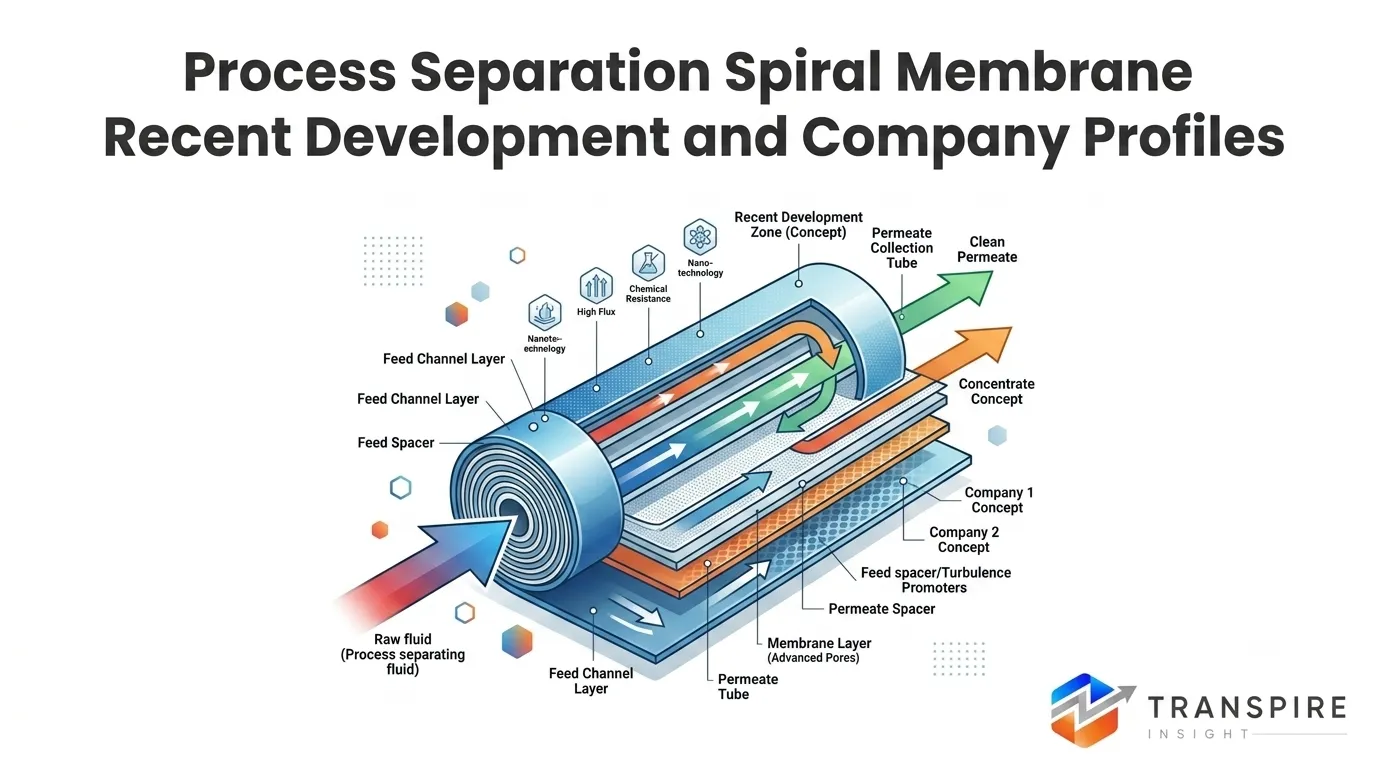
The process separation spiral membrane market represents a critical segment within industrial filtration and separation technologies. Characterized by tightly packed membrane layers wrapped around a central tube, spiral-wound configurations offer exceptionally high packing density and surface area efficiency. This design minimizes equipment footprints while drastically improving throughput. As industries prioritize resource recovery, high-purity processing, and strict environmental compliance, spiral membranes are becoming essential assets across municipal water treatment, food and beverage manufacturing, pharmaceuticals, and chemical processing sectors.
Recent Development News
Stay Ahead of Emerging Opportunities with Expert Market Insights by Transpire Insight
Transpire Insight provides comprehensive, data-driven market intelligence to support smarter business decisions. Our research is rooted in comprehensive analysis, authoritative predictions, and industry expertise, enabling organizations to make informed decisions in rapidly evolving markets. In-depth analysis of market segmentation, competitive positioning, regional trends, and emerging investment opportunities in high-growth areas. We blend accuracy with actionable intelligence, empowering companies to uncover new avenues for growth, bolster strategic decision-making, and stay ahead in a dynamic market.
Download the exclusive Process Separation Spiral Membrane Market sample report today to uncover expert insights, emerging trends, and the opportunities defining the future of the industry.
Process Separation Spiral Membrane Market Size & Statistics
Regional Growth and Demand Analysis by Transpire Insight
In North America, the market is segmented into the U.S., Canada, and Mexico, each presenting distinct opportunities shaped by industrial base and regulatory intensity. The United States and Canada anchor the region's dominance through strict environmental compliance standards and heavy investment in water and wastewater treatment infrastructure, with utilities and industrial operators steadily replacing legacy filtration assets with advanced spiral-wound systems, while Mexico contributes through the modernization of its manufacturing base and growing industrial water-reuse initiatives. Key European markets include Germany, the UK, France, Italy, and the Rest of Europe, where pharmaceutical, chemical, and food-processing sectors' focus on sustainability is driving demand for advanced separation systems. Europe is emerging as a leader in resource-efficient processing, with EU circular-economy and carbon-reduction policy pushing manufacturers toward energy-efficient membrane operation and reduced chemical consumption to meet environmental mandates.
Asia-Pacific's growth is being propelled by rapid industrial expansion across the region, which is driving rising demand for water treatment, food processing, and pharmaceutical-grade separation systems. This surge is fueled by China's manufacturing and water-infrastructure investment, India's accelerating industrialization and wastewater regulation, and Japan's advanced membrane manufacturing base. Rising urbanization, growing water scarcity concerns, and government-backed clean-water programs have resulted in widespread adoption of spiral membrane systems across municipal, industrial, and healthcare applications, with the region experiencing substantial growth in desalination capacity, particularly in China and India. Continued industrial modernization, tightening discharge regulations, and energy-efficiency demands are expected to sustain this growth going forward.
Top 15 Trends in the Process Separation Spiral Membrane Market
Proceed to Checkout to purchase the exclusive Process Separation Spiral Membrane Market report and gain instant access to in-depth market intelligence, strategic analysis, and future growth opportunities.
These membranes dominate due to superior permeability and salt rejection, prompting manufacturers to prioritize polyamide-based formulations over older cellulose acetate designs.
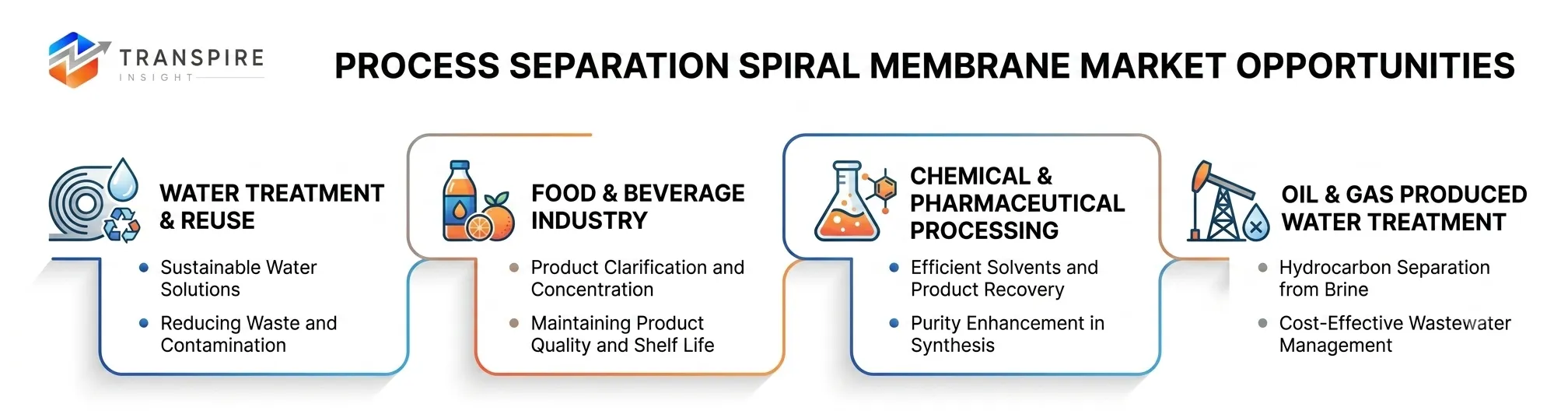
Water scarcity is pushing municipalities and industries toward large-scale desalination and recycling projects, making spiral membranes essential infrastructure for sustainable water management systems.
Stringent quality-control requirements in drug manufacturing are increasing reliance on spiral membranes for purification, concentration, and separation steps within biopharmaceutical production processes.
Producers are investing heavily in new facilities to meet rising demand, exemplified by multimillion-dollar plant investments targeting food, beverage, life science, and industrial sectors.
Governments worldwide are tightening discharge and drinking-water standards, compelling industries and utilities to adopt advanced membrane separation technologies for regulatory compliance and pollution control.
Companies are consolidating through strategic acquisitions of membrane product lines and technologies, strengthening market position, expanding regional presence, and broadening technical service capabilities.
List of Top 25 Companies Leading the Process Separation Spiral Membrane Market
Customize the exclusive Process Separation Spiral Membrane Market report today to receive tailored insights, country-specific analysis, and business-focused market intelligence.
1. DuPont de Nemours, Inc.
High-performance membrane chemistry leads to municipal and industrial process liquid filtration.
Founded: 1802 | HQ: Wilmington, Delaware, USA.
Why It Ranks: Unmatched market share and extensive material science research capabilities.
Regional Dominance: Strongest market presence across North America and Western European territories.
Product Line: FilmTec reverse osmosis and nanofiltration elements for water purification.
2. Toray Industries, Inc.
Pioneer in advanced polymer synthesis for high-rejection reverse osmosis separation systems.
Founded: 1926 | HQ: Tokyo, Japan.
Why It Ranks: Technology leadership in energy-efficient desalination and specialty process separation elements.
Regional Dominance: Major dominance in Asia-Pacific and growing Middle Eastern markets.
Product Line: ROMBRAIN spiral-wound reverse osmosis and ultrafiltration membrane module systems.
3. Hydranautics (Nitto Denko Group)
Delivers ultra-low energy and fouling-resistant membrane configurations for complex wastewater.
Founded: 1963 | HQ: Oceanside, California, USA.
Why It Ranks: Innovative anti-fouling geometries that reduce industrial operational and maintenance expenses.
Regional Dominance: Extensive commercial presence across North America and South America regions.
Product Line: CPA and ESPA series high-efficiency spiral-wound reverse osmosis membranes.
4. Kovalus Separation Solutions
Specializes in customized crossflow filtration modules for dairy and bioprocessing applications.
Founded: 1963 | HQ: Wilmington, Massachusetts, USA.
Why It Ranks: Direct leadership in specialized food, beverage, and life sciences separation.
Regional Dominance: Heavy footprint across North American and European dairy processing hubs.
Product Line: Fluid Systems and SelRO spiral nanofiltration and ultrafiltration elements.
5. Veolia Water Technologies
Integrates advanced membrane element production directly into large-scale water projects.
Founded: 1853 | HQ: Paris, France.
Why It Ranks: Massive end-to-end project footprint and total water management integration.
Regional Dominance: Uncontested market leadership across European and Middle Eastern municipal sectors.
Product Line: Specialized spiral membrane systems for industrial process water reuse.
6. Pentair plc (X-Flow)
Engineers robust separation modules designed for extreme chemical and thermal operational environments.
Founded: 1966 | HQ: London, United Kingdom.
Why It Ranks: Outstanding reliability in heavy industrial wastewater and harsh process separation.
Regional Dominance: Strong distribution networks across Western Europe and Asian industrial centers.
Product Line: High-flux spiral membrane modules for industrial process water clarification.
7. Asahi Kasei Corporation
Leverages precise hollow and spiral material chemistry for high-purity medical applications.
Founded: 1931 | HQ: Tokyo, Japan.
Why It Ranks: Premier manufacturing quality control targeting biotechnology and semiconductor separation needs.
Regional Dominance: Market leadership in East Asian high-tech industrial manufacturing hubs.
Product Line: Microza filtration modules and specialized process separation membrane systems.
8. LG Chem
Utilizes thin-film nanocomposite technology to deliver superior salt rejection performance levels.
Founded: 1947 | HQ: Seoul, South Korea.
Why It Ranks: Rapid market share gains driven by breakthrough nanocomposite membrane innovations.
Regional Dominance: Expanding footprint in Asia-Pacific and Latin American desalination markets.
Product Line: NanoH2O seawater and brackish water reverse osmosis spiral elements.
9. Mann+Hummel (MICRODYN-NADIR)
Focuses on custom membrane element configurations tailored to challenging industrial streams.
Founded: 1941 | HQ: Ludwigsburg, Germany.
Why It Ranks: Exceptional customization capabilities for complex food, dairy, and chemical applications.
Regional Dominance: Established market dominance across European industrial and manufacturing sectors.
Product Line: BIO-CEL and TRISEP custom-wound spiral membranes for process separations.
10. AXEON Water Technologies
Produces accessible, highly versatile standard spiral membrane elements for commercial systems.
Founded: 1989 | HQ: Temecula, California, USA.
Why It Ranks: Cost-effective commercial solution scaling and broad distributor channel network presence.
Regional Dominance: Strong leadership in North American commercial and light industrial markets.
Product Line: High-rejection polyamide spiral-wound reverse osmosis and nanofiltration elements.
Schedule a meeting with our market experts to discuss the exclusive Process Separation Spiral Membrane Market report and identify the best research solution for your organization.
Conclusion
The process separation spiral membrane market is positioned for sustained expansion as industries transition toward energy-efficient, sustainable separation methods. Key players continue to innovate with thin-film nanocomposites and anti-fouling geometries to combat operational degradation. While initial installation costs remain a consideration for smaller operators, the long-term economic gains from lower energy consumption, water reuse, and valuable product recovery make spiral membranes indispensable. Going forward, advancing polymer chemistry will solidify their market leadership in process engineering.


Send us a brief description of your challenge and we'll get back to you within 24 hours.

 inquiry@transpireinsight.com
 APAC:+91 7666513636
 Address


