
Sep 01, 2026
By Transpire Insight

Description
According to a research report published by Transpire Insight, the probiotic dietary supplement market size is projected to grow from USD 11.34 billion in 2026 to USD 19.23 billion by 2035, at a CAGR of 13.2% during the forecast period 2026-2035. Market growth is fuelled by increased consumer awareness of gut health, the growth of preventive healthcare, and a spike in the demand for immunity-boosting supplements. Moreover, constant innovations in strain-stabilization and growing e-commerce distribution channels all over the world quickly increase retail access among various market segments.
Introduction
The probiotic dietary supplement market is growing at a rapid pace due to the increasing consumer concern about digestive health, immunity support, and personalized nutrition. Probiotics are live beneficial microorganisms that re-establish balance in the gut microflora, providing health benefits for the prevention of gastrointestinal and metabolic diseases. Consumers are more interested in holistic health and are turning to more sustainable forms such as capsules, gummies, and powders over synthetic products. As science continues to advance with the development of multi-strain probiotics and delivery systems, probiotic dietary supplements have become more than just a wellness product; they're a mainstay in everyday health care.
Recent Development News
Stay Ahead of Emerging Opportunities with Expert Market Insights by Transpire Insight
Transpire Insight provides comprehensive, data-driven market intelligence to support smarter business decisions. Our research is rooted in comprehensive analysis, authoritative predictions, and industry expertise, enabling organizations to make informed decisions in rapidly evolving markets. In-depth analysis of market segmentation, competitive positioning, regional trends, and emerging investment opportunities in high-growth areas. We blend accuracy with actionable intelligence, empowering companies to uncover new avenues for growth, bolster strategic decision-making, and stay ahead in a dynamic market.
Probiotic Dietary Supplement Market Size & Statistics
Regional Growth and Demand Analysis by Transpire Insight
Asia-Pacific's leadership rests on deep-rooted fermented food traditions that have long embedded probiotics into everyday diets across China, Japan, and South Korea. The companies have established decades of consumer confidence by means of fermented dairy products, and local authorities have increasingly streamlined the process for the approval of new probiotic strains and novel health claims. Multinationals such as DSM-Firmenich and Chr. Hansen are still attracting investors due to the increase in people's disposable income and their growing interest in digestive and immune wellness. Hansen is pushing for more regional manufacturing and R&D.
The rapid growth of the Middle East and Africa is attributed to the betterment of healthcare infrastructure and the rising young population who are becoming health-conscious. Gulf retailers are marketing brands like probiotics from Reckitt Benckiser's Culturelle and Danone's Activia to their local market, while local manufacturers are creating lines of probiotics that are halal certified to cater to dietary needs. Meanwhile, increasing regional obesity and digestive-disorder has further fueled supplement adoption, as has government support for wellness initiatives.
Download the exclusive Probiotic Dietary Supplement Market brochure today to uncover expert insights, emerging trends, and the opportunities defining the future of the industry.
Top 15 Trends in the Probiotic Dietary Supplement Market
Spore-Based, Microencapsulated Strains
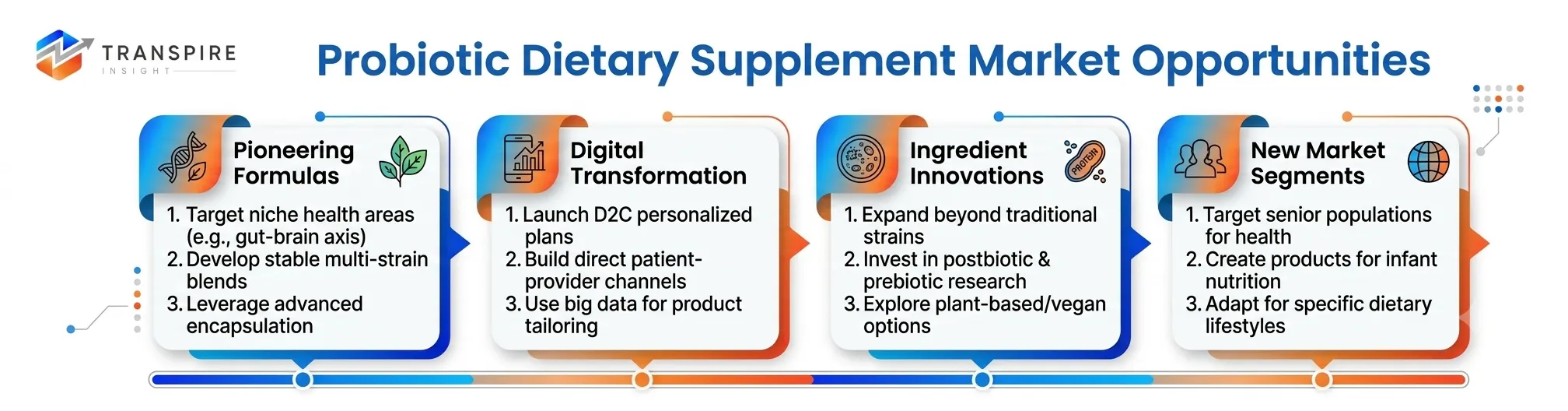
Spore-based and microencapsulated probiotic strains are gaining traction for their superior heat and moisture resistance, improving shelf stability and survivability through gastric transit for consumers.
Postbiotic and Synbiotic Blends
Postbiotics and synbiotic blends are rising fast, combining prebiotic fibers with live cultures to enhance gut colonization, offering longer shelf life than traditional probiotic-only formulations.
E-commerce and D2C Sales
Online and direct-to-consumer channels now drive significant probiotic supplement sales, as subscription models, influencer marketing, and quiz-based recommendations help brands reach younger, digitally native buyers.
Immune Health Positioning
Probiotic supplements increasingly target immune health, combining specific bacterial strains with vitamins like zinc and vitamin D to offer broader wellness benefits beyond digestion alone.
Microbiome-Targeted R&D
Rising R&D investment in microbiome science is enabling next-generation, genetically characterized probiotic strains, allowing manufacturers to substantiate specific health claims through robust clinical trial evidence.
Gut-Brain Axis / Psychobiotics
Gut-brain axis research is fueling demand for psychobiotic supplements, as consumers increasingly seek probiotic strains marketed for stress relief, better sleep, and improved overall mood.
List of Top 25 Companies Leading the Probiotic Dietary Supplement Market
Nestlé leads nutrition by offering clinical probiotic brands like Garden of Life.
Founded: 1866 | HQ: Vevey, Switzerland.
Why It Ranks: Dominates retail supplement shelves through continuous research and diverse probiotic brand acquisitions.
Regional Dominance: Maintains significant market share across North America, Europe, and emerging Asian regions.
Product Line: Offers specialized probiotics for digestive health, immunity support, and prenatal wellness.
BioGaia pioneers healthcare probiotic products utilizing clinically proven Lactobacillus reuteri strains worldwide.
Founded: 1990 | HQ: Stockholm, Sweden.
Why It Ranks: Recognized globally for pediatric probiotic drops and extensive scientific clinical backing.
Regional Dominance: Strong presence across Europe, Latin America, and expanding Asian retail pharmacy channels.
Product Line: Manufactures pediatric drops, chewable gut tablets, and adult immune care supplements.
Probi develops scientifically validated probiotic strains for supplement and food markets.
Founded: 1991 | HQ: Lund, Sweden.
Why It Ranks: Industry leader in gut health research and patented strain-stabilization delivery technologies.
Regional Dominance: Commands robust market presence across European, North American, and Asia-Pacific markets.
Product Line: Provides iron absorption probiotics, digestive solutions, and active sports nutrition formulations.
Novonesis supplies premium microbial probiotic cultures to leading supplement manufacturers continuously.
Founded: 1874 | HQ: Hørsholm, Denmark.
Why It Ranks: Unmatched bio-bank capabilities and decades of rigorous probiotic strain innovation.
Regional Dominance: Establishes strong market leadership across Europe, North America, and Latin American territories.
Product Line: Delivers bulk probiotic strains for gut health, immunity, and infant nutrition.
Yakult invented functional probiotic drinks utilizing the proprietary strain L. casei Shirota.
Founded: 1935 | HQ: Tokyo, Japan.
Why It Ranks: Iconic pioneer in probiotic delivery with unmatched consumer brand awareness worldwide.
Regional Dominance: Uncontested market dominance in Asia-Pacific while expanding across Europe and the Americas.
Product Line: Produces fermented probiotic beverages, dietary supplements, and targeted gut health formulas.
ADM provides advanced probiotic and postbiotic ingredients to major supplement brand owners.
Founded: 1902 | HQ: Chicago, Illinois, USA.
Why It Ranks: Vast distribution network and cutting-edge microbiome ingredient research and development.
Regional Dominance: Holds strong dominance in North America, Western Europe, and growing Asian markets.
Product Line: Offers BPL1 probiotic strains, weight management blends, and customizable dietary solutions.
Lallemand specializes in yeast and bacteria probiotic development for human health applications.
Founded: 1915 | HQ: Montreal, Canada.
Why It Ranks: Extensive manufacturing footprint and expertise in microencapsulation technologies for gut stability.
Regional Dominance: Leads market distribution across North America, Europe, and key South American countries.
Product Line: Formulates brain-gut microflora blends, women's health probiotics, and oral health solutions.
IFF produces premium HOWARU probiotic strains backed by clinical health research studies.
Founded: 1958 | HQ: New York, New York, USA.
Why It Ranks: supplier of clinically documented strains supporting immunity, stress, and digestion.
Regional Dominance: Commands significant market share in North America, Europe, and Asia-Pacific healthcare sectors.
Product Line: Features HOWARU premium probiotic strains for immunity, women's health, and digestion.
Reckitt markets leading digestive wellness brands like Digestive Advantage to consumers.
Founded: 1819 | HQ: Slough, United Kingdom.
Why It Ranks: Expansive retail pharmaceutical footprint paired with strong brand consumer loyalty worldwide.
Regional Dominance: Powerful distribution dominance across North America, Western Europe, and fast-growing emerging markets.
Product Line: Sells patented daily probiotic gummies, intensive digestive caps, and immune supplements.
Church Dwight delivers popular gummy probiotics through market-leading consumer supplement brands globally.
Founded: 1846 | HQ: Ewing, New Jersey, USA.
Why It Ranks: Dominates the rapidly expanding gummy probiotic category with highly palatable product formats.
Regional Dominance: Strongest market influence in North America with increasing retail distribution expansion.
Product Line: Manufactures adult probiotic gummies, kids chewable supplements, and combination immune formulas.
Conclusion
Gut health, Immune resistance, and metabolic wellness are the key factors driving the probiotic dietary supplement market to see significant growth with rising consumer consciousness. Strain viability, precision synbiotics, and customized delivery formats are key areas that are being aggressively developed by key industry players to cater to the changing consumer preferences. The gut microbiome is a field that will see significant investments and innovations as research furthers its understanding of its effects on various facets of health. In the end, leadership in this dynamic sector of preventive healthcare wellness will be strategic scientific validation and regulatory compliance.


Send us a brief description of your challenge and we'll get back to you within 24 hours.

 inquiry@transpireinsight.com
 APAC:+91 7666513636
 Address


