
Aug 03, 2026
By Transpire Insight
Description
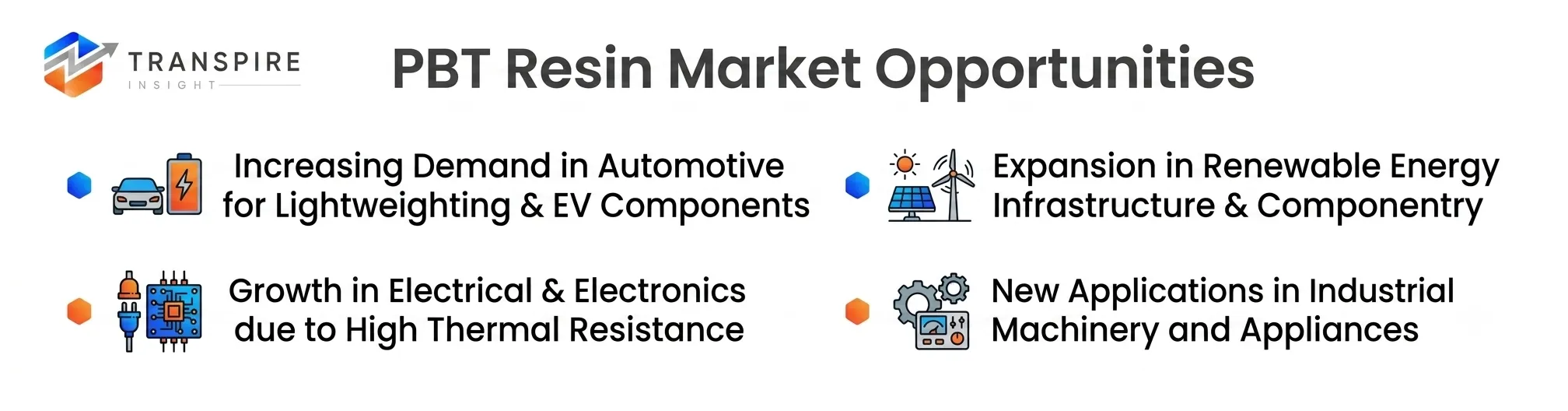
According to a research report published by Transpire Insight, The PBT Resin Market size is projected to Grow from USD 5676.2 Million in 2025 to USD 8302.5 Million by 2035, at a CAGR of 7% during the forecast period 2026-2035. Factors responsible for fueling the growth of this market include the increasing demand for light-weight automotive parts, production of EVs, electronics production, and usage of high-performance engineering polymers. The constant innovation witnessed in glass-fiber reinforced PBT, flame retardants, recycling resins, and bio-engineered polymers is further enhancing the adoption of the PBT resin market. Apart from that, the investments made in the electrical infrastructure and renewable energy systems, and advanced consumer electronics are expected to generate significant opportunities for this market in the coming years.
Introduction
The PBT (Polybutylene Terephthalate) Resin Market involves the manufacturing and usage of a high-performance engineering thermoplastic that finds extensive use across the automobile industry, electronics and electrical industry, industrial machinery sector, consumer appliance market, medical equipment industry, and telecommunication industry. PBT resin is known for its outstanding mechanical strength, dimensional stability, electrical insulation properties, resistance to chemicals, heat resistance, and moisture resistance. It finds significant application in connectors, switches, sensors, circuit breakers, automotive parts, and precision molded parts.
Recent Development News
Stay Ahead of Emerging Opportunities with Expert Market Insights by Transpire Insight
The insights that have been shared through this blog are based on intensive market research carried out by Transpire Insight, an advisor that works with many organizations. Thanks to the analysis of extensive data, forecasts made by our specialists, and industry intelligence, our reports allow clients to find strategic growth opportunities in dynamically developing industries. For all those who would like to get more detailed information regarding market segmentation, competitive analysis, regional outlooks, and future investment tendencies, there is no doubt that our full report will be of great value.
Download the exclusive PBT Resin Market sample report today to uncover expert insights, emerging trends, and the opportunities defining the future of the industry.
PBT Resin Market Size & Statistics
Regional Growth and Demand Analysis by Transpire Insight:
The Asia-Pacific region is the dominant regional player in the PBT Resin Market, contributing nearly 52% of the market share. The reason why the Asia-Pacific region is dominating the PBT Resin Market is its high presence of automotive, electric vehicle, electrical & electronics, consumer appliances, and semiconductors manufacturing. Countries like China, Japan, South Korea, and Taiwan have a robust production network which creates a huge demand for PBT for various applications such as connectors, sensors, switches, circuit breakers, automotive parts, and electronic housing. The region is further boosting its growth due to the high rate of vehicle electrification owing to the good electrical insulating property, heat resistance, dimensional stability, and chemical resistance of PBT resin.
Fastest-growing region: Asia-Pacific is also expected to be the fastest-growing region driven by rising vehicle electrification, automotive electrification, electronics manufacturing, infrastructure development, and engineering plastic demand.
Top 15 Trends in the PBT Resin Market
Proceed to Checkout to purchase the exclusive PBT Resin Market report and gain instant access to in-depth market intelligence, strategic analysis, and future growth opportunities.
1. Increasing Adoption of PBT in Electric Vehicle Components
The fast shift towards electric vehicles will see the increase in the use of PBT resins in electric and electronic parts of electric vehicles. The electrical insulating property, resistance to heat, stability in size, and resistance to chemicals makes it a good choice for use in connectors, housing of sensors, charging parts, battery parts, and power electronics. With increased production of electric vehicles, there is an increased demand for durable plastics.
2. Growing Demand for Lightweight Automotive Engineering Plastics
Increasingly, automotive manufacturers are opting for plastics instead of metals in order to reduce vehicle weight. PBT resins provide the necessary properties of strength, stability, heat resistance, and moldability, and they can be used in various automotive applications. It is anticipated that rising demands for efficiency, driving range, and performance will lead to greater use of lightweight PBT parts.
3. Rising Use of PBT in Electrical and Electronic Connectors
The use of PBT in electrical and electronic connectors is getting more prominent due to its effectiveness as insulating material that offers accuracy, strength, heat resistance and chemical resistance. An increased production of smartphones, computers, industrial electronics, automotive electronics, and electrical gadgets is driving up the demand for such connector materials. Miniaturization of electronic gadgets has also driven the development of more accurate and advanced PBT grades.
4. Expansion of Flame-Retardant PBT Resin Grades
Flame-retardant PBT has seen rising demand in recent years due to increased safety standards from electrical, electronics, automotive, and industrial industries. The enhanced properties of flame retardant grades include better ignition resistance and heat resistance along with good mechanical and electrical properties. Flame retardant grades are extremely useful in connectors, switches, circuit breakers, charging units, and electronic housings.
5. Increasing Development of Recycled and Sustainable PBT
"Sustainability is emerging as an important trend within the PBT market, as companies attempt to minimize the amount of plastic waste and lessen the environmental impact of engineering plastics." Recycling of PBT, chemically recycling, better recovery processes, and low carbon feedstock, without compromising on performance, are some of the areas that companies are focusing on. It is believed that sustainability demands from the automotive and electronics industries will promote the use of recycled PBT.
6. Growing Demand for Hydrolysis-Resistant PBT Materials
Moisture-resistant PBT grades are becoming increasingly important for automotive, electrical, and industrial applications subject to exposure to moisture and high temperatures. The use of these new material formulations assists in retaining the mechanical integrity and physical dimensions over extended periods of time. The growing use of PBT in automotive applications, electric vehicles, and other applications requiring long-term reliability is driving efforts toward developing moisture-resistant grades of PBT.
Top 25 Companies Leading the PBT Resin Market
Customize the exclusive PBT Resin Market report today to receive tailored insights, country-specific analysis, and business-focused market intelligence.
1. BASF SE
BASF SE is a chemical company offering engineering plastics and specialty polymer solutions for automotive, electrical, electronics, industrial, and consumer applications.
Founded: 1865 | Headquarters: Ludwigshafen, Germany
Why It Ranks: Strong PBT portfolio, particularly through its Ultradur® engineering plastics range.
Regional Dominance: Europe, North America, and Asia-Pacific.
Product Line: Ultradur® PBT, glass-fiber-reinforced PBT, flame-retardant PBT, hydrolysis-resistant PBT, and specialty engineering plastics.
Recent Development: BASF continues expanding specialty Ultradur® PBT grades designed for demanding automotive, electrical, and electronics applications.
2. SABIC
SABIC is a major chemicals and engineering thermoplastics manufacturer serving automotive, electrical & electronics, healthcare, consumer goods, and industrial markets.
Founded: 1976 | Headquarters: Riyadh, Saudi Arabia
Why It Ranks: Extensive engineering thermoplastics portfolio and strong focus on advanced PBT formulations.
Regional Dominance: Middle East, Asia-Pacific, Europe, and North America.
Product Line: LNP™ PBT compounds, flame-retardant PBT, reinforced PBT, specialty compounds, and electrical/electronics materials.
Recent Development: SABIC has expanded its specialty PBT portfolio with materials targeting miniaturized electronic and consumer-device applications.
3. Toray Industries, Inc.
Toray Industries is a diversified Japanese chemical manufacturer producing advanced polymers, fibers, composites, and engineering plastics.
Founded: 1926 | Headquarters: Tokyo, Japan
Why It Ranks: Strong expertise in high-performance PBT materials for automotive and electrical applications.
Regional Dominance: Asia-Pacific, Europe, and North America.
Product Line: TOYOLAC® PBT, reinforced PBT, flame-retardant PBT, hydrolysis-resistant PBT, and specialty polymer compounds.
Recent Development: Toray is increasing its focus on sustainable engineering plastics and materials incorporating recycled and lower-carbon feedstocks.
4. Mitsubishi Engineering-Plastics Corporation
Mitsubishi Engineering-Plastics develops and manufactures high-performance engineering plastics for automotive, electrical, electronics, and industrial applications.
Founded: 1994 | Headquarters: Tokyo, Japan
Why It Ranks: Established supplier of PBT-based engineering plastics and specialty compounds.
Regional Dominance: Japan and broader Asia-Pacific, with established operations in Europe and North America.
Product Line: NOVADURAN® PBT, reinforced PBT, flame-retardant PBT, hydrolysis-resistant grades, and specialty engineering compounds.
Recent Development: The company continues developing advanced PBT grades with improved dimensional stability, flame resistance, and durability.
5. Celanese Corporation
Celanese is a specialty materials company producing engineered polymers and high-performance materials for automotive, electronics, medical, and industrial markets.
Founded: 1918 | Headquarters: Irving, Texas, USA
Why It Ranks: Broad engineering-materials expertise and strong position in high-performance polymer compounds.
Regional Dominance: North America, Europe, and Asia-Pacific.
Product Line: Crastin® PBT, glass-reinforced PBT, flame-retardant PBT, hydrolysis-resistant grades, and specialty polymer compounds.
Recent Development: Celanese continues advancing engineered PBT formulations for automotive electrification, electrical components, and demanding industrial applications.
6. LG Chem Ltd.
LG Chem is a major South Korean chemical and materials manufacturer supplying advanced polymers and engineering plastics to automotive, electronics, and industrial customers.
Founded: 1947 | Headquarters: Seoul, South Korea
Why It Ranks: Strong presence in Asia's automotive and electronics manufacturing ecosystem.
Regional Dominance: Asia-Pacific, North America, and Europe.
Product Line: LUPOX® PBT compounds, reinforced PBT, flame-retardant grades, specialty engineering plastics, and automotive polymer materials.
Recent Development: LG Chem continues developing high-performance engineering plastics designed for EV components and advanced electrical/electronic applications.
7. Chang Chun Group
Chang Chun Group is a major Taiwanese chemical manufacturer with products spanning polymers, resins, electronic materials, and specialty chemicals.
Founded: 1949 | Headquarters: Taipei, Taiwan
Why It Ranks: Significant Asian manufacturing capabilities and expertise in engineering plastics.
Regional Dominance: Taiwan, China, Southeast Asia, and other Asia-Pacific markets.
Product Line: PBT resin, modified PBT compounds, engineering plastics, electronic materials, and specialty polymers.
Recent Development: Chang Chun continues strengthening engineering-plastic production and developing materials for electronics and automotive applications.
8. Polyplastics Co., Ltd.
Polyplastics is a leading Japanese engineering plastics manufacturer serving automotive, electrical, electronics, industrial, and precision-component industries.
Founded: 1964 | Headquarters: Tokyo, Japan
Why It Ranks: Strong specialization in high-performance engineering thermoplastics and precision molding materials.
Regional Dominance: Japan and Asia-Pacific, with growing reach.
Product Line: DURANEX® PBT, reinforced PBT, flame-retardant PBT, high-flow grades, and specialty engineering plastics.
Recent Development: Polyplastics continues introducing high-performance materials optimized for miniaturized electrical components and automotive applications.
9. DuPont de Nemours, Inc.
DuPont develops specialty materials and engineering polymers for automotive, electronics, healthcare, industrial, and consumer applications.
Founded: 2019 (current company) | Headquarters: Wilmington, Delaware, USA
Why It Ranks: Strong engineering-materials expertise and established relationships with automotive and electronics manufacturers.
Regional Dominance: North America, Europe, and Asia-Pacific.
Product Line: Crastin® PBT, reinforced engineering polymers, flame-retardant materials, and specialty polymer solutions.
Recent Development: DuPont continues optimizing engineering polymer solutions for electrification, connectivity, and demanding electrical applications.
10. Lanxess AG
LANXESS is a German specialty chemicals company producing high-performance plastics, additives, and specialty materials for automotive, electrical, electronics, and industrial applications.
Founded: 2004 | Headquarters: Cologne, Germany
Why It Ranks: Strong position in specialty engineering plastics and customized PBT compounds.
Regional Dominance: Europe, North America, and Asia-Pacific.
Product Line: Pocan® PBT, glass-fiber-reinforced PBT, flame-retardant PBT, hydrolysis-resistant compounds, and specialty engineering plastics.
Recent Development: LANXESS continues developing sustainable and high-performance Pocan® PBT grades for automotive electrification and electrical/electronics applications.
Schedule a meeting with our market experts to discuss the exclusive PBT Resin Market report and identify the best research solution for your organization.
Conclusion
The PBT Resin Market is growing steadily due to rising demands of lightweight, heat resistant, electrically insulating and dimensionally stable engineering plastic products in automotive, electric vehicles, electrical & electronics, consumer appliances and industrial applications. Growth in the number of electric vehicles and automotive electrification is paving way for increased demands of PBT in connectors, sensors, charging devices and other electrical components, whereas, the electronics industry is fueling demand for flame retardant, high temperature and miniaturized PBT resins. The sustainability factor is gaining significance for which companies are working towards recycled PBT, chemical recycling, bio-based raw materials and low-carbon manufacturing processes. Some of the key companies which are leading the PBT Resin Market include BASF SE, SABIC, Toray Industries, Mitsubishi Engineering Plastics, Celanese, LG Chem, Chang Chun Group, Polyplastics, DuPont and LANXESS. Overall, rising automotive electrification, electronics miniaturization and sustainable polymers are likely to drive the growth of the PBT Resin Market.


Send us a brief description of your challenge and we'll get back to you within 24 hours.

 inquiry@transpireinsight.com
 APAC:+91 7666513636
 Address


