
Sep 02, 2026
By Transpire Insight
Description
According to a research report published by Transpire Insight, the pasta and noodles market size is projected to grow from USD 97.45 billion in 2026 to USD 130.4 billion by 2035, at a CAGR of 6.80% during the forecast period 2026-2035. Urbanization, quick lifestyles of consumers, and the booming growth of retail outlets are all contributing to the demand for quick meals. Additionally, the ongoing innovation of high-protein, gluten-free, and fortified products addresses the rising consumer awareness towards health and drives growth in pasta and noodle consumption.
Introduction
Pasta and noodles are an extremely steady, dynamic market segment in the packaged food industry that shows strong growth due to the demand for convenience, affordability, and versatility in eating. The market caters to various types of pasta, including traditional dry pasta, fresh artisanal pasta, and ready-to-eat instant noodles, all responding to evolving consumer preferences. Asia-Pacific is the top-consuming region, and North America and Europe have a strong preference for premium, organic, and health-oriented alternatives. The industry continues to have strong operating momentum in consumer markets with continued growth in distribution and flavor diversification.
Recent Development News
Stay Ahead of Emerging Opportunities with Expert Market Insights by Transpire Insight
Transpire Insight provides comprehensive, data-driven market intelligence to support smarter business decisions. Our research is rooted in comprehensive analysis, authoritative predictions, and industry expertise, enabling organizations to make informed decisions in rapidly evolving markets. In-depth analysis of market segmentation, competitive positioning, regional trends, and emerging investment opportunities in high-growth areas. We blend accuracy with actionable intelligence, empowering companies to uncover new avenues for growth, bolster strategic decision-making, and stay ahead in a dynamic market.
Pasta and Noodles Market Size & Statistics
Regional Growth and Demand Analysis by Transpire Insight
The Europeans are the leaders in terms of manufacturing depth and their capacity to continually re-invent a legacy category. At Barilla, Italian durum wheat is combined with chickpeas, lentils, and peas to create a line of pasta that offers more protein and fibre than standard pasta, without any compromise to the texture, whilst Pasta Garofalo's new high-protein spaghetti and penne are milled from Italian durum wheat and provide a comparable boost in protein and fibre without sacrificing the texture appeal. Increased regulatory pressure is encouraging this evolution, as emerging new front-of-pack standards for fibre, sodium and protein content will motivate manufacturers to make more meaningful changes to their labels and recipes. Innovation, as well as tradition, fuels Europe's market leadership by continuing to incentivize brands to claim heritage while making nutritional improvements visible on their products, across retail and foodservice channels throughout the region.
Asia-Pacific's rapid rise is founded on cultural depth and category reinvention. China, Japan, South Korea, India and Indonesia drive consumption, relying on wheat-based noodles every day, but producers are actively targeting younger, urban consumers with fusion and premium formats. Korean regional players are not just localizing Western products; it's a hybrid format that is also being exported, as is the Korean bulgogi flavor in the air-dried instant pasta brand Tangle from Samyang Foods, which combines the Korean flavor with an Alfredo-style sauce. As e-commerce grows and retail modernizes, the relationship between manufacturers and more and more convenience-oriented households is diminishing, while the internationalization of dishes such as ramen, pho, and pad thai is also returning to customers' confidence and investment in the brand. The Asian-Pacific region's export-focused innovation and cultural iconization is key to sustaining its growth pace above the average.
Top 15 Trends in the Pasta and Noodles Market
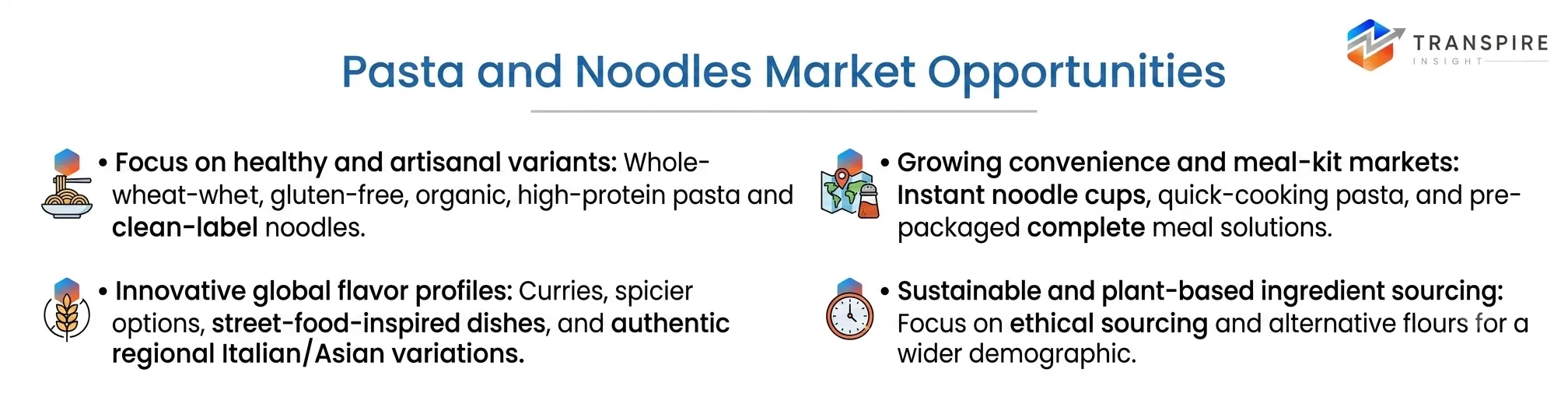
Manufacturers are fortifying pasta and noodles with pea, lentil, chickpea, and soy proteins to meet growing demand for muscle-friendly, satiety-boosting, convenient everyday meal options.
Producers are expanding gluten-free, multigrain, and ancient-grain lines using quinoa, millet, and buckwheat to serve health-conscious consumers seeking wellness without sacrificing familiar taste or texture.
Busy urban households are driving demand for instant cups, ready-to-heat pouches, and portionable meal formats that deliver quick, convenient nutrition without compromising flavor or quality.
Tighter fiber, sodium, and protein disclosure rules in Europe and North America are pushing manufacturers toward reformulated recipes, ingredient transparency, and clearer, consumer-friendly nutritional claims.
Pulse flours like faba, chickpea, and yellow pea are replacing wheat in gluten-reduced pastas, though manufacturers must balance earthy flavor notes against familiar texture expectations.
Consumers are paying premiums for artisanal, imported Italian durum wheat pasta and specialty shapes, as brands emphasize authentic sourcing, craftsmanship, and heritage storytelling in marketing.
Top 25 Companies Leading the Pasta And Noodles Market
List of Top 10 Companies Leading the Pasta And Noodles Market
1. Barilla Group
Barilla is the leader in traditional Italian dry pasta manufacturing.
Founded: 1877 | HQ: Parma, Italy.
Why It Ranks: Exceptional heritage and expansive retail network secure top market leadership placement.
Regional Dominance: Holds leading market shares across Europe and North American pasta sales categories.
Product Line: Blue Box Pasta, Collezione, Gluten-Free Pasta, Protein+, Pasta Sauces.
2. Nissin Foods Holdings Co., Ltd.
Nissin Foods invented the world's first instant noodles in Japan in 1958.
Founded: 1948 | HQ: Tokyo, Japan.
Why It Ranks: Pioneering instant noodle innovations maintains unrivaled brand recognition and market sales.
Regional Dominance: Strong market leadership across Asia-Pacific and massive retail footprint in North America.
Product Line: Cup Noodles, Top Ramen, RaOh, UFO Yakisoba, Demae Ramen.
3. Nestlé S.A.
Nestlé operates the iconic MAGGI brand, dominating instant noodles across Asian markets.
Founded: 1866 | HQ: Vevey, Switzerland.
Why It Ranks: Unmatched food distribution network and massive consumer brand trust drive volume.
Regional Dominance: Absolute market supremacy across South Asia, Southeast Asia, and Middle Eastern regions.
Product Line: MAGGI 2-Minute Noodles, MAGGI Fusian, Nutri-licious Noodles, Prepared Pasta.
4. Indofood CBP Sukses Makmur Tbk
Indofood produces Indomie, one of the most consumed instant noodle brands globally.
Founded: 1990 | HQ: Jakarta, Indonesia.
Why It Ranks: High-volume, low-cost manufacturing capabilities establish supreme market positioning across emerging economies.
Regional Dominance: Unrivaled market dominance in Southeast Asia and strong market penetration in Africa.
Product Line: Indomie Mi Goreng, Pop Mie, Sarimi, Supermi, Indomie Real Meat.
5. Toyo Suisan Kaisha, Ltd.
Toyo Suisan manufactures the globally popular Maruchan instant noodle brand across markets.
Founded: 1953 | HQ: Tokyo, Japan.
Why It Ranks: Affordable cup noodle offerings capture massive retail market share across Western markets.
Regional Dominance: Major market controller in North America and key commercial player in Japan.
Product Line: Maruchan Ramen, Instant Lunch, Yakisoba, Akai Kitsune, Midori no Tanuki.
6. Samyang Foods Co., Ltd.
Samyang created South Korea's first instant noodle product line back in 1963.
Founded: 1961 | HQ: Seoul, South Korea.
Why It Ranks: Viral Buldak spicy noodle sensation created tremendous exponential international sales expansion globally.
Regional Dominance: Rapidly growing market footprint spanning North America, Europe, and Asia-Pacific retail regions.
Product Line: Buldak Hot Chicken Ramen, Samyang Ramen, Sutah Ramen, Kimchi Ramen.
7. The Kraft Heinz Company
Kraft Heinz manufactures universally recognized packaged macaroni and cheese product lines globally.
Founded: 2015 | HQ: Chicago, Illinois, USA
Why It Ranks: Dominant North American market hold in convenient boxed meal macaroni product solutions.
Regional Dominance: Strong structural sales dominance across North America and select European retail markets.
Product Line: Kraft Macaroni & Cheese, Kraft Dinner, Velveeta Shells & Cheese.
8. Tingyi (Cayman Islands) Holding Corp.
Tingyi manufactures Master Kong, China's largest domestic instant noodle brand nationwide today.
Founded: 1996 | HQ: Tianjin, China.
Why It Ranks: Massive localized distribution network commands significant revenue in Asian noodle market sales.
Regional Dominance: Leading market share and operational dominance throughout Greater Mainland China retail territory.
Product Line: Master Kong Roasted Beef Noodles, Pickled Cabbage Noodles, Seafood Noodles.
9. Nongshim Co., Ltd.
Nongshim is South Korea's largest instant noodle and snack food manufacturer today.
Founded: 1965 | HQ: Seoul, South Korea.
Why It Ranks: Flagship Shin Ramyun brand drives extensive exports and international market growth.
Regional Dominance: Strong market lead in East Asia with widespread distribution in North America.
Product Line: Shin Ramyun, Neoguri, Chapagetti, Ansungtangmyun, Shin Black Ramyun.
10. ITC Limited
ITC's Sunfeast Yippee! brand is a major instant noodle seller in India.
Founded: 1910 | HQ: Kolkata, India.
Why It Ranks: Innovative non-lumpy noodle formats capture substantial market share in South Asian regions.
Regional Dominance: Powerful operational presence and market penetration throughout the Indian subcontinent retail region.
Product Line: Sunfeast Yippee! Magic Masala, Powerovens, Mood Masala, Pasta Treat.
Conclusion
The pasta and noodles market is expected to keep growing as market leaders cater to the growing preference among consumers for convenience, health, and premiumization. Local flavors and the innovation of new formulations, including those with higher protein content, gluten-free, and organic, will help sustain category growth in both mature and emerging markets. In addition, the wide range of e-commerce platforms and strong modern retail networks provide easy access to the product. In the end, strategic brand diversity, nutritional improvements, and robust distribution supply chains will help determine the long-term market leader for the key food manufacturers across the globe.


Send us a brief description of your challenge and we'll get back to you within 24 hours.

 inquiry@transpireinsight.com
 APAC:+91 7666513636
 Address


