
Aug 14, 2026
By Transpire Insight
Description
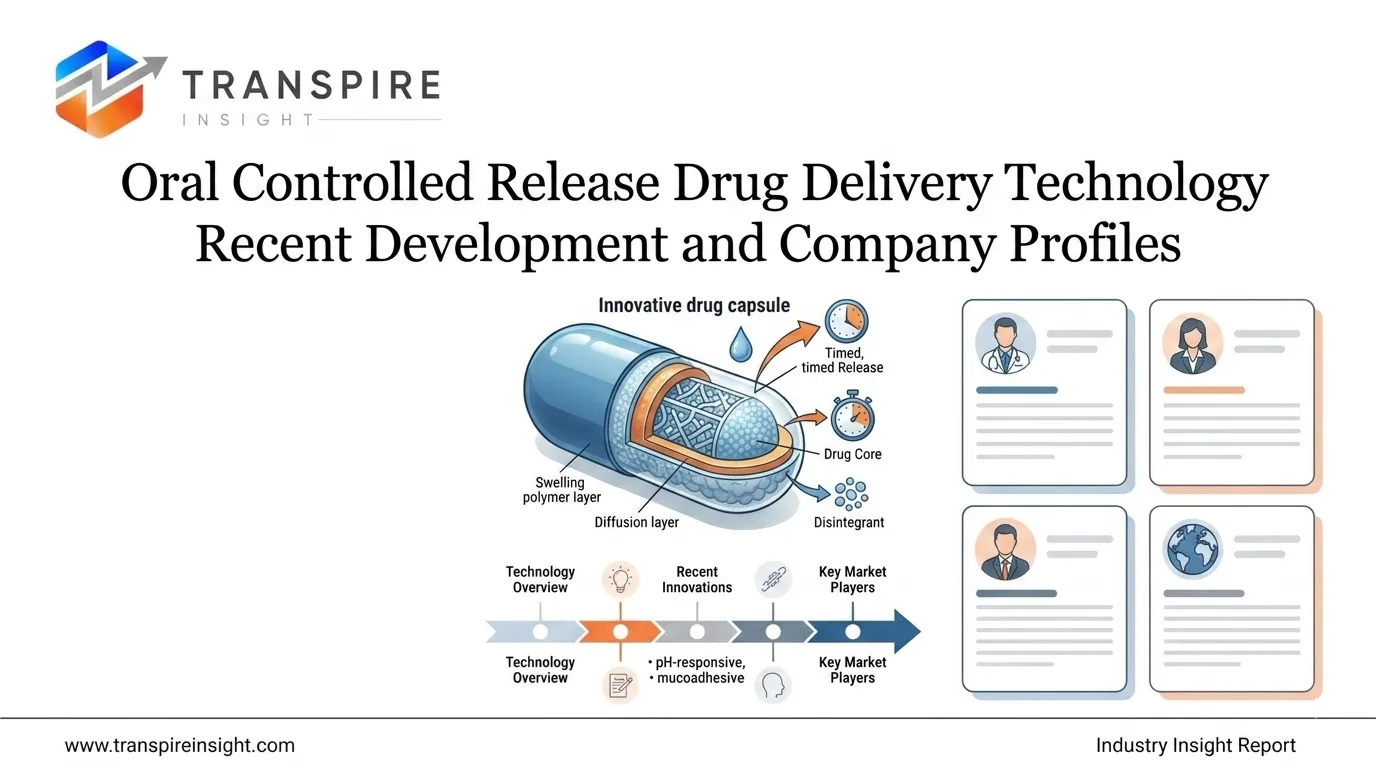
According to a research report published by Transpire Insight, the oral controlled release drug delivery technology market size is projected to grow from USD 37,104 million in 2026 to USD 61,043.2 million by 2035, at a CAGR of 8.3% during the forecast period 2026-2035. The escalating prevalence of chronic diseases, an aging population that needs a more convenient dosage, and an ongoing trend of polymer chemistry that improves drug safety, efficacy, and adherence all around the world are driving market growth.
Introduction
The oral controlled-release drug delivery technology has transformed the treatment of pharmaceutical drugs by providing a constant level of therapeutic drugs in the body for extended periods of time. This method can decrease the number of doses, lower the risk of side effects, and dramatically increase patient compliance, compared to traditional immediate-release tablets. The technology provides custom release rates for complex treatments using sophisticated polymeric matrices and osmotic delivery systems. This arrangement is particularly important for the efficient management of chronic, long-term health conditions such as cardiovascular conditions, diabetes, and central nervous system disorders.
Recent Development News
Stay Ahead of Emerging Opportunities with Expert Market Insights by Transpire Insight
Transpire Insight provides comprehensive, data-driven market intelligence to support smarter business decisions. Our research is rooted in comprehensive analysis, authoritative predictions, and industry expertise, enabling organizations to make informed decisions in rapidly evolving markets. In-depth analysis of market segmentation, competitive positioning, regional trends, and emerging investment opportunities in high-growth areas. We blend accuracy with actionable intelligence, empowering companies to uncover new avenues for growth, bolster strategic decision-making, and stay ahead in a dynamic market.
Download the exclusive Oral Controlled Release Drug Delivery Technology Market sample report today to uncover expert insights, emerging trends, and the opportunities defining the future of the industry.
Oral Controlled Release Drug Delivery Technology Market Size & Statistics
Regional Growth and Demand Analysis by Transpire Insight:
The oral controlled release drug delivery technology market is estimated to be the highest during the forecast period in North America. Meanwhile, North America was the biggest market by value with more than 41.3% of market value, supported by its abundant pharmaceutical R&D activity, the regulatory approval process for complex generics is more established in the FDA, and the diffusion, osmotic, and matrix platforms are widely used in the region. Diffusion Controlled Release was the primary market shareholder in the release-technology segment with over 35.6% of the market; it offered predictable release profiles, sustained plasma profile, better patient compliance, easy design, and speedy manufacturing. However, growth here is comparatively mature; the U.S. oral controlled release drug delivery technology market is expected to grow at a CAGR of 2.9% during 2026–36 and will have the largest share within North America, albeit the share would be less than what it is today, with a well-established pharmaceutical compounding and formulation-science ecosystem supporting this leadership. Major formulation science and excipient suppliers based in the area are also continuing to provide North American manufacturers with early access to the new and innovative polymer and coating technologies that are coming to market.
Asia-Pacific is expected to be the fastest-growing market for the oral controlled release drug delivery technology market over the forecast period. This trend is being reinforced by generic manufacturers and CDMO manufacturing base growth and by the fact that the region has a large treatment-seeking chronic disease base as well as low production cost, making it an attractive market for sponsors who are outsourcing complex oral formulation work. Meanwhile, India and China are becoming major bases for controlled and extended-release generics, and South Korea is developing as a hotspot for cutting-edge delivery-platform research and development. The market is expected to grow at a CAGR of 5.5% in South Asia & Pacific by 2036, driven by continued investments in domestic formulation capabilities and regulatory modernization. Asia Pacific is already a strong market accounting for an estimated 38.5% of total market share, at $16.9 billion, and is poised for further growth due to the increasing chronic disease burden (diabetes, cardiovascular disease, gastrointestinal disorders), expanding hospital and homecare infrastructure, and increasing local investment in matrix delivery, reservoir delivery, and osmotic delivery.
Top 15 Trends in the Oral Controlled Release Drug Delivery Technology Market
Proceed to Checkout to purchase the exclusive Oral Controlled Release Drug Delivery Technology Market report and gain instant access to in-depth market intelligence, strategic analysis, and future growth opportunities.
Osmotic pump technologies deliver zero-order, pH-independent drug release, improving dosing precision and patient compliance, making them increasingly preferred for chronic-disease, once-daily oral therapies.
Pellet and bead-based dosage forms allow flexible dose combinations and predictable gastrointestinal transit, supporting improved bioavailability and easier administration for pediatric and elderly patients.
Manufacturers increasingly favor once-daily dosing to boost adherence and reduce pill burden, particularly for chronic conditions like diabetes, cardiovascular disease, and psychiatric disorders.
Additive manufacturing enables complex, patient-specific release profiles and multi-drug combinations within a single tablet, opening new possibilities for personalized and flexible-dose therapy.
Machine learning models now predict drug-release kinetics and optimize excipient selection, shortening development timelines and reducing costly trial-and-error formulation cycles for manufacturers.
India and China are becoming growing hubs for controlled-release and extended-release generic manufacturing and API-excipient integration, lowering production costs and expanding supply capacity.
List of Top 25 Companies Leading the Hemodialysis Membrane Market
Customize the exclusive Oral Controlled Release Drug Delivery Technology Market report today to receive tailored insights, country-specific analysis, and business-focused market intelligence.
1. Fresenius Medical Care AG & Co. KGaA
World’s largest provider of advanced polysulfone membrane dialyzers for artificial kidneys.
Founded: 1996 | HQ: Bad Homburg, Germany.
Why It Ranks: Holds massive market share with unmatched vertically integrated manufacturing power.
Regional Dominance: Dominates Europe, North America, and maintains a major clinic footprint.
Product Line: FX CorDiax high-flux dialyzers, polysulfone membranes, and specialized filtration systems.
2. Baxter International Inc.
Pioneered synthetic high-flux membrane technologies to enhance toxic solute clearance.
Founded: 1931 | HQ: Deerfield, Illinois, USA.
Why It Ranks: Unmatched presence in hospital supply chains and innovation in biocompatible membranes.
Regional Dominance: Dominates North America while expanding rapidly across Latin American renal networks.
Product Line: Theranova medium cut-off dialyzers, Polyflux high-flux synthetic membrane series, and cartridges.
3. B. Braun Melsungen AG
Offers eco-friendly hollow-fiber membrane dialyzers with optimized blood-flow geometry.
Founded: 1839 | HQ: Melsungen, Germany.
Why It Ranks: Recognized globally for precision engineering, safety standards, and sustainable equipment manufacturing.
Regional Dominance: Commands Europe and holds a dominant share across emerging Asian healthcare centers.
Product Line: Xevonta polyethersulfone dialyzers, Diacap Ultra filters, and specialized blood lines.
4. Nipro Corporation
Key supplier of polyethersulfone and cellulose triacetate membranes for dialyzers.
Founded: 1954 | HQ: Osaka, Japan.
Why It Ranks: Delivers high-volume, cost-effective dialysis consumables without compromising structural membrane quality.
Regional Dominance: Controls major market share across Asia-Pacific and South American healthcare markets.
Product Line: Elisio polyethersulfone dialyzers, SureFlux hollow-fiber dialyzers, and dialyzer components.
5. Asahi Kasei Medical Co., Ltd.
Industry pioneer in high-performance polysulfone and regenerated cellulose hemodialysis membranes.
Founded: 1931 | HQ: Tokyo, Japan.
Why It Ranks: Renowned for high-flux biocompatible membranes that minimize inflammation during treatments.
Regional Dominance: Holds strong leadership in East Asia with growing clinical distribution across Europe.
Product Line: Rexeed polysulfone dialyzers, APS series hollow-fiber dialyzers, and therapeutic apheresis.
6. Nikkiso Co., Ltd.
Integrates proprietary synthetic membrane filtration systems into advanced automated hemodialysis machinery.
Founded: 1953 | HQ: Tokyo, Japan.
Why It Ranks: Strong technical synergy between machine electronics and high-performance dialyzer membrane units.
Regional Dominance: Commands Japan and maintains a substantial market footprint in Western European markets.
Product Line: FLX series polysulfone dialyzers, continuous renal replacement therapy (CRRT) membrane filters.
7. Toray Industries, Inc.
World leader in polymethylmethacrylate (PMMA) membranes designed to remove middle-molecule toxins.
Founded: 1926 | HQ: Tokyo, Japan.
Why It Ranks: Unique chemistry patents offer specialized therapeutic benefits for complex chronic dialysis patients.
Regional Dominance: Dominates specialized Japanese nephrology markets and holds a strong European presence.
Product Line: Filtryzer PMMA membrane dialyzers, Toraylight polysulfone series, and hemoperfusion cartridges.
8. Bain Medical Equipment Co., Ltd.
Fast-growing manufacturer producing millions of hollow-fiber synthetic membrane dialyzers annually.
Founded: 2003 | HQ: Guangzhou, China.
Why It Ranks: Rapid manufacturing expansion coupled with aggressive pricing strategies in tenders.
Regional Dominance: Dominates domestic Chinese healthcare systems and expands across Southeast Asian markets.
Product Line: Polyethersulfone hollow-fiber dialyzers, high-flux dialyzers, and related hemodialysis lines.
9. Kawasumi Laboratories, Inc.
Specializes in lightweight, highly durable synthetic membranes engineered for consistent clearance.
Founded: 1957 | HQ: Tokyo, Japan.
Why It Ranks: Decades of reliable manufacturing precision and high biocompatibility ratings from clinicians.
Regional Dominance: Strong historical presence in Asian medical markets and select North American outlets.
Product Line: Kawasumi polysulfone dialyzers, arterial-venous blood tubing sets, and vascular access needles.
10. Farmasol S.r.l.
European niche manufacturer producing custom synthetic membrane dialyzers and custom solutions.
Founded: 1988 | HQ: San Felice sul Panaro, Italy.
Why It Ranks: Exceptional manufacturing flexibility and tailored solutions for private dialysis center chains.
Regional Dominance: Strong presence across Southern Europe, the Middle East, and North Africa.
Product Line: High-flux and low-flux polyethersulfone dialyzers, customized hemodialysis concentrates, and tubing.
Schedule a meeting with our market experts to discuss the exclusive Oral Controlled Release Drug Delivery Technology Market report and identify the best research solution for your organization.
Conclusion
The hemodialysis membrane market is still indispensable in the current renal care scenario thanks to the growing worldwide population of ESRD. Key players are constantly researching to create synthetic polymers with a high degree of biocompatibility and efficient removal of toxins, while minimizing inflammation in the patient. In the future, strategic regional partnerships, automated manufacturing, and high-flux membrane developments will shape the industry. These constant developments make dialysis treatments safer, more effective, and available to everyone with chronic kidney disease.


Send us a brief description of your challenge and we'll get back to you within 24 hours.

 inquiry@transpireinsight.com
 APAC:+91 7666513636
 Address


