
Aug 01, 2026
By Transpire Insight
Description
According to a research report published by Transpire Insight, The Optical Backplane Connectors Market Size is projected to Grow from USD 4589.6 Million in 2025 to USD 4899.2 Million by 2035, at a CAGR of 7% during the forecast period 2026-2035. The growth in the market is due to increased adoption of hyperscale data centers, increased demand for fast optical communication, development of 5G and future 6G infrastructure, and increasing use of AI and cloud computing technologies. Innovations in the field of high-density optical networks, increased investment in high-performance computing systems, and the increased need for low power high bandwidth interconnects will further boost the growth in the market. Furthermore, innovations in optical connector technology and rapid development of digital infrastructure around the world will also open up tremendous opportunities during the forecast period.
Introduction
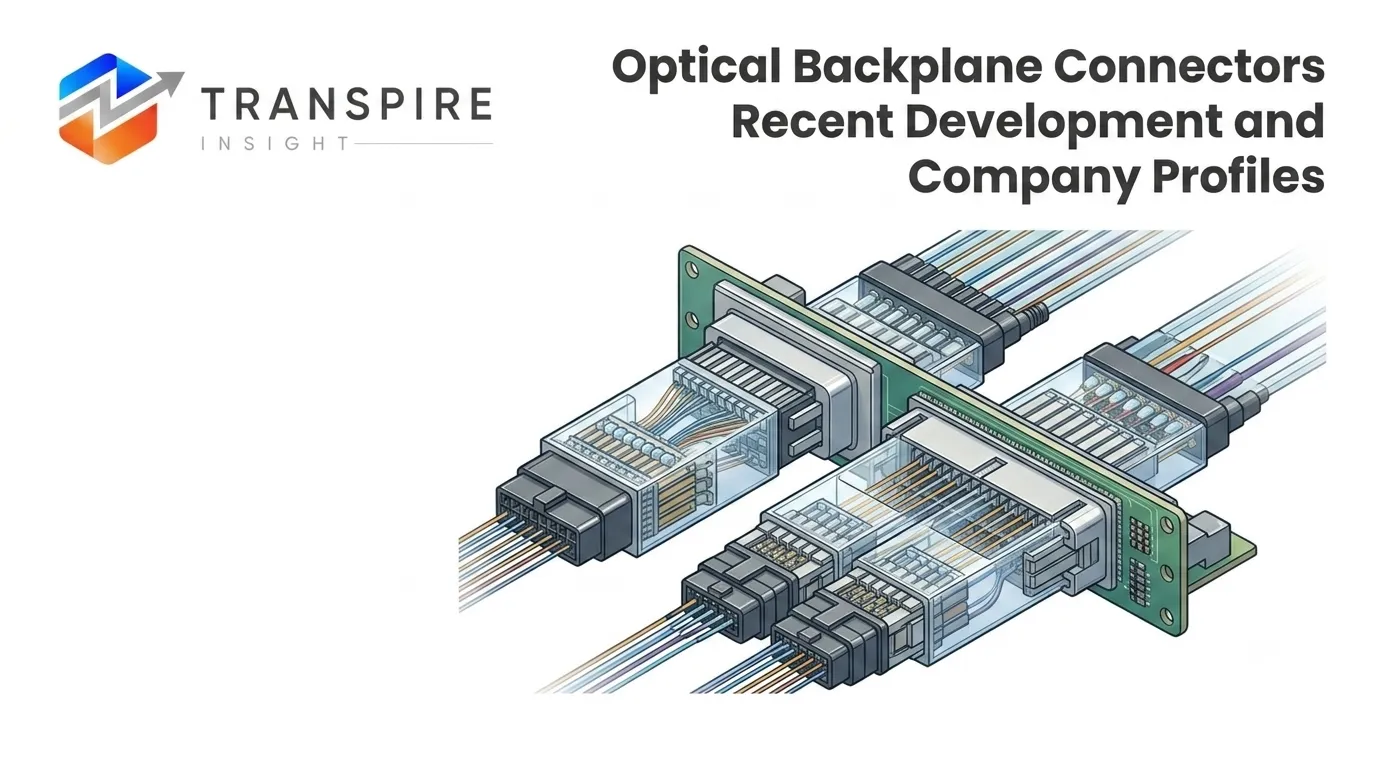
The Optical backplane connectors market includes optical backplane connector products that are high speed optical interconnection devices that are used for data transfer in huge quantities between different circuit boards and modules of systems in telecommunication, data centers, high-performance computing, aerospace, defense, and industrial networks. As opposed to electrical backplane connectors, optical backplane connectors make use of optical fiber for higher bandwidth, low latency, electromagnetic interference (EMI) reduction and energy efficiency.
Recent Development News
Stay Ahead of Emerging Opportunities with Expert Market Insights by Transpire Insight
The insights that have been shared through this blog are based on intensive market research carried out by Transpire Insight, an advisor that works with many organizations. Thanks to the analysis of extensive data, forecasts made by our specialists, and industry intelligence, our reports allow clients to find strategic growth opportunities in dynamically developing industries. For all those who would like to get more detailed information regarding market segmentation, competitive analysis, regional outlooks, and future investment tendencies, there is no doubt that our full report will be of great value.
Download the exclusive Optical Backplane Connectors Market sample report today to uncover expert insights, emerging trends, and the opportunities defining the future of the industry.
Optical Backplane Connectors Market Size & Statistics
Regional Growth and Demand Analysis by Transpire Insight:
North America leads the Optical Backplane Connectors Market, contributing around 41% of the market share.
The North American region is a market leader in the Optical Backplane Connectors Market owing to its robust presence of hyperscale data centers, high cloud computing infrastructure, and adoption of AI & high-performance computing technologies. This region comprises many tech giants, cloud service providers, and networking equipment suppliers who need ultra-high-speed optical connections for next-generation servers and communication systems. Ongoing investments in 5G infrastructures, AI data centers, defense electronics, aerospace applications, and high-bandwidth optical networking coupled with advanced R&D abilities and optical connector makers add more value to North America's market supremacy.
Fastest growing region: The Asia-Pacific region is estimated to have the highest CAGR during the forecast period on account of the fast emergence of cloud data centers, increasing semiconductor production, adoption of 5G and future communication networks, investments in AI infrastructure, and high-speed optical networking requirements in China, Japan, South Korea, Taiwan, and India.
Top 15 Trends in the Optical Backplane Connectors Market
Proceed to Checkout to purchase the exclusive Optical Backplane Connectors Market report and gain instant access to in-depth market intelligence, strategic analysis, and future growth opportunities.
1. Growing Adoption of High-Density Optical Interconnects
As there is an increasing requirement for larger bandwidth and fast data transfer, the trend toward high-density optical interconnections is growing in today’s communications technology. The factors that are leading to this are increased data transfer rate, better signal integrity, reduced interference, greater scalability, minimized losses, and compatibility with future network technologies.
2. Expansion of AI-Driven Data Center Infrastructure
With the fast adoption of artificial intelligence workloads, there will be a greater need for optical backplane connectors that will support ultra-fast speed transmission of data in hyperscale data centers. Growth drivers include an increase in artificial intelligence computing capabilities, fast server communication, high-efficiency data centers, more cloud investments, low latency, and network reliability.
3. Increasing Deployment of Co-Packaged Optics
The integration of optics with switching chips is being done by manufacturers to enhance performance and save power in high-speed networking. This is driven by better energy savings, shorter optical path lengths, less thermal issues, bandwidth density, improved system performance, and adoption in hyperscale networks.
4. Rising Demand for High-Speed Optical Backplane Connectors
As the move to 800G and beyond toward terabit networking gains pace, the need for connectors that can support ultra-high data transfer rates becomes necessary. Increased network capacity, enhanced communication efficiency, decreased network congestion, better switch compatibility, increased cloud connectivity, and growing telecommunication infrastructure are driving this trend.
5. Growth of 800G and 1.6T Optical Networking
Emerging Optical Networking Standards Are Changing the Way That Communication Networks Work through Faster Data Transmission for Cloud and Enterprise Applications. Bandwidth Availability, Network Scalability, Higher Transmission Efficiency, Enhanced Support for AI, Increased Performance of Data Centers, and Ongoing Innovation in Optical Technology Are Driving Market Growth.
6. Development of Energy-Efficient Optical Connectivity Solutions
Organizations are concentrating on lowering energy consumption without compromising on optical performance. Operating cost savings, better thermal performance, lower carbon footprint, increased equipment efficiency, increased lifespan of the system, and alignment with sustainability goals are some benefits associated with energy-efficient optical connector solutions.

Top 25 Companies Leading the Optical Backplane Connectors Market
Customize the exclusive Optical Backplane Connectors Market report today to receive tailored insights, country-specific analysis, and business-focused market intelligence.
1. TE Connectivity Ltd.
TE Connectivity is a technology company specializing in connectors, sensors, and connectivity solutions for industrial, automotive, aerospace, and communication industries.
Founded:2007 (origin dates back to 1941 as AMP Incorporated) | Headquarters: Galway, Ireland
Why It Ranks: Leading provider of high-speed optical connectors and advanced interconnect technologies.
Regional Dominance: Strong presence across North America, Europe, and Asia-Pacific.
Product Line: Optical Backplane Connectors, Fiber Optic Connectors, High-Speed Interconnects, Cable Assemblies, and Data Center Connectivity Solutions.
Recent Development: Expanded optical connectivity solutions for AI-driven data center infrastructure.
2. Amphenol Corporation
Amphenol Corporation designs and manufactures electrical, electronic, and fiber optic connectors for high-performance applications.
Founded:1932 | Headquarters: Wallingford, Connecticut, USA
Why It Ranks: leader in advanced optical and high-speed connector technologies.
Regional Dominance: Strong presence across North America, Europe, and Asia-Pacific.
Product Line: Optical Backplane Connectors, Fiber Optic Connectors, Circular Connectors, High-Speed Interconnects, and Cable Assemblies.
Recent Development: Expanded high-speed optical interconnect solutions for AI and cloud infrastructure.
3. Molex LLC
Molex develops electronic connectivity products for data communications, industrial automation, telecommunications, and consumer electronics.
Founded:1938 | Headquarters: Lisle, Illinois, USA
Why It Ranks: Major innovator in high-density optical interconnect systems.
Regional Dominance: Strong presence across North America, Europe, and Asia-Pacific.
Product Line: Optical Backplane Connectors, VersaBeam Optical Systems, Fiber Optic Connectors, Cable Assemblies, and Data Center Solutions.
Recent Development: Introduced advanced optical circuit switch platforms and expanded VersaBeam EBO solutions.
4. US Conec Ltd.
US Conec develops high-performance optical connectivity components for data centers, telecommunications, and enterprise networking.
Founded:1992 | Headquarters: Hickory, North Carolina, USA
Why It Ranks: Pioneer in high-density fiber optic connector technology.
Regional Dominance: Strong presence across North America, Europe, and Asia-Pacific.
Product Line: Optical Backplane Connectors, MPO Connectors, Fiber Optic Interconnects, and High-Density Connectivity Solutions.
Recent Development: Expanded next-generation multi-fiber optical connector technologies.
5. Corning Incorporated
Corning is a materials science company specializing in optical communications, specialty glass, ceramics, and advanced materials.
Founded:1851 | Headquarters: Corning, New York, USA
Why It Ranks: Leading supplier of fiber optic connectivity solutions for hyperscale networks.
Regional Dominance: Strong presence across North America, Europe, and Asia-Pacific.
Product Line: Optical Backplane Connectors, Fiber Optic Cables, Optical Connectivity Solutions, and Data Center Infrastructure Products.
Recent Development: Expanded AI-focused optical connectivity technologies with PRIZM® TMT solutions.
6. Rosenberger Group
Rosenberger develops high-frequency, fiber optic, and high-voltage connectivity solutions for industrial and communication markets.
Founded:1958 | Headquarters: Fridolfing, Germany
Why It Ranks: Leading provider of precision optical connector technologies.
Regional Dominance: Strong presence across Europe, North America, and Asia-Pacific.
Product Line: Optical Backplane Connectors, Fiber Optic Connectors, RF Connectors, High-Speed Data Connectors, and Telecom Solutions.
Recent Development: Expanded optical connectivity solutions for high-speed communication networks.
7. Sumitomo Electric Industries, Ltd.
Sumitomo Electric is a diversified technology company specializing in optical fibers, electronic devices, automotive components, and industrial materials.
Founded:1897 | Headquarters: Osaka, Japan
Why It Ranks: Major manufacturer of advanced optical communication products.
Regional Dominance: Strong presence across Asia-Pacific, North America, and Europe.
Product Line: Optical Backplane Connectors, Optical Fibers, Fiber Optic Components, and Communication Devices.
Recent Development: Expanded optical communication technologies supporting next-generation networking.
8. Fujikura Ltd.
Fujikura manufactures fiber optic cables, communication components, electronic products, and automotive wiring systems.
Founded:1885 | Headquarters: Tokyo, Japan
Why It Ranks: leader in optical fiber connectivity technologies.
Regional Dominance: Strong presence across Asia-Pacific, North America, and Europe.
Product Line: Optical Backplane Connectors, Fiber Optic Connectors, Optical Fibers, Fusion Splicers, and High-Speed Optical Components.
Recent Development: Expanded optical interconnect technologies for hyperscale data centers.
9. SENKO Advanced Components, Inc.
SENKO develops fiber optic connectivity products for telecommunications, enterprise networking, and data center applications.
Founded:1946 | Headquarters: Tokyo, Japan
Why It Ranks: Recognized innovator in high-density optical connector systems.
Regional Dominance: Strong presence across Asia-Pacific, North America, and Europe.
Product Line: Optical Backplane Connectors, SN Connectors, MPO Connectors, Fiber Optic Adapters, and Data Center Connectivity Solutions.
Recent Development: Introduced SN and SN-MT backplane connectors supporting up to 128 optical fibers.
10. Hirose Electric Co., Ltd.
Hirose Electric designs and manufactures advanced connectors for telecommunications, industrial automation, automotive, and consumer electronics.
Founded:1937 | Headquarters: Tokyo, Japan
Why It Ranks: Leading supplier of precision high-speed connector technologies.
Regional Dominance: Strong presence across Asia-Pacific, Europe, and North America.
Product Line: Optical Backplane Connectors, Board-to-Board Connectors, Fiber Optic Connectors, High-Speed Connectors, and Industrial Connectivity Solutions.
Recent Development: Expanded high-speed optical connector portfolio for next-generation communication equipment.
Schedule a meeting with our market experts to discuss the exclusive Optical Backplane Connectors Market report and identify the best research solution for your organization.
Conclusion
The Optical Backplane Connectors Market is experiencing considerable growth due to the increased demand for extremely fast, low latency, and power-efficient transmission of data in hyperscale data centers, AI infrastructure, telecom, high-performance computing, aerospace, and defense applications. With the shift towards 800G/1.6T networking, co-packaging of optics, silicon photonic technology, and new cloud architecture, there has been an unprecedented need for innovative optical backplane connectors technology. Major industry players such as TE Connectivity Ltd., Amphenol Corporation, Molex LLC, US Conec Ltd., Corning Incorporated, Rosenberger Group, Sumitomo Electric Industries, Ltd., Fujikura Ltd., SENKO Advanced Components, Inc., and Hirose Electric Co., Ltd. continue to gain an edge within the market through innovation and investment in high-density optical interconnect technology. With continued advancement in digitalization and adoption of AI technologies and high-speed communication networks globally, the Optical Backplane Connectors Market is anticipated to grow continuously in the coming years.


Send us a brief description of your challenge and we'll get back to you within 24 hours.

 inquiry@transpireinsight.com
 APAC:+91 7666513636
 Address


