
Aug 20, 2026
By Transpire Insight
Description
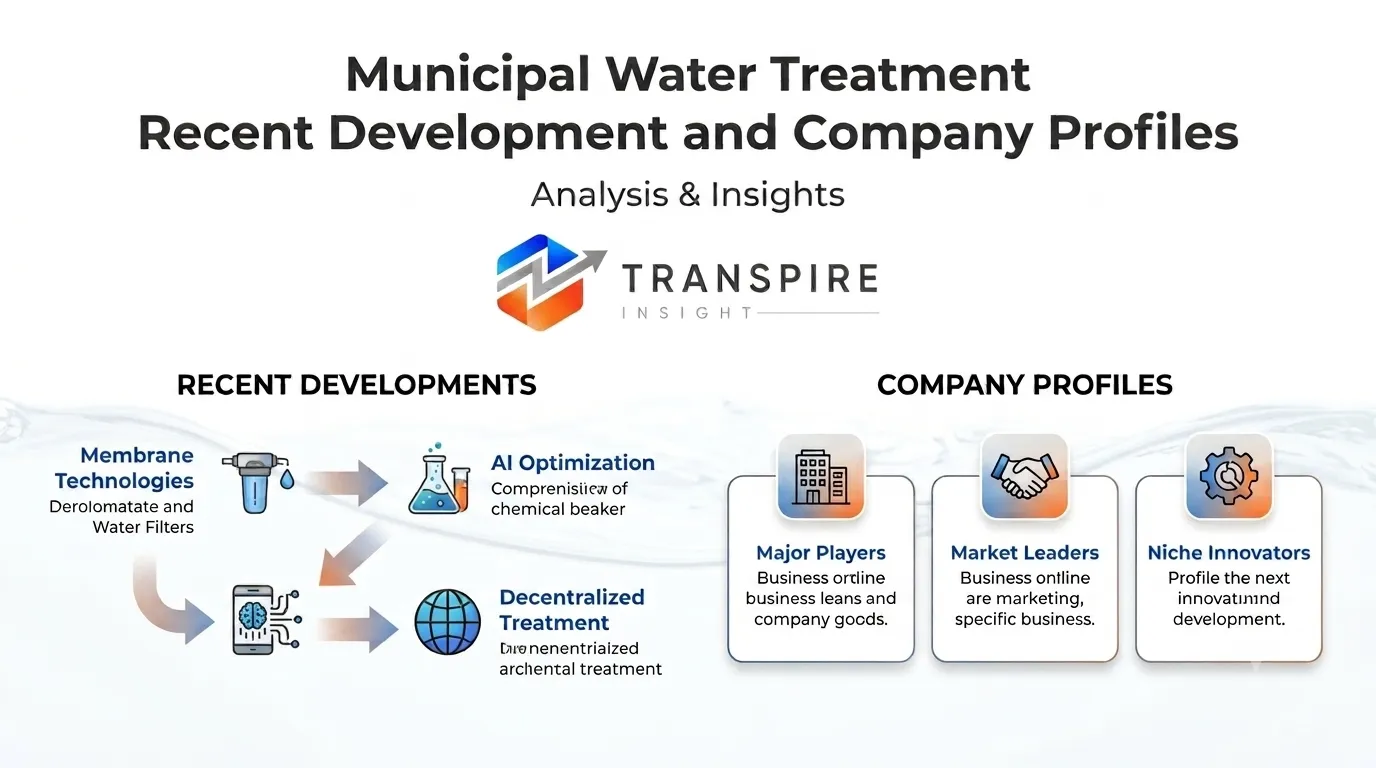
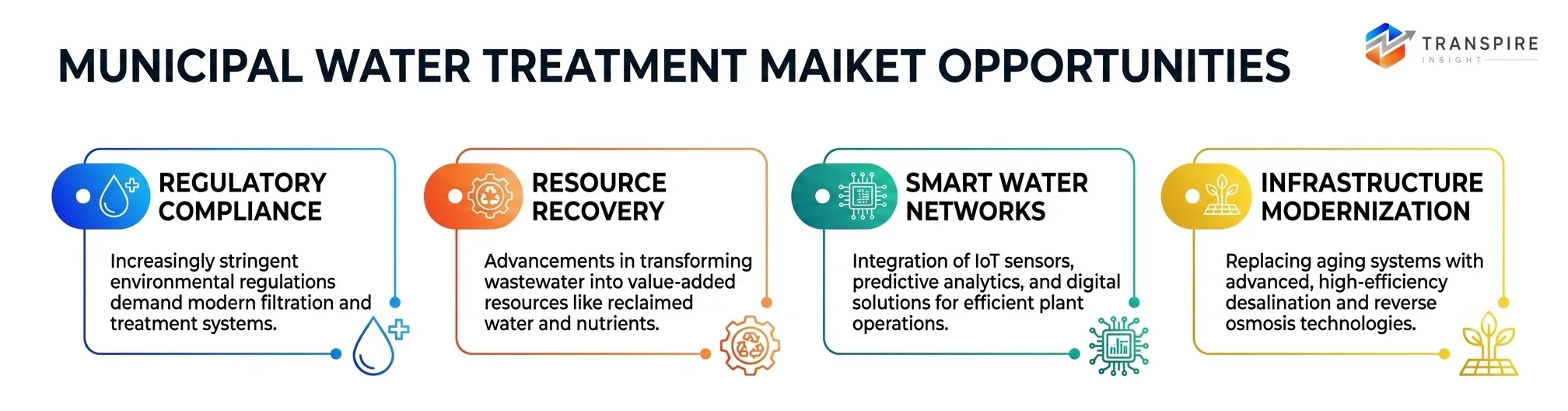
According to a research report published by Transpire Insight, The Municipal Water Treatment Market size is projected to Grow from USD 131.98 Billion in 2025 to USD 186.10 Billion by 2035, at a CAGR of 5.87% during the forecast period 2026-2035. Growth is facilitated through rapid urbanization, growing population, aging water infrastructure, growing scarcity of water, tightening environmental regulations, and increasing need for sanitation services. The use of membrane filtration, reverse osmosis, ultraviolet disinfection, advanced biological treatment, desalination, sludge management, and wastewater reuse technologies is becoming increasingly common among municipalities to achieve improved water quality and resource efficiency. In addition, digital transformation is prompting utilities to utilize smart meters, sensors, automation of water treatment, predictive analysis, and remote monitoring, thus reducing costs and improving performance of water treatment. Growth in the investment in recycling, resource recovery, energy efficient water treatment and climate resilient infrastructure is likely to generate further market opportunities till 2035.
Introduction
The Municipal Water Treatment Market represents the technologies, equipment, chemicals, and services employed by municipalities for the purification of water and the treatment of wastewater, so that raw water becomes drinkable. In addition to that, the market is of great importance to human health, to the control of water pollution and sanitation, and provides secure water supply, as cities become bigger. Currently, municipal water treatment plants are evolving beyond traditional filtering and biological processes to technologies such as membrane-based methods, reverse osmosis, UV treatment, advanced oxidation, nutrients removal, sludge treatment, desalination and water reuse systems. Besides, utilities start using connected sensors and automated control and monitoring tools in order to optimize the operations of their water treatment plants. Increased water scarcity, more stringent discharge requirements, climate change effects, and shift toward circular water management practices drive the evolution of the market.
Recent Development News
Stay Ahead of Emerging Opportunities with Expert Market Insights by Transpire Insight
The insights that have been shared through this blog are based on intensive market research carried out by Transpire Insight, an advisor that works with many organizations. Thanks to the analysis of extensive data, forecasts made by our specialists, and industry intelligence, our reports allow clients to find strategic growth opportunities in dynamically developing industries. For all those who would like to get more detailed information regarding market segmentation, competitive analysis, regional outlooks, and future investment tendencies, there is no doubt that our full report will be of great value.
Download the exclusive Municipal Water Treatment Market sample report today to uncover expert insights, emerging trends, and the opportunities defining the future of the industry.
Municipal Water Treatment Market Size & Statistics
Regional Growth and Demand Analysis by Transpire Insight:
The Municipal Water Treatment Market is dominated by Asia-Pacific due to urbanization, population increase, water stress, and huge investments in the construction of water and wastewater management infrastructures. Asian countries including China, India, Japan, South Korea, and countries from Southeast Asia have increased their capacities of municipal water treatment facilities because of growing water needs, sanitation needs, and pollution prevention needs.
This region has an enormous number of people living in urban areas, which means that there is a great need for treated water and sewage treatment. Government programs in the field of water security, sanitation, river recovery, wastewater reuse, desalination, and modernization are promoting more investments in water treatment. Also, the lack of water resources and water pollution forces municipalities to use new treatment technologies, such as membrane filtration, reverse osmosis, ultraviolet disinfection, biological treatment, and water reuse systems.
North America continues to be one of the most developed markets, backed up by the aging infrastructure for water, strong environmental laws, significant investments in urban municipalities, and use of sophisticated treatment techniques. Nevertheless, the combination of a large number of people, fast urbanization, infrastructure building, and high requirements for water treatment in Asia-Pacific makes it the best market.
Top 15 Trends in the Municipal Water Treatment Market
Proceed to Checkout to purchase the exclusive Municipal Water Treatment Market report and gain instant access to in-depth market intelligence, strategic analysis, and future growth opportunities.
City utilities are resorting to membrane filtration methods as a way to improve the quality of water as well as deal with the increasing complexities of contamination problems. Methods such as ultrafiltration, nanofiltration, and reverse osmosis are gaining importance as ways to eliminate suspended particles, microorganisms, dissolved compounds, and other pollutants. There is also a link between the increasing importance of these methods and the concept of water reuse and recycling, in which case the quality of the treatment process must be constant.
Increasing water shortages coupled with growing demands as a result of increasing urban populations are making it necessary for municipal authorities to view their wastewater as a source of water that can be reused and not just treated wastewater. More advanced technologies for treating wastewater are being developed so as to ensure that wastewater is treated up to a point where it can be reused for irrigating agricultural land and even for consumption.
Municipal wastewater treatment plants are increasingly adopting connectivity of sensors, automation of controls, remote monitoring via the cloud, and real-time data platforms to enhance the visibility of their operations. Information technology can assist utilities to continuously monitor variables such as water quality, flow rates, pressure, chemical levels, and equipment performance. Data generated through these processes can assist in addressing operational issues, ensuring consistent treatment processes, and efficient facility management by utilities.
The issue of energy consumption is becoming an important one for city utilities as it takes a lot of energy to pump, aerate, filter and disinfect water and wastewater. Thus, high-efficiency pumps, efficient aeration, variable-speed drives, energy-efficient membranes and better process control systems are being used. There is also research into generating energy from wastewater treatment, such as biogas production, which helps to decrease costs of operation and build more environmentally-friendly municipal infrastructure.
Water scarcity issues have spurred cities facing water stress to look at ways of increasing their sources of water by using desalination and purification technologies. Reverse osmosis continues to play an important role in many desalination processes while innovations in pre-treatment, membranes, energy recovery, and brine management continue to resolve any operational problems. Desalination is increasingly being looked at along with other water security options such as reuse and conservation.
Artificial intelligence, IoT, and predictive analytics are technologies that have started to be used in municipal facilities to convert plant data into useful information. AI can help in predicting when equipment needs to be maintained or replaced, detecting any abnormalities in water quality, helping in chemical dosing and energy management. The use of IoT in equipment can help in monitoring the facilities remotely and in detecting the potential failure of equipment.
Top 25 Companies Leading the Municipal Water Treatment Market
Customize the exclusive Municipal Water Treatment Market report today to receive tailored insights, country-specific analysis, and business-focused market intelligence.
1. Veolia Environnement S.A.
Veolia is an environmental services company providing water management, wastewater treatment, drinking-water services, waste management, and environmental solutions to municipalities and industries.
Founded: 1853 | Headquarters: Paris, France
Why It Ranks: Veolia ranks among the leading companies because of its extensive municipal water operations, project portfolio, advanced treatment technologies, and integrated water-management capabilities.
Regional Dominance: Europe, North America, Asia-Pacific, Latin America, and the Middle East.
Product Line: Drinking-water treatment, wastewater treatment, desalination, membrane technologies, water reuse, sludge management, digital water solutions, and water utility services.
Recent Development: Veolia continues expanding advanced water-treatment and reuse projects while investing in digitalization, resource recovery, and solutions designed to improve water resilience and reduce environmental impacts.
2. SUEZ S.A.
SUEZ is a environmental services company specializing in water and wastewater management, recycling, resource recovery, and sustainable infrastructure solutions.
Founded: 1858 | Headquarters: Paris, France
Why It Ranks: SUEZ has a strong position through its extensive municipal water contracts, advanced treatment technologies, engineering capabilities, and expertise in water reuse and resource management.
Regional Dominance: Europe, Asia-Pacific, North America, Latin America, and the Middle East.
Product Line: Drinking-water treatment, wastewater treatment, desalination, water reuse, membrane systems, sludge management, smart water solutions, and water infrastructure services.
Recent Development: SUEZ is increasing its focus on wastewater reuse, advanced membrane technologies, digital water management, and resource-efficient treatment systems to address water scarcity and municipal infrastructure requirements.
3. Xylem Inc.
Xylem is a water technology company providing equipment, digital solutions, and services for water and wastewater transport, treatment, monitoring, and infrastructure management.
Founded: 2011 | Headquarters: Washington, D.C., USA
Why It Ranks: Xylem's strong technology portfolio, municipal customer base, digital water capabilities, and expertise in pumps and treatment equipment make it a major market participant.
Regional Dominance: North America, Europe, Asia-Pacific, and Latin America.
Product Line: Water pumps, wastewater treatment equipment, filtration, disinfection, monitoring systems, smart water technologies, digital solutions, and water infrastructure services.
Recent Development: Xylem continues investing in digital water technologies, smart monitoring, advanced treatment, and integrated solutions designed to improve municipal water efficiency and infrastructure resilience.
4. Ecolab Inc.
Ecolab is a water, hygiene, and infection-prevention company providing water-treatment technologies and services to municipalities and industrial customers.
Founded: 1923 | Headquarters: St. Paul, Minnesota, USA
Why It Ranks: Ecolab benefits from its extensive expertise in water management, treatment chemicals, monitoring, process optimization, and resource-efficiency solutions.
Regional Dominance: North America, Europe, Asia-Pacific, Latin America, and the Middle East.
Product Line: Water-treatment chemicals, filtration, water monitoring, wastewater solutions, digital water-management systems, disinfection, and water-efficiency services.
Recent Development: Ecolab continues developing digital and water-management solutions that help customers optimize water consumption, treatment performance, energy use, and operational efficiency.
5. Pentair plc
Pentair is a water-treatment and water-management company offering solutions for filtration, water quality, flow management, and water infrastructure applications.
Founded: 1966 | Headquarters: London, United Kingdom
Why It Ranks: Pentair's broad water technology portfolio and expertise in filtration, pumps, flow management, and water-quality solutions support its position across municipal and other water-treatment applications.
Regional Dominance: North America, Europe, Asia-Pacific, and other international markets.
Product Line: Water filtration, pumps, membrane systems, water-quality equipment, flow-management products, disinfection solutions, and water treatment technologies.
Recent Development: Pentair continues to invest in efficient filtration, water-quality technologies, and smart water-management solutions aimed at improving water efficiency and treatment performance.
6. DuPont de Nemours, Inc.
DuPont is a diversified science and technology company with a major role in water treatment through membrane, separation, and purification technologies.
Founded: 1802 | Headquarters: Wilmington, Delaware, USA
Why It Ranks: DuPont's advanced membrane technologies and strong technical expertise in water purification make it an important supplier to municipal drinking-water, wastewater, and water-reuse projects.
Regional Dominance: North America, Europe, Asia-Pacific, and emerging markets.
Product Line: Reverse osmosis membranes, ultrafiltration, nanofiltration, ion-exchange resins, water purification systems, and specialty separation technologies.
Recent Development: DuPont continues advancing membrane and ion-exchange technologies to improve water recovery, contaminant removal, energy efficiency, and wastewater reuse applications.
7. Toray Industries, Inc.
Toray Industries is a Japanese technology company with significant expertise in advanced materials and water-treatment technologies, particularly membrane-based purification systems.
Founded: 1926 | Headquarters: Tokyo, Japan
Why It Ranks: Toray's strong membrane technology portfolio and extensive experience in reverse osmosis, ultrafiltration, and water-reuse applications support its competitive position.
Regional Dominance: Asia-Pacific, North America, Europe, and the Middle East.
Product Line: Reverse osmosis membranes, ultrafiltration membranes, microfiltration systems, membrane modules, water-purification technologies, and wastewater-treatment solutions.
Recent Development: Toray continues developing high-performance membrane technologies designed to improve water recovery, reduce energy consumption, and support desalination and municipal wastewater-reuse projects.
8. Kurita Water Industries Ltd.
Kurita Water Industries is a Japanese water-treatment company providing water-treatment chemicals, equipment, engineering services, and water-management solutions.
Founded: 1949 | Headquarters: Tokyo, Japan
Why It Ranks: Kurita combines water-treatment chemicals, equipment, engineering, and digital solutions, giving it a broad capability across municipal and industrial water applications.
Regional Dominance: Japan and wider Asia-Pacific, with operations across Europe, North America, and other international markets.
Product Line: Water-treatment chemicals, filtration systems, wastewater treatment, membrane technologies, water-quality monitoring, process optimization, and water-management services.
Recent Development: Kurita is strengthening digital water-management and treatment technologies while expanding solutions focused on water conservation, operational efficiency, and sustainable resource use.
9. Kemira Oyj
Kemira is a Finland-based chemicals company specializing in sustainable chemical solutions for water-intensive industries and municipal water and wastewater treatment.
Founded: 1920 | Headquarters: Helsinki, Finland
Why It Ranks: Kemira has strong expertise in treatment chemicals and process optimization, supporting municipalities in improving clarification, sludge handling, nutrient removal, and overall treatment performance.
Regional Dominance: Europe, North America, and Asia-Pacific.
Product Line: Coagulants, flocculants, polymers, water-treatment chemicals, wastewater solutions, sludge-management chemicals, and process-optimization solutions.
Recent Development: Kemira continues developing more sustainable water-treatment chemistry and solutions designed to improve resource efficiency, reduce environmental impacts, and optimize municipal wastewater processes.
10. Grundfos Holding A/S
Grundfos is a Danish water technology company specializing in pumps, pumping systems, dosing equipment, digital controls, and water-management solutions.
Founded: 1945 | Headquarters: Bjerringbro, Denmark
Why It Ranks: Grundfos has a strong position in municipal water infrastructure because efficient pumping is fundamental to water supply, wastewater collection, treatment, and distribution systems.
Regional Dominance: Europe, North America, Asia-Pacific, and emerging markets.
Product Line: Water and wastewater pumps, dosing pumps, pumping systems, controls, monitoring technologies, energy-efficient solutions, and digital water-management systems.
Recent Development: Grundfos continues focusing on energy-efficient pumping, digital monitoring, intelligent controls, and integrated water solutions that help municipalities reduce energy consumption and improve infrastructure performance.
Schedule a meeting with our market experts to discuss the exclusive Municipal Water Treatment Market report and identify the best research solution for your organization.
Conclusion
The Municipal Water Treatment Market will be characterized by sustained growth due to factors like growing water demand, infrastructure replacement, water shortages, contamination, and stringent water quality regulations. Trends in the market include the shift from traditional water treatment methods to more modern membrane filtration, wastewater recycling, intelligent monitoring and controls, energy efficiency, and digitization of treatment processes. AI, IoT, predictive maintenance, and process automation have allowed municipalities to make their treatment processes reliable and efficient in terms of energy consumption, chemicals usage, and maintenance costs. Major players such as Veolia, SUEZ, Xylem, Ecolab, Pentair, DuPont, Toray Industries, Kurita Water Industries, Kemira, and Grundfos have been enhancing their positions by introducing new technologies, building infrastructure, and providing sustainable solutions for water management. Looking ahead, water recycling, removal of emerging contaminants, climate resilient infrastructure, low carbon water treatment, and circular water management will continue to be key trends within the market.


Send us a brief description of your challenge and we'll get back to you within 24 hours.

 inquiry@transpireinsight.com
 APAC:+91 7666513636
 Address


