
Aug 14, 2026
By Transpire Insight
Description
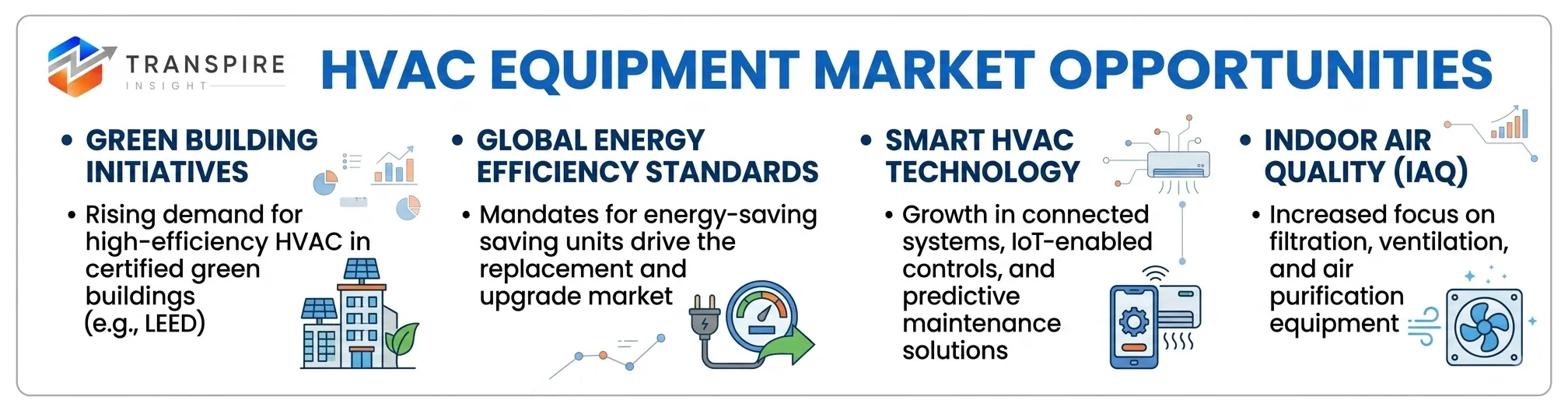
According to a research report published by Transpire Insight, the HVAC equipment market size is projected to grow from USD 250,315.4 million in 2026 to USD 350,860.4 million by 2035, at a CAGR of 6.2% during the forecast period 2026-2035. warming, fast city development, high efficiency requirements, and the increased use of smart building automation are the pillars. Furthermore, governments' support policies, such as the heat pump rebates in Europe, encourage modern energy-efficient HVAC investments globally.
Introduction
The Heating, Ventilation, and Air Conditioning (HVAC) equipment industry is an essential component of contemporary infrastructure, playing a key role in maintaining environmental comfort, operational efficiency, and energy management in various industries around the globe. The industry is regarded as a multi-billion-dollar business and spans a wide range of thermal solutions for residential, commercial, and industrial applications. There is an unmet need for climate control systems with thermal efficiency, sustainability, and cutting-edge technology, and the market is adapting quickly. The sector continues to play a crucial role in the landscape of modern urban development, energy transitions, and building modernization, with continuous technical innovations.
Recent Development News
Stay Ahead of Emerging Opportunities with Expert Market Insights by Transpire Insight
Transpire Insight provides comprehensive, data-driven market intelligence to support smarter business decisions. Our research is rooted in comprehensive analysis, authoritative predictions, and industry expertise, enabling organizations to make informed decisions in rapidly evolving markets. In-depth analysis of market segmentation, competitive positioning, regional trends, and emerging investment opportunities in high-growth areas. We blend accuracy with actionable intelligence, empowering companies to uncover new avenues for growth, bolster strategic decision-making, and stay ahead in a dynamic market.
Download the exclusive HVAC Equipment Market sample report today to uncover expert insights, emerging trends, and the opportunities defining the future of the industry.
HVAC Equipment Market Size & Statistics
Regional Growth and Demand Analysis by Transpire Insight:
North America leads HVAC equipment demand, anchored by the United States market. Growth in the region is supported by rising demand for energy-efficient heating, ventilation, and air conditioning systems across residential, commercial, and industrial sectors, alongside urbanization, extreme seasonal temperatures, and aging building infrastructure that is pushing owners toward replacement and upgrade cycles rather than new installs. Indirect distribution remains the dominant channel in the region, as buyers prefer authorized dealers and distributors to secure warranty coverage, professional installation, and reliable access to spare parts, reinforcing the position of established regional partners. Heating equipment continues to lead within the broader product mix, supported by rising demand for energy-efficient and sustainable heating solutions, particularly in colder regions across North America. Regulatory pressure is also reshaping specifications, as refrigerant-transition rules are steering manufacturers and installers toward next-generation low-GWP systems, a shift expected to keep North America's growth durable even as the market matures relative to emerging regions.
Asia-Pacific stands out as the fastest-growing and largest contributor to HVAC market expansion, led by China, India, and Southeast Asia. Within the region, India stands out as the single fastest-growing national market, with cooling demand driven by rising temperatures, rapid urbanization, and an expanding commercial building stock, while China anchors both manufacturing capacity and domestic consumption. Regional demand patterns are also shaped by climate and density: dense urban areas are increasingly adopting district cooling and centralized systems for efficiency, while tropical climates are driving strong demand for advanced dehumidification solutions.
Top 15 Trends in the HVAC Equipment Market
Proceed to Checkout to purchase the exclusive HVAC Equipment Market report and gain instant access to in-depth market intelligence, strategic analysis, and future growth opportunities.
Heat pump sales outpaced gas furnace sales by 32% in 2024, aided by tax credits and state mandates like New York's all-electric requirement.
Industry is shifting from R-410A to alternatives like R-32 and R-290, driven by AIM Act phasedown rules requiring an 85% HFC cut by 2036.
AI diagnostics and IoT-enabled predictive maintenance deliver 18 to 35 percent energy savings while significantly cutting unplanned equipment downtime across commercial building portfolios.
Connected sensors let building managers monitor performance remotely, enabling automated scheduling that improves comfort while reducing excess energy consumption across large facilities.
New units now maintain 100% heating capacity even at 0°F, removing a major adoption barrier for northern, colder-climate residential and commercial markets.
Services and maintenance segments are growing faster than equipment sales, driven by aging assets and increasingly complex, specialist-dependent installed systems.
Top 25 Companies Leading the HVAC Equipment Market
Customize the exclusive HVAC Equipment Market report today to receive tailored insights, country-specific analysis, and business-focused market intelligence.
1. Daikin Industries, Ltd.
Daikin pioneered Variable Refrigerant Volume technology, redefining energy management in commercial air conditioning.
Founded: October 1924| HQ: Osaka, Japan.
Why It Ranks: Holds leadership through aggressive innovation, vast distribution, and top-tier market share.
Regional Dominance: Dominates Asia-Pacific, Japan, and maintains expansive market footprints across European regions.
Product Line: Variable Refrigerant Flow systems, split air conditioners, chillers, and heat pumps.
2. Carrier Corporation
Founded by the inventor of modern air conditioning, Willis Carrier, in 1915.
Founded: June 1915 | HQ: Palm Beach Gardens, Florida, USA.
Why It Ranks: Maintains unmatched brand legacy paired with cutting-edge sustainable cold-chain and building solutions.
Regional Dominance: Dominates North America while expanding rapidly across Latin America and Western Europe.
Product Line: Residential split systems, commercial rooftop units, chillers, and advanced building controls.
3. Trane Technologies plc
Trane specializes heavily in ultra-efficient industrial chillers and sustainable building management solutions.
Founded: 1913 | HQ: Swords, Dublin, Ireland.
Why It Ranks: Commands top-tier industry status through focus on decarbonization and smart systems.
Regional Dominance: Holds massive market leadership across North America and key industrial European sectors.
Product Line: Centrifugal chillers, air handlers, heat pumps, and interactive automated building software.
4. Johnson Controls International plc
Manufactured the world's first electric room thermostat, pioneering automated interior environmental control.
Founded: 1885 | HQ: Cork, Ireland.
Why It Ranks: Uniquely combines comprehensive HVAC hardware directly with world-class smart building automation.
Regional Dominance: Enjoys balanced market presence spanning North America, Europe, and the Middle East.
Product Line: York chillers, air handling units, smart thermostats, and integrated facility software.
5. Lennox International Inc.
Introduced the first riveted steel furnace in 1895, setting early industry standards.
Founded: 1895 | HQ: Richardson, Texas, USA.
Why It Ranks: Ranks highly due to premium direct-to-dealer networks and superior energy efficiency ratings.
Regional Dominance: Highly dominant across the North American residential and light commercial equipment sectors.
Product Line: High-efficiency furnaces, heat pumps, air conditioners, and indoor air quality systems.
6. Mitsubishi Electric Corporation
Renowned for pioneering quiet, ultra-reliable ductless mini-split systems for residential use.
Founded: January 1921 | HQ: Tokyo, Japan.
Why It Ranks: Leads globally in VRF efficiency, inverter technologies, and sophisticated mini-split units.
Regional Dominance: Dominates Asia-Pacific, Japan, and maintains huge market shares across North America.
Product Line: Ductless mini-split air conditioners, VRF units, lossnay ventilators, and heat pumps.
7. LG Electronics Inc.
Integrates proprietary artificial intelligence and variable-speed inverter technology across its climate units.
Founded: October 1958 | HQ: Seoul, South Korea.
Why It Ranks: Commands market power by offering high-tech consumer electronics integrated into HVAC units.
Regional Dominance: Strong market hold across South Korea, broader Asia-Pacific, Europe, and North America.
Product Line: Multi V VRF systems, residential air conditioners, air-to-water heat pumps, chillers.
8. Gree Electric Appliances, Inc.
Ranks as one of the world's largest specialized residential air conditioner manufacturers.
Founded: 1991 | HQ: Zhuhai, China.
Why It Ranks: Massive economies of scale enable dominance in affordable residential unit production.
Regional Dominance: Unrivaled dominance across mainland China, emerging Asian economies, and South America.
Product Line: Window ACs, split air conditioners, packaged terminal units, and commercial chillers.
9. Midea Group
Operates extensive robotic smart factories, mass-producing climate hardware for brand partners.
Founded: 1968 |HQ: Foshan, China.
Why It Ranks: Huge manufacturing capacity and diversified OEM partnerships power its market presence.
Regional Dominance: Deep footprint across China, Asia-Pacific, Middle Eastern territories, and European markets.
Product Line: Inverter air conditioners, heat pump water heaters, modular chillers, and dehumidifiers.
10. MHI (Mitsubishi Heavy Industries, Ltd.)
Leverages heavy aerospace and industrial engineering expertise to manufacture extreme-duty chiller units.
Founded: January 1934 | HQ: Tokyo, Japan.
Why It Ranks: Renowned for industrial-grade durability, heavy-duty chillers, and large-scale district cooling.
Regional Dominance: Highly influential across Asia-Pacific, Middle Eastern infrastructure projects, and Europe.
Product Line: Centrifugal chillers, commercial VRF systems, heat pumps, and thermal energy storage.
Schedule a meeting with our market experts to discuss the exclusive HVAC Equipment Market report and identify the best research solution for your organization.
Conclusion
In the rapidly evolving HVAC equipment market, the climate action, technology, and infrastructure nexus continues to be a key theme. To satisfy demands, driven by decarbonization objectives, energy efficiency laws, and smart building adoption, leading equipment providers are always innovating. With the growth of urban centers around the world and the increasing impact of extreme weather events, the need for advanced thermal management systems grows more critical than ever. Firms that focus on sustainability, predictive IoT-based maintenance, and heat pump technology will be champions of this dynamic market. Sustainability, predictive IoT-based maintenance, and the use of heat pump technology will be the cornerstones of these companies dominating the market.


Send us a brief description of your challenge and we'll get back to you within 24 hours.

 inquiry@transpireinsight.com
 APAC:+91 7666513636
 Address


