
Aug 05, 2026
By Transpire Insight
Description
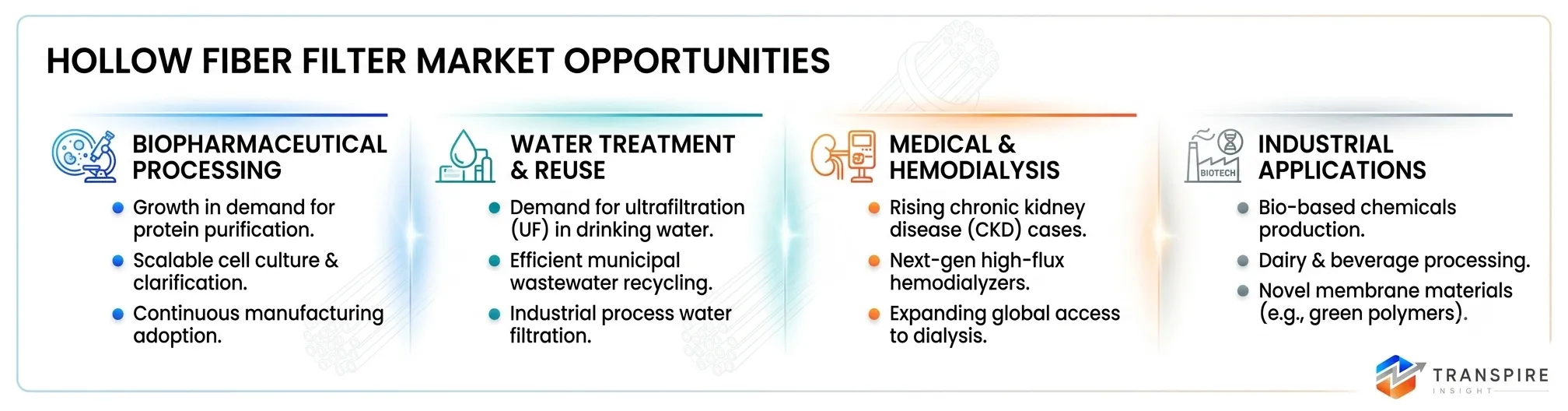
According to a research report published by Transpire Insight, The Hollow Fiber Filter Market size is projected to Grow from USD 716.2 Million in 2025 to USD 1442.5 Million by 2035, at a CAGR of 15.6% during the forecast period 2026-2035. The market for Hollow Fiber Filters is growing because there is an increasing trend towards miniaturized and more efficient membrane filtration systems that have the capacity to achieve precise separation within less space and resource requirements. The rising need for quality and safe water, increasing standards for effluent discharge and investments in water treatment facilities in urban and industrial areas will boost the application of hollow fiber membranes. In the pharmaceutical industry, there is an increase in the production of biologicals, vaccines and cell based treatments, which will result in increased demands for efficient microfiltration and ultrafiltration technology. Food and beverage manufacturers are also beginning to utilize membrane filtration as a means of clarifying, concentrating and purifying products while relying less on traditional separation methods. At the same time, developments in fouling-resistant membrane technology, higher flux hollow fibers, automatic filtration systems and single use bioprocessing kits will help in enhancing efficiency and commercialization of these technologies. Increased focus on water recycling, resource conservation and process intensification will help in generating further opportunities for hollow fiber filters.
Introduction
The Hollow Fiber Filter Market is related to the market of filtration equipment in which membranes, i.e. bundle of thin tubes, separate impurities, microorganisms, suspended solids, proteins, and other substances from the liquid. This kind of filtration is greatly valued due to such features of the filtration device as the high area of the membrane surface, compact size, controlled separation properties, and great capacity. Such filters are extensively used in such areas as biopharmaceuticals, water and wastewater treatment, food and beverages, medicine, laboratories, and different kinds of industrial separations. The future growth of this market will be supported by the development of new materials for membranes, fouling-resistant filters, filtration effectiveness improvements, process automation, and single-use filtration kits; the demand for purified water and bioprocessing is supporting applications for hollow fiber filtration.
Recent Development News
Stay Ahead of Emerging Opportunities with Expert Market Insights by Transpire Insight
The insights that have been shared through this blog are based on intensive market research carried out by Transpire Insight, an advisor that works with many organizations. Thanks to the analysis of extensive data, forecasts made by our specialists, and industry intelligence, our reports allow clients to find strategic growth opportunities in dynamically developing industries. For all those who would like to get more detailed information regarding market segmentation, competitive analysis, regional outlooks, and future investment tendencies, there is no doubt that our full report will be of great value.
Download the exclusive Hollow Fiber Filter Market sample report today to uncover expert insights, emerging trends, and the opportunities defining the future of the industry.
Hollow Fiber Filter Market Size & Statistics
Regional Growth and Demand Analysis by Transpire Insight:
The leading region in the Hollow Fiber Filtration Market is North America. Grand View Research states that North America will account for approximately 42.7% share of the total market revenue in 2025 and is likely to dominate the market in the forecast period. North America is dominating due to the presence of a thriving pharmaceutical and biotechnology sector, excellent R&D infrastructure, adoption of biologics manufacturing processes, and early deployment of single-use and continuous bioprocessing technologies. It also includes major investments in membrane and filtration technologies, well-established relationship between pharmaceutical companies and filtration technology companies, and conducive regulatory and research environment. The United States accounts for the leading position in terms of country-level contributions due to the presence of well-established biologics manufacturing processes and CDMO operations, and development of membrane filtration technology.
Asia-Pacific is the fastest-growing region. Grand View Research states that Asia-Pacific is expected to register a CAGR of 17.62% from 2025 to 2033. Growth is being driven by expansion of biopharmaceutical manufacturing, increase in biologics production, increasing adoption of single-use and continuous processing, governmental support, foreign investments, and development of new biotechnology hubs in China, India, and Japan.
Top 15 Trends in the Hollow Fiber Filter Market
Proceed to Checkout to purchase the exclusive Hollow Fiber Filter Market report and gain instant access to in-depth market intelligence, strategic analysis, and future growth opportunities.
1. Increasing Adoption of High-Performance Hollow Fiber Membranes
There have been improvements in the development of membranes that are better in terms of their permeability, selectivity, strength, and contaminant removal efficiencies by the manufacturers of hollow fiber filtration systems. There have been developments in polymer chemistry, membrane structure, and surface modifications that are allowing the manufacturers to improve filtration efficiency without making changes to the physical dimensions of the equipment. This improvement is especially relevant in processes that require constant separations, such as biopharmaceutical processing and advanced water treatments.
2. Growing Demand for Hollow Fiber Ultrafiltration Systems
Applications of ultrafiltration have now become highly significant since various industries need to remove suspended particles, colloids, microorganisms, proteins, and macromolecules but at the same time retain desirable compounds. This process involves the use of hollow fiber elements which offer high membrane surface area with very small module size and hence can be used in a continuous and high-volume mode of operation. The applications of these hollow fiber ultrafiltration devices have now extended into various fields such as water treatment, bio-processing, pharmaceuticals, and foods.
3. Rising Use of Hollow Fiber Membranes in Biopharmaceutical Manufacturing
With the rise in the development of biological products, vaccines, recombinant proteins, cell-based therapies, and other complex therapies, there is an increasing requirement for effective membrane filtration systems. Hollow fiber systems provide options for processing methods such as clarification, concentration, diafiltration, and purification in addition to scalability for various production levels. The move towards intensified and continuous bioprocessing is further fueling the demand for compact membrane units. In light of the needs for consistent process and sterility along with effective product recovery in pharmaceuticals, hollow fiber filtration is gaining relevance.
4. Expansion of Hollow Fiber Technology in Water and Wastewater Treatment
The scarcity of water sources, the production of larger quantities of waste water, and stringent standards on water quality have led to an increasing trend towards the use of membrane filtration technology among the utility industry and industries at large. The utilization of hollow fiber membranes can lead to efficient removal of suspended solids, microorganisms, and other contaminants while ensuring that the design of the treatment system is more compact.
5. Increasing Adoption of Fouling-Resistant Membrane Materials
The problem of membrane fouling still persists owing to the deposition of organic materials, microbes, particles, and other such elements that can result in poor filtration efficiency and increased needs for cleaning. Thus, there is a development of membranes with a modified surface, hydrophilic material, and other properties that could lower the chances of contaminant deposition. Fouling resistance allows increasing the cycle time, maintaining steady flux rate, and lowering the needs for chemical cleaning. This aspect is of great importance in wastewater processing and bioprocessing.
6. Growing Demand for Single-Use Hollow Fiber Filtration Systems
Single-use hollow fiber filtration is emerging as an important trend within the biopharmaceutical industry due to its potential for simplifying equipment preparation, minimizing the need for cleaning and sterilization, and reducing the likelihood of cross-contamination during different production batches. Single-use hollow fiber filters fit very well in manufacturing processes that are flexible since they allow for different biological products to be produced using the same facility. The growing importance of personalized medicine, small batch sizes, and process intensification is increasing the demand for such filtration devices.
Top 25 Companies Leading the Hollow Fiber Filter Market
Customize the exclusive Hollow Fiber Filter Market report today to receive tailored insights, country-specific analysis, and business-focused market intelligence.
1. Merck KGaA
Merck KGaA is a science and technology company with a major life-science business supplying filtration, bioprocessing, and membrane-based solutions for pharmaceutical and laboratory applications.
Founded: 1668 | Headquarters: Darmstadt, Germany
Why It Ranks: Strong life-science presence, extensive bioprocessing portfolio, customer base, and advanced filtration solutions for pharmaceutical manufacturing.
Regional Dominance: Europe, North America, and Asia-Pacific.
Product Line: Millipore® membrane filters, Pellicon® ultrafiltration systems, membrane cassettes, single-use filtration systems, and bioprocessing solutions.
Recent Development: Merck continues expanding its bioprocessing and membrane-filtration capabilities to support the growing demand for biologics manufacturing, intensified processing, and single-use technologies.
2. Danaher Corporation
Danaher Corporation is a science and technology company serving life sciences, diagnostics, and biotechnology markets through a portfolio of specialized operating companies.
Founded: 1969 | Headquarters: Washington, D.C., USA
Why It Ranks: Strong position in bioprocessing, advanced filtration technologies, manufacturing capabilities, and extensive relationships with pharmaceutical and biotechnology companies.
Regional Dominance: North America, Europe, and Asia-Pacific.
Product Line: Bioprocess filtration systems, membrane technologies, single-use processing equipment, chromatography solutions, and laboratory technologies through its life-science businesses.
Recent Development: Danaher continues investing in bioprocessing technologies designed to improve the efficiency, scalability, and flexibility of biologics manufacturing.
3. Parker Hannifin Corporation
Parker Hannifin is a diversified motion and control technology company providing filtration and separation solutions for industrial, medical, laboratory, and life-science applications.
Founded: 1918 | Headquarters: Cleveland, Ohio, USA
Why It Ranks: Broad filtration expertise, extensive engineered-product portfolio, distribution network, and strong presence across industrial and life-science applications.
Regional Dominance: North America, Europe, and Asia-Pacific.
Product Line: Membrane filtration products, laboratory filtration systems, industrial filters, separation technologies, and bioprocessing filtration solutions.
Recent Development: Parker continues developing advanced filtration and separation products focused on improved efficiency, reliability, contamination control, and process performance.
4. 3M
3M is a diversified technology company with filtration products used across healthcare, industrial, food and beverage, water, and other processing applications.
Founded: 1902 | Headquarters: Saint Paul, Minnesota, USA
Why It Ranks: Strong filtration technology expertise, extensive materials science capabilities, customer reach, and diverse application base.
Regional Dominance: North America, Europe, and Asia-Pacific.
Product Line: Membrane filters, cartridge filters, clarification products, biopharmaceutical filtration solutions, and industrial separation products.
Recent Development: 3M continues focusing on filtration technologies that improve contaminant removal, process reliability, and product quality across healthcare and industrial applications.
5. Sartorius AG
Sartorius is a leading international provider of technologies and equipment for biopharmaceutical research and manufacturing, including advanced membrane filtration and single-use processing systems.
Founded: 1870 | Headquarters: Göttingen, Germany
Why It Ranks: Strong biopharmaceutical filtration expertise, broad membrane portfolio, extensive single-use capabilities, and close relationships with biologics manufacturers.
Regional Dominance: Europe, North America, and Asia-Pacific.
Product Line: Sartoflow® filtration systems, Sartocon® membrane cassettes, Vivaflow® systems, single-use filtration assemblies, and ultrafiltration products.
Recent Development: Sartorius continues expanding its filtration and downstream bioprocessing technologies to support intensified manufacturing and the increasing production of complex biologics.
6. Repligen Corporation
Repligen is a life-sciences company focused on technologies used in biopharmaceutical manufacturing, with filtration and fluid-management products serving downstream processing applications.
Founded: 1981 | Headquarters: Waltham, Massachusetts, USA
Why It Ranks: Specialized bioprocessing expertise, strong hollow-fiber and filtration capabilities, and a focused portfolio serving biologics manufacturers.
Regional Dominance: North America, Europe, and Asia-Pacific.
Product Line: KrosFlo® hollow fiber filtration systems, TangenX® flat-sheet filtration technologies, XCell® ATF systems, membranes, and single-use fluid-management products.
Recent Development: Repligen continues expanding its bioprocessing platform around hollow-fiber filtration, tangential flow filtration, and single-use technologies to support scalable biologics production.
7. Koch Separation Solutions
Koch Separation Solutions provides membrane-based separation, filtration, and purification technologies for water, food, beverage, pharmaceutical, chemical, and industrial applications.
Founded: 1967 | Headquarters: Wilmington, Massachusetts, USA
Why It Ranks: Strong membrane separation expertise, broad industrial application coverage, and established hollow-fiber and membrane technology capabilities.
Regional Dominance: North America, Europe, and Asia-Pacific.
Product Line: Hollow-fiber membranes, ultrafiltration, microfiltration, nanofiltration, reverse osmosis, membrane bioreactors, and integrated separation systems.
Recent Development: Koch Separation Solutions continues advancing membrane-based separation systems for water reuse, wastewater treatment, food processing, and industrial purification applications.
8. Toray Industries, Inc.
Toray Industries is a diversified Japanese materials and technology company with extensive expertise in membrane technology, water treatment, chemicals, and advanced materials.
Founded: 1926 | Headquarters: Tokyo, Japan
Why It Ranks: Strong membrane-material expertise, water-treatment presence, advanced hollow-fiber technology, and broad international manufacturing and distribution capabilities.
Regional Dominance: Asia-Pacific, North America, and Europe.
Product Line: Hollow-fiber ultrafiltration membranes, microfiltration membranes, reverse-osmosis membranes, membrane bioreactors, and water-treatment systems.
Recent Development: Toray continues investing in advanced membrane technologies for water purification, wastewater reclamation, and resource recovery, with emphasis on higher efficiency and improved membrane performance.
9. LG Chem
LG Chem is a major South Korean chemical and materials company with a growing presence in advanced membrane and water-treatment technologies through its membrane business.
Founded: 1947 | Headquarters: Seoul, South Korea
Why It Ranks: Strong materials-science capabilities, expanding membrane technology portfolio, extensive Asian manufacturing base, and growing water-treatment presence.
Regional Dominance: Asia-Pacific, North America, and Europe.
Product Line: Ultrafiltration membranes, reverse-osmosis membranes, nanofiltration technologies, water-treatment membrane systems, and advanced separation materials.
Recent Development: LG Chem continues expanding its advanced membrane and water-treatment capabilities to address increasing demand for industrial water reuse, wastewater treatment, and high-efficiency purification.
10. DuPont
DuPont is a materials and specialty-products company with a significant water-solutions business providing membrane technologies for purification, desalination, wastewater treatment, and industrial water reuse.
Founded: 1802 | Headquarters: Wilmington, Delaware, USA
Why It Ranks: Strong water-treatment presence, extensive membrane technology portfolio, established customer relationships, and broad application coverage.
Regional Dominance: North America, Europe, and Asia-Pacific.
Product Line: FilmTec™ reverse-osmosis membranes, ultrafiltration membranes, nanofiltration membranes, membrane bioreactor technologies, and integrated water-treatment solutions.
Recent Development: DuPont continues developing and expanding membrane technologies aimed at improving water recovery, contaminant removal, energy efficiency, and industrial water reuse.
Schedule a meeting with our market experts to discuss the exclusive Hollow Fiber Filter Market report and identify the best research solution for your organization.
Conclusion
The Hollow Fiber Filter Market is set for significant growth due to growing demand for highly effective, compact, and efficient membrane filtration systems that can be used in the biopharmaceutical production industry, water and wastewater treatment, food and beverages processing, and other industrial applications. The market is driven by increasing production of biologicals, growing needs for water recycling, strict purification demands, and growing use of single-use and continuous filtration systems. Technological innovations are increasingly concentrating on the development of high flux membranes, anti-fouling membranes, improved selectivity, increased life cycle, and automation of the filtration process. Key companies active in the market such as Merck KGaA, Danaher Corporation, Parker Hannifin, 3M, Sartorius AG, Repligen Corporation, Koch Separation Solutions, Toray Industries, LG Chem, and DuPont are expanding through membrane innovation, diversified filtration solutions, and international markets development. Future market opportunities will arise in advanced biological processing, decentralized water treatment, industrial water recycling, micropollutant removal, and sustainable membrane technology.


Send us a brief description of your challenge and we'll get back to you within 24 hours.

 inquiry@transpireinsight.com
 APAC:+91 7666513636
 Address


