
Sep 02, 2026
By Transpire Insight
Description
According to a research report published by Transpire Insight, the food service equipment market size is projected to grow from USD 41.26 billion in 2026 to USD 68.3 billion by 2035, at a CAGR of 8.50% during the forecast period 2026-2035. Rising urbanization, rapid expansion of quick-service restaurant chains, and widespread adoption of kitchen automation drive the market. Furthermore, strict food safety regulations and growing demand for energy-efficient, smart IoT-enabled commercial kitchen equipment significantly boost industry expansion globally.
Introduction
The food service equipment market comprises specialized commercial machinery used for food preparation, cooking, refrigeration, storage, and sanitation across restaurants, hotels, hospitals, and institutional cafeterias. Driven by evolving consumer dining preferences, rapid growth in online food delivery platforms, and persistent labor shortages, operators are increasingly investing in high-efficiency, automated appliances. Additionally, stringent environmental guidelines are forcing manufacturers to innovate sustainable, low-emission technologies. Consequently, the industry is experiencing robust growth while undergoing a profound digital transformation centered around connected kitchen ecosystems.
Recent Development News
Stay Ahead of Emerging Opportunities with Expert Market Insights by Transpire Insight
Transpire Insight provides comprehensive, data-driven market intelligence to support smarter business decisions. Our research is rooted in comprehensive analysis, authoritative predictions, and industry expertise, enabling organizations to make informed decisions in rapidly evolving markets. In-depth analysis of market segmentation, competitive positioning, regional trends, and emerging investment opportunities in high-growth areas. We blend accuracy with actionable intelligence, empowering companies to uncover new avenues for growth, bolster strategic decision-making, and stay ahead in a dynamic market.
Food Service Equipment Market Size & Statistics
Regional Growth and Demand Analysis by Transpire Insight
Asia Pacific's lead position is anchored in rapid urbanization, rising disposable incomes, and the fast expansion of quick-service and cloud kitchen formats across China, India, Japan, and Southeast Asia. China remains the single largest contributor within the region, as international and homegrown restaurant chains continue opening outlets and upgrading kitchens to keep pace with a growing middle class. Equipment makers are responding with compact, high-throughput cooking and refrigeration lines built for space-constrained urban kitchens, while local governments' food-safety and hospitality-sector initiatives further encourage operators to replace older units. This mix of new outlet openings and modernization is what keeps the region ahead on both share and growth rate.
North America remains a close second, powered less by new outlet growth and more by disciplined replacement cycles across a mature, well-established restaurant and hospitality base. Operators are prioritizing energy efficiency, connectivity, and labor-saving automation as staffing pressures persist across full-service and quick-service chains alike. For instance, ITW Food Equipment Group recently showcased heavy-duty mixers and advanced dishwashers built for energy efficiency and productivity at the NAFEM Show, reflecting the region's push toward smarter commercial kitchens. Meanwhile, chains such as White Castle have piloted next-generation fryers with a smaller footprint and faster cook times, signaling how automation is steadily reshaping equipment demand even in an already mature market.
Top 15 Trends in the Food Service Equipment Market
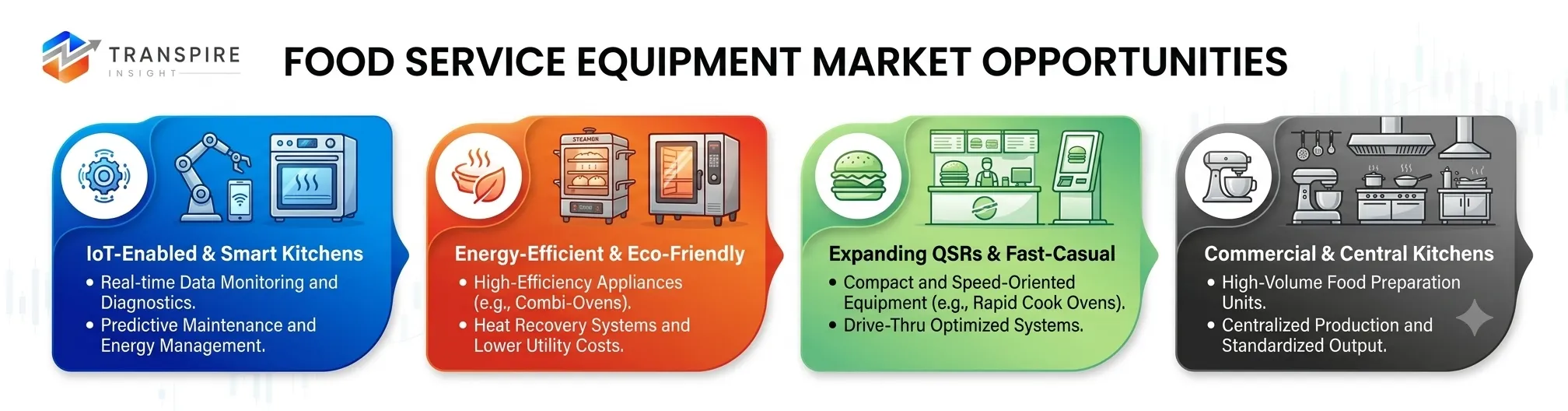
Commercial kitchens are increasingly integrating AI-powered ovens and fryers that track cooking cycles, predict maintenance needs, and automatically optimize overall energy consumption levels across shifts.
Manufacturers are launching Energy Star-rated ovens, fryers, and refrigeration units that cut utility costs and emissions, as operators face rising pressure to lower environmental impact.
Delivery-only cloud kitchens are fueling demand for compact, high-throughput cooking and holding equipment designed for tight spaces, faster turnover, and lower overall operating costs significantly.
Persistent kitchen staff shortages are pushing operators toward automated fryers, dishwashers, and prep stations that maintain output quality and consistency with far fewer skilled hands.
Growing takeout, delivery, and pre-packaged meal demand is boosting sales of holding cabinets, warming units, and refrigerated storage that preserve food quality for longer periods.
Tighter food safety and sanitation regulations across regions are compelling operators to replace aging equipment with certified, easier-to-clean, contamination-resistant models across commercial kitchen operations nationwide.
List of Top 25 Companies Leading the Food Service Equipment Market
1. Ali Group
It stands as the world's largest and most diversified commercial foodservice conglomerate.
Founded: 1963 | HQ: Milan, Italy / Chicago, USA.
Why It Ranks: Controls over 115 premier brands delivering unparalleled market scale.
Regional Dominance: Holds dominant market share across North America, Europe, and Asia-Pacific territories.
Product Line: Offers cooking, refrigeration, ice making, bakery, and beverage dispensing equipment platforms.
2. The Middleby Corporation
Pioneers advanced automated cooking technologies for major quick-service restaurant chains.
Founded: 1888 | HQ: Elgin, Illinois, USA.
Why It Ranks: Operates an extensive network of industry-leading commercial cooking and automation brands.
Regional Dominance: Dominates commercial kitchen equipment sectors throughout North America and Western Europe.
Product Line: Manufactures conveyor ovens, automated fryers, combi ovens, and beverage solutions.
3. ITW Food Equipment Group
Delivers heavy-duty, premium commercial kitchen machinery renowned for exceptional operational reliability.
Founded: 1912 | HQ: Glenview, Illinois, USA.
Why It Ranks: Backed by industrial power with industry-defining food preparation and sanitation brands.
Regional Dominance: Commands massive market share across institutional kitchens throughout the Americas and Europe.
Product Line: Produces commercial dishwashers, mixers, slicers, ranges, and heavy cooking equipment.
4. Hoshizaki Corporation
World-renowned leader in commercial ice machine technology and commercial refrigeration engineering.
Founded: 1947 | HQ: Toyoake, Aichi, Japan.
Why It Ranks: Unmatched reputation for durability, water efficiency, and precision temperature management engineering.
Regional Dominance: Holds absolute market leadership across Asian markets while rapidly expanding globally.
Product Line: Manufactures commercial ice makers, refrigerators, display cases, and draft beer dispensers.
5. Rational AG
Invented combi-steamer technology, setting the standard for modern thermal cooking.
Founded: 1973 | HQ: Landsberg am Lech, Germany.
Why It Ranks: Commands over fifty percent market share in commercial combi-steamer technology.
Regional Dominance: Maintains undisputed market leadership across Europe, North America, and major Asian cities.
Product Line: Specializes in intelligent iCombi Pro ovens and iVario multifunctional cooking units.
6. Electrolux Professional
Delivers complete, sustainable commercial food service and laundry solutions for enterprises.
Founded: 1919 | HQ: Stockholm, Sweden.
Why It Ranks: Leads sustainability innovation with highly energy-efficient and eco-friendly commercial appliances.
Regional Dominance: Holds massive market presence in Europe, the Middle East, and expanding regions.
Product Line: Produces modular cooking ranges, blast chillers, dishwashers, and beverage dispense systems.
7. Welbilt
Operates a powerhouse portfolio of commercial cooking, refrigeration, and beverage brands.
Founded: 1929 | HQ: Tampa, Florida, USA.
Why It Ranks: Integrates smart, connected kitchen solutions trusted by top restaurant chains.
Regional Dominance: Enjoys widespread adoption across North American and European quick-service dining establishments.
Product Line: Supplies high-speed ovens, fryers, ice machines, and master kitchen controllers.
8. The Vollrath Company
Premier manufacturer of high-quality stainless steel food preparation and serving gear.
Founded: 1874 | HQ: Sheboygan, Wisconsin, USA.
Why It Ranks: Trusted single-source provider for smallwares, countertop equipment, and custom serving systems.
Regional Dominance: Maintains deep distribution networks across North American food service and institutional sectors.
Product Line: Offers induction cooktops, cookware, food warmers, serving counters, and prep utensils.
9. Hatco Corporation
Industry innovator specializing in commercial warming, holding, and water heating technology.
Founded: 1950 | HQ: Milwaukee, Wisconsin, USA.
Why It Ranks: Sets industry standards for consistent heat retention and food safety engineering.
Regional Dominance: Dominates holding and warming equipment categories across North American restaurant networks.
Product Line: Manufactures heated display cabinets, strip heaters, booster water heaters, and salamanders.
10. Hobart Corporation
Iconic brand celebrated for producing virtually indestructible food mixers and dishwashers.
Founded: 1897 | HQ: Troy, Ohio, USA.
Why It Ranks: Essential staple in commercial bakeries, institutional cafeterias, and high-volume kitchens globally.
Regional Dominance: Widespread leadership throughout North America and major commercial markets in Europe.
Product Line: Produces commercial dishwashers, planetary mixers, food slicers, and heavy meat grinders.
Conclusion
The food service equipment market is undergoing a rapid evolution driven by technological innovation, energy efficiency demands, and shifting consumer dining habits. As labor shortages persist globally, automated, smart, and IoT-enabled appliances are becoming indispensable for commercial kitchens seeking operational efficiency and consistent quality. Furthermore, strategic consolidation through high-profile acquisitions continues to reshape competitive dynamics among industry leaders. Moving forward, manufacturers that successfully blend sustainable design, digital connectivity, and modular versatility will remain best positioned to capture market share in this dynamic landscape.


Send us a brief description of your challenge and we'll get back to you within 24 hours.

 inquiry@transpireinsight.com
 APAC:+91 7666513636
 Address


