
Sep 08, 2026
By Transpire Insight
Description
According to a research report published by Transpire Insight, the energy management systems market size is projected to grow from USD 46.28 billion in 2026 to USD 85.23 billion by 2035, at a CAGR of 13.7% during the forecast period 2027-2035. Rapidly increasing enterprise energy management deployments are being propelled by a combination of growing industrial power needs, tight carbon reduction targets, fluctuating energy costs, quick deployment of renewable microgrids, smart grid modernization, and the use of AI-driven IoT analytics.
Introduction
Technology in the Energy Management Systems (EMS) market is evolving quickly as a result of increasing demands for sustainability, changing utility prices, and the complexity of decentralising the grid. EMS platforms bring together hardware sensors, cloud telemetry and AI algorithms to maximize energy efficiency in industrial, commercial and residential applications. In response to ESG goals, organizations are increasingly shifting to automated EMS architectures to optimize power use, reduce operating costs, and ensure real-time operational efficiency of distributed infrastructural assets.
Recent Development News
Stay Ahead of Emerging Opportunities with Expert Market Insights by Transpire Insight
Transpire Insight provides comprehensive, data-driven market intelligence to support smarter business decisions. Our research is rooted in comprehensive analysis, authoritative predictions, and industry expertise, enabling organizations to make informed decisions in rapidly evolving markets. In-depth analysis of market segmentation, competitive positioning, regional trends, and emerging investment opportunities in high-growth areas. We blend accuracy with actionable intelligence, empowering companies to uncover new avenues for growth, bolster strategic decision-making, and stay ahead in a dynamic market.
Energy Management Systems Market Size & Statistics
Regional Growth and Demand Analysis by Transpire Insight
North America's lead rests on aggressive utility-side infrastructure upgrades layered on top of a mature regulatory push for efficiency. Eversource recently completed a 1.3-million-meter advanced metering infrastructure rollout spanning Massachusetts and Connecticut, while National Grid connected roughly 3.4 million endpoints across the Northeast. These deployments feed interval consumption data into cloud analytics engines that power automated demand response and predictive load forecasting, turning what used to be static utility billing infrastructure into an active, self-optimizing energy management layer. Combined with early smart grid adoption, strong incentive programs, and heavy investment from industrial and commercial operators upgrading legacy building systems, this has kept North America ahead of every other region on revenue share, even as growth rates elsewhere begin to overtake it.
Asia Pacific's momentum comes from a different direction: large-scale renewable integration rather than retrofit activity. China is investing heavily in ultra-high-voltage transmission corridors and AI-enhanced dispatch centers to balance the roughly 1,200 GW of planned wind and solar capacity coming online, a scale of intermittent generation that makes intelligent energy management systems a grid necessity rather than an efficiency add-on. India has crossed 1 GWh of cumulative installed battery storage capacity, driven by solar-plus-storage projects and microgrid buildouts aimed at strengthening reliability in under-electrified areas. Japan and South Korea are layering EMS platforms onto dense manufacturing and data center clusters facing rising power costs. Together, these forces are pulling the region's growth rate well above the average, even though its overall revenue base still trails North America and Europe.
Top 15 Trends in the Energy Management Systems Market
AI-driven predictive analytics help operators forecast consumption trends, detect anomalies early, and automate load-shifting decisions, reducing energy waste and boosting operational efficiency across industrial facilities.
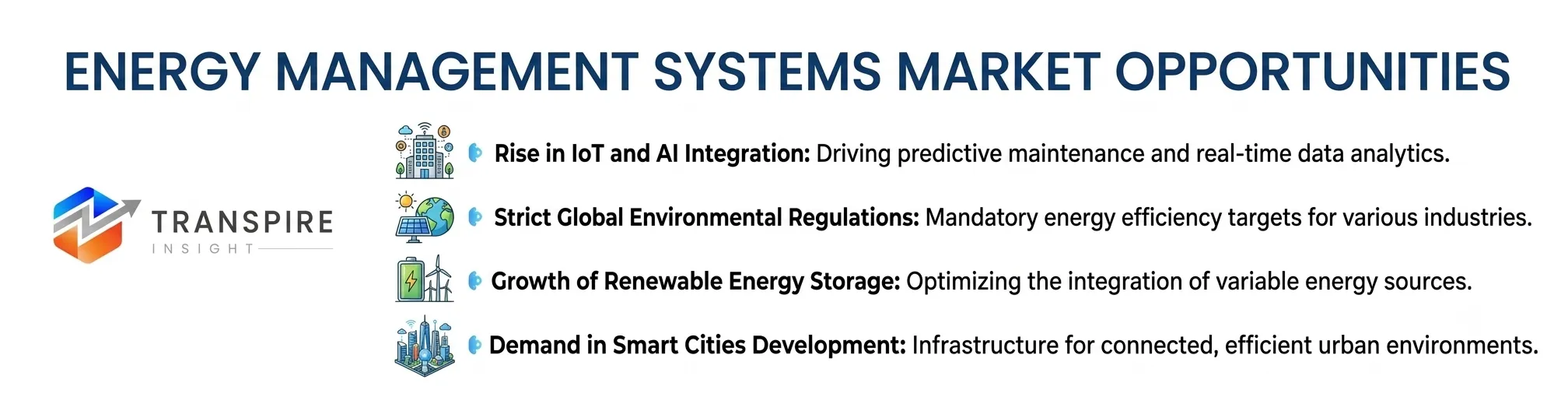
Utilities are integrating solar, wind, and storage assets directly into EMS platforms, enabling real-time balancing of variable renewable generation against fluctuating industrial and commercial demand.
Enterprises increasingly favor Energy-as-a-Service subscriptions over capital purchases, shifting energy spend from capex to opex while gaining bundled monitoring, optimization, and maintenance under one contract.
Utilities are scaling advanced metering infrastructure rollouts, connecting millions of smart meters that stream interval consumption data into cloud analytics engines supporting automated demand response.
Energy management platforms increasingly integrate with battery storage assets, enabling automated peak shaving, arbitrage, and backup power orchestration across commercial, industrial, and large utility-scale installations.
Surging AI workloads are pushing data center operators to deploy sophisticated EMS tools that track power usage effectiveness, optimize cooling loads, and manage rack density.
Top 25 Companies Leading the Energy Management Systems Market
1. Schneider Electric
Delivers end-to-end eco-friendly digital energy software powering industrial operations.
Founded: 1836 | HQ: Rueil-Malmaison, France.
Why It Ranks: Unrivaled dominance in comprehensive EcoStruxure building and industrial microgrid solutions.
Regional Dominance: (Strongest market presence across Europe, North America, and Asia-Pacific).
Product Line: EcoStruxure Energy Hub, Power Monitoring Expert, EcoStruxure Building Operation, Microgrid Advisor, Resource Advisor, PowerLogic Meters.
2. Siemens AG
Offers intelligent building software for automated energy optimization and smart infrastructure.
Founded: 1847 | HQ: Munich, Germany.
Why It Ranks: Industry leadership in smart grid control, automation, and industrial digital transformation.
Regional Dominance: Europe and North America with growing dominance across Asia-Pacific industrial sectors.
Product Line: Desigo CC, Siemens Xcelerator, Spectrum Power EMS, Gridscale X, MindSphere Energy Analytics, SENTRON Power Management.
3. Honeywell International Inc.
Provides cloud-native building software targeting emissions reduction and optimized energy usage.
Founded: 1906 | HQ: Charlotte, North Carolina, USA.
Why It Ranks: Deep enterprise integration of AI analytics into automated commercial facility controls.
Regional Dominance: North America with massive operational scaling across the Middle East and Asia.
Product Line: Honeywell Forge Energy Optimization, Enterprise Performance Management, EXPERION PKS, Building Management System (BMS), Smart Energy Suite.
4. ABB Ltd
Engineers scalable power distribution hardware and software for heavy industrial facilities.
Founded: 1988 | HQ: Zurich, Switzerland.
Why It Ranks: Market authority in electrification, automation, and enterprise utility monitoring networks.
Regional Dominance: Europe and Asia-Pacific with heavy footprint across North American industrial hubs.
Product Line: ABB Ability Energy Manager, OPTIMAX for Industrial Energy, Network Manager EMS, System 800xA, Ekip Smart Hub.
5. Johnson Controls
Speeds net-zero transformation using interconnected building automation and thermal control systems.
Founded: 1885 | HQ: Cork, Ireland.
Why It Ranks: Outstanding leader in smart building automation and decarbonization energy solutions.
Regional Dominance: North America and Europe with expanding market share in Asia-Pacific.
Product Line: OpenBlue Enterprise Manager, Metasys Building Automation System, Central Plant Optimization, Cloud Analytics, Performance Infrastructure Solutions.
6. General Electric (GE Vernova)
Optimizes power utility grids using advanced software and dynamic telemetry.
Founded: 1892 | HQ: Cambridge, Massachusetts, USA.
Why It Ranks: Core pioneer in grid-scale energy management systems and utility control software.
Regional Dominance: North America and Europe with strong presence across Latin America.
Product Line: GridOS EMS, Orchestration Software, Smallworld Network GIS, Digital Twin for Energy, DERMS Platform.
7. Eaton Corporation
Manufactures high-efficiency power management systems ensuring seamless electrical infrastructure control.
Founded: 1911 | HQ: Dublin, Ireland.
Why It Ranks: Essential leader in data center, industrial, and commercial power management.
Regional Dominance: North America and Europe with rising industrial presence in Asia.
Product Line: Brightlayer Industrial Suite, Foreseer EPMS, Microgrid Energy Management System, EnergyAware UPS, Power Xpert Software.
8. Emerson Electric Co.
Empowers process industries with high-precision automation and operational efficiency tracking.
Founded: 1890 | HQ: St. Louis, Missouri, USA.
Why It Ranks: Superior expertise in industrial energy optimization and process automation software.
Regional Dominance: North America and Middle East with extensive Asian manufacturing deployments.
Product Line: DeltaV Automation System, Ovation Distributed Control System, Plantweb Optics, Energy Management Information System (EMIS).
9. Yokogawa Electric Corporation
Integrates industrial automation and enterprise energy management for critical processing plants.
Founded: 1915 | HQ: Tokyo, Japan.
Why It Ranks: Premier choice for heavy process plant efficiency, safety, and decarbonization.
Regional Dominance: Asia-Pacific and Middle East with major industrial footholds worldwide.
Product Line: CENTUM VP, Visual MESA Energy Management System, FAST/TOOLS SCADA, Exaquantum Energy Management System.
10. Mitsubishi Electric Corporation
Builds factory automation and smart energy controls for commercial and residential buildings.
Founded: 1921 | HQ: Tokyo, Japan.
Why It Ranks: Leading innovator in factory energy management systems and energy-saving equipment.
Regional Dominance: Asia-Pacific leading position with heavy penetration in Europe and America.
Product Line: e-F@ctory Energy Management Solution, MELSOFT Energy Manager, EcoWebServer, Genesis64 Building Automation.
Conclusion
Energy Management Systems is a crucial pillar in the modernization and carbon neutrality of the world's industries. Today's market leaders are making seamless integration of hardware sub-metering and cloud predictive software become a reality due to the combination of ever-increasing power costs, even harsher environmental rules, and new advancements in artificial intelligence. Distributed energy sources are growing in all markets around the world, and intelligent EMS platforms will continue to be irreplaceable to optimise energy use, reduce operation costs and provide a sustainable and resilient energy future in all key markets.


Send us a brief description of your challenge and we'll get back to you within 24 hours.

 inquiry@transpireinsight.com
 APAC:+91 7666513636
 Address


