
Aug 01, 2026
By Transpire Insight
Description
According to a research report published by Transpire Insight, The E-Bike Battery Swapping Station Market Size is projected to Grow from USD 662.5 Million in 2025 to USD 2152.4 Million by 2035, at a CAGR of 22.8% during the forecast period 2026-2035. The factors that contribute to market growth include increasing adoption of electric bikes, urbanization, government incentives for zero emissions transport, and the rapid growth in shared mobility and last mile delivery services. The other factor contributing to market growth includes growing investments in smart city solutions, battery as a service (BaaS) business model, Internet of Things (IoT) enabled energy management system, and battery ecosystem. The improvements in battery technology and renewable energy-based charging stations are likely to offer many growth opportunities for the market in the future.
Introduction
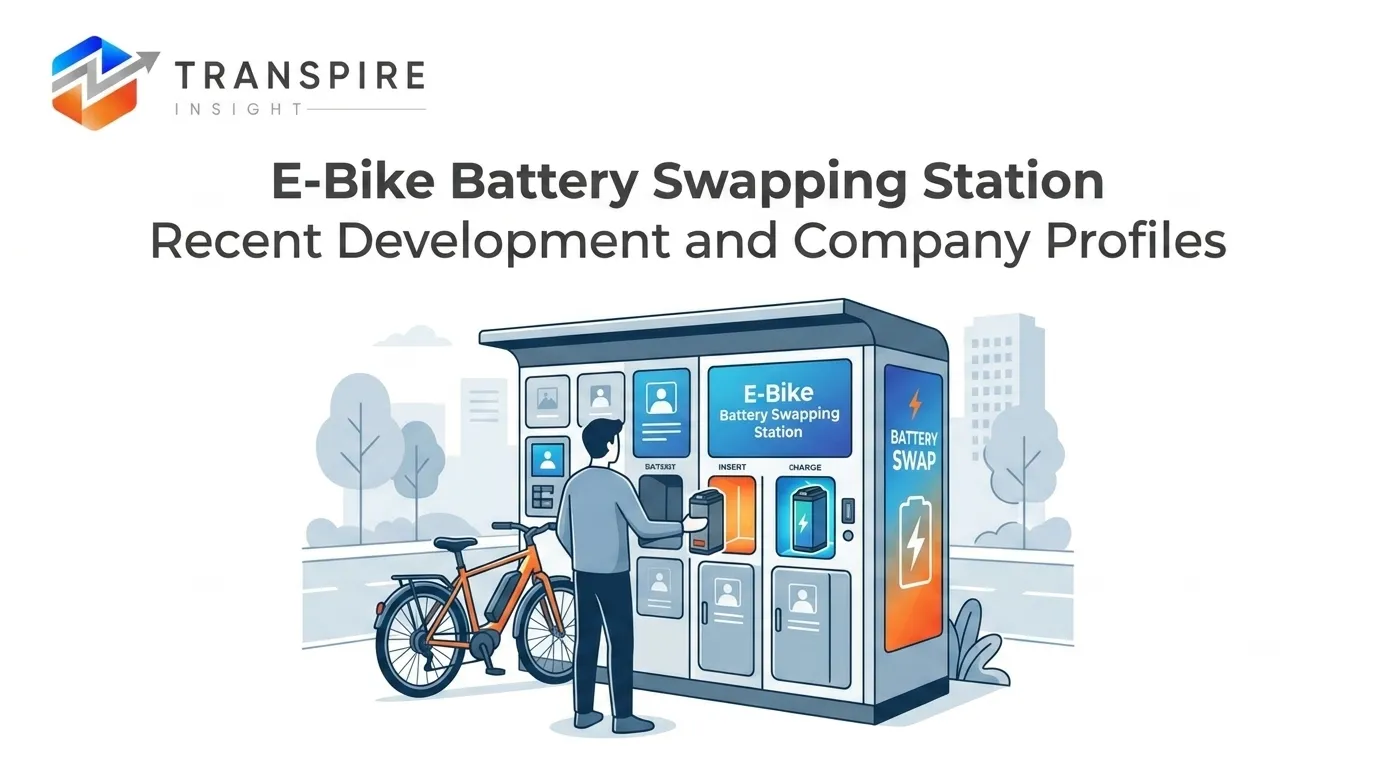
The E-Bike Battery Swapping Station Market consists of systems and services that help users of electric bicycles swap their discharged batteries with charged batteries in just a few minutes, saving them from having to wait for lengthy battery recharging process. Such battery swapping stations have been adopted by urban mobility systems, shared e-bikes systems, delivery and logistics, public transportation hubs, commercial centers and smart cities, among others. Battery swapping stations are essential for standardized battery systems, digital payments, IoT-enabled tracking, and fleet management systems in the expanding electric micromobility market.
Recent Development News
Stay Ahead of Emerging Opportunities with Expert Market Insights by Transpire Insight
The insights that have been shared through this blog are based on intensive market research carried out by Transpire Insight, an advisor that works with many organizations. Thanks to the analysis of extensive data, forecasts made by our specialists, and industry intelligence, our reports allow clients to find strategic growth opportunities in dynamically developing industries. For all those who would like to get more detailed information regarding market segmentation, competitive analysis, regional outlooks, and future investment tendencies, there is no doubt that our full report will be of great value.
Download the exclusive E-Bike Battery Swapping Station Market sample report today to uncover expert insights, emerging trends, and the opportunities defining the future of the industry.
E-Bike Battery Swapping Station Market Size & Statistics
Regional Growth and Demand Analysis by Transpire Insight:
Asia-Pacific is the dominant region in the E-Bike Battery Swapping Station Market, holding nearly 46% of the total market share worldwide. The E-Bike Battery Swapping Station Market is dominated by the Asia-Pacific region owing to the large-scale adoption of electric two-wheelers, strong support from the government towards electric mobility, and a well-established battery swapping ecosystem in countries such as China, Taiwan, India, and Indonesia. Asia-Pacific enjoys an advantage in terms of dense urban populations, large scale use of electric bikes for commute and last mile delivery, and quick rollout of Battery-as-a-Service (BaaS) models. Some of the key players like Gogoro, SUN Mobility, and Indofast Energy are continuously increasing their battery swapping stations, along with favorable policies in EV and smart city infrastructures.
Rapidly expanding region: Europe is set to witness the most rapid expansion during the forecasted period owing to rising usage of shared micromobility solutions, stringent emission norms, growth in urban sustainability programs, and investments in battery swap stations for commercial electric bike operations and deliveries. Programs like Swobbee’s deployment of battery swap systems in European and North American cities support the growth trend.
Top 15 Trends in the E-Bike Battery Swapping Station Market
Proceed to Checkout to purchase the exclusive E-Bike Battery Swapping Station Market report and gain instant access to in-depth market intelligence, strategic analysis, and future growth opportunities.
1. Growing Adoption of Battery-as-a-Service (BaaS) Models
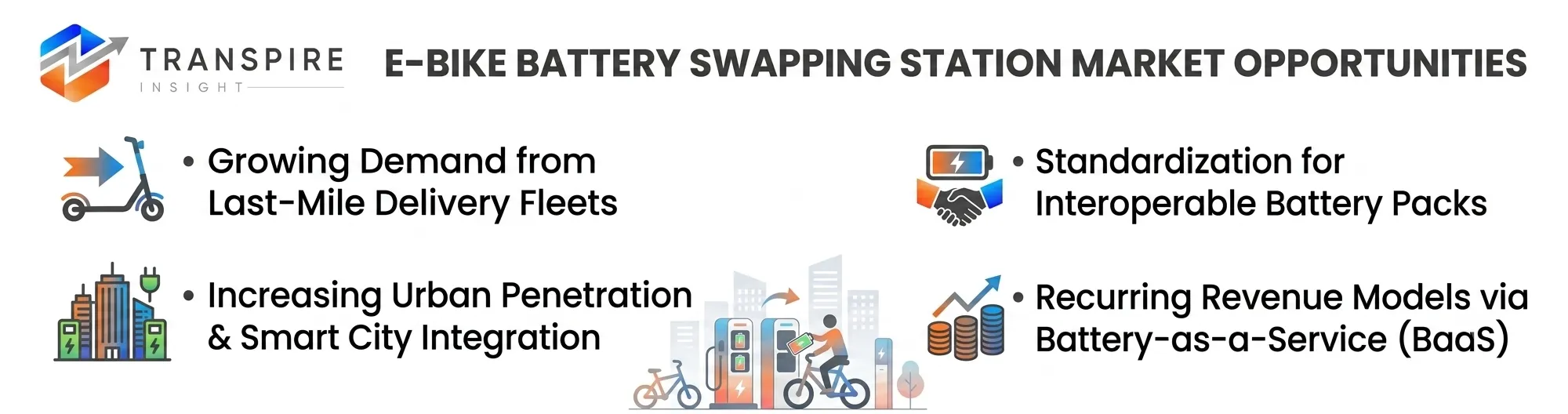
The Battery as a Service model is gaining popularity due to its ability to differentiate between battery and vehicle ownership, thereby lowering the cost of buying an e-bike. Factors contributing to the trend include lower vehicle purchase cost, predictable subscription prices, fast battery swapping, reduced battery management, improved utilization of the fleet, and greater consumer convenience.
2. Expansion of Smart Battery Swapping Networks
Companies are quickly installing smart battery swap stations that have IoT connectivity and cloud monitoring features to increase efficiency. Battery tracking in real time, automated inventory management, optimal charging cycles, increased availability of the stations, decreased downtime of riders, and network scalability are driving market growth.
3. Increasing Standardization of Swappable Battery Systems
Standard battery formats are being encouraged by the manufacturers and governments for increasing compatibility between different electric bike brands and swapping networks. Compatibility, increased adoption of consumers, deployment of infrastructure, complexity reduction, better collaboration between ecosystem and investment confidence are helping the industry grow.
4. Rising Deployment for Last-Mile Delivery Fleets
Logistics and food delivery firms are increasingly implementing battery swap stations, which will enable their delivery fleets to continue running uninterrupted, as they do not have to wait for long periods of time to charge their batteries.
5. Growth of Shared E-Bike Mobility Services
The proliferation of bike sharing apps in cities has led to an increased demand for centralized battery swapping services that would ensure continuous operation of the fleet. The factors driving market growth include vehicle availability, better fleet management, reduced maintenance costs, convenience, high urban mobility adoption, and the development of smart cities.
6. Development of IoT-Enabled Battery Management Platforms
IoT-enabled systems which will help in monitoring the health, charging condition, and station performance of batteries are being used by battery swap service providers. It is becoming essential to have an intelligent battery ecosystem due to benefits like predictive maintenance, extended life of battery, efficient energy management, and better customer experience.
Top 25 Companies Leading the E-Bike Battery Swapping Station Market
Customize the exclusive E-Bike Battery Swapping Station Market report today to receive tailored insights, country-specific analysis, and business-focused market intelligence.
1. Gogoro Inc.
Gogoro Inc. is a technology company specializing in electric two-wheel mobility, battery swapping infrastructure, and smart energy ecosystems.
Founded:2011 | Headquarters: Taipei, Taiwan
Why It Ranks: Pioneer and leader in e-bike and electric scooter battery swapping networks.
Regional Dominance: Strong presence across Taiwan, China, India, Indonesia, Singapore, and the Philippines.
Product Line: Battery Swapping Stations, Smart Batteries, Battery-as-a-Service (BaaS), Electric Scooters, and Energy Management Platforms.
Recent Development: Expanded battery-swapping partnerships across Southeast Asia to accelerate urban electric mobility.
2. SUN Mobility
SUN Mobility develops modular battery swapping technology and Battery-as-a-Service solutions for electric two-wheelers, three-wheelers, and commercial fleets.
Founded:2017 | Headquarters: Bengaluru, Karnataka, India
Why It Ranks: Leading provider of battery swapping infrastructure in India.
Regional Dominance: Strong presence across India with expansion into international markets.
Product Line: Battery Swapping Stations, Smart Batteries, BaaS Platforms, Fleet Energy Solutions, and EV Infrastructure.
Recent Development: Expanded battery swapping network through partnerships with commercial mobility providers.
3. NIO Power
NIO Power, a division of NIO Inc., develops intelligent battery swapping, charging, and energy service infrastructure for electric vehicles.
Founded:2017 | Headquarters: Shanghai, China
Why It Ranks: leader in automated battery swapping technology.
Regional Dominance: Strong presence across China with expanding operations in Europe.
Product Line: Battery Swap Stations, Fast Charging Stations, Battery-as-a-Service, Energy Cloud Platform, and Smart Charging Solutions.
Recent Development: Continued expansion of intelligent battery swapping stations supporting multiple EV platforms.
4. Ample Inc.
Ample develops modular battery swapping systems designed to provide rapid energy replenishment for electric vehicles and mobility fleets.
Founded:2014 | Headquarters: San Francisco, California, USA
Why It Ranks: Recognized innovator in modular battery swapping technology.
Regional Dominance: Strong presence across North America and Europe.
Product Line: Modular Battery Swapping Systems, Automated Swapping Stations, Fleet Energy Solutions, and Smart Battery Platforms.
Recent Development: Expanded battery swapping deployments through partnerships with shared mobility operators.
5. Swobbee GmbH
Swobbee develops battery swapping and charging infrastructure for light electric vehicles, supporting smart urban mobility ecosystems.
Founded:2017 | Headquarters: Berlin, Germany
Why It Ranks: European leader in open battery swapping infrastructure.
Regional Dominance: Strong presence across Germany and other European countries.
Product Line: Battery Swapping Stations, Charging Cabinets, Fleet Management Software, and Battery Sharing Platforms.
Recent Development: Expanded battery swapping infrastructure for shared e-bike and cargo bike fleets across Europe.
6. Honda Motor Co., Ltd.
Honda is a mobility manufacturer producing motorcycles, automobiles, power products, and electric mobility technologies.
Founded:1948 | Headquarters: Tokyo, Japan
Why It Ranks: Investing heavily in standardized battery swapping ecosystems for electric two-wheelers.
Regional Dominance: Strong presence across Asia-Pacific, Europe, and North America.
Product Line: Electric Motorcycles, Swappable Battery Systems, Battery Sharing Platforms, and Mobility Solutions.
Recent Development: Expanded participation in battery standardization initiatives for electric motorcycles.
7. Yadea Group Holdings Ltd.
Yadea is one of the world's largest manufacturers of electric two-wheelers and smart mobility products.
Founded:2001 | Headquarters: Wuxi, Jiangsu, China
Why It Ranks: Major supplier of electric bikes compatible with battery swapping ecosystems.
Regional Dominance: Strong presence across China, Southeast Asia, Europe, and Latin America.
Product Line: Electric Bicycles, Electric Scooters, Swappable Battery Solutions, Smart Mobility Systems, and Charging Infrastructure.
Recent Development: Expanded smart electric mobility portfolio with advanced battery technologies.
8. AIMA Technology Group Co., Ltd.
AIMA Technology manufactures electric bicycles, scooters, and intelligent mobility products for domestic and international markets.
Founded:1999 | Headquarters: Tianjin, China
Why It Ranks: Leading producer of electric two-wheelers supporting battery swapping compatibility.
Regional Dominance: Strong presence across China, Southeast Asia, and Europe.
Product Line: Electric Bicycles, Electric Scooters, Swappable Battery Systems, and Smart Mobility Products.
Recent Development: Expanded international distribution and smart battery technology offerings.
9. TAILG Group
TAILG Group is a manufacturer of electric bicycles, scooters, and intelligent transportation solutions.
Founded:2004 | Headquarters: Shenzhen, Guangdong, China
Why It Ranks: Major supplier supporting the rapid expansion of battery swapping-enabled electric mobility.
Regional Dominance: Strong presence across China, Southeast Asia, and Africa.
Product Line: Electric Bicycles, Electric Scooters, Smart Battery Systems, Battery Swapping-Compatible Vehicles, and Mobility Solutions.
Recent Development: Increased investment in intelligent battery technologies and overseas expansion.
10. Segway-Ninebot Group
Segway-Ninebot develops intelligent electric mobility products including e-bikes, scooters, robotics, and smart transportation solutions.
Founded:2012 | Headquarters: Beijing, China
Why It Ranks: leader in connected electric micromobility products.
Regional Dominance: Strong presence across Asia-Pacific, Europe, and North America.
Product Line: Electric Bicycles, Electric Scooters, Smart Batteries, Connected Mobility Platforms, and Urban Transportation Solutions.
Recent Development: Expanded connected e-bike portfolio featuring advanced battery management and fleet connectivity technologies.
Schedule a meeting with our market experts to discuss the exclusive E-Bike Battery Swapping Station Market report and identify the best research solution for your organization.
Conclusion
The E-Bike Battery Swapping Station Market is witnessing fast growth owing to the growing popularity of faster, efficient, and more sustainable electric transport. The rising popularity of Battery as a Service (BaaS) business model, the increasing deployment of battery swapping technologies in shared mobility and last mile delivery fleets, and the growing investments in smart city developments are among the drivers of market growth. Ongoing developments in battery swapping, battery management systems enabled by IoT, renewable energy sources integration, and energy optimization using artificial intelligence (AI) are among other trends making operations more efficient and convenient. The leading market participants such as Gogoro Inc., SUN Mobility, NIO Power, Ample Inc., Swobbee GmbH, Honda Motor Co., Ltd., Yadea Group Holdings Ltd., AIMA Technology Group Co., Ltd., TAILG Group, and Segway-Ninebot Group make significant contributions to technological development and market growth. Owing to the promotion of sustainable and clean transport solutions worldwide and the rise in the adoption of electric micro-mobility vehicles, the E-Bike Battery Swapping Station Market is expected to experience steady growth in the future.


Send us a brief description of your challenge and we'll get back to you within 24 hours.

 inquiry@transpireinsight.com
 APAC:+91 7666513636
 Address


