
Aug 10, 2026
By Transpire Insight
Description
According to a research report published by Transpire Insight, The Digital Visa Services Market Size is projected to Grow from USD 3890.2 Million in 2025 to USD 6210.5 Million by 2035, at a CAGR of 8% during the forecast period 2026-2035. The market for Digital Visa Services is growing because there is an increased use of electronic visas, as more and more governments and travelers are moving from conventional paper-based immigration processes to advanced digital visa systems that are fast and more efficient. This is fueled by increased international tourism, business trips, migration across borders, the push towards government digitalization efforts, and widespread use of e-visas and electronic travel authorization systems. Increased numbers of passengers are motivating immigration departments to automate the process of application submission, document authentication, payment, appointment booking, and issuance of visas on one platform. Additionally, new technologies like biometric identification, artificial intelligence, automated document scanning, digital identity verification, cloud platforms, and fraud detection systems are making the process of processing visa applications more efficient and secure.
Introduction
The Digital Visa Services Market is the market of technology solutions that streamline and digitize the process of applying, verifying, processing, paying and issuing visas for international travelers. These solutions allow applicants to fill in forms, provide necessary documentation, conduct digital identity checks, monitor application status, get notifications and, when possible, receive electronic visas without resorting to conventional paper-based procedures. The growth of this market is promoted by rising international tourism, business trips, cross-border movement of people, governmental digitalization initiatives and desire to decrease the burden of administrative procedures for immigration authorities. Furthermore, modern visa portals use advanced technologies such as biometrics, artificial intelligence, automatic verification of documents, secure payments and fraud detection for faster and more secure processing.
Recent Development News
Stay Ahead of Emerging Opportunities with Expert Market Insights by Transpire Insight
The insights that have been shared through this blog are based on intensive market research carried out by Transpire Insight, an advisor that works with many organizations. Thanks to the analysis of extensive data, forecasts made by our specialists, and industry intelligence, our reports allow clients to find strategic growth opportunities in dynamically developing industries. For all those who would like to get more detailed information regarding market segmentation, competitive analysis, regional outlooks, and future investment tendencies, there is no doubt that our full report will be of great value.
Download the exclusive Digital Visa Services Market sample report today to uncover expert insights, emerging trends, and the opportunities defining the future of the industry.
Digital Visa Services Market Size & Statistics
Regional Growth and Demand Analysis by Transpire Insight:
North America holds a dominant position in the Digital Visa Services Market and is recognized as the largest regional market by HTF Market Intelligence in 2025.
The position held by North America in the Digital Visa Services Market is due to its advanced digital infrastructure, high rates of technology adoption, significant government investments in immigration modernization, and high levels of international travel and business mobility. Both the U.S. and Canada have made efforts to move towards digital processing of visa and immigration cases involving online applications, electronic documents, biometric validation, digital identity management, and application tracking.
HTF Market Intelligence identifies Europe as the fastest-growing region in the Digital Visa Services Market on account of its increasing digitalization, cross-border travels, and modernization of immigration procedures.
However, Asia-Pacific can be considered another major high-growth region. In other studies focusing on eVisas, Asia-Pacific emerges as the largest region for eVisa services and platforms due to high levels of travel volumes, government digital transformation initiatives, and rapid adoption in India, China, Southeast Asia, Japan, and Australia.
Top 15 Trends in the Digital Visa Services Market
Proceed to Checkout to purchase the exclusive Digital Visa Services Market report and gain instant access to in-depth market intelligence, strategic analysis, and future growth opportunities.
1. Increasing Adoption of Fully Digital Visa Applications
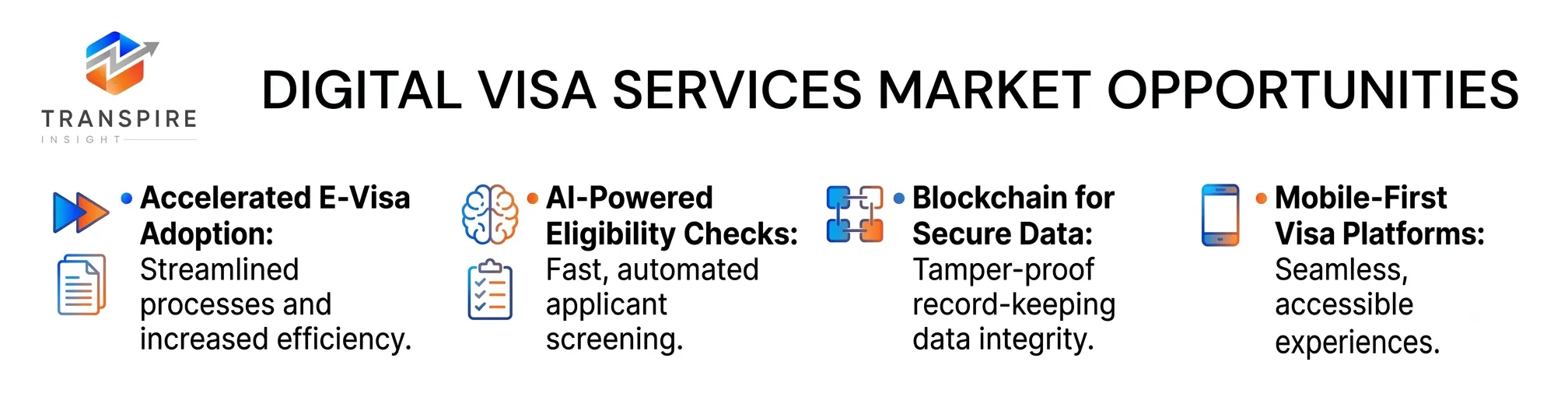
Paper-based visa application processes have been increasingly phased out by governments and immigration agencies in favor of end-to-end digital applications. Individuals can fill out the application form, upload documentation, make payments, and track the progress of their application via digital means, saving time on paperwork and unnecessary visits. This development is prompting the service providers to develop intuitive platforms that can manage a high volume of applications.
2. Expansion of e-Visa and Electronic Travel Authorization Systems
Electronic visas and travel authorizations have emerged as a growing trend in the market, as nations try to streamline the process of international travel without compromising on their border controls. Electronic authorizations enable eligible individuals to get authorization for their travel prior to their arrival, thus making them less dependent on physical visa stamps and cumbersome procedures at embassies.
3. Growing Use of Artificial Intelligence in Visa Processing
Use of artificial intelligence for the purpose of classifying documents, data extraction, application verification, detecting fraud, and automating administrative procedures is becoming more popular. Artificial intelligence-based systems will assist in processing large numbers of applications effectively by recognizing missing information in any application that can be deemed suspicious. With the increase in digital visas, use of AI technology is anticipated to become even more significant.
4. Rising Integration of Biometric Identity Verification
Facial and fingerprint recognition biometrics technologies are now increasingly integrating themselves into digital visa systems. Biometrics authentication in online visa applications will make it easier for governments to authenticate applicants and curb identity fraud. This trend is facilitating more interoperability among visa platforms, biometric data systems, border control systems, and other government systems of identity management.
5. Increasing Demand for Mobile-Based Visa Services
Modern travelers are expecting visa services to be delivered through smartphone-based technology. Mobile-based platforms and applications allow for the completion of applications, notifications, document uploads, payment transactions, and tracking of visa application statuses when the traveler is on the move. It is driving service providers towards having responsive interfaces, digital wallets, mobile identity authentication, and application alerts.
6. Growing Focus on Visa Fraud Detection and Cybersecurity
As immigration procedures go online, cybersecurity and fraud protection have become mandatory requirements as opposed to merely being nice-to-haves. Visa systems need to guard against any kind of information breach or cyber attack in relation to the collection of data ranging from passports to biometrics and payment information. Hence, providers are beefing up security in the form of encryption, identity management, fraud detection, etc.
Top 25 Companies Leading the Digital Visa Services Market
Customize the exclusive Digital Visa Services Market report today to receive tailored insights, country-specific analysis, and business-focused market intelligence.
1. VFS Global
VFS is the world's largest visa outsourcing and technology-services specialist, providing administrative and biometric services for governments and diplomatic missions. It operates thousands of application centres across more than 150 countries.
Founded: 2001 | Headquarters: Zurich, Switzerland & Dubai, UAE
Why It Ranks: It has unmatched scale in visa application outsourcing, extensive biometric enrolment capabilities, strong government relationships, and technology-enabled application and appointment services.
Regional Dominance: Europe, Asia-Pacific, Middle East & Africa, North America, and Latin America.
Product Line: Visa application processing, biometric enrolment, appointment scheduling, document services, application tracking, passport services, eVisa support, and digital government services.
Recent Development: In May 2025, VFS inaugurated the world's largest visa application centre in Dubai's Wafi complex, designed to handle up to 10,000 visa requests daily, demonstrating continued investment in high-capacity visa infrastructure.
2. TLScontact
TLScontact provides visa, consular, and citizen services to governments and diplomatic missions, combining secure application processing with technology-enabled government-service delivery.
Founded: Early 2000 | Headquarters: Paris, France
Why It Ranks: Strong government relationships, specialized visa-processing expertise, secure biometric services, and growing digital-transformation capabilities make TLScontact a major player in outsourced visa services.
Regional Dominance: Europe, Central Asia, Sub-Saharan Africa, and North America.
Product Line: Visa application centres, biometric collection, document handling, appointment services, application support, consular services, and digital government solutions.
Recent Development: In 2025, TLScontact opened six renewed visa centres in Morocco, including a 3,500-square-meter Casablanca centre, as part of a new French visa-outsourcing contract. The company also opened its first North American visa application centre in 2025.
3. BLS International Services Ltd.
BLS International is an Indian technology-enabled services company specializing in visa, passport, consular, e-governance, biometric, and citizen services. It has processed more than 360 million applications and serves over 46 client governments.
Founded: 2005 | Headquarters: New Delhi, India
Why It Ranks: Strong government-service expertise, extensive network, growing eVisa and biometric capabilities, and its position as a major listed visa and consular-services provider.
Regional Dominance: India, Europe, Middle East, Africa, Asia-Pacific, and the Americas.
Product Line: Visa outsourcing, eVisa services, passport services, biometric enrolment, consular services, attestation, citizen services, and e-governance solutions.
Recent Development: BLS International reported a 44% year-on-year revenue increase in Q1 FY2026 and also announced a three-year contract from India's Ministry of External Affairs to establish and operate Indian Visa Application Centres in China.
4. CGI Inc.
CGI Inc. is a IT and business-consulting company providing digital transformation, systems integration, cybersecurity, and government technology solutions.
Founded: 1976 | Headquarters: Montreal, Quebec, Canada
Why It Ranks: CGI's government technology expertise, large workforce, secure digital platforms, and experience modernizing public-sector processes make it relevant to digital immigration and visa ecosystems. CGI has approximately 94,000 professionals and 400 locations worldwide.
Regional Dominance: North America, Europe, Asia-Pacific, and Australia.
Product Line: Government digital services, cloud transformation, cybersecurity, identity solutions, application modernization, data analytics, and systems integration.
Recent Development: In 2026, CGI is celebrating its 50th year in business, highlighting continued expansion of its IT and government-technology capabilities.
5. IDEMIA
IDEMIA specializes in identity technologies, biometric authentication, secure credentials, digital identity, and public-security solutions that support trusted travel and border-management ecosystems.
Founded: 2017 | Headquarters: Courbevoie, France
Why It Ranks: Strong biometric identification expertise, secure identity technologies, digital credentials, and extensive relevance to e-passports, border control, and traveler identity verification.
Regional Dominance: Europe, North America, Asia-Pacific, Middle East, and Latin America.
Product Line: Biometric identity systems, digital identity, e-passports, identity verification, border-control technologies, facial recognition, and secure credentials.
Recent Development: IDEMIA has continued expanding its digital-identity capabilities and regional innovation infrastructure; its APAC headquarters and Innovation Centre in Singapore were established to support next-generation identity-security technologies across the region.
6. Thales Group
Thales Group is a technology company providing digital identity, cybersecurity, biometrics, secure documents, and border-management technologies for governments and organizations.
Founded: 2000 | Headquarters: Paris, France
Why It Ranks: Strong expertise in digital identity and secure travel documents, combined with biometric authentication, border-management systems, and government technology capabilities.
Regional Dominance: Europe, North America, Asia-Pacific, Middle East, and Africa.
Product Line: Digital identity, biometric systems, e-passports, secure identity documents, border-control systems, cybersecurity, and travel-document technologies.
Recent Development: Thales continues developing digital identity and biometric solutions aimed at making travel and identity verification more secure and increasingly digital.
7. Entrust Corporation
Entrust is a digital-security and identity company focused on protecting people, devices, and data while enabling trusted digital experiences across the identity lifecycle.
Founded: 1969 | Headquarters: Minneapolis, Minnesota, USA
Why It Ranks: Strong expertise in identity verification, digital credentials, authentication, secure document issuance, and fraud prevention—key technologies supporting digital visa ecosystems.
Regional Dominance: North America, Europe, Asia-Pacific, and Latin America.
Product Line: Digital identity, identity verification, authentication, digital certificates, secure ID issuance, biometric identity solutions, and encryption technologies.
Recent Development: Entrust continues expanding identity-centric security solutions across onboarding, authentication, transaction security, monitoring, and emerging post-quantum cryptography applications.
8. GDIT (General Dynamics Information Technology)
GDIT is the government-technology business of General Dynamics, delivering IT modernization, cybersecurity, cloud, data, and mission-critical digital services to government agencies.
Founded: 1997 as GDIT | Headquarters: Falls Church, Virginia, USA
Why It Ranks: Strong U.S. government technology expertise, secure IT infrastructure, identity and data-management capabilities, and experience handling large-scale public-sector modernization programs.
Regional Dominance: United States, with capabilities supporting international defense and government missions.
Product Line: Cloud computing, cybersecurity, digital modernization, identity and access management, data analytics, AI, mission IT, and enterprise systems integration.
Recent Development: In December 2025, GDIT opened its Mission Emerge Center in Virginia to accelerate AI, cybersecurity, drone, and advanced technology solutions for national-security missions.
9. Accenture plc
Accenture is a professional-services company providing consulting, technology, cloud, AI, cybersecurity, and digital-transformation services to governments and businesses.
Founded: 1989 | Headquarters: Dublin, Ireland
Why It Ranks: Strong capabilities in public-sector digital transformation, cloud modernization, AI, cybersecurity, data management, and citizen-facing digital services make Accenture relevant to the modernization of visa and immigration processes.
Regional Dominance: North America, Europe, Asia-Pacific, Middle East, and Latin America.
Product Line: Digital government, cloud transformation, AI, cybersecurity, data analytics, application modernization, customer experience, and public-sector consulting.
Recent Development: Accenture continues increasing investment in AI-led transformation and government digital services, supporting public agencies in modernizing legacy systems and improving citizen-facing digital experiences.
10. Tata Consultancy Services (TCS)
Tata Consultancy Services is a IT services, consulting, and business-solutions company providing digital transformation and technology services to governments and enterprises.
Founded: 1968 | Headquarters: Mumbai, Maharashtra, India
Why It Ranks: Strong delivery capabilities, extensive expertise in government technology, cloud, cybersecurity, AI, digital identity, and large-scale citizen-service platforms.
Regional Dominance: India, North America, Europe, Asia-Pacific, Middle East, and Latin America.
Product Line: Digital government solutions, AI, cloud services, cybersecurity, identity management, data analytics, application modernization, and citizen-service platforms.
Recent Development: In April 2025, TCS launched SovereignSecure Cloud™, DigiBOLT™, and its Cyber Defense Suite in India, targeting secure and sovereign digital transformation for government and public-sector organizations.
Schedule a meeting with our market experts to discuss the exclusive Digital Visa Services Market report and identify the best research solution for your organization.
Conclusion
The Digital Visa Services Market is poised to grow with the increasing preference of government agencies, immigration authorities, and travelers for faster and technologically advanced visa process solutions that replace conventional manual visa procedures. E-Visa services, electronic travel authorization, biometric verification, online submission of documents, digital payment methods, automated visa applications and tracking, among other trends, are driving this market towards change. Increasing international tourism, business travel, and government efforts towards digitalization will provide new opportunities for vendors in the coming years. Major companies are focusing on AI-based verification and fraud detection, secure identity management systems, multi-lingual platforms, and mobile-first solutions for improving the performance of their processes. In the future, the market will benefit from increased adoption of digital immigration infrastructure by governments, increasing need for cybersecurity in the travel and immigration process, interoperability of border management systems, and increasing need for hassle-free international travel.


Send us a brief description of your challenge and we'll get back to you within 24 hours.

 inquiry@transpireinsight.com
 APAC:+91 7666513636
 Address


