
Aug 10, 2026
By Transpire Insight
Description
According to a research report published by Transpire Insight, the digital manufacturing market size is projected to grow from USD 845.12 million in 2026 to USD 1891.12 million by 2035, at a CAGR of 22% during the forecast period 2026-2035. AI and Industrial IoT platforms for real-time optimisation in operations are fast gaining legs and are driving the digital manufacturing market. In addition, skyrocketing demand for smart, mass-customized production in the automotive, aerospace, and healthcare industries speeds enterprise deployments globally.
Introduction
Digital manufacturing incorporates computer-based systems, simulation software, IoT devices, and artificial intelligence into the physical manufacturing process. This process enables real-time data collection and analysis, creating a continuous feedback loop to optimize the assembly process and make it a self-learning ecosystem. It streamlines processes, minimizes downtime, cuts down on material waste, and accelerates product delivery in international supply chains.
Recent Development News
Stay Ahead of Emerging Opportunities with Expert Market Insights by Transpire Insight
Transpire Insight provides comprehensive, data-driven market intelligence to support smarter business decisions. Our research is rooted in comprehensive analysis, authoritative predictions, and industry expertise, enabling organizations to make informed decisions in rapidly evolving markets. In-depth analysis of market segmentation, competitive positioning, regional trends, and emerging investment opportunities in high-growth areas. We blend accuracy with actionable intelligence, empowering companies to uncover new avenues for growth, bolster strategic decision-making, and stay ahead in a dynamic market.
Download the exclusive Digital Manufacturing Market sample report today to uncover expert insights, emerging trends, and the opportunities defining the future of the industry.
Digital Manufacturing Market Size & Statistics
Regional Growth and Demand Analysis by Transpire Insight:
North America is estimated to generate the highest demand during the forecast period in the digital manufacturing market. The region's dominant position is owed to a deeply established base of automotive, aerospace, and electronics manufacturers, a mature technology ecosystem, and widespread early adoption of digital twin, IIoT, and AI-enabled production tools among top-tier manufacturers and system integrators. This scale is reinforced by strong government backing through smart manufacturing incentive programs, alongside the presence of leading technology providers such as Siemens, Dassault Systèmes, Autodesk, PTC, and Rockwell Automation, which give North American manufacturers first access to new AI-enabled and cloud-based manufacturing tools as they come to market.
Asia-Pacific is projected to grow the fastest during the forecast period in the digital manufacturing market. This acceleration is being driven by a rapidly expanding manufacturing base, large-scale industrial output, and rising government mandates around smart factory adoption. China is a major contributor to this momentum, with initiatives such as "Made in China 2025" and its successor pushing manufacturers toward mandatory digital technology integration across priority sectors. Taiwan and South Korea's world-leading semiconductor and electronics manufacturing ecosystems are major consumers of precision design and simulation software, with investment levels rivaling those seen in North America. India is similarly investing heavily in industrial digitization and attracting foreign manufacturing investment, while local system integrators across the region are increasingly forming strategic alliances with technology companies to bring AI, robotics, and digital twin capabilities into local factories. Taken together, this positions Asia-Pacific as the momentum-driven growth leader even as North America retains the larger absolute market.
Top 15 Trends in Digital Manufacturing Market
Proceed to Checkout to purchase the exclusive Digital Manufacturing Market report and gain instant access to in-depth market intelligence, strategic analysis, and future growth opportunities.
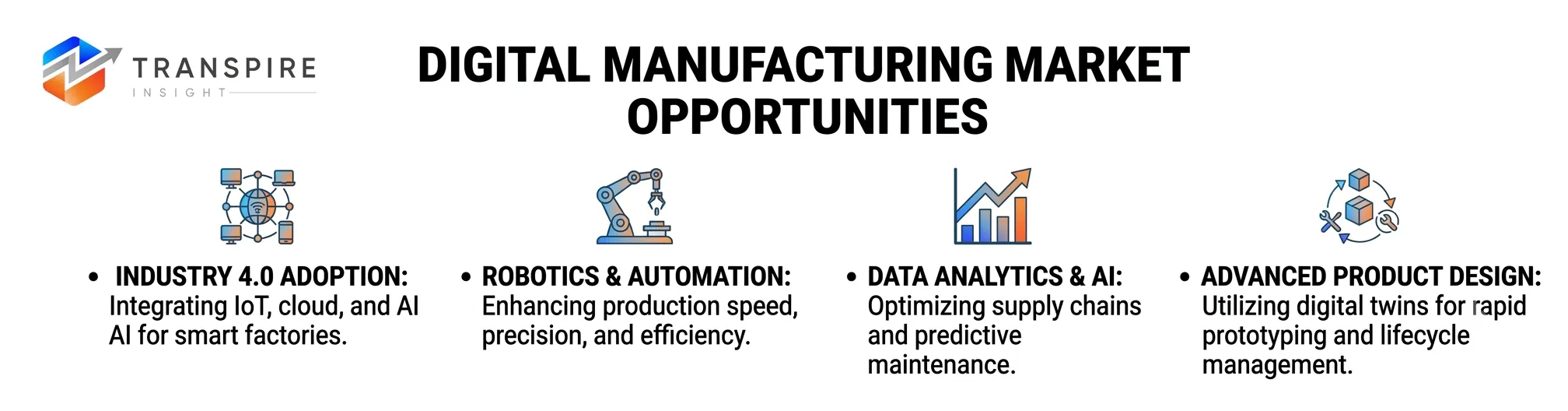
Machine learning analyzes equipment sensor data to forecast failures before they occur, minimizing unplanned downtime, reducing repair costs, and extending overall machinery lifespan significantly.
Virtual replicas of physical assets enable manufacturers to test processes, predict outcomes, and optimize production layouts digitally before implementing costly changes on actual factory floors.
Connected sensors across equipment collect real-time operational data, enabling continuous monitoring, remote diagnostics, and data-driven decision-making that improves efficiency and reduces operational costs.
Robots designed to safely work alongside humans handle repetitive or hazardous tasks, boosting productivity while addressing labor shortages without fully replacing human workforce roles.
AI algorithms generate optimized product designs based on constraints like material, weight, and cost, accelerating innovation cycles and enabling lightweight, efficient manufacturing solutions.
Energy-efficient automation, waste reduction systems, and carbon-tracking technologies help manufacturers meet regulatory requirements while lowering operational costs and improving corporate environmental sustainability profiles.
List of Top 25 Leading Companies in the Digital Manufacturing Market
Customize the exclusive Digital Manufacturing Market report today to receive tailored insights, country-specific analysis, and business-focused market intelligence.
1. Siemens AG
industrial giant pioneering enterprise digital twin software and smart factory automation.
Founded: 1847 | HQ: Munich, Germany.
Why It Ranks: Unmatched dominance in factory PLCs, cloud integration, and European digital transformation.
Regional Dominance: Europe, North America, Asia-Pacific.
Product Line: Xcelerator portfolio, MindSphere IoT, Totally Integrated Automation (TIA) platform.
2. Dassault Systèmes
Market leader in 3D product simulation, PLM, and virtual twin design.
Founded: 1981 | HQ: Vélizy-Villacoublay, France.
Why It Ranks: World-standard computer-aided engineering and virtual manufacturing simulation software tools.
Regional Dominance: Europe, North America.
Product Line: 3DEXPERIENCE platform, CATIA, SOLIDWORKS, DELMIA.
3. PTC Inc.
Innovation driver in industrial IoT integration, CAD modeling, and enterprise AR.
Founded: 1985 | HQ: Boston, Massachusetts, USA.
Why It Ranks: Essential role in connecting physical machinery hardware with digital monitoring platforms.
Regional Dominance: North America, Europe.
Product Line: ThingWorx IIoT Platform, Creo CAD, Windchill PLM, Vuforia.
4. Autodesk, Inc.
Software powerhouse driving digital design, generative CAD, and advanced additive manufacturing.
Founded: 1982 | HQ: San Francisco, California, USA.
Why It Ranks: Dominant ecosystem for cloud-native product engineering, generative design, and CAD workflows.
Regional Dominance: North America, Europe, Asia-Pacific.
Product Line: Fusion 360, AutoCAD, Inventor, Moldflow.
5. Rockwell Automation
Dedicated industrial automation and digital factory software solutions provider.
Founded: 1903 | HQ: Milwaukee, Wisconsin, USA.
Why It Ranks: Pervasive industrial control hardware and operational data analytics across North America.
Regional Dominance: North America, Asia-Pacific.
Product Line: FactoryTalk software platform, Allen-Bradley hardware, Plex Smart Manufacturing.
6. ABB Ltd
leader in industrial robotics, process control, and edge-connected automation systems.
Founded: 1988 | HQ: Zürich, Switzerland.
Why It Ranks: Expansive deployment of connected industrial robots and factory digital twin tools.
Regional Dominance: Europe, Asia-Pacific, North America.
Product Line: ABB Ability digital platform, RobotStudio, PickMaster.
7. Schneider Electric
Enterprise expert integrating industrial energy management software with automated plant operations.
Founded: 1836 | HQ: Rueil-Malmaison, France.
Why It Ranks: Benchmark sustainability-focused smart factory software and industrial process infrastructure.
Regional Dominance: Europe, North America, Asia-Pacific.
Product Line: EcoStruxure platform, Modicon PLCs, Aveva industrial software integration.
8. Honeywell International Inc.
Advanced process control and automated warehouse digital solutions market leader.
Founded: 1906 | HQ: Charlotte, North Carolina, USA.
Why It Ranks: High reliability in process-critical software platforms and real-time operational diagnostics.
Regional Dominance: North America, Middle East, Asia-Pacific.
Product Line: Honeywell Forge analytics, Experion Process Knowledge System (PKS), Safety Manager.
9. SAP SE
Enterprise resource platform integrating smart shop-floor analytics with business operations.
Founded: 1972 | HQ: Walldorf, Germany.
Why It Ranks: Critical backend foundation for manufacturing supply chains and production execution software.
Regional Dominance: Europe, North America.
Product Line: SAP Digital Manufacturing Cloud, SAP S/4HANA Manufacturing, SAP ME.
10. General Electric (GE Vernova / GE Digital)
Pioneer in industrial IoT, predictive maintenance analytics, and digital twin technology.
Founded: 1892 | HQ: Cambridge, Massachusetts, USA.
Why It Ranks: Strong analytics capabilities for optimizing heavy industry and energy sector manufacturing.
Regional Dominance: North America, Europe.
Product Line: Proficy Smart Factory software, Predix IIoT platform.
Schedule a meeting with our market experts to discuss the exclusive Digital Manufacturing Market report and identify the best research solution for your organization.
Conclusion
The digital manufacturing market is making a fundamental transition from Agentic AI, Predictive Analytics, and Enterprise Digital Twins. But as industrial businesses are moving beyond basic automation, the integration of OT data with cloud software creates unparalleled operational resilience, resource efficiency and speedy product customization. In the age of growing sustainability requirements and workforce transformation, investments in connected and data-driven factories will continue to be essential. Those that can successfully marry smart software, robotics and edge analytics will be the future of manufacturing competitiveness.


Send us a brief description of your challenge and we'll get back to you within 24 hours.

 inquiry@transpireinsight.com
 APAC:+91 7666513636
 Address


