
Aug 28, 2026
By Transpire Insight
Description
According to a research report published by Transpire Insight, the digital healthcare supply chain management market size is projected to grow from USD 6.8 billion in 2026 to USD 31.9 billion by 2035, at a CAGR of 22.32% during the forecast period 2026-2035. Rising demand for real-time inventory visibility, stringent drug serialization mandates, and operational vulnerability drive overall growth. Rapid adoption of cloud software, automated procurement workflows, AI demand forecasting, and urgent provider needs to eliminate costly stockouts propel robust worldwide market expansion.
Introduction
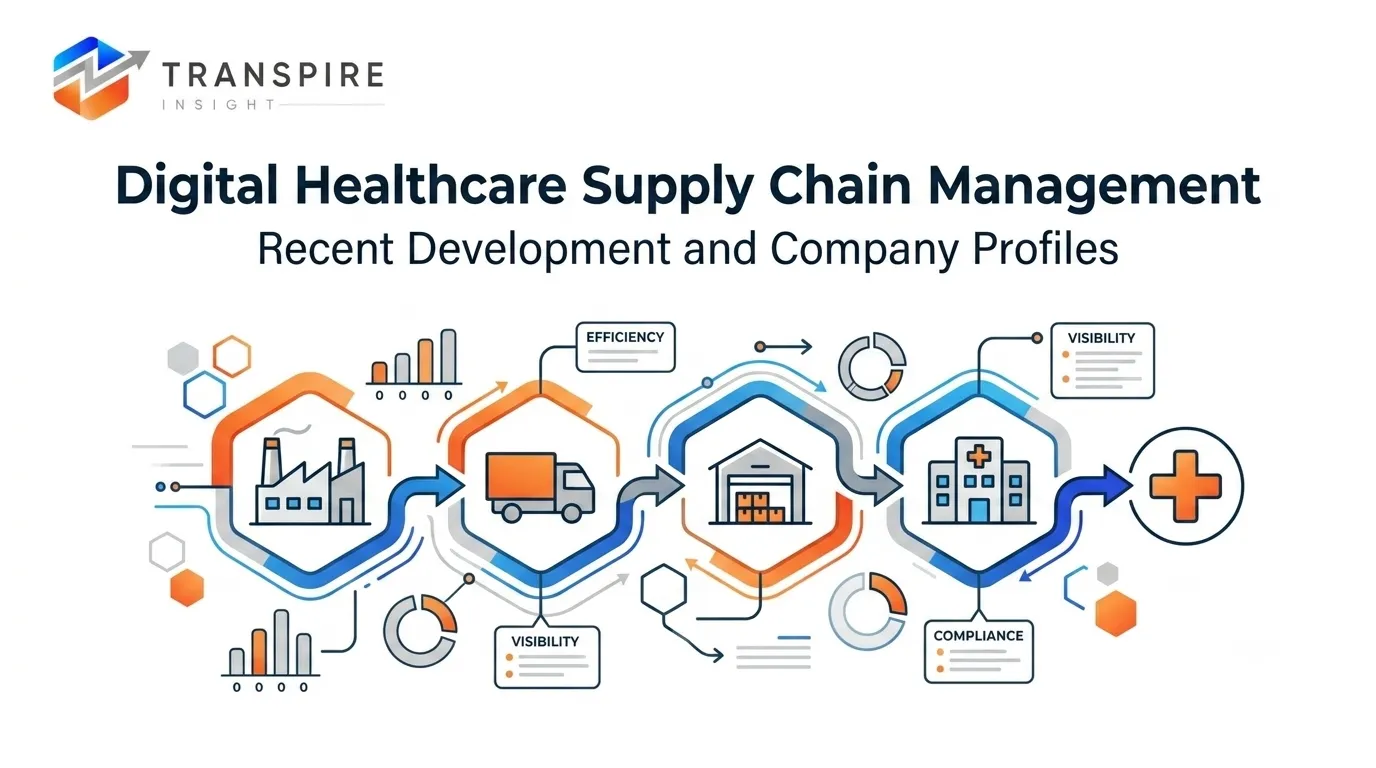
The digital healthcare supply chain management market represents the integration of advanced software, automation, and data analytics to optimize medical inventory, procurement, and logistics operations. Healthcare organizations globally are replacing fragmented manual tracking systems with cloud-native platforms to establish end-to-end visibility and ensure regulatory compliance like DSCSA. By leveraging artificial intelligence, IoT asset tracking, and predictive forecasting, health systems mitigate drug shortages, curb operational waste, and enhance care delivery efficiency. Consequently, digital supply chain solutions have evolved into essential infrastructure for modern healthcare provider networks.
Recent Development News
Stay Ahead of Emerging Opportunities with Expert Market Insights by Transpire Insight
Transpire Insight provides comprehensive, data-driven market intelligence to support smarter business decisions. Our research is rooted in comprehensive analysis, authoritative predictions, and industry expertise, enabling organizations to make informed decisions in rapidly evolving markets. In-depth analysis of market segmentation, competitive positioning, regional trends, and emerging investment opportunities in high-growth areas. We blend accuracy with actionable intelligence, empowering companies to uncover new avenues for growth, bolster strategic decision-making, and stay ahead in a dynamic market.
Download the exclusive Digital Healthcare Supply Chain Management Market sample report today to explore expert insights, key trends, and emerging opportunities shaping the future of the industry.
Digital Healthcare Supply Chain Management Market Size & Statistics
Regional Growth and Demand Analysis by Transpire Insight
The North American region is expected to hold the largest share of the digital healthcare supply chain management market, accounting for 44% during the forecast period. The U.S. and Canada continue to lead the region, backed by a strong concentration of hospital networks, pharmaceutical distributors, and healthcare IT vendors. Persistent drug shortages and stringent regulatory oversight around pharmaceutical traceability are pushing healthcare organizations to accelerate digital procurement and inventory visibility adoption. Demand remains robust, further supported by rapid cloud migration, with nearly 70% of U.S. hospitals on track to adopt a cloud-based platform, rising deployment of AI-driven demand forecasting tools, and strong uptake across hospital systems, pharmaceutical distribution, and medical device supply chains. North America's leadership is further reinforced by mature healthcare IT infrastructure, early adoption of smart hospital practices, and a well-established base of supply chain software providers and system integrators.
Asia Pacific is expected to witness the highest growth rate at a CAGR of 12% in the digital healthcare supply chain management market during the forecast period. The region's rapid expansion is driven by large-scale hospital construction, government-backed digital health infrastructure initiatives, and rising automation investments across China, Japan, South Korea, and India. Factors such as a lower installed base, vaccine self-sufficiency programs, and ongoing hospital modernization are accelerating adoption of digital supply chain platforms throughout the region. Demand is further strengthened as local health systems scale up digital procurement capacity, regional vendors expand cold-chain and logistics offerings, and enterprises increasingly adopt RFID tagging, IoT-enabled tracking, and AI-powered inventory management systems. Asia Pacific is projected to remain the fastest-growing market as healthcare digitization deepens and hospital networks continue to modernize at an accelerated pace.
Top 15 Trends in the Digital Healthcare Supply Chain Management Market
Proceed to checkout to purchase the exclusive Digital Healthcare Supply Chain Management Market report and get instant access to detailed market insights, strategic analysis, and future growth opportunities.
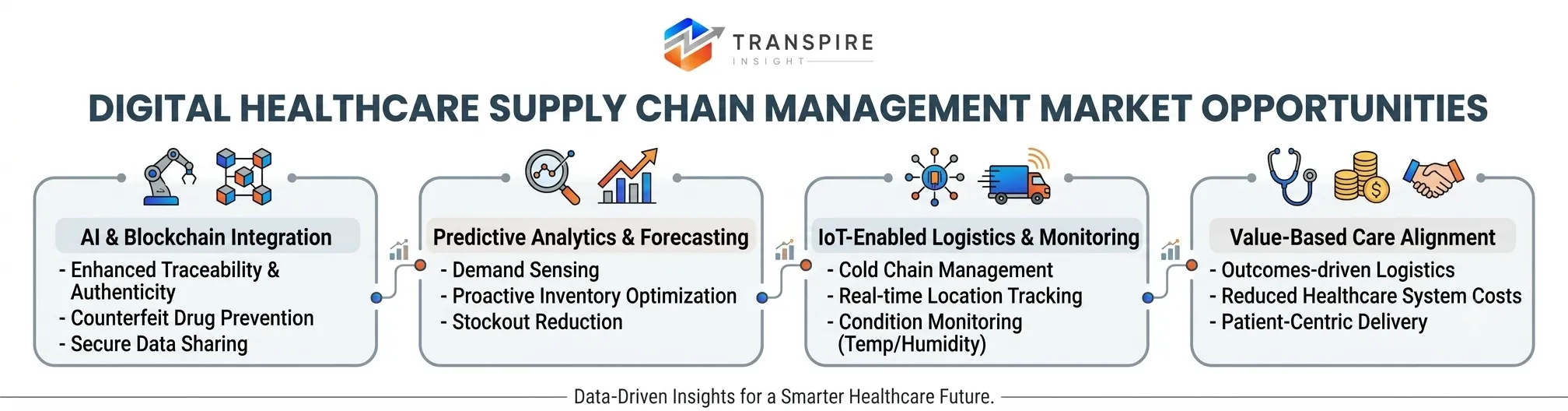
AI-powered analytics adoption helps organizations predict disruptions, automate procurement, and optimize inventory using demand signals like weather and political instability, per recent industry commentary.
RFID generated the largest technology market share at 26.4% in 2025, improving asset visibility, reducing human error, and streamlining large hospital inventory management systems significantly.
Blockchain provides a decentralized, immutable record of product origin, ensuring authenticity, simplifying recalls through batch identification, and automating payments via smart contracts.
Cloud platforms are expanding rapidly, with nearly 70% of U.S. hospitals expected to adopt cloud-based approaches by 2026, enabling scalable, interoperable procurement and logistics workflows.
Digitally enabled supply chains using twins are 38% more likely to deliver margin improvement because they model real-time "what-if" disruption scenarios effectively.
Industry consensus at LogiMed 2026 identified agentic AI, where workflows are orchestrated across systems, as the next frontier for supply chain automation and decision-making.
List of Top 25 Companies Leading the Digital Healthcare Supply Chain Management Market
Customize the exclusive Digital Healthcare Supply Chain Management Market report to receive insights tailored to your needs, including country-specific analysis and business-focused market intelligence.
1. SAP SE
SAP powers mission-critical enterprise supply chain management for premier hospital systems.
Founded: 1972 | HQ: Walldorf, Germany.
Why It Ranks: Unmatched enterprise ERP scale enables seamless integration across massive healthcare operations.
Regional Dominance: Europe maintains strong operational leadership alongside extensive penetration across North American markets.
Product Line: SAP Integrated Business Planning and S/4HANA Supply Chain for Healthcare suite.
2. Oracle Corporation
Oracle delivers cloud-based supply planning and inventory optimization for major health networks.
Founded: 1977 | HQ: Austin, Texas, USA.
Why It Ranks: Deep clinical integration following Cerner acquisition creates unmatched end-to-end digital visibility.
Regional Dominance: Dominates North American hospital systems while expanding rapidly throughout Asia-Pacific regions.
Product Line: Oracle Fusion Cloud Supply Chain Management and Product Lifecycle Management suite.
3. McKesson Corporation
McKesson combines large-scale pharmaceutical distribution with proprietary digital inventory management software.
Founded: 1833 | HQ: Irving, Texas, USA.
Why It Ranks: Vast distribution infrastructure paired with digital tracking delivers unmatched supply reliability.
Regional Dominance: Holds massive market presence and dominant market share across North America.
Product Line: Supplylogix inventory management, Fulfill-Rx, and EnterpriseRx digital pharmacy workflow solutions.
4. Cardinal Health, Inc.
Cardinal Health streamlines clinical supply management using smart tracking and digital analytics.
Founded: 1971 | HQ: Dublin, Ohio, USA.
Why It Ranks: Integrates automated inventory cabinets with data platforms to minimize hospital stockouts.
Regional Dominance: Maintains powerful market control across United States hospitals and clinical centers.
Product Line: WaveMark Supply Management Solution and Cardinal Health Inventory Management software platform.
5. Healthcare Exchange (GHX)
GHX operates the largest cloud-based trading network connecting healthcare providers and suppliers.
Founded: 2000 | HQ: Louisville, Colorado, USA.
Why It Ranks: Unrivaled healthcare procurement e-commerce network automating billions in medical spending.
Regional Dominance: Dominates the North American market while steadily scaling across European health systems.
Product Line: GHX Exchange, NuVia data management, and Orderexpress digital procurement platform.
6. Tecsys Inc.
Tecsys builds specialized supply chain platforms tailored directly to complex hospital operations.
Founded: 1983 | HQ: Montreal, Canada
Why It Ranks: Exceptional domain expertise in point-of-use tracking and consolidated service centers.
Regional Dominance: Strong command across North America with growing adoption throughout Western Europe.
Product Line: Elite Healthcare Supply Chain Platform and Omni-Location Tracking software suite.
7. Infor Solutions
Infor offers healthcare-specific enterprise software unifying supply procurement with clinical workflows.
Founded: 2002 | HQ: New York City, New York, USA.
Why It Ranks: CloudSuite Healthcare provides industry-tuned analytics for operational efficiency and planning.
Regional Dominance: footprint with heavy installation density across North America and Europe.
Product Line: Infor CloudSuite Healthcare, Supply Management, and Demand Planning applications suite.
8. IBM Corporation
IBM leverages artificial intelligence and blockchain to secure drug and device traceability.
Founded: 1911 | HQ: Armonk, New York, USA.
Why It Ranks: Advanced Sterling analytics platform provides unmatched supply intelligence and risk forecasting.
Regional Dominance: Broad presence covering North America, Europe, Latin America, and Asia-Pacific.
Product Line: IBM Sterling Supply Chain Intelligence Suite and IBM Blockchain for Healthcare.
9. Blue Yonder Group, Inc.
Blue Yonder brings AI-driven supply planning and dynamic fulfillment to healthcare networks.
Founded: 1985 | HQ: Scottsdale, Arizona, USA.
Why It Ranks: Machine learning algorithms optimize complex inventory demand forecasting across hospital branches.
Regional Dominance: Widespread enterprise presence in North America, Western Europe, and Asia-Pacific regions.
Product Line: Luminate Supply Chain Management platform and Healthcare Demand Planning suite.
10. Manhattan Associates, Inc.
Manhattan Associates optimizes medical warehouse logistics and point-of-care fulfillment workflows seamlessly.
Founded: 1990 | HQ: Atlanta, Georgia, USA.
Why It Ranks: Premier warehouse management software ensures rapid, accurate medical equipment movement worldwide.
Regional Dominance: Strong market share across North America, Europe, and major Latin American hubs.
Product Line: Manhattan Active Supply Chain and Healthcare Warehouse Management System (WMS).
Schedule a meeting with our market experts to discuss the exclusive Digital Healthcare Supply Chain Management Market report and find the right research solution for your business.
Conclusion
The digital healthcare supply chain management market is experiencing transformative evolution driven by real-time data orchestration, stringent traceability mandates, and advanced artificial intelligence technologies. As major healthcare providers shift away from legacy manual tracking toward integrated cloud solutions, vendors offering end-to-end operational visibility are securing sustainable competitive advantages. Moving forward, the industry will prioritize automated demand forecasting, IoT asset tracking, and transparent vendor collaboration. Ultimately, digital supply chain investments will remain essential for health systems aiming to lower operational costs and eliminate supply bottlenecks globally.


Send us a brief description of your challenge and we'll get back to you within 24 hours.

 inquiry@transpireinsight.com
 APAC:+91 7666513636
 Address


