
Aug 10, 2026
By Transpire Insight
Description
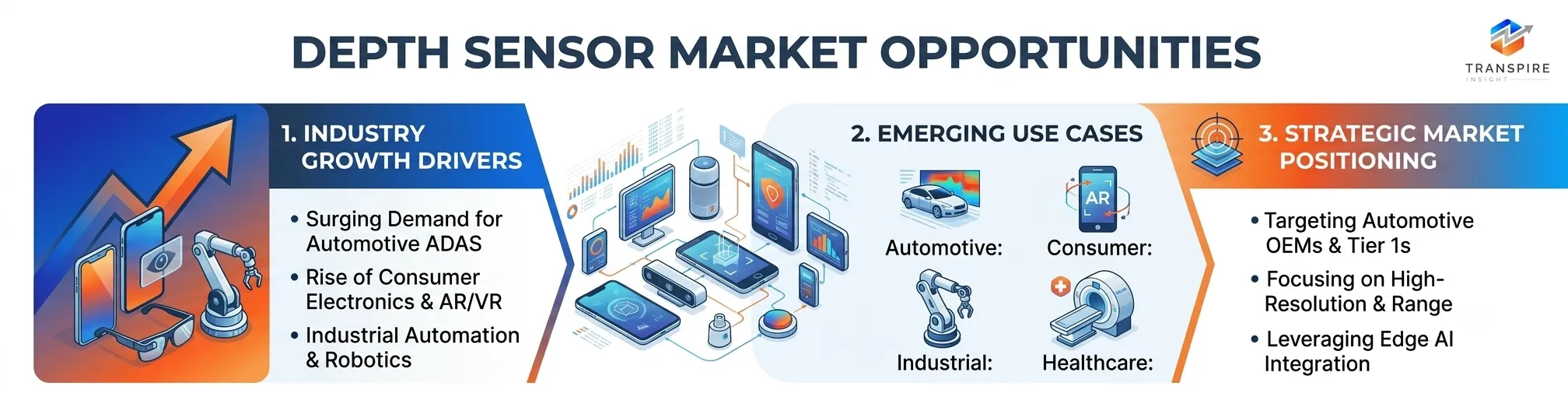
According to a research report published by Transpire Insight, the depth sensor market size is projected to grow from USD 5134.7 million in 2026 to USD 7612.3 million by 2035, at a CAGR of 10.81% during the forecast period 2026-2035. The AR/VR device market is rapidly growing, advanced driver assistance systems (ADAS) are increasingly being integrated in AVs, and the demand for AI-powered industrial robotics is surging, all of these are major market shapers for the depth sensor market across the globe.
Introduction
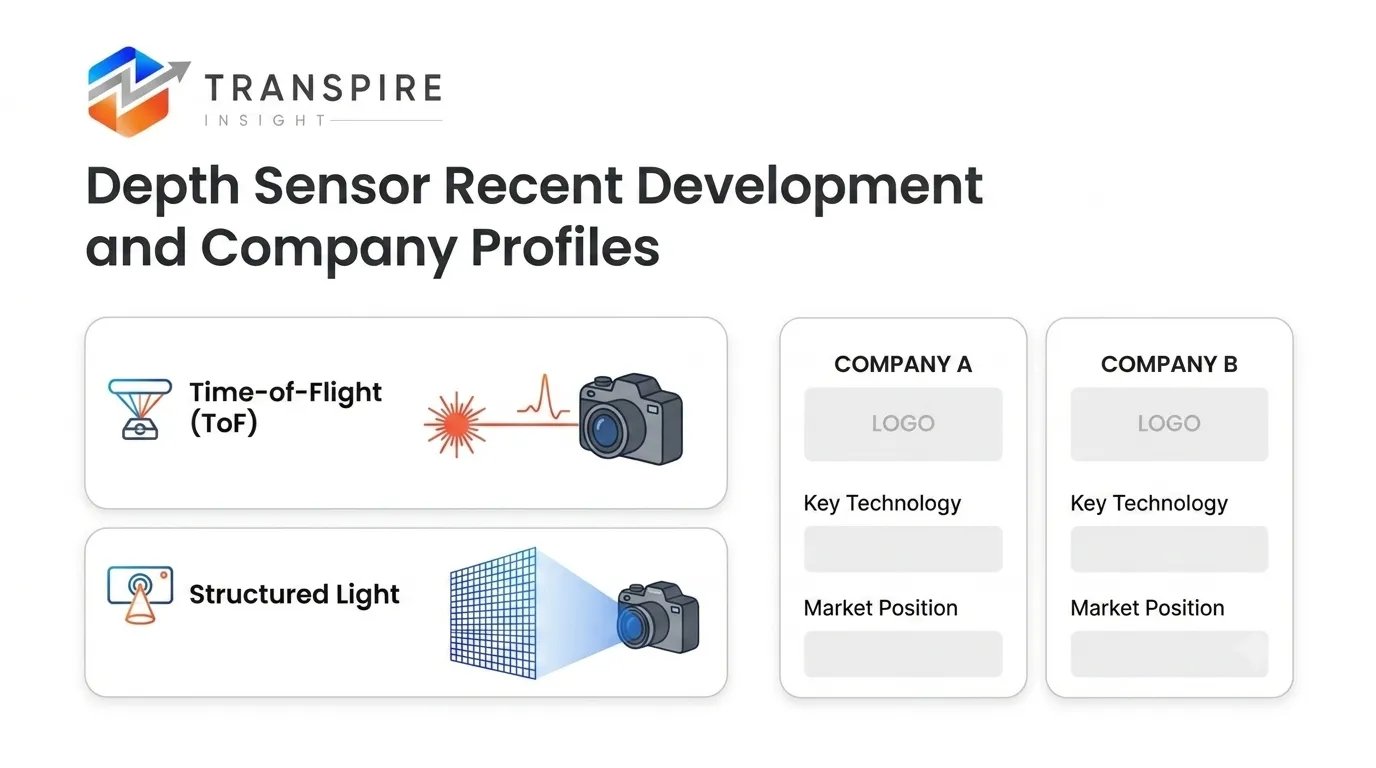
The market for depth sensing technology is undergoing a dramatic change as optical technologies such as Time-of-Flight (ToF), structured light, and stereoscopic vision improve. These sensors can support real-time 3D spatial mapping, distance measurement, and object recognition on various platforms. Their strategic value is evident in their quick integration into smartphones, driverless cars, industrial robotics, and augmented reality headsets used by consumers. The trend of more and more automated systems moving to depth sensing as standard equipment, driven by improvements in hardware miniaturization and reduced costs, is sweeping the world. From improved hardware miniaturization and falling production costs, depth sensing is making the transition from a luxury of high-tech to a requirement in all automated systems around the world.
Recent Development News
Stay Ahead of Emerging Opportunities with Expert Market Insights by Transpire Insight
Transpire Insight provides comprehensive, data-driven market intelligence to support smarter business decisions. Our research is rooted in comprehensive analysis, authoritative predictions, and industry expertise, enabling organizations to make informed decisions in rapidly evolving markets. In-depth analysis of market segmentation, competitive positioning, regional trends, and emerging investment opportunities in high-growth areas. We blend accuracy with actionable intelligence, empowering companies to uncover new avenues for growth, bolster strategic decision-making, and stay ahead in a dynamic market.
Download the exclusive Depth Sensor Market sample report today to uncover expert insights, emerging trends, and the opportunities defining the future of the industry.
Depth Sensor Market Size & Statistics
Regional Growth and Demand Analysis by Transpire Insight
The market is dominated by the Asia-Pacific region, which is supported by the high level of smartphone production, consumer electronics production, and rapid growth in automotive demand in China, Japan, India, and South Korea. The region is the leader in revenue share, due to its depth in electronics manufacturing and fast consumer-device refresh cycles. Smartphone usage and production are increasing rapidly in Asia-Pacific, especially in China and India, adding to the demand for depth sensing technologies. The region's leadership is also being reinforced by a wide range of growing AI-driven depth cameras in smartphones, increasing automation in factories, and government smart-manufacturing initiatives, while also bolstered by a rising trend of robotics deployment and logistics modernization, which builds up the demand-validation infrastructure. Use cases are being fueled by the economies in China, Japan, South Korea, India, Australia, and ASEAN, among other areas: consumer devices, factory automation, mobility, surveillance, healthcare, and logistics.
The United States and Canada are leading the way in the depth camera market in North America due to the growth and adoption of ADAS and AI integration. The U.S. is at the forefront of the region with its broad technology sector, strong automotive industry, and government policies and regulations that have nurtured the development of AI and robotics systems within the vehicle. Growing demand for AI-powered spatial analytics, gesture-based interfaces, and cloud-connected sensing platforms in the defense and autonomous-mobility industries is creating a growing competitive landscape, further boosted by the growing use of video content and gaming, and by rising demand for 3D imaging technology throughout the region.
Top 15 Trends in the Depth Sensor Market
Proceed to Checkout to purchase the exclusive Depth Sensor Market report and gain instant access to in-depth market intelligence, strategic analysis, and future growth opportunities.
AI-driven Sensor Fusion
Combining depth data with AI enables real-time spatial understanding, powering autonomous vehicles, robots, and smart devices with greater accuracy and adaptive decision-making capabilities.
Automotive ADAS Growth
Automakers increasingly integrate depth sensors into driver-assistance and autonomous systems, driven by safety regulations, smart mobility investments, and demand for reliable collision-avoidance technology.
Smartphone AR/facial Recognition
Consumer electronics manufacturers embed advanced depth sensors for facial unlock, augmented reality filters, and gesture control, enhancing interactivity and driving mass-market device adoption.
Time-of-Flight Sensor Expansion
ToF technology is gaining preference for its accuracy and speed in distance measurement, increasingly replacing older stereo-vision methods across consumer and industrial applications.
Sensor Miniaturization
Manufacturers are shrinking sensor modules while improving performance, enabling integration into wearables, compact smartphones, drones, and space-constrained industrial equipment without sacrificing precision.
Industrial Robotics Automation
Factories deploy depth sensors for machine vision, quality inspection, and safe human-robot collaboration, supporting Industry 4.0 initiatives and smart manufacturing modernization worldwide.
List of Top 25 Companies Leading the Depth Sensor Market
Customize the exclusive Depth Sensor Market report today to receive tailored insights, country-specific analysis, and business-focused market intelligence.
1. Sony Group Corporation
Captures over forty percent of the image sensor market share.
Founded: 1946 | HQ: Tokyo, Japan
Why It Ranks: World leader in CMOS image sensors and mobile 3D depth-sensing modules.
Regional Dominance: Holds dominant market presence across Asia-Pacific and North American consumer sectors.
Product Line: DepthSense ToF sensors, Exmor image sensor series, and custom modules.
2. Infineon Technologies AG
Pioneers high-performance Time-of-Flight sensor chipsets for automotive and consumer electronics.
Founded: 1999 | HQ: Neubiberg, Germany
Why It Ranks: Dominates automotive in-cabin driver monitoring systems and smart device depth applications.
Regional Dominance: Strong European industrial footprint with massive supply chain integration.
Product Line: REAL3 3D ToF image sensors and automotive LiDAR solutions.
3. STMicroelectronics N.V.
Pioneered integrated VCSEL-based micro-Time-of-Flight distance sensors for mobile and IoT devices.
Founded: 1987 | HQ: Plan-les-Ouates, Switzerland
Why It Ranks: Shipped billions of FlightSense ToF modules worldwide for proximity sensing.
Regional Dominance: Key presence across European semiconductor hubs and Asian consumer hardware assembly.
Product Line: FlightSense ToF sensors, ambient light sensors, and MEMS components.
4. Texas Instruments Incorporated
Delivers robust industrial-grade 3D ToF solutions for factory automation and robotics.
Founded: 1930 | HQ: Dallas, Texas, USA
Why It Ranks: Extensive analog and embedded processing catalog supporting industrial depth-sensing platforms.
Regional Dominance: Dominates North American industrial automation and automotive tier-one supplier networks.
Product Line: OPT8241 ToF controllers, OPT9221 spatial sensors, and signal processors.
5. Intel Corporation
Pioneered accessible 3D stereoscopic depth cameras for developer and commercial applications.
Founded: 1968 | HQ: Santa Clara, California, USA
Why It Ranks: Industry-standard depth cameras widely utilized in robotics and spatial scanning.
Regional Dominance: Strong North American innovation base with globally distributed enterprise hardware distribution.
Product Line: RealSense D400 depth camera series, stereo modules, and processors.
6. PMD Technologies AG
Invented groundbreaking phase-shift Time-of-Flight technology used in spatial perception systems.
Founded: 2002 | HQ: Siegen, Germany
Why It Ranks: Premier pure-play ToF depth-sensing intellectual property developer powering electronics.
Regional Dominance: European R&D headquarters with major partnership ties across Asian manufacturers.
Product Line: pmd ToF depth sensors, IRS 3D modules, and middleware.
7. AMS-OSRAM AG
Market leader in VCSEL illumination sources for 3D depth sensing arrays.
Founded: 1981 | HQ: Premstaetten, Austria
Why It Ranks: Key emitter component provider enabling structured light and ToF depth systems.
Regional Dominance: Broad European optical manufacturing base supplying consumer tech OEMs.
Product Line: VCSEL illumination arrays, dot projectors, and optical ToF modules.
8. Qualcomm Technologies, Inc.
Integrates advanced depth-sensing signal processing directly into mobile System-on-Chips (SoCs).
Founded: 1985 | HQ: San Diego, California, USA
Why It Ranks: Dominates smartphone application processors with native hardware support for depth perception.
Regional Dominance: Major market share in North American and Asian mobile device ecosystems.
Product Line: Spectra ISP depth modules, Snapdragon processors, and XR perception kits.
9. OMNIVISION
Leading innovator in compact CMOS image sensors for automotive and surveillance depth.
Founded: 1995 | HQ: Santa Clara, California, USA
Why It Ranks: Major provider of compact depth-sensing image sensors for automotive safety systems.
Regional Dominance: Dual operational strengths spanning North American design and Asian manufacturing networks.
Product Line: Nyxel Near-Infrared sensors, CameraCubeChip ToF modules, and image sensors.
10. Stereolabs Inc.
Leading provider of long-range 3D passive spatial perception cameras for autonomy.
Founded: 2010 | HQ: San Francisco, California, USA.
Why It Ranks: Delivers high-resolution human-scale spatial depth mapping for field robotics platforms.
Regional Dominance: High adoption across North American and European industrial automation sectors.
Product Line: ZED 2i stereo depth camera, ZED-X automotive sensor, and spatial AI SDKs.
Schedule a meeting with our market experts to discuss the exclusive Depth Sensor Market report and identify the best research solution for your organization.
Conclusion
This will contribute to the continued growth of the depth sensor market as 3D spatial perception becomes a core foundational technology. ToF and LiDAR architectures are undergoing constant evolution as key companies continue to improve them, owing to the increasing use of autonomous vehicles, growing spatial computing environments, and industrial AI integration. As the manufacturing costs of this type of sensor keep falling, and on-sensor edge processing continues to develop and advance, depth sensors will become ubiquitous in everyday consumer electronics, healthcare systems, and smart automation, changing the way machines interpret and navigate physical environments.


Send us a brief description of your challenge and we'll get back to you within 24 hours.

 inquiry@transpireinsight.com
 APAC:+91 7666513636
 Address


