
Sep 09, 2026
By Transpire Insight
Description
According to a research report published by Transpire Insight, the dental care products market size is projected to grow from USD 65.8 billion in 2026 to USD 114.53 billion by 2035, at a CAGR of 7.8% during the forecast period 2027-2035. Some of the major factors driving the growth of the market for oral care products are increasing consciousness of preventive oral care, the growing incidence of dental caries, increased disposable income, growing demand for sustainable/organic formulations, and innovations in smart electric toothbrushes and whitening products.
Introduction
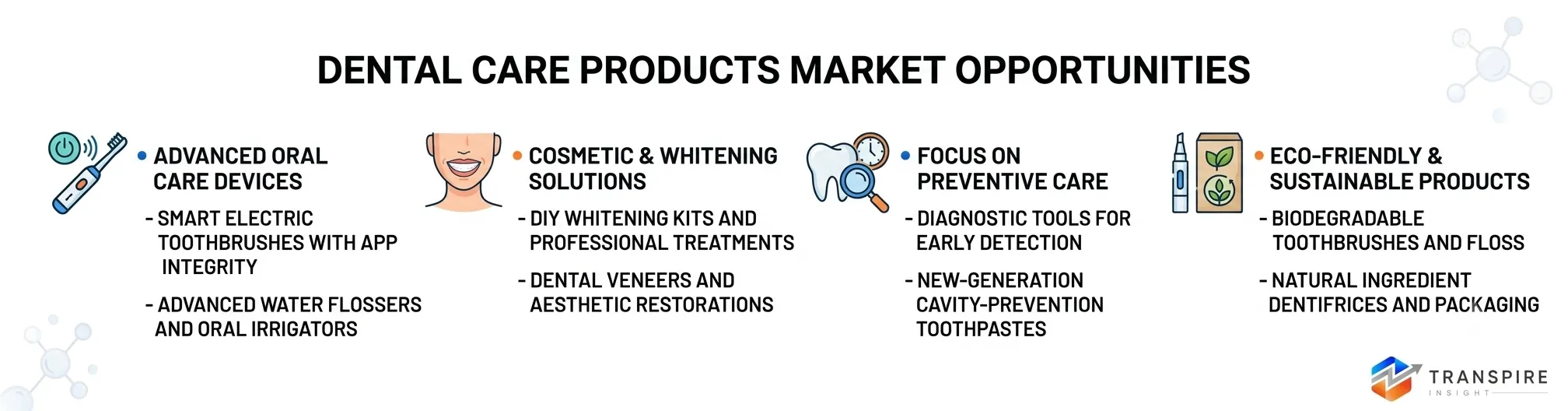
The market for dental care products is steadily growing as consumers' consumption patterns and their focus on health have changed. Oral health is no longer considered a routine – it is a key component of general well-being and prevention. The industry is undergoing a transformation with advancements in smart technology, eco-friendly formulations, and the direct-to-consumer digital path. So, brands and specialty brands are always updating their product lines to meet the growing demands of consumers globally.
Recent Development News
Stay Ahead of Emerging Opportunities with Expert Market Insights by Transpire Insight
Transpire Insight provides comprehensive, data-driven market intelligence to support smarter business decisions. Our research is rooted in comprehensive analysis, authoritative predictions, and industry expertise, enabling organizations to make informed decisions in rapidly evolving markets. In-depth analysis of market segmentation, competitive positioning, regional trends, and emerging investment opportunities in high-growth areas. We blend accuracy with actionable intelligence, empowering companies to uncover new avenues for growth, bolster strategic decision-making, and stay ahead in a dynamic market.
Dental Care Products Market Size & Statistics
Regional Growth and Demand Analysis by Transpire Insight
North America's leadership stems from deep-rooted oral hygiene awareness, dense retail and e-commerce distribution, and the presence of major manufacturers headquartered in the region. As brands are adding more benefits to their existing products, they are incorporating premium, multi-benefit formulas into toothpaste, as seen in Colgate-Palmolive's new Elixir line offering a combination of whitening and enamel-repair technology. Meanwhile, Philips Sonicare and Procter & Gamble's Oral-B remain the big boys in the connected-toothbrush business with AI-powered pressure sensors and app coaching built into their existing product lines. What's unique about this regional trend is that the dental insurance companies are funding smart toothbrushes and toothpaste with high fluoride content and are linking use data to premium discounts, making oral hygiene a new insured, tech-enabled category. New patient treatment volumes and the high cost for treatment are still driving replacement and upgrade cycles for brushes, pastes and rinses throughout the region.
The rapid growth of the Asia-Pacific region is driven by China's manufacturing consolidation and scale, as well as India's high growth rate due to rising disposable income and urbanisation. Almost 90% of the adult population in India suffers from dental issues, which is driving first-time and repeat buyers to purchase low-priced toothpaste, toothbrush and mouthwash from modern retail outlets and through the growing e-commerce platforms. Herbal and natural products are expanding in companies like Unilever, Church & Dwight and Sunstar Suisse to cater to local preferences, and Japanese consumers are shifting towards interdental cleaners and sensitivity-focused pastes, representing a more mature and preventative-care approach. Oral health awareness messages backed by the government in multiple Asia-Pacific markets are also supporting this trend, and are helping to support category volume growth even as per-capita spending is lower than in North America and Europe.
Top 15 Trends in the Dental Care Products Market
Electric and Smart Toothbrushes
Consumers worldwide are steadily shifting from manual to electric, app-connected toothbrushes with pressure sensors and AI feedback, driven by rising awareness of proper brushing technique.
Whitening and Enamel-Repair Products
Manufacturers are increasing active-ingredient concentrations, combining whitening agents with enamel-repair compounds in toothpaste formulations, responding to rising consumer demand for visible cosmetic results alongside protection.
E-commerce and Direct-to-Consumer Channels
Online retail and direct-to-consumer subscription models are expanding rapidly, offering convenience, competitive pricing, and personalized product recommendations that traditional supermarket and pharmacy channels cannot match.
Probiotic and Microbiome-Focused Oral Care
Probiotic-infused mouthwashes and rinses targeting the oral microbiome are gaining traction, reflecting a shift toward science-backed, preventive formulations that address bacterial balance rather than symptoms.
Insurer-Linked Incentives for Smart Brush Usage
Dental insurers in the US and Europe subsidize smart toothbrushes and high-fluoride toothpaste, linking usage data to premium discounts and encouraging preventive, technology-assisted oral hygiene.
Expanding Geriatric Population Driving Preventive Oral Care
An expanding geriatric population, more susceptible to tooth loss and gum disease, is driving demand for preventive dental care products, denture-care solutions, and sensitivity formulations.
List of Top 25 Companies Leading the Dental Care Products Market
1. Colgate-Palmolive Company
World leader in consumer oral care products across more than two centuries.
Founded: 1806 | HQ: New York, New York, USA.
Why It Ranks: Unrivaled retail distribution networks and massive overall toothpaste market share leadership.
Regional Dominance: Holds dominant market shares across North America, Latin America, and Asia-Pacific.
Product Line: Toothpaste, manual and electric toothbrushes, mouthwashes, dental floss, and whitening.
2. Procter & Gamble Co. (P&G)
Owns iconic billion-dollar oral hygiene brands such as Crest and Oral-B.
Founded: 1837 | HQ: Cincinnati, Ohio, USA.
Why It Ranks: Dominates power toothbrushes and cosmetic teeth whitening solutions through deep R&D.
Regional Dominance: Strongest footprint in North America, Western Europe, and key Asian markets.
Product Line: Crest toothpastes, Oral-B electric toothbrushes, mouth rinses, and whitening strips.
3. Haleon plc
Spun off from GSK to become a massive pure-play consumer health company.
Founded: 2022 | HQ: Weybridge, United Kingdom.
Why It Ranks: Holds category-defining positions in tooth sensitivity and complete gum care.
Regional Dominance: Strong presence across Europe, North America, and major emerging consumer markets.
Product Line: Sensodyne, Parodontax, Polident denture care products, and Aquafresh family toothpastes.
4. Unilever PLC
Operates popular oral care brands across more than 50 nations.
Founded: 1929 | HQ: London, United Kingdom.
Why It Ranks: Massive consumer reach and strong localization strategies in emerging markets.
Regional Dominance: Dominates market penetration in Asia-Pacific, Latin America, and parts of Europe.
Product Line: Signal, Close-Up, Pepsodent, Zendium toothpastes, and specialized oral health rinses.
5. Johnson & Johnson
Pioneered antiseptic mouth rinses with its world-renowned flagship Listerine brand lineup.
Founded: 1886 | HQ: New Brunswick, New Jersey, USA.
Why It Ranks: Listerine remains the globally dominant clinical and consumer liquid mouthwash brand.
Regional Dominance: Holds vast market share leadership in North America, Europe, and Asia.
Product Line: Listerine antiseptic rinses, Reach dental floss, and specialized oral rinses.
6. Koninklijke Philips N.V.
Revolutionized power toothbrushing technology with its widely acclaimed Sonicare Sonic Series.
Founded: 1891 | HQ: Amsterdam, Netherlands.
Why It Ranks: Leader in high-end electric toothbrushes, app-connected smart devices, and oral irrigators.
Regional Dominance: Commands major market share in North America, Western Europe, and China.
Product Line: Sonicare electric toothbrushes, Sonicare Power Flosser, and professional whitening systems.
7. Kao Corporation
Major Japanese personal care conglomerate known for advanced medicinal oral care formulations.
Founded: 1887 | HQ: Tokyo, Japan.
Why It Ranks: Strong focus on preventive dentistry innovations and specialized periodontal oral health products.
Regional Dominance: Highly dominant across Japan, East Asia, and major Southeast Asian territories.
Product Line: Clear Clean toothpaste, Guardhalo gum care, and specialized targeted oral rinses.
8. Lion Corporation
Key Japanese oral hygiene pioneer continuously introducing active plaque-enzyme formula innovations.
Founded: 1891 | HQ: Tokyo, Japan.
Why It Ranks: Top market shares in toothbrushes and preventative dental care in Asia.
Regional Dominance: High dominance in Japan, South Korea, China, and Southeast Asian regions.
Product Line: Clinica, Systema, Nonio toothpastes, toothbrushes, and specialized preventative mouthwashes.
9. Sunstar Group
Swiss-headquartered Japanese firm deeply dedicated to systemic-oral health connection research solutions.
Founded: 1932 | HQ: Etoy, Switzerland.
Why It Ranks: Trusted reputation among professional dentists for clinical interdental and periodontal products.
Regional Dominance: Strong market presence in Japan, North America, and across Western European countries.
Product Line: GUM toothpastes, interdental brushes, Butler professional dental products, and mouth rinses.
10. Church & Dwight Co., Inc.
Built an oral care powerhouse centered around sodium bicarbonate baking soda technology.
Founded: 1846 | HQ: Ewing, New Jersey, USA.
Why It Ranks: Dominates value-tier electric toothbrushes alongside specialty baking soda whitening toothpastes.
Regional Dominance: Primary operational and market strength situated throughout the North American continent.
Product Line: Arm & Hammer toothpastes, Spinbrush battery toothbrushes, and Waterpik water flossers.
Conclusion
The dental care products market is witnessing continued robust growth owing to the need for preventive hygiene products and cosmetic enhancements, along with the adoption of cutting-edge digital technologies among consumers. Multinationals dominate the market by making strategic investment decisions, creating localised distribution networks, and formulating products around natural products. In the future, as the world evolves towards a more sustainable future and consumer demand for “smart” oral care devices grows, businesses that embrace sustainability and innovation will dominate the landscape of oral health products.


Send us a brief description of your challenge and we'll get back to you within 24 hours.

 inquiry@transpireinsight.com
 APAC:+91 7666513636
 Address


