
Sep 04, 2026
By Transpire Insight

Description
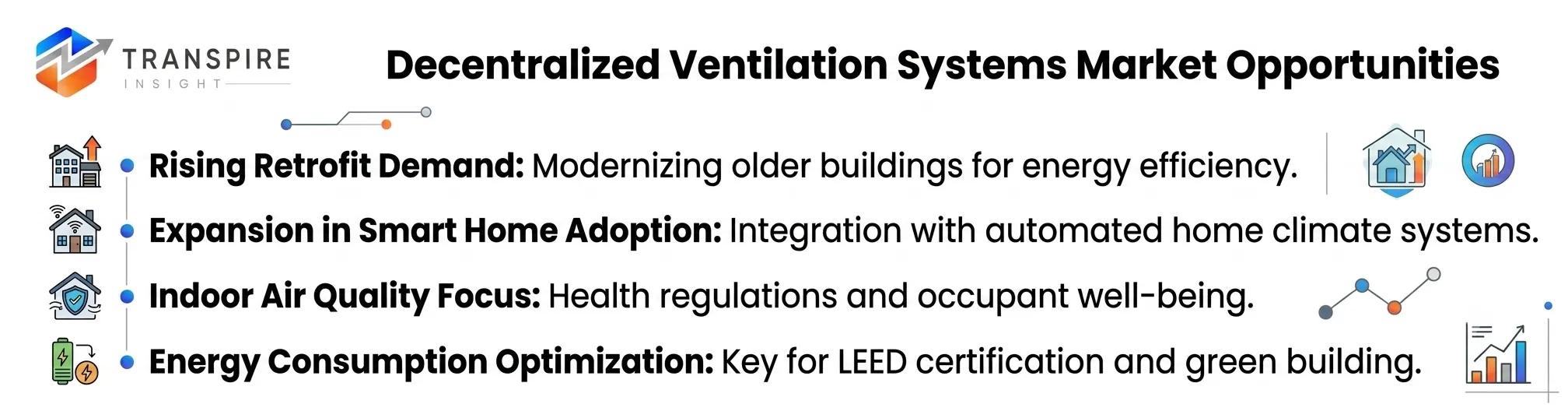
According to a research report published by Transpire Insight, the decentralized ventilation systems market size is projected to grow from USD 11.16 billion in 2026 to USD 19.34 billion by 2035, at a CAGR of 8.25% during the forecast period 2027-2035. Key factors contributing to the energy market growth include rising demand for energy-efficient retrofits, increasing smart heat recovery systems in residential and commercial buildings, and the low ducting requirements.
Introduction
The Decentralized Ventilation Systems market is growing at a fast pace, driven by the new building codes that emphasize energy efficiency and better indoor air quality. However, decentralised systems provide room-specific airflow control, without the need for ducts, significantly reducing installation costs and heat loss, compared to central HVAC systems. With the support of urban renewal movements, rigorous environmental standards, and smart sensor systems, decentralized ventilation systems that recover heat have become a must-have solution for a healthy and energy-efficient residential and commercial building.
Recent Development News
Stay Ahead of Emerging Opportunities with Expert Market Insights by Transpire Insight
Transpire Insight provides comprehensive, data-driven market intelligence to support smarter business decisions. Our research is rooted in comprehensive analysis, authoritative predictions, and industry expertise, enabling organizations to make informed decisions in rapidly evolving markets. In-depth analysis of market segmentation, competitive positioning, regional trends, and emerging investment opportunities in high-growth areas. We blend accuracy with actionable intelligence, empowering companies to uncover new avenues for growth, bolster strategic decision-making, and stay ahead in a dynamic market.
Decentralized Ventilation Systems Market Size & Statistics
Regional Growth and Demand Analysis by Transpire Insight
Europe's lead rests on a combination of strict building-renovation codes and a dense, mature supplier base. Rehau's Geneo Inovent, which integrates ventilation directly into window frames, illustrates how European suppliers are engineering compact, retrofit-friendly designs to meet these tightening standards without requiring major structural changes to older housing stock.
Asia-Pacific's growth is being driven by rapid urbanization across China, India, and Japan, alongside newer national energy standards that are pushing builders away from bulky ducted systems. Mitsubishi Electric's Lossnay Series has gained particular traction in single-room retrofit and space-constrained applications, reflecting how the region's dense, fast-growing urban housing stock favors decentralized, room-level airflow solutions over centralized alternatives that are harder to retrofit into existing buildings.
Top 15 Trends in Decentralized Ventilation Systems
Rising Adoption of Heat Recovery Ventilation Systems
Heat recovery systems are gaining share as tighter building envelopes demand mechanical ventilation, transferring exhaust warmth to incoming air while cutting heating and cooling loads.
Retrofit and Renovation Driving Deployment Growth
Retrofit and renovation projects lead deployment as building owners upgrade airflow without extensive ductwork, favoring decentralized units for older, space-constrained structures needing fast upgrades.
Smart, IoT-Enabled Ventilation Gaining Traction
Smart, IoT-enabled ventilation systems now offer app-based control, occupancy sensing, and automated airflow adjustment, appealing to homeowners and facility managers seeking convenience and measurable savings.
Stricter Building Energy Efficiency Codes
Governments are tightening building energy codes worldwide, pushing developers toward mechanical ventilation with heat recovery to meet airtightness and efficiency mandates in renovated structures nationwide.
Compact, Window-Integrated Ventilation Designs Emerging
Manufacturers are embedding ventilation directly into window frames, offering compact, space-efficient units that deliver airflow and heat recovery without facade penetration in dense urban retrofits.
Urbanization Fueling Asia-Pacific Market Expansion
Rapid urbanization across China, India, and Japan is accelerating decentralized ventilation adoption, as new energy standards push installers toward compact, efficient, energy-saving room-level airflow solutions.
List of Top 25 Companies Leading the Decentralized Ventilation Systems Market
Swiss ventilation pioneer renowned for high-performance heat recovery decentralized systems globally.
Founded: 1895 | HQ: Gränichen, Switzerland.
Why It Ranks: market leader in energy-efficient residential and commercial ventilation technology.
Regional Dominance: Europe and North America with expanding footprint across East Asia.
Product Line: ComfoAir 70, ComfoSpot 50, ComfoFan, Zender ComfoSystems product series.
German manufacturer specializing exclusively in decentralized residential ventilation and heat recovery.
Founded: 1959 | HQ: Berlin, Germany.
Why It Ranks: Benchmark innovator for ultra-compact, push-pull decentralized heat recovery systems.
Regional Dominance: Strong leadership in Germany, Western Europe, and European retrofit markets.
Product Line: e², e²60, SILENTO, ego, NEXXT decentralized heat recovery units.
German specialist dedicated to high-efficiency decentralized ventilation units with heat recovery.
Founded: 1980 | HQ: Alling, Germany.
Why It Ranks: Top European provider of acoustic-insulated, filter-heavy decentralized ventilation equipment.
Regional Dominance: Dominant regional market footprint throughout Central and Western Europe.
Product Line: M-WRG-II series, M-WRG series, ULA, and network controllers.
International supplier of energy-efficient indoor air quality solutions and ductless fans.
Founded: 2002 | HQ: Crawley, United Kingdom.
Why It Ranks: Rapidly expanding market giant with an extensive portfolio of ventilation brands.
Regional Dominance: United Kingdom, Western Europe, Australasia, and Nordic regional markets.
Product Line: Vent-Axia PureAir, Fresh, VoltAir, Manrose, Simx ventilation systems.
ventilation leader manufacturing advanced airflow, air handling, and distribution products.
Founded: 1974 | HQ: Skinnskatteberg, Sweden
Why It Ranks: Key international supplier of high-end decentralized commercial and residential units.
Regional Dominance: Strong market position in Europe, CIS, Middle East, and Asia.
Product Line: SAVE series, Topvex, VSR, Mini HRV, SmartLy series.
Japanese technology leader famous for patented Lossnay energy recovery ventilation technology.
Founded: 1921 | HQ: Tokyo, Japan
Why It Ranks: Industry benchmark for paper-core energy recovery exchangers and ultra-quiet fans.
Regional Dominance: Unmatched market share in Asia-Pacific, North America, and Europe.
Product Line: Lossnay VL-50, Lossnay VL-100, Vertical Lossnay, Air2O systems.
Electronics giant producing energy-efficient indoor air quality systems and smart ventilators.
Founded: 1918 | HQ: Kadoma, Osaka, Japan.
Why It Ranks: leader in reliable DC motor technology and whisper-quiet ventilation.
Regional Dominance: Massive footprint across Asia-Pacific, North America, and European markets.
Product Line: WhisperAir Repair, CosmoSpot, Intelli-Balance ERV, WhisperComfort series.
German ventilation manufacturer offering comprehensive decentralized and residential airflow products.
Founded: 1900 | HQ: Munich, Germany.
Why It Ranks: Dominant provider of versatile single-room reverse-flow heat recovery ventilation systems.
Regional Dominance: Europe, Eastern Europe, Middle East, and expanding presence.
Product Line: VENTO Expert, VENTO V50, Freshbox, Vento Duo series.
One of the world's largest manufacturers of residential and industrial ventilation.
Founded: 1990 | HQ: Kyiv, Ukraine.
Why It Ranks: Massive manufacturing scale supplying affordable decentralized heat recovery wall units.
Regional Dominance: Strong presence in Eastern Europe, Central Europe, and exports.
Product Line: TwinFresh Comfo, TwinFresh Expert, Micra 50, Breeze series.
German pioneer specializing in decentralized ventilation systems utilizing ceramic heat accumulators.
Founded: 1999 | HQ: Löberschütz, Germany.
Why It Ranks: Recognized inventor of high-efficiency ceramic-core pair ventilation heat exchanger technology.
Regional Dominance: Strong market presence across Germany, Austria, Switzerland, and Central Europe.
Product Line: iV14-Zero, iV-Smart, iV-Compact, Corner series ventilation systems.
Conclusion
The decentralized ventilation systems market is part of a trend toward smart, energy-efficient building solutions. Room-specific heat recovery technology is an ideal, ductless solution compared with traditional systems, as codes are tightening worldwide and indoor air quality is becoming a priority. Innovations in ceramic heat exchangers, low-noise DC motors, and automatic sensor controls will make decentralized ventilation an essential standard for building renovations and new, low-emission residential and commercial buildings around the world.


Send us a brief description of your challenge and we'll get back to you within 24 hours.

 inquiry@transpireinsight.com
 APAC:+91 7666513636
 Address


