
Oct 27, 2026
By Transpire Insight
Description
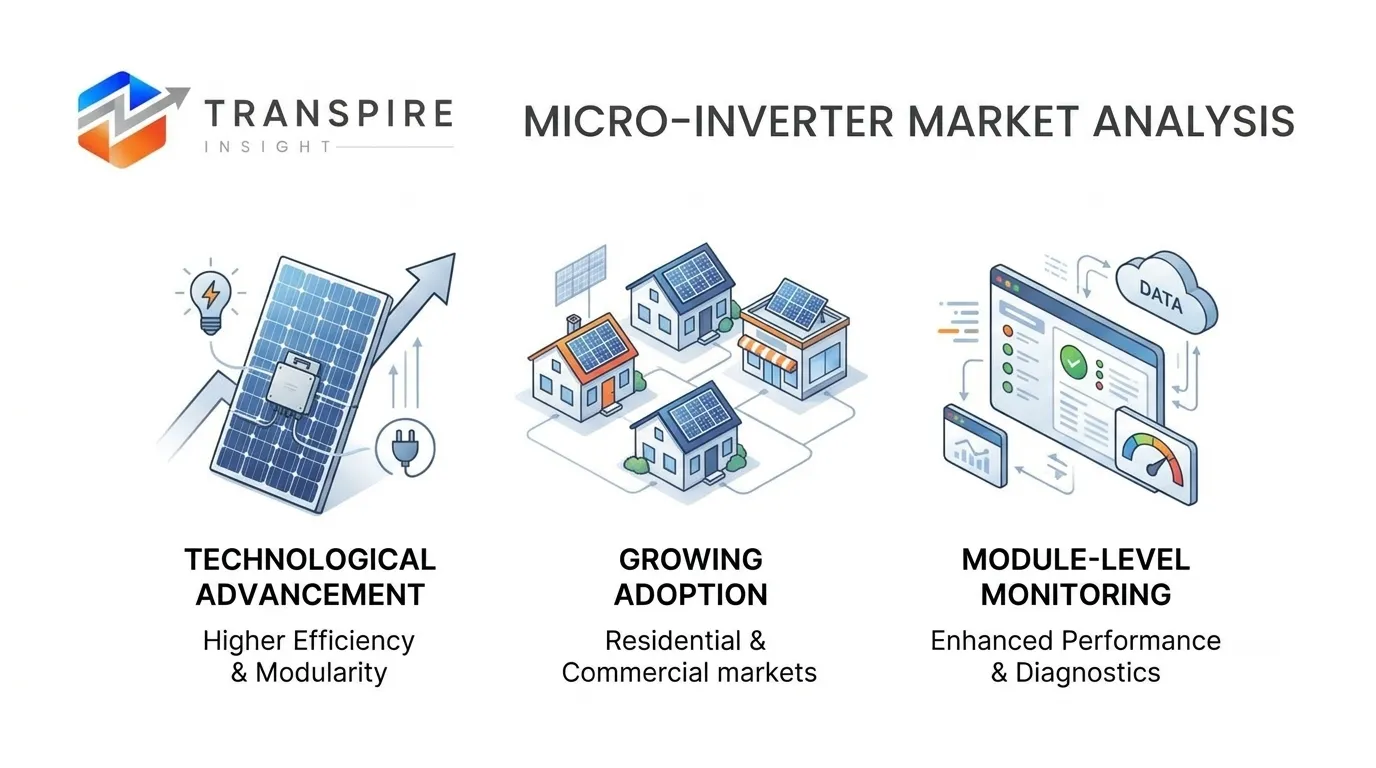
According to a research report published by Transpire Insight, the micro-inverter market size is projected to grow from USD 5.12 billion in 2026 to USD 9.40 billion by 2035, at a CAGR of 15.23% during the forecast period 2027-2035. The residential rooftop market is growing at a fast pace, safety compliance standards (NEC rapid shutdown), module-level power optimization, and easy integration with smart home energy storage systems are driving the adoption of micro-inverters.
Introduction
The micro-inverter market functions as a key enabler in the efficient utilization of PV panels in the modern energy conversion system. Micro-inverters convert Direct Current (DC) to Alternating Current (AC) at each module, reducing shading losses and enhancing reliability for the system. Driven by increasing decarbonization goals, safety standards, and smart grid integration, the industry is rapidly moving toward high-wattage, multi-in-one, and energy storage solutions.
Recent Development News
June 2026: Enphase Energy introduced its new generation IQ9N series of microinverters with advanced wide-bandgap semiconductors for high-power home systems.
In March 2026, Enphase Energy joined the Capital Good Fund to speed up micro-inverter-based solar projects for low-income homeowners.
Stay Ahead of Emerging Opportunities with Expert Market Insights by Transpire Insight
Transpire Insight provides comprehensive, data-driven market intelligence to support smarter business decisions. Our research is rooted in comprehensive analysis, authoritative predictions, and industry expertise, enabling organizations to make informed decisions in rapidly evolving markets. In-depth analysis of market segmentation, competitive positioning, regional trends, and emerging investment opportunities in high-growth areas. We blend accuracy with actionable intelligence, empowering companies to uncover new avenues for growth, bolster strategic decision-making, and stay ahead in a dynamic market.
Micro-inverter Market Size & Statistics
The Market Size for Micro-inverter Was Estimated to be Worth USD 5.12 Billion in 2026.
The Market Size is Going to Expand at a CAGR of 15.23% between 2026 and 2035.
The Micro-inverter Market Size is anticipated to reach USD 13.25 Billion by 2035.
North America is projected to drive the highest demand during the forecast period, accounting for 39% of the micro-inverter market.
Asia Pacific is projected to grow the fastest during the forecast period at a CAGR of 19.5% in the micro-inverter market.
Regional Growth and Demand Analysis by Transpire Insight
North America's dominance rests on regulatory push as much as demand. Rapid-shutdown mandates under NEC 690.12 have made panel-level safety a code requirement rather than an option, and micro-inverters meet this bar inherently, pushing residential installers toward them by default. The U.S. residential solar base, anchored by players like Enphase Energy, continues to lean on smart-home integration and monitoring dashboards to differentiate offerings even as incentive structures like California's NEM 3.0 have compressed rooftop payback periods. At the same time, federal manufacturing incentives are pulling production back onshore, chipping away at the heavy historical reliance on Chinese-made components and reshaping the region's supply chain around domestic assembly.
Asia-Pacific's growth is being driven by scale rather than policy alone. India's commercial-and-industrial rooftop segment is expanding quickly as factories, warehouses, and office parks turn to solar to cut energy costs, while China continues to anchor the region as both the largest manufacturing base and a growing installation market. Australia's residential penetration remains among the highest globally, giving the region a rare combination of mature household adoption and early-stage industrial uptake. Falling component costs, government-backed rooftop programs, and rising awareness of shading tolerance and panel-level optimization are together pulling first-time solar adopters across urban and semi-urban markets toward micro-inverter systems over traditional string inverters.
Top 15 Trends in the Micro-Inverter Market
Rising adoption of MLPE
Module-level power electronics let each panel operate independently, maximizing energy harvest under partial shading and preventing one underperforming panel from limiting the whole rooftop system.
NEC 690.12 Rapid-Shutdown Compliance
NEC 690.12 rapid-shutdown rules require panel-level voltage reduction within seconds, a requirement micro-inverters meet inherently, making them the default choice for compliant residential solar installations.
Hybrid Micro-Inverters with Battery Storage
Manufacturers are pairing micro-inverters with integrated battery storage, enabling homeowners to store excess solar power onsite and increasing overall system resilience, flexibility, and resale value.
AI-enabled Monitoring and Predictive Maintenance
AI-enabled monitoring analyzes panel-level performance data in real time, flagging underperformance or faults early and enabling predictive maintenance that reduces downtime and improves energy yield.
Smart Home and Energy-Management Integration
Micro-inverters increasingly connect with smart home and energy-management platforms, letting homeowners monitor, control, and optimize solar production and consumption remotely through mobile apps and dashboards.
EV-Charging Support Built into Units
Some manufacturers now build EV-charging capability directly into micro-inverter units, letting homeowners channel excess rooftop solar output straight into vehicle charging without needing extra hardware.
Conclusion
With the growing penetration of residential solar energy, increasing safety standards, and the rising trend of integrating batteries, the micro-inverter market is on an upward trajectory. High-wattage, multi-in-one solutions are fueling innovation from key players such as Enphase and APsystems. The trend of moving toward efficiency at the level of the panel is further strengthened by regional expansion in North America, Europe, and Asia-Pacific. In an era of declining hardware expenses and increasing smart grid integration, micro-inverters will continue to be important to resilient, decentralized renewable energy systems around the world.


Send us a brief description of your challenge and we'll get back to you within 24 hours.

 inquiry@transpireinsight.com
 APAC:+91 7666513636
 Address


