
Oct 14, 2026
By Transpire Insight
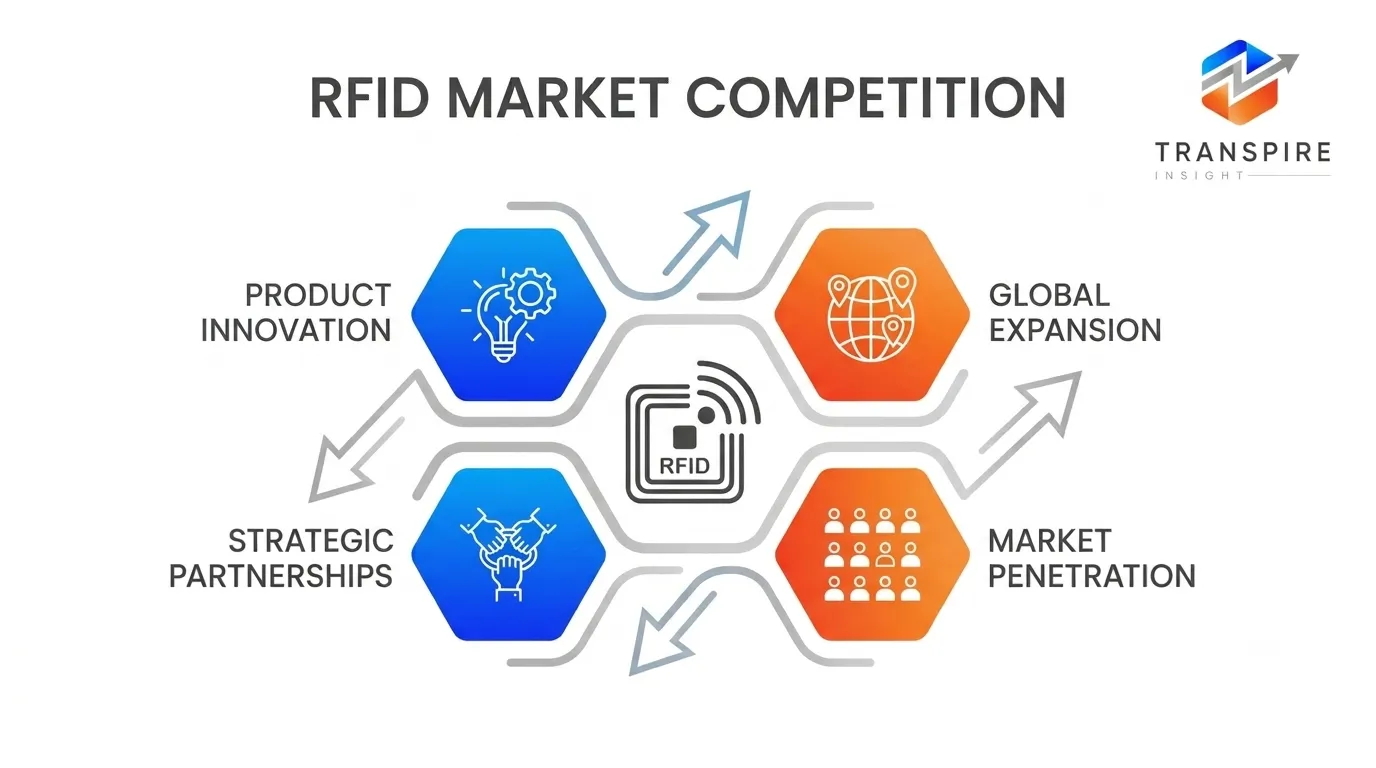
Description
According to a research report published by Transpire Insight, the RFID market size is projected to grow from USD 15.6 billion in 2026 to USD 29.3 billion by 2035, at a CAGR of 8.94% during the forecast period 2027-2035. Expansion of omnichannel retail compliance mandates, growing integration with AI and IoT ecosystems, demands for real-time supply chain visibility, and legal mandates like EU Digital Product Passports accelerate market adoption.
Introduction
The Radio Frequency Identification (RFID) market has transitioned from a basic stock-counting tool into an indispensable backbone for enterprise automation and supply chain visibility. Fueled by surging retail compliance requirements, advanced logistics tracking, and healthcare integration, the RFID industry is expanding rapidly. Leveraging high-frequency (HF), ultra-high-frequency (UHF), and active RFID systems, enterprises achieve real-time asset traceability, automated compliance, and streamlined inventory workflows across worldwide operations.
Recent Development News
April 2026: Becton, Dickinson and Company launched an advanced RFID- and AI-enabled medication dispensing system targeting the European market to eliminate clinical inventory errors and ensure automated pharmaceutical compliance.
September 2026: Zebra Technologies expanded its comprehensive RFID product portfolio by integrating Impinj Gen2X chips across its range, coinciding with six hardware manufacturers embedding RAIN RFID capabilities directly into cellular smartphones.
Stay Ahead of Emerging Opportunities with Expert Market Insights by Transpire Insight
Transpire Insight provides comprehensive, data-driven market intelligence to support smarter business decisions. Our research is rooted in comprehensive analysis, authoritative predictions, and industry expertise, enabling organizations to make informed decisions in rapidly evolving markets. We provide in-depth analysis of market segmentation, competitive positioning, regional trends, and emerging investment opportunities in high-growth areas. We blend accuracy with actionable intelligence, helping companies uncover new growth avenues, strengthen strategic decision-making, and stay ahead in a dynamic market.
Enterprise Governance Risk and Compliance Solutions Market Size & Statistics
The Market Size for RFID Market Was Estimated to be Worth USD 15.6 Billion in 2026.
The Market Size is Going to Expand at a CAGR of 8.94% between 2026 and 2035.
The RFID Market Size is anticipated to reach USD 29.3 Billion by 2035.
North America is projected to drive the highest demand during the forecast period, accounting for 37.15% of the RFID market.
Asia-Pacific is projected to grow the fastest during the forecast period at a CAGR of 12.58% in the RFID market.
Regional Growth and Demand Analysis by Transpire Insight
North America leads the RFID market, anchored by DSCSA compliance, aggressive retail mandates, and large-scale data center footprints. Major retailers such as Walmart, Target, and Nordstrom have set supplier tagging mandates, keeping demand steady across apparel, beauty, and electronics. Walmart's collaboration with Avery Dennison to bring RFID labels to bakery, meat, and deli items shows adoption moving beyond apparel into fresh food, supported by FDA food traceability expectations. Mature channel partnerships and policy certainty continue to sustain capital allocation toward new RFID deployments across the region.
Asia Pacific shows the strongest growth trajectory, driven by smart manufacturing, automated warehousing, and expanding e-commerce across China, India, Japan, and Southeast Asia. China anchors regional demand through its advanced manufacturing base, while Japan and India are advancing retail modernization and digital supply chains. In India, QodeNext's partnership with Clustag to deliver RAIN RFID intralogistics solutions shows how manufacturers are adopting at-source tagging to satisfy brand compliance requirements. Rising regulatory pressure and the shift toward traceable production models are expected to keep regional demand on a steep upward curve.
Top 15 Trends in the RFID Market
UHF RFID is becoming the preferred frequency for retailers because long read range and bulk scanning improve inventory accuracy, replenishment speed, and omnichannel stock visibility.
Retailers are extending RFID labels to bakery, meat, and deli items, enabling digital use-by dates, smarter markdowns, faster rotation, and reduced food waste across stores.
Hospitals deploy RFID to track equipment, medical supplies, and patients, reducing equipment loss, speeding clinical workflows, and strengthening compliance with medication and sterilization safety protocols.
Battery-powered active tags and real-time location systems deliver continuous asset visibility across factories, hospitals, and warehouses, increasingly supported by bundled sensors and recurring software subscriptions.
Manufacturers embed RFID tags during production to meet brand compliance requirements, reducing downstream labeling effort and improving traceability from factory floor to retail shelf.
RFID platforms connect with IoT networks and cloud analytics, turning raw tag reads into actionable insights for inventory planning, asset utilization, and supply chain decisions.
List of Top 25 Companies Leading the RFID Market
1. Impinj, Inc.
Industry pioneer known for developing foundational RAIN RFID chips and system engines.
Founded: 2000 | HQ: Seattle, Washington, USA.
Why It Ranks: Market leader in UHF RFID silicon chips and enterprise infrastructure deployments.
Regional Dominance: Strongest market footprint across North America and Europe's retail sector.
Product Line: Monza endpoint chips, Indy reader chips, Speedway fixed readers, and software.
2. Avery Dennison Corporation
Largest producer and converter of pressure-sensitive RFID inlays and labels.
Founded: 1935 | HQ: Mentor, Ohio, USA.
Why It Ranks: Unmatched production scale supplying billions of UHF tags to retail.
Regional Dominance: Dominates North America and Europe while scaling manufacturing across Asia-Pacific.
Product Line: Smartrac RFID inlays, ultra-thin tags, intelligent packaging, and sensor tags.
3. Zebra Technologies Corporation
Primary supplier of industrial RFID printers, handheld readers, and rugged scanners.
Founded: 1969 | HQ: Lincolnshire, Illinois, USA.
Why It Ranks: Comprehensive hardware and software ecosystems integrated into warehouse logistics systems.
Regional Dominance: Deep operational dominance across North America, Europe, and Latin America markets.
Product Line: ZT400 RFID printers, MC3300R mobile computers, fixed readers, and antennae.
4. NXP Semiconductors N.V.
semiconductor giant producing secure high-performance NFC and HF RFID chips.
Founded: 2006 | HQ: Eindhoven, Netherlands.
Why It Ranks: World leader in secure contact-free chips powering payments, transit, and identity.
Regional Dominance: Dominant footprint across Europe, APAC, and North American public transit networks.
Product Line: UCODE UHF ICs, ICODE HF chips, NTAG NFC chips, and MIFARE.
5. HID (ASSA ABLOY)
Trusted leader in secure physical identity cards, access control, and tag creation.
Founded: 1991 | HQ: Austin, Texas, USA.
Why It Ranks: Industry-standard security credentials deployed across thousands of corporations and government agencies.
Regional Dominance: Dominates North America and Europe for physical access and asset protection.
Product Line: Seos credential cards, industrial tags, reader modules, and location services.
6. Checkpoint Systems (CCL Industries)
Dominates Loss Prevention (EAS) and item-level tracking within multinational retail operations.
Founded: 1969 | HQ: Thorofare, New Jersey, USA.
Why It Ranks: End-to-end retail vertical integration combining source tagging with store inventory software.
Regional Dominance: High adoption across North American, European, and South American retail chains.
Product Line: ItemOptix software, RFID labels, surveillance hardware, and source-tagging solutions.
7. SATO Holdings Corporation
Japanese pioneer in barcode printing, auto-identification, and RFID tagging integration solutions.
Founded: 1940 | HQ: Tokyo, Japan.
Why It Ranks: Premier provider of industrial print engines and tagging for healthcare applications.
Regional Dominance: Dominates Japan and Asia-Pacific while expanding across European logistics hubs.
Product Line: CL4NX Plus RFID printers, PJM RFID tags, and thermal labels.
8. Honeywell International Inc.
Industrial conglomerate delivering integrated RFID scanning hardware for complex supply chains.
Founded: 1906 | HQ: Charlotte, North Carolina, USA.
Why It Ranks: Rugged mobile hardware widely deployed in distribution, aerospace, and defense applications.
Regional Dominance: Strong market presence across North America, Europe, and Middle East industrial sectors.
Product Line: IH25 handheld RFID readers, mobile computers, fixed readers, and tags.
9. Beontag (Confidex)
graphic and RFID converter specializing in heavy-duty industrial tags.
Founded: 2011 | HQ: São Paulo, Brazil / Tampere, Finland
Why It Ranks: Leading specialist in high-durability tags engineered for extreme industrial environments.
Regional Dominance: Rapidly expanding across South America, Europe, and North American auto manufacturing.
Product Line: Confidex Steelwave, Ironside surface tags, tire tags, and specialized inlays.
10. Alien Technology
Longtime RFID Innovator known for developing high-sensitivity enterprise readers and ICs.
Founded: 1994 | HQ: San Jose, California, USA.
Why It Ranks: High-reliability tag ICs and portal readers favored for mass logistics.
Regional Dominance: Extensive deployment throughout North America, China, and distribution nodes.
Product Line: Higgs ICs, Squiggle RFID inlays, ALR-F800 enterprise readers, and portals.
Conclusion
Driven by mandatory retail compliance, supply chain digitalization, and legislative traceability mandates, the RFID market is experiencing unprecedented momentum. Key industry leaders continue to pioneer advancements in high-density tags, eco-friendly substrates, and integrated AI analytics. As enterprises shift from basic inventory counts toward continuous real-time asset monitoring, RFID serves as a foundational digital layer connecting physical supply chains to digital ecosystems.


Send us a brief description of your challenge and we'll get back to you within 24 hours.

 inquiry@transpireinsight.com
 APAC:+91 7666513636
 Address


