
Oct 15, 2026
By Transpire Insight
Description
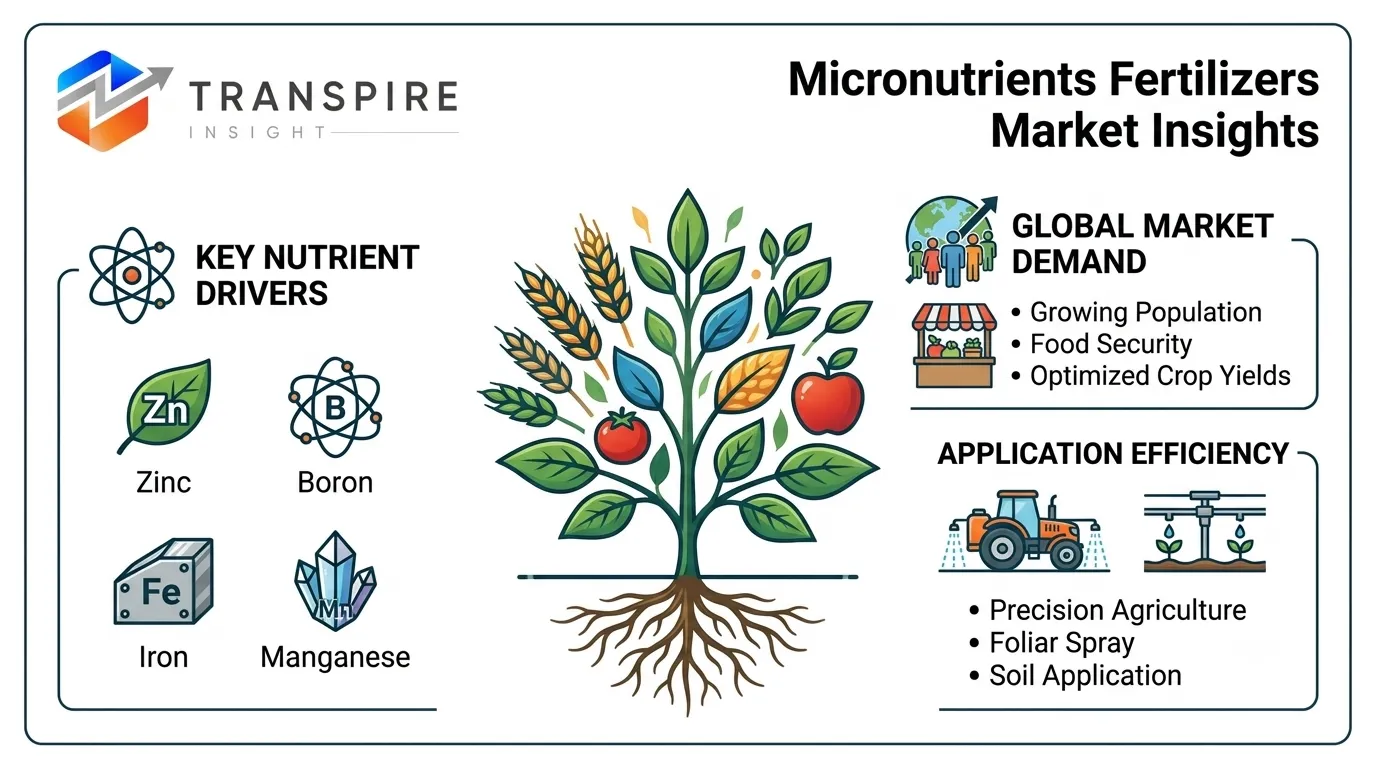
According to a research report published by Transpire Insight, the Micronutrients Fertilizers Market size is projected to grow from USD 6.55 billion in 2026 to USD 10.22 billion by 2035, at a CAGR of 6.84% during the forecast period 2027-2035. Market growth is driven by expanding food demand, severe widespread soil micronutrient deficiencies, surging adoption of precision agriculture, and shifting consumer preferences toward high-value fruits and crop quality.
Introduction
The Micronutrients Fertilizers Market plays a pivotal role in modern agriculture by addressing essential soil nutrient deficiencies, such as zinc, iron, boron, and manganese. As intensive farming practices deplete natural soil vitality, these specialized formulations ensure optimal crop yield, quality, and stress resistance. Integrating micronutrients into balanced crop nutrition regimes remains crucial for sustaining food security, improving fertilizer use efficiency, and enhancing plant disease resilience.
Recent Development News
March 2026: ag-tech research highlights showed rapid expansion in nano-micronutrient formulations and precision fertigation systems. Key industry leaders prioritized smart-release chelated micronutrients to optimize plant uptake and combat severe spring fertilizer supply constraints.
February 2026: The Indian Micro-Fertilizers Manufacturers Association hosted the 6th National Crop Nutrition Summit & B2B Expo in Mumbai. Industry leaders gathered to address regional soil degradation and accelerate adoption of bio-fortified and customized micronutrient blends across emerging agricultural markets.
Stay Ahead of Emerging Opportunities with Expert Market Insights by Transpire Insight
Transpire Insight provides comprehensive, data-driven market intelligence to support smarter business decisions. Our research is rooted in comprehensive analysis, authoritative predictions, and industry expertise, enabling organizations to make informed decisions in rapidly evolving markets. We provide in-depth analysis of market segmentation, competitive positioning, regional trends, and emerging investment opportunities in high-growth areas. We blend accuracy with actionable intelligence, helping companies uncover new growth avenues, strengthen strategic decision-making, and stay ahead in a dynamic market.
Micronutrients Fertilizers Market Size & Statistics
The Market Size for Micronutrients Fertilizers Was Estimated to be Worth USD 6.55 Billion in 2026.
The Market Size is Going to Expand at a CAGR of 6.84% between 2026 and 2035.
The Micronutrients Fertilizers Market Size is anticipated to reach USD 10.22 Billion by 2035.
Asia-Pacific is projected to drive the highest demand during the forecast period, accounting for 39.1% of the micronutrients fertilizers market.
Asia-Pacific is projected to grow the fastest during the forecast period at a CAGR of 8.9% in the Micronutrients Fertilizers Market.
Regional Growth and Demand Analysis by Transpire Insight
Asia-Pacific anchors demand because of its large cultivated area, widespread nutrient depletion in soils, and government micronutrient subsidy programs in South and Southeast Asia. Zinc is the leading nutrient in the region at 34.2% share, while boron is projected to grow fastest at a 9.2% CAGR. In India, soils are commonly deficient in boron (47%), iron (37%), and zinc (39%), which sustains demand. Coromandel International commissioned a USD 25 million plant in Kakinada that raised chelated zinc and boron output by 40%. Vietnam is projected to be the fastest-growing country in the region.
Outside Asia-Pacific, South America benefits from rising cultivation of soybean, corn, fruits, and vegetables. In Brazil, Yara's Rondonópolis plant adds 45,000 metric tons of liquid capacity aimed at pivot owners, and its YaraVita liquid micronutrient sales grew 19%, largely from fertigation in cotton and coffee. North America and Europe are mature yet strategically significant markets, where growth leans on premium products such as ICL's water-soluble micronutrient and N-P-K fertilizers introduced in North America. Globally, Yara, Mosaic, ICL, K+S, and Coromandel hold a combined 57.4% share, which signals moderate concentration.
Top 15 Trends in the Micronutrients Fertilizers Market
Rising Adoption of Chelated Micronutrient Formulations
Chelated micronutrients stay soluble and available across alkaline or high-pH soils, so growers pay more for them to correct deficiencies, lift yields, improve crop quality.
Growing Fertigation and Drip Irrigation Integration
Fertigation delivers micronutrients straight to the root zone through irrigation water, cutting wastage while improving uptake, which drives steady adoption across cotton, coffee, and horticulture.
Nano-Fertilizer Technology Gaining Commercial Traction
Nano formulations deliver tiny nutrient doses with higher absorption efficiency, so manufacturers are commissioning dedicated plants for farmers seeking lower application volumes and less runoff.
Boron Emerging as Fastest-Growing Nutrient Segment
Boron is projected to grow fastest among micronutrients, supported by expanding oilseed, fruit, and vegetable cultivation where it governs flowering, pollination, and overall fruit quality.
Government Subsidies and Soil Testing Programs Expanding
Subsidy schemes and soil health testing programs across South and Southeast Asia are making micronutrients affordable and encouraging balanced fertilization, lifting consumption among smallholder farmers.
Precision Agriculture Enabling Site-Specific Nutrient Management
Soil sensors, mapping, and variable-rate application let growers apply micronutrients only where deficiencies exist, improving efficiency, lowering input costs, and supporting sustainable, higher-quality crop production.
List of Top 25 Companies Leading the Micronutrients Fertilizers Market
Yara International ASA
Operates a massive distribution network serving sustainable precision farming solutions.
Founded: 1905 | HQ: Oslo, Norway.
Why It Ranks: Dominates globally through superior R&D and premium targeted crop formulations.
Regional Dominance: Dominates European and North American markets with extensive reach.
Product Line: Procote range, YaraVera, YaraLiva, and specialty foliar micronutrient sprays.
The Mosaic Company
Leading producer of concentrated phosphate and potash crop nutrients worldwide.
Founded: 2004 | HQ: Tampa, Florida, USA.
Why It Ranks: Unmatched scale in blending high-performance micronutrients directly into macronutrient fertilizers.
Regional Dominance: Dominant across North and South America.
Product Line: MicroEssentials (SZ, S10, S15), Aspire, and K-Mag product lines.
Nutrien Ltd.
World's largest provider of crop inputs, services, and agricultural solutions.
Founded: 2018 | HQ: Saskatoon, Saskatchewan, Canada.
Why It Ranks: Unrivaled retail network directly connecting proprietary micronutrient formulations to farmers.
Regional Dominance: Strong leadership across North America, Australia, and South American markets.
Product Line: Loveland Products, Smart Quat, and custom liquid micronutrient blends.
BASF SE
chemical giant delivering advanced chelation technologies for optimal absorption.
Founded: 1865 | HQ: Ludwigshafen, Germany.
Why It Ranks: Pioneering chemical expertise creating highly stable micro-granule chelated nutrients.
Regional Dominance: Widespread presence across Europe, Asia-Pacific, and Latin American agricultural sectors.
Product Line: Librel chelated micronutrients range including copper, iron, and zinc.
Syngenta AG (Part of Sinochem Holdings)
Key driver in integrating crop protection with customized plant nutrition programs.
Founded: 2000 | HQ: Basel, Switzerland.
Why It Ranks: Exceptional distribution paired with advanced research in biological nutrition.
Regional Dominance: Strong foothold across Europe, North America, and rapid Asia-Pacific expansion.
Product Line: Isabion, Quantis, and specialized seed-applied micronutrient nutrient treatment solutions.
ICL Group Ltd.
Specialty minerals company delivering innovative, targeted crop nutrition and fertigation.
Founded: 1923 | HQ: Tel Aviv, Israel.
Why It Ranks: Leading expertise in soluble micro-nutritional salts and controlled-release fertilizer technologies.
Regional Dominance: Dominates Europe, Israel, North America, and key Latin American regions.
Product Line: Agromaster, Solu-Feed, Nova, and Flext-range specialty micronutrient blends.
Coromandel International Limited
Pioneer in customized crop nutrition catering to diverse Indian farming ecosystems.
Founded: 1961 | HQ: Hyderabad, Telangana, India.
Why It Ranks: Deep penetration in South Asia with comprehensive micronutrient soil solutions.
Regional Dominance: Dominates the Indian subcontinent and is rapidly expanding across South Asia.
Product Line: Gromor, Finast, Kazim, and customized soil and foliar mixtures.
K+S Aktiengesellschaft
Major European supplier of natural mineral products for agricultural and industrial applications.
Founded: 1889 | HQ: Kassel, Germany.
Why It Ranks: Strong focus on sulfur, magnesium, and essential trace minerals integration.
Regional Dominance: Strong market position across Europe, South America, and Asia.
Product Line: Korn-Kali, EPSO Top, EPSO Microtop, and ESTA Kieserit.
Haifa Group
pioneer in potassium nitrate and plant-dedicated specialty water-soluble fertilizers.
Founded: 1966 | HQ: Haifa, Israel.
Why It Ranks: Benchmark quality in foliar feeding and precision fertigation micronutrient delivery.
Regional Dominance: Operates in over 100 countries across Europe, Americas, and MEA.
Product Line: Haifa Micro, Poly-Feed, Multi-K, and Haifa Bonus foliar products.
EuroChem Group AG
Leading vertical supplier of nitrogen, phosphate, and specialized trace element mixes.
Founded: 2001 | HQ: Zug, Switzerland.
Why It Ranks: production scale driving cost-effective distribution of essential crop nutrients.
Regional Dominance: Primary market coverage across Europe, CIS countries, and Latin America.
Product Line: Nitrophoska, Aqualis water-soluble line, and specialized trace-element blends.
Conclusion
The Micronutrients Fertilizers Market continues to evolve as a fundamental pillar of sustainable agriculture. Driven by innovation in chelation technology, precision fertigation, and bio-fortified formulations, top market leaders are empowering farmers to optimize crop productivity while combating widespread soil degradation. Strategic investments and technological advances in 2026 ensure that targeted micronutrients will remain essential for food security, balanced crop nutrition, and sustainable yield optimization.


Send us a brief description of your challenge and we'll get back to you within 24 hours.

 inquiry@transpireinsight.com
 APAC:+91 7666513636
 Address


