
Oct 08, 2026
By Transpire Insight
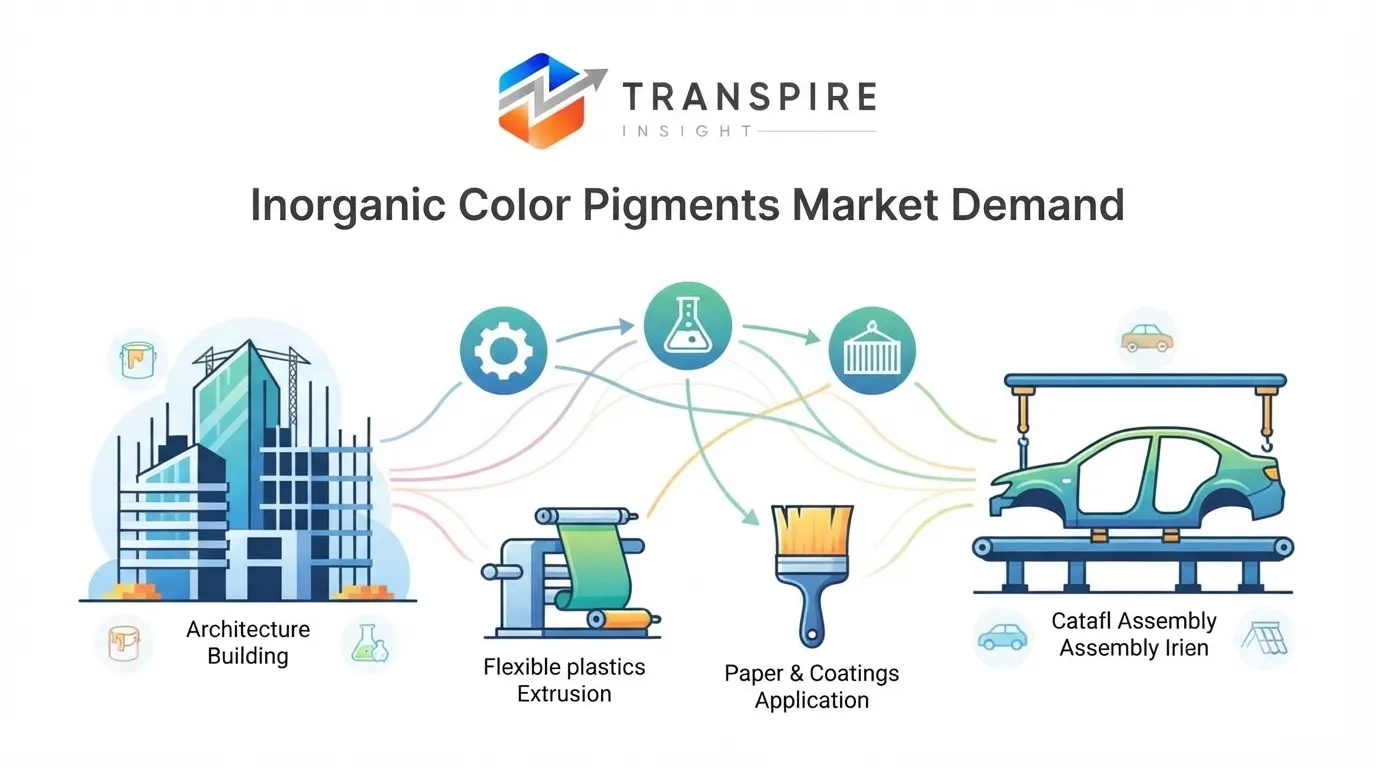
Description
According to a research report published by Transpire Insight, the inorganic color pigments market size is projected to grow from USD 4.21 billion in 2026 to USD 6.21 billion by 2035, at a CAGR of 3.15% during the forecast period 2027-2035. Market growth is being driven by a number of infrastructure projects, the increasing demand for heat-resistant industrial coatings, the growth of plastic production, and the increased use of long-lasting, weather-proof titanium dioxide and iron oxide pigments.
Introduction
The inorganic colour pigments market is a vital segment of the industrial coatings, plastics, construction, and inks industry. Inorganic pigments have high opacity, high heat resistance, lightfastness, chemical stability, and are capable of maintaining structural visual integrity under extreme environments. With a growing emphasis on sustainability and increasingly rigorous standards for various applications, key chemical companies are constantly creating and developing new sustainable, non-toxic products that are in alignment with the demands of contemporary building, automotive, and industrial use.
Recent Development News
January 2026: The U.S. EPA introduced major changes to the regulations for particulate risk assessments for titanium dioxide, carbon black, and iron oxide pigments that include new science-based batch processing requirements.
March 2026: Lanxess broadened its international outreach for eco-engineered iron oxide yellow pigments with improved lightfastness and lower carbon footprint processing.
Stay Ahead of Emerging Opportunities with Expert Market Insights by Transpire Insight
Transpire Insight provides comprehensive, data-driven market intelligence to support smarter business decisions. Our research is rooted in comprehensive analysis, authoritative predictions, and industry expertise, enabling organizations to make informed decisions in rapidly evolving markets. We provide in-depth analysis of market segmentation, competitive positioning, regional trends, and emerging investment opportunities in high-growth areas. We blend accuracy with actionable intelligence, helping companies uncover new growth avenues, strengthen strategic decision-making, and stay ahead in a dynamic market.
Inorganic Color Pigments Market Size & Statistics
The Market Size for Inorganic Color Pigments Was Estimated to be Worth USD 4.21 Billion in 2026.
The Market Size is Going to Expand at a CAGR of 3.15% between 2026 and 2035.
The Inorganic Color Pigments Market Size is anticipated to reach USD 6.21 Billion by 2035.
North America is projected to drive the highest demand during the forecast period, accounting for 32% of the inorganic color pigments market.
Asia-Pacific is projected to grow the fastest during the forecast period at a CAGR of 4.2% in the inorganic color pigments market.
Regional Growth and Demand Analysis by Transpire Insight
North America's leadership rests on its entrenched construction and automotive coatings base, where inorganic pigments such as iron oxide and titanium dioxide remain the default choice for architectural finishes, concrete coloring, and vehicle paint systems valued for weathering and UV resistance. But specialty players such as Shepherd Color and TOMATEC are moving this base into lucrative new space, with the development of more complicated inorganic pigment lines for EV battery bodies and outdoor applications, which require high-temperature resistance and chemical inertness.
Asia-Pacific's acceleration is driven by China's dominant pigment manufacturing base and India's cost advantage, reinforced by "Make in India" policy support that is turning the country into a growing export hub for pigment formulation. Demand for ceramics is growing in both markets, and cities in Germany and the Netherlands are driving demand for reflective coatings for urban cooling separately, showing how regulatory and climate agendas are changing consumption patterns regionally. Companies like DIC Corporation, Toyo Ink SC Holdings, Clariant, and Lanxess are investing in expanding production capacity and R&D expenditure in order to tap into this trend and begin to close the gap with North America over the next few years.
Top 15 Trends in the Inorganic Color Pigments Market
European manufacturers are steadily replacing chromium-based and lead-based colorants with REACH-compliant alternatives, driven by tightening regulations and consistently rising demand for sustainable, non-toxic pigment formulations.
Automotive OEMs increasingly specify complex inorganic pigments for EV battery housings, valuing their superior heat resistance, chemical inertness, and long-term color stability under harsh conditions.
Rapid urbanization across China and India is driving construction activity, boosting consumption of iron oxide and titanium dioxide pigments in architectural coatings and concrete flooring.
China holds the largest pigment manufacturing capacity in Asia-Pacific, while India's lower costs and "Make in India" support position it as a rising export hub.
Leading players such as Clariant and Lanxess are investing heavily in R&D to develop sustainable pigment formulations, further strengthening regulatory compliance and enhancing product quality.
Specialty manufacturers such as Shepherd Color and TOMATEC are developing custom pigment lines for battery housings, EV parts, and outdoor materials needing exceptional long-term durability.
List of Top 25 Companies Leading the Inorganic Color Pigments Market
1. The Chemours Company
World leader in titanium dioxide production via sulfate and chloride processes.
Founded: 2015 | HQ: Wilmington, Delaware, USA.
Why It Ranks: High output capacity and strong specialty chemicals market valuation.
Regional Dominance: Dominates North America while expanding heavily across major industrial hubs.
Product Line: Premium titanium dioxide white pigments engineered for protective and industrial coatings.
2. Venator Materials PLC
Premier manufacturer specializing in white pigments and high-performance color additives.
Founded: 2017 | HQ: Wynyard, United Kingdom.
Why It Ranks: Leading provider of titanium dioxide and functional additives in Europe.
Regional Dominance: Holds strong primary leadership across European, Middle Eastern, and African markets.
Product Line: Titanium dioxide formulations alongside specialty iron oxide and functional mineral additives.
3. Tronox Holdings plc
Fully integrated producer of titanium ore and titanium dioxide pigments globally.
Founded: 2012 | HQ: Stamford, Connecticut, USA.
Why It Ranks: Vertical integration guarantees consistent raw mineral sourcing and high output.
Regional Dominance: Maintains extensive supply chain dominance across and Asia-Pacific regional sectors.
Product Line: Titanium dioxide pigments, zircon mineral sands, and specialty titanium chemical products.
4. LANXESS AG
Operates world-scale iron oxide synthetic manufacturing facilities for industrial supply.
Founded: 2004 | HQ: Cologne, Germany.
Why It Ranks: Market-leading Synthetic Iron Oxide production volume for construction and coatings.
Regional Dominance: Commands major market presence throughout European and North American industrial hubs.
Product Line: Synthetic iron oxides and chromium oxides specialized for durable construction colorants.
5. Kronos Worldwide, Inc.
Operates international production facilities producing highly refined white titanium dioxide.
Founded: 1916 | HQ: Dallas, Texas, USA.
Why It Ranks: Century-long technical legacy in specialty white inorganic pigment chemistry.
Regional Dominance: Operates robust, long-standing distribution channels across North America and Western Europe.
Product Line: Highly refined titanium dioxide pigments tailored for papers, coatings, and plastics.
6. DIC Corporation
Diverse Japanese chemical giant with immense market dispersion holdings.
Founded: 1908 | HQ: Tokyo, Japan.
Why It Ranks: market share boosted through strategic colorant acquisition and scale.
Regional Dominance: Leads heavily across Asia-Pacific while maintaining extensive printing pigment reach.
Product Line: Inorganic colorants, complex inorganic color pigments, printing inks, and synthetic resins.
7. Heubach Group
Major pigment manufacturer offering comprehensive organic and inorganic solutions.
Founded: 1806 | HQ: Langelsheim, Germany.
Why It Ranks: Extensive historic portfolio spanning complex inorganic color pigments and anti-corrosives.
Regional Dominance: Deep historical stronghold in Europe with expanding operations across North America.
Product Line: Complex inorganic color pigments, chrome yellows, anti-corrosive pigments, and color preparations.
8. Sudarshan Chemical Industries Ltd.
India's largest chemical pigment manufacturer exporting color solutions globally.
Founded: 1951 | HQ: Pune, India.
Why It Ranks: Rapid international footprint expansion and competitive, cost-effective inorganic production.
Regional Dominance: Dominates Indian domestic markets while rapidly increasing exports into Asia-Pacific regions.
Product Line: Inorganic color pigments, effect pigments, specialty colorants, and custom pigment dispersions.
9. Cathay Industries (Dynacolor)
Leading international manufacturer specializing in high-grade synthetic iron oxide colors.
Founded: 1979 | HQ: Hong Kong / Global.
Why It Ranks: Globally recognized for eco-friendly iron oxide production for construction.
Regional Dominance: Exceptional market share across Asia-Pacific construction markets and North American coatings.
Product Line: Synthetic iron oxides, high-purity iron oxides, and custom construction coloring systems.
10. Cabot Corporation
Premier producer of specialized carbon black and reinforced performance colorants.
Founded: 1882 | HQ: Boston, Massachusetts, USA.
Why It Ranks: Dominates high-performance black inorganic colorants for plastics and coatings.
Regional Dominance: Strong manufacturing and commercial dominance centered across North America and Europe.
Product Line: Specialty carbon black, fumed silica, and performance inorganic black color formulations.
Conclusion
The inorganic color pigments market continues to be a key segment of the industrial manufacturing sector. The growing construction, automotive, and consumer plastics market in emerging markets is driving manufacturers to focus on environmentally friendly synthetic processes, sustainable supply chains, and better heat-resistant formulations. The sector shows long-term growth, with some of the most important innovations from leaders balancing function and environmental compliance.


Send us a brief description of your challenge and we'll get back to you within 24 hours.

 inquiry@transpireinsight.com
 APAC:+91 7666513636
 Address


