
Oct 30, 2026
By Transpire Insight
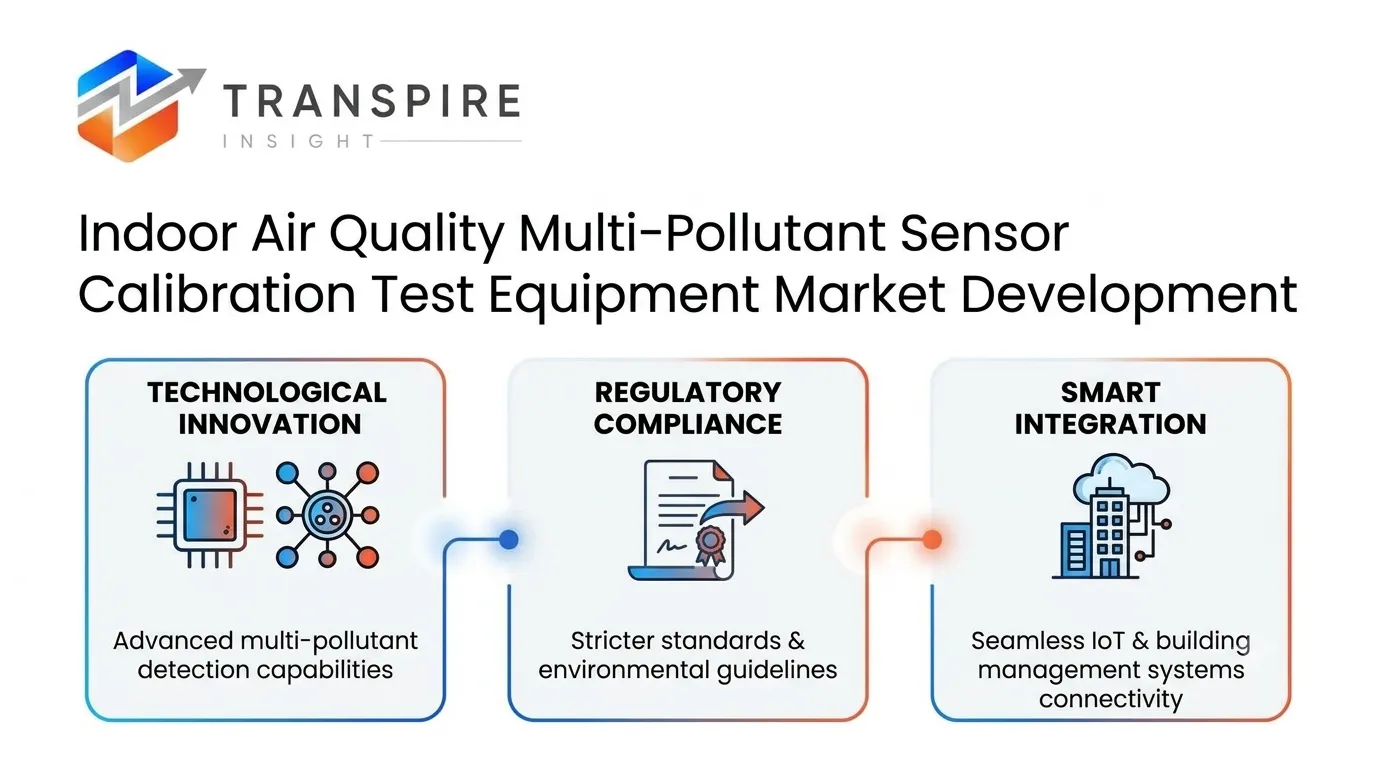
Description
According to a research report published by Transpire Insight, the indoor air quality multi-pollutant sensor calibration test equipment market size is projected to grow from USD 223.7 billion in 2026 to USD 346.8 billion by 2035, at a 17.34% CAGR during the 2027-2035 forecast period. Stringent indoor air safety regulations, rapid adoption of low-cost multi-pollutant IoT sensors, smart building HVAC integration, demand for high-precision sensor validation, and expanding occupational health standards globally.
Introduction
The Indoor Air Quality (IAQ) Multi-Pollutant Sensor Calibration Test Equipment Market provides essential diagnostic platforms, environmental chambers, and gas generation systems used to validate multi-gas and particulate sensors. As low-cost IAQ sensors proliferate across smart buildings, healthcare, and consumer electronics, maintaining measurement accuracy over time requires precise calibration. This market delivers high-precision test equipment, automated benches, and reference gas generators that ensure regulatory compliance, reduce baseline drift, and enable reliable indoor monitoring worldwide.
Recent Development News
March 2026: Market research updates highlighted a major surge in continuous multi-pollutant sensor calibration demand, driven by new commercial building ventilation mandates and automated multi-gas validation platform deployments.
April 2026: Leading analytical instrument providers introduced next-generation AI-enabled portable calibration systems, enabling real-time zero-and-span drift corrections for multi-parameter indoor air sensors on automated production lines.
Stay Ahead of Emerging Opportunities with Expert Market Insights by Transpire Insight
Transpire Insight provides comprehensive, data-driven market intelligence to support smarter business decisions. Our research is rooted in comprehensive analysis, authoritative predictions, and industry expertise, enabling organizations to make informed decisions in rapidly evolving markets. We provide in-depth analysis of market segmentation, competitive positioning, regional trends, and emerging investment opportunities in high-growth areas. We blend accuracy with actionable intelligence, empowering companies to uncover new avenues for growth, bolster strategic decision-making, and stay ahead in a dynamic market.
Indoor Air Quality Multi-Pollutant Sensor Calibration Test Equipment Market Size & Statistics
The Market Size for Indoor Air Quality Multi-Pollutant Sensor Calibration Test Equipment Was Estimated to be Worth USD 223.7 Billion in 2026.
The Market Size is Going to Expand at a CAGR of 17.34% between 2026 and 2035.
The Indoor Air Quality Multi-Pollutant Sensor Calibration Test Equipment Market Size is anticipated to reach USD 346.8 Billion by 2035.
North America is projected to drive the highest demand during the forecast period, accounting for 36% of the indoor air quality multi-pollutant sensor calibration test equipment market.
Asia Pacific is projected to grow the fastest during the forecast period at a CAGR of 7.3% in the indoor air quality multi-pollutant sensor calibration test equipment market.
Regional Growth and Demand Analysis by Transpire Insight
North America remains the anchor of demand because its testing ecosystem is mature and standards-driven. In the United States, the AQ-SPEC validation ecosystem sets the performance baseline for commercial sensor testing, and laboratories are steadily replacing legacy hardware with automated chambers that can run long-duration multi-pollutant evaluations. Certification frameworks such as LEED v5 and WELL require concurrent monitoring of particulate matter and volatile organic compounds, so sensor manufacturers need traceable calibration records to win commercial building projects. The National Renewable Energy Laboratory’s work on laboratory test methods for low-cost indoor air quality sensors has also pushed independent labs toward formal validation setups. Canada adds demand through northern test centers focused on cold-weather HVAC integration, and suppliers such as TSI and 2B Technologies serve this installed base.
Asia Pacific is growing fastest because production capacity is being built or expanded rather than simply replaced. India leads at a 7.3% CAGR as local sensor assembly and commercial building digitization expand from a still-localized base, with benchtop calibrators seeing strong uptake for basic quality control of high-volume, low-cost air quality monitors. China follows at 6.9%, where automated, rack-mounted calibration systems are built into large manufacturing lines to run baseline and span checks on thousands of consumer-grade sensors every day. South Korea is estimated at 6.6%, as smart-home and semiconductor electronics makers use complex chambers to refine compensation algorithms before launch. Japan, at 5.5%, is driven mainly by replacement of installed infrastructure, with HORIBA and Kanomax among the regional suppliers. Vietnam is also gaining prominence as semiconductor assembly and export-oriented industrial parks expand.
Top 15 Trends in the Indoor Air Quality Multi-Pollutant Sensor Calibration Test Equipment Market
Laboratories are moving beyond isolated carbon dioxide checks toward chambers that expose sensors to several pollutants together, revealing cross-sensitivity flaws that single-gas testing routinely misses.
Automated calibrators run unattended multi-day scripts covering baseline, span, and cross-interference checks, extending testing capacity beyond staffed shifts and eliminating manual adjustments that compromise datasets.
Building codes increasingly require simultaneous validation of volatile organic compounds and particulate matter, pushing laboratories toward hybrid systems that generate both gases and aerosols together.
LEED v5 and WELL frameworks demand concurrent monitoring of particulate matter and volatile organic compounds, so sensor manufacturers need traceable calibration documentation for premium projects.
Reactive gases like nitrogen dioxide and formaldehyde degrade in stored cylinders, so laboratories add permeation ovens that generate traceable concentrations on demand, avoiding invalid runs.
Asian manufacturers embed automated, rack-mounted calibration systems into assembly lines, running baseline and span checks on thousands of consumer-grade sensors daily to protect export quality.
List of Top 25 Companies Leading the Indoor Air Quality Multi-Pollutant Sensor Calibration Test Equipment Market
1. TSI Incorporated
Manufactures world-class aerosol measurement and precision gas calibration testing instruments.
Founded: 1961 | HQ: Shoreview, Minnesota, USA.
Why It Ranks: Market leader in particle generator and precision fluid flow calibration technology.
Regional Dominance: North America, Europe, Asia-Pacific.
Product Line: Certifier Flow Analyzers, Automated Filter Testers, Precision Aerosol Generators.
2. HORIBA, Ltd.
Delivers advanced gas division, dilution, and environmental multi-pollutant calibration systems globally.
Founded: 1953 | HQ: Kyoto, Japan.
Why It Ranks: Unmatched analytical accuracy in multi-gas reference standards and automated calibrators.
Regional Dominance: Asia-Pacific, Japan, Europe, North America.
Product Line: APMC-370 Ambient Gas Calibrators, Gas Dividers, Zero Air Generators.
3. Teledyne API (Teledyne Technologies)
Engineers high-performance reference gas calibrators and zero air generators for environmental applications.
Founded: 1988 | HQ: San Diego, California, USA.
Why It Ranks: Industry standard for precision multi-gas dilution and ozone calibration equipment.
Regional Dominance: North America, Europe, Asia-Pacific.
Product Line: T700 Dynamic Gas Calibrators, T701 Zero Air Generators, Multi-Gas Systems.
4. Thermo Fisher Scientific Inc.
Provides comprehensive laboratory analytical instruments and specialized air sensor calibration benches.
Founded: 1956 | HQ: Waltham, Massachusetts, USA.
Why It Ranks: Massive scale offering end-to-end multi-pollutant reference and calibration solutions.
Regional Dominance: (North America, Europe, Asia-Pacific).
Product Line: Model 146i Multi-Gas Calibrator, Model 111 Zero Air Supply, Test Chambers.
5. Sabio Instruments (Envitech Ltd.)
Specializes in precision gas calibration systems designed for multi-parameter environmental monitors.
Founded: 1998 | HQ: Round Rock, Texas, USA.
Why It Ranks: High reliability in automated multi-gas dilution and permeation tube calibration.
Regional Dominance: North America, Europe.
Product Line: Model 4010 Gas Dilution Calibrator, Portable Gas Calibrators, Permeation Ovens.
6. Palas GmbH
Pioneers high-precision aerosol generation, conditioning, and particle sensor calibration equipment solutions.
Founded: 1983 | HQ: Karlsruhe, Germany.
Why It Ranks: Recognized leader in particle size distribution and aerosol generator calibration systems.
Regional Dominance: Europe, Asia-Pacific, North America.
Product Line: PAG 1000 Particle Generator, Aerosol Spectrometers, Calibration Test Rigs.
7. Aerodyne Research, Inc.
Develops state-of-the-art analytical calibration systems for volatile organic compounds and fine particulates.
Founded: 1970 | HQ: Billerica, Massachusetts, USA.
Why It Ranks: World leader in specialized aerosol mass spectrometer calibration and gas generation.
Regional Dominance: North America, Europe.
Product Line: Aerosol Generation Systems, VOC Calibration Sources, Time-of-Flight Calibration Units.
8. Environics, Inc.
Designs automated computer-controlled gas blending and dilution systems for high-accuracy sensor testing.
Founded: 1986 | HQ: Tolland, Connecticut, USA.
Why It Ranks: Premium custom engineering for multi-pollutant concentration gas mixing and calibration.
Regional Dominance: North America, Europe, Asia-Pacific.
Product Line: Series 4000 Multi-Component Gas Mixing System, Series 6103 Ozone Calibrator.
9. Aeroqual Limited
Develops advanced integrated sensor testing benches, reference systems, and smart calibration modules.
Founded: 2001 | HQ: Auckland, New Zealand.
Why It Ranks: Innovator in automated low-cost air quality sensor validation and calibration tools.
Regional Dominance: Asia-Pacific, North America, Europe.
Product Line: Smart Calibration Accessories, Air Calibrator Systems, Multi-Gas Validation Kits.
10. LNI Swissgas S.A.
Engineers premium gas generators and dynamic gas calibration systems for analytical applications.
Founded: 1984 | HQ: Versoix, Switzerland.
Why It Ranks: High-precision Swiss engineering for zero air generators and multi-gas calibrators.
Regional Dominance: Europe, Middle East, North America.
Product Line: Sonimix 2106 Gas Calibrator, Sonimix 7000 Zero Air Generator, Dilution Systems.
Conclusion
The Indoor Air Quality Multi-Pollutant Sensor Calibration Test Equipment Market is essential for ensuring data integrity across air monitoring networks. As low-cost multi-gas sensors expand into smart buildings, automotive cabins, and industrial facilities, high-precision calibration hardware guarantees regulatory compliance and operational accuracy. Led by analytical instrument pioneers, the market will continue advancing through automated gas dilution, AI-driven drift compensation, and high-throughput production testing platforms.


Send us a brief description of your challenge and we'll get back to you within 24 hours.

 inquiry@transpireinsight.com
 APAC:+91 7666513636
 Address


