
Oct 09, 2026
By Transpire Insight
Description
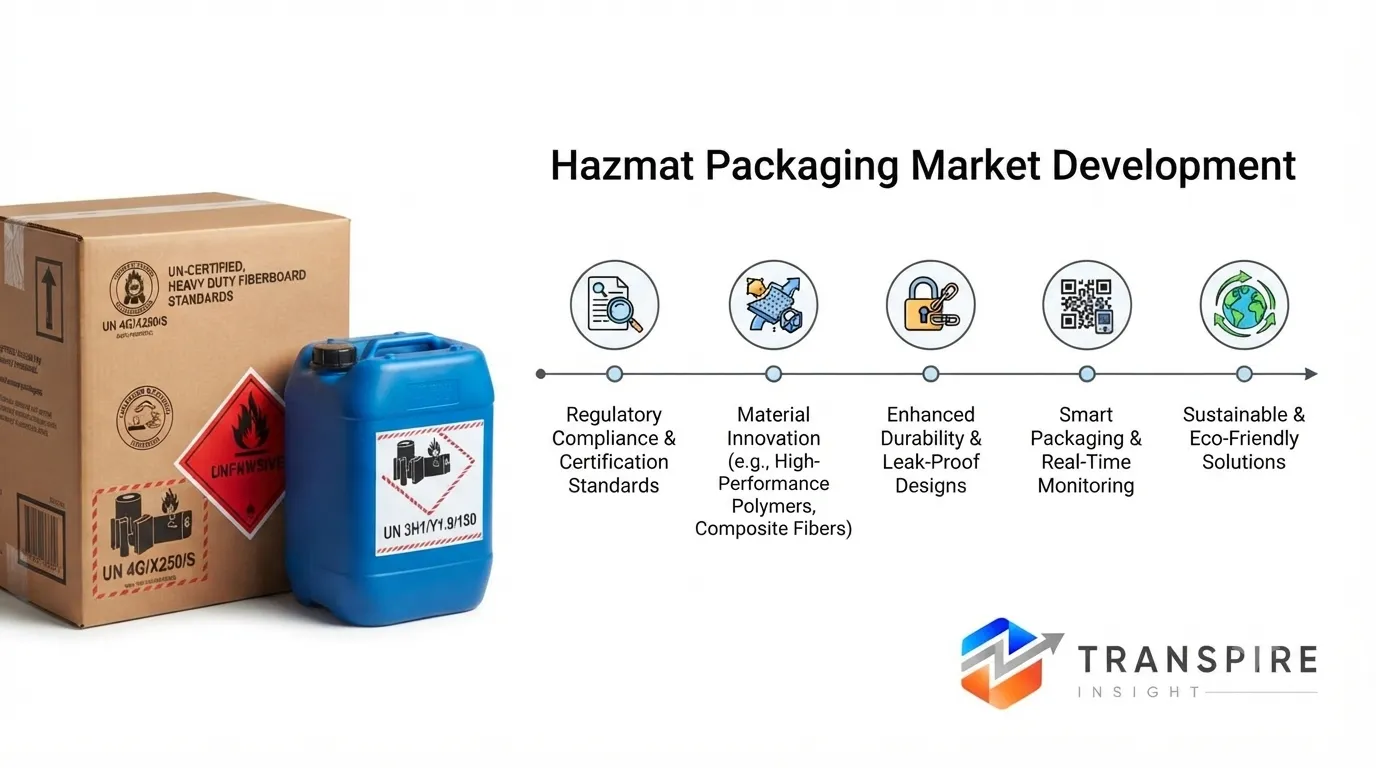
According to a research report published by Transpire Insight, the hazmat packaging market size is projected to grow from USD 13.3 billion in 2026 to USD 24.12 billion by 2035, at a CAGR of 5.86% during the forecast period 2027-2035. The market is being supported by strict international dangerous goods regulations, increasing trade of chemicals and pharmaceuticals, safety-oriented logistics, and the rising demand for UN-certified sustainable industrial packaging.
Introduction
The hazmat packaging market is an important sector, which has the primary responsibility to ensure the safe containment, storage, and transportation of hazardous chemicals, pharmaceuticals, biological materials, and energy storage products. This sector is governed by strict regulations and employs specialized drums, rigid IBCs, pails and boxes that can withstand the harshest thermal, chemical, and physical stresses. The ongoing structural and material innovations are stimulated by rapid industrialization, growing chemical trade, and increasingly stringent safety compliance requirements.
Recent Development News
June 2026: Regulatory authorities revised transport compliance requirements for lithium-ion battery logistics, driving a need for high-barrier, thermal-insulating secondary hazmat packaging.
September 2026: Strategic Packaging Insights announced that the world's use of UN-certified circular polymer drums and smart tracking sensors in hazardous waste containers is on the rise.
Stay Ahead of Emerging Opportunities with Expert Market Insights by Transpire Insight
Transpire Insight provides comprehensive, data-driven market intelligence to support smarter business decisions. Our research is rooted in comprehensive analysis, authoritative predictions, and industry expertise, enabling organizations to make informed decisions in rapidly evolving markets. We provide in-depth analysis of market segmentation, competitive positioning, regional trends, and emerging investment opportunities in high-growth areas. We blend accuracy with actionable intelligence, helping companies uncover new growth avenues, strengthen strategic decision-making, and stay ahead in a dynamic market.
Hazmat Packaging Market Size & Statistics
The Market Size for Hazmat Packaging Was Estimated to be Worth USD 13.3 Billion in 2026.
The Market Size is Going to Expand at a CAGR of 5.86% between 2026 and 2035.
The Hazmat Packaging Market Size is anticipated to reach USD 24.12 Billion by 2035.
North America is projected to drive the highest demand during the forecast period, accounting for 41.9% of the hazmat packaging market.
Asia-Pacific is projected to grow the fastest during the forecast period at a CAGR of 9% in the hazmat packaging market.
Regional Growth and Demand Analysis by Transpire Insight
North America's lead rests on its dense base of chemical, pharmaceutical, and oil & gas manufacturers operating under strict OSHA, DOT/PHMSA, and international shipping mandates that make certified hazmat packaging non-negotiable. Consolidation is reshaping the supplier landscape here: Pipeline Packaging's acquisition of Houston-based HAZMATPAC expanded its rigid-container and UN-certification footprint, while Greif's earlier purchase of Lee Container broadened its blow-molded drum portfolio across agriculture, specialty chemicals, and lubricants. Established players like Labelmaster's DGeo division continue pushing regulatory-driven innovation, including packaging engineered to contain lithium battery fires and maintain safe toxic-gas levels for first responders, underscoring how compliance pressure, not just volume, keeps North America ahead.
Asia-Pacific's momentum is being built on a different foundation: rapid industrialization and chemical, pharmaceutical, and electronics manufacturing scaling sharply across China, India, and Vietnam. The region was a standout with two Indian startups, the eco-packaging company Bambrew raised USD 10.3M to scale up its line of plant-based alternatives, and Movopack, another Indian startup, received USD 2.5M to scale up sustainable e-commerce packaging; both were investing in greener hazmat-adjacent solutions. As the urban population grows and the regional shipping-compliance rules become tougher, local manufacturers are increasingly being forced to manufacture the same certified drum, IBC, and flexitank formats that are the norm in North America, making Asia-Pacific volume equal to North America in the next ten years or so.
Top 15 Trends in the Hazmat Packaging Market
Rise of eco-friendly, recyclable hazmat packaging materials
Manufacturers are replacing conventional plastics with recyclable, bio-based materials as regulators and customers push for sustainability, cutting environmental impact without compromising containment safety or compliance.
Smart labels enabling real-time hazmat shipment tracking
FID and QR-enabled smart labels let shippers track hazmat consignments in real time, improving chain-of-custody visibility, documentation accuracy, and incident response across supply chains.
Lithium battery packaging demand surging with EVs
Booming electric-vehicle and consumer-electronics sales are driving demand for UN-certified lithium battery packaging designed to contain thermal runaway, fire risk, and short-circuit hazards during transit.
Stricter DOT, IATA, IMDG regulatory enforcement
Regulators worldwide are tightening DOT, IATA, and IMDG dangerous-goods enforcement, forcing packaging makers to upgrade certification, testing, and labeling standards or risk rejections at customs.
Reusable and returnable packaging systems gaining traction
Chemical and logistics firms are adopting reusable drums, IBCs, and pallet systems to cut costs and waste, supporting circular-economy goals while meeting hazmat containment standards.
Digitalization of dangerous goods documentation and compliance
Companies are digitizing dangerous-goods declarations, safety data sheets, and shipping documentation, replacing manual paperwork with cloud-based compliance software that reduces errors and speeds cross-border clearance.
List of Top 25 Companies Leading the Hazmat Packaging Market
1. Greif, Inc.
Industry giant providing complete industrial containment and UN-certified hazmat solutions globally.
Founded: 1877 | HQ: Delaware, Ohio, USA.
Why It Ranks: Unmatched manufacturing presence and extensive UN-tested industrial drum product portfolio.
Regional Dominance: North America
Product Line: Steel drums, fiber drums, intermediate bulk containers (IBCs), and plastic pails.
2. Mauser Packaging Solutions
World leader in reconditioning services and heavy-duty industrial hazmat packaging production.
Founded: 1896 | HQ: Oak Brook, Illinois, USA.
Why It Ranks: Pioneer in circular economy reconditioning and heavy-duty UN-approved plastic containers.
Regional Dominance: Europe and North America
Product Line: Composite IBCs, plastic drums, reconditioned containers, and steel pails.
3. SCHÜTZ GmbH & Co. KGaA
innovator in dangerous liquid logistics and UN-rated Intermediate Bulk Containers.
Founded: 1958 | HQ: Selters, Germany.
Why It Ranks: Dominates the bulk liquid dangerous goods transport segment through innovation.
Regional Dominance: Europe
Product Line: Ecobulk IBCs, plastic drums, and specialized hazard barrier inner bottles.
4. Berry Inc.
manufacturer offering innovative UN-certified recycled plastic containers for dangerous goods.
Founded: 1967 | HQ: Evansville, Indiana, USA.
Why It Ranks: High polymer processing capability paired with UN compliance for hazardous materials.
Regional Dominance: (North America & Europe)
Product Line: UN jerrycans, heavy-duty pails, barrier bottles, and hazardous chemical containers.
5. Hoover CS
Leading provider of sustainable chemical packaging and reusable stainless steel hazmat containers.
Founded: 1911 | HQ: Houston, Texas, USA.
Why It Ranks: Unrivaled specialist in reusable stainless steel IBCs for harsh chemical transport.
Regional Dominance: North America
Product Line: Stainless steel IBCs, catalyst bins, and ISO tank containers.
6. THIELMANN
authority in high-grade stainless steel container solutions for dangerous liquids.
Founded: 1952 | HQ: Zug, Switzerland.
Why It Ranks: Premium engineering standards for chemical, nuclear, and high-hazard material transport.
Regional Dominance: Europe
Product Line: Stainless steel pressure vessels, hazardous liquid drums, and portable tanks.
7. Eagle Manufacturing Company
Premier provider of industrial safety, secondary spill containment, and hazmat storage.
Founded: 1894 | HQ: Wellsburg, West Virginia, USA.
Why It Ranks: Gold standard brand for occupational safety, compliance, and hazmat spill containment.
Regional Dominance: North America
Product Line: Safety cans, overpack drums, hazardous waste cans, and spill pallets.
8. Balmer Lawrie & Co. Ltd.
State-owned enterprise holding significant market share in industrial barrel hazmat packaging.
Founded: 1867 | HQ: Kolkata, West Bengal, India.
Why It Ranks: Key supplier to Asia's chemical, lubricant, and dangerous petroleum transportation sectors.
Regional Dominance: Asia-Pacific
Product Line: Plain steel drums, internally coated barrels, and hazardous chemical pails.
9. Air Sea Containers, Inc.
Dedicated leader in regulatory dangerous goods packaging systems and shipping supplies.
Founded: 1991 | HQ: Miami, Florida, USA.
Why It Ranks: Specialized expert in compliant multi-component dangerous goods packaging kits for logistics.
Regional Dominance: North America
Product Line: UN 4G/4GV boxes, infectious substance packaging, thermal shippers, and jerricans.
10. BWAY Corporation
Major manufacturer of rigid metal and plastic dangerous goods transport containers.
Founded: 1875 | HQ: Atlanta, Georgia, USA.
Why It Ranks: Core supplier of UN-rated rigid metal cans and heavy-duty pails.
Regional Dominance: North America
Product Line: UN-rated steel pails, tight-head plastic pails, and paint containers.
Conclusion
The hazmat packaging market continues to play a crucial role in safeguarding the safety of goods transported internationally and ensuring the security and integrity of the supply chain. With the increasingly demanding international regulatory environment and the value of chemicals, market leaders are constantly taking the next step in UN-approved engineering, intelligent monitoring, and environmentally friendly materials. In an age of increasing trade, the top 25 companies will drive the world's move toward safer, more environmentally friendly hazardous transport solutions.


Send us a brief description of your challenge and we'll get back to you within 24 hours.

 inquiry@transpireinsight.com
 APAC:+91 7666513636
 Address


