
Oct 02, 2026
By Transpire Insight
Description
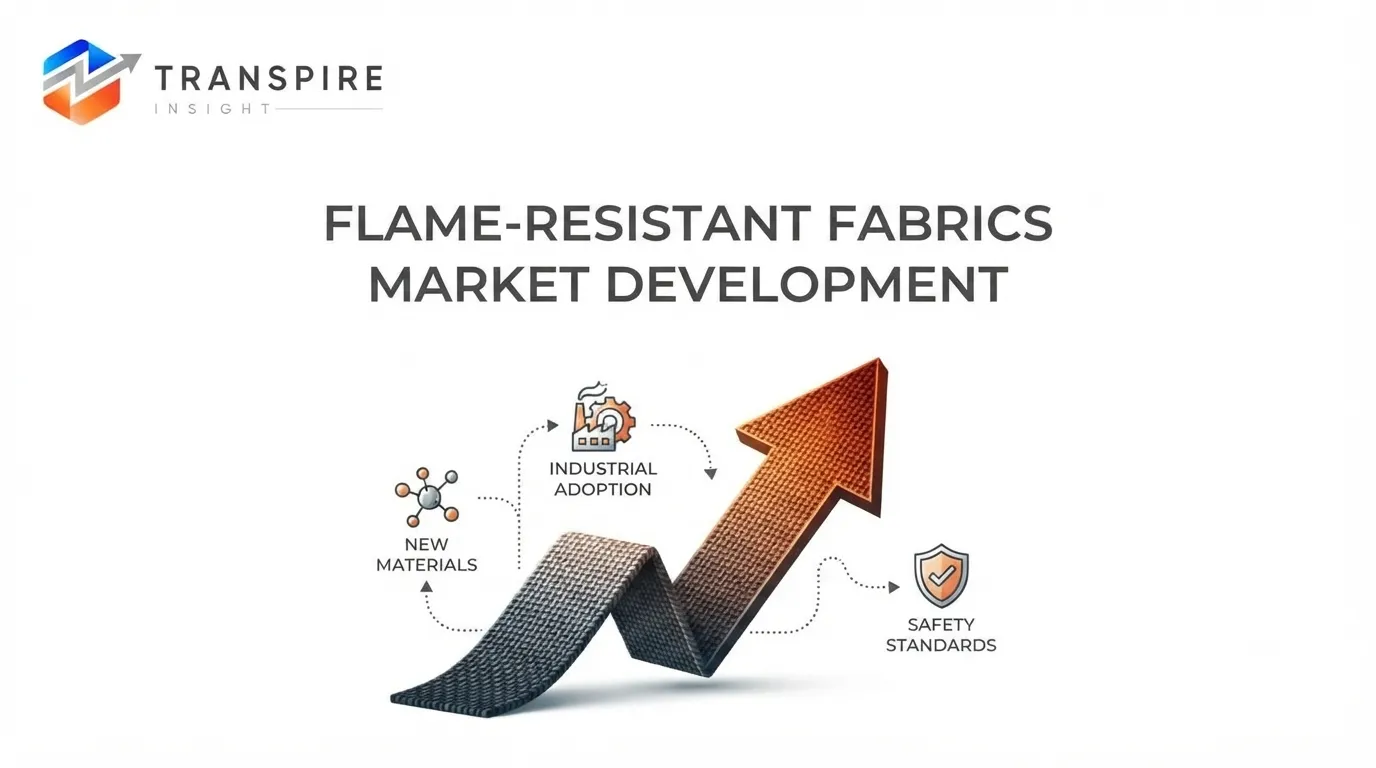
According to a research report published by Transpire Insight, the flame-resistant fabrics market size is projected to grow from USD 5.85 billion in 2026 to USD 8.19 billion by 2035, at a CAGR of 6.33% during the forecast period 2027-2035. The key factors behind market growth are stringent occupational safety regulations, the growing energy industry and the expanding manufacturing sector, as well as the desire for multi-hazard protection in lightweight, high-comfort protective wear.
Introduction
Fabrics that are engineered to resist flames, prevent the spread of fire, and self-extinguish when exposed to a flame or direct heat are referred to as Flame-resistant (FR) fabrics. The textiles are utilised in a wide variety of high-risk applications, such as the oil & gas, defense, chemical processing, and utility sectors, where they offer protection against severe thermal burn injuries. FR fabrics are regarded as an essential part of the standards for industrial safety, protective workwear, and structural use, available as synthetic fibers with inherent flame resistance or as natural fibers that can be treated with flame-resistant (FR) chemicals.
Recent Development News
March 2026: The leading protective textile manufacturers introduced next-generation inherently flame-resistant stretch textiles, while maintaining the thermal protection level and providing multi-directional mobility.
January 2026: safety apparel manufacturers increased production capacity for treated FR fabrics that are more environmentally friendly and do not contain halogens to meet new regulations in North America and Europe.
Stay Ahead of Emerging Opportunities with Expert Market Insights by Transpire Insight
Transpire Insight provides comprehensive, data-driven market intelligence to support smarter business decisions. Our research is rooted in comprehensive analysis, authoritative predictions, and industry expertise, enabling organizations to make informed decisions in rapidly evolving markets. We provide in-depth analysis of market segmentation, competitive positioning, regional trends, and emerging investment opportunities in high-growth areas. We blend accuracy with actionable intelligence, helping companies uncover new growth avenues, strengthen strategic decision-making, and stay ahead in a dynamic market.
Flame-Resistant Fabrics Market Size & Statistics
The Market Size for Flame-Resistant Fabrics Was Estimated to be Worth USD 5.85 Billion in 2026.
The Market Size is Going to Expand at a CAGR of 6.33% between 2026 and 2035.
The Flame-Resistant Fabrics Market Size is anticipated to reach USD 8.19 Billion by 2035.
Asia-Pacific is projected to drive the highest demand during the forecast period, accounting for 46.20% of the flame-resistant fabrics market.
Asia-Pacific is projected to grow the fastest during the forecast period at a CAGR of 10.36% in the flame-resistant fabrics market.
Regional Growth and Demand Analysis by Transpire Insight
Asia Pacific is the leading region for flame-resistant fabrics, with a robust manufacturing ecosystem across both China and India and Southeast Asian countries where demand for protective textiles is growing in the oil and gas, construction, and electrical utility industries due to increasing industrial safety regulations and rapid infrastructure development. Investors' confidence in the longer term consumption trend was reinforced by India's Arvind Ltd, which raised $50 million directly to increase the production capacity of fire-retardant fabric. In fact, China and India are still the fastest-growing national markets in the area, despite stronger enforcement of workplace-safety laws, and a growing body of manufacturing jobs. Regional suppliers are increasing capacity both for the original and chemically treated fabric types, with local governments formalising codes for fire safety in factories and public infrastructure, thus solidifying Asia Pacific as the biggest and fastest-growing region.
Top 15 Trends in the Flame-Resistant Fabrics Market
Inherently flame-resistant fibers, where resistance is built into the fiber structure rather than chemically applied, are gaining preference for their durability and long-term protective performance.
Manufacturers are developing PFAS-free flame-retardant finishes that meet strict fire-safety standards while avoiding the environmental and health risks linked to commonly used fluorinated chemical treatments.
Automakers are increasing use of flame-resistant fabrics in seating, wiring insulation, and cabin interiors, driven by stricter vehicle fire-safety codes and growing electric-vehicle battery-related concerns.
Industries and workers increasingly demand tailored flame-resistant garments built for specific job roles, incorporating reinforced panels, ergonomic cuts, and functional pockets alongside certified fire protection.
Suppliers such as Rivertex Technical Fabrics are launching recyclable, non-PVC flame-retardant fabrics, responding to buyer pressure for sustainable options that still meet strict certification requirements.
Following litigation alleging inherent flame-resistant garments failed after repeated wash cycles, buyers now demand audited, real-world durability data rather than relying solely on laboratory certifications.
List of Top 25 Companies Leading the Flame-Resistant Fabrics Market
Innovates synthetic aramid fibers like Nomex and Kevlar for high-heat protection.
Founded: 1802 | HQ: Wilmington, Delaware, USA.
Why It Ranks: Commands the market through pioneering, world-renowned aramid protection brand offerings.
Regional Dominance: Leads globally, with heavy distribution presence throughout North America and Europe.
Product Line: Nomex inherent fabrics, Kevlar thermal materials, and protective utility weaves.
Produces high-tensile para-aramids and meta-aramids tailored for extreme firefighting conditions.
Founded: 1918 | HQ: Tokyo, Japan.
Why It Ranks: Maintains structural dominance in advanced high-performance protective fiber chemical technologies.
Regional Dominance: Holds significant operational share across Asia-Pacific and European industrial markets.
Product Line: Teijinconex meta-aramid fibers, Twaron para-aramid textiles, and Technora yarns.
Engineers woven safety textiles for defense, industrial workwear, and emergency response.
Founded: 1925 | HQ: Nijverdal, Netherlands.
Why It Ranks: Sets standards for multi-hazard industrial protective apparel fabric compositions.
Regional Dominance: Strongly dominant across Europe and the North American utility sector.
Product Line: Tecasafe Plus, Defender M military fabrics, and industrial FR blends.
Pioneers durable flame-retardant treated cotton blends for industrial protective safety apparel.
Founded: 1865 | HQ: Spartanburg, South Carolina, USA.
Why It Ranks: Leading innovator in proprietary flame-retardant finishing chemical process treatments.
Regional Dominance: Maintains high market penetration throughout North American manufacturing sectors.
Product Line: Westex UltraSoft, Westex DH, and heavy-duty flame-retardant protective textiles.
Manufactures synthetic modacrylic fibers extensively blended into inherent flame-resistant textiles.
Founded: 1949 | HQ: Osaka, Japan.
Why It Ranks: Primary supplier of high-quality modacrylic fibers essential for soft FR textiles.
Regional Dominance: Dominates raw fiber export markets across Asia-Pacific and regions.
Product Line: Kanecaron modacrylic fibers, Protex inherent flame-retardant fibers, and non-woven mats.
Supplies sustainable wood-based cellulosic fibers with inherent flame-retardant protective performance characteristics.
Founded: 1938 | HQ: Lenzing, Austria.
Why It Ranks: Leads eco-conscious FR textiles market through sustainable cellulosic fiber technologies.
Regional Dominance: Highly established throughout Western Europe and expanding into North America.
Product Line: TENCEL Protective, Lenzing FR inherent fibers, and sustainable blended yarns.
Produces high-performance polybenzimidazole fibers that withstand extreme heat without melting.
Founded: 1983 | HQ: Charlotte, North Carolina, USA.
Why It Ranks: Unmatched brand reputation for high-temperature outer shell firefighter protective fabrics.
Regional Dominance: Strongest market footprint in North American and European fire services.
Product Line: PBI Matrix, PBI Gold, and heat-resistant thermal barrier outer fabrics.
Delivers heavy-duty flame-retardant operational workwear fabrics for heavy manufacturing and utility work.
Founded: 1891 | HQ: Adlington, United Kingdom
Why It Ranks: Premier European manufacturer delivering certified flame-resistant workwear fabrics at scale.
Regional Dominance: Commands significant market share in the UK and the European Continent.
Product Line: Flametough, Flamestat anti-static FR series, and lightweight protective cotton blends.
Develops specialized flame-retardant chemical formulations for durable treated industrial textile applications.
Founded: 1863 | HQ: Brussels, Belgium.
Why It Ranks: Crucial supplier of chemical precursors used in flame-retardant textile treatment.
Regional Dominance: Widespread presence across Western Europe, North America, and South America.
Product Line: PROBAN flame-retardant cotton treatments, specialized polymer finishes, and chemical agents.
Provides advanced textile effect chemicals that deliver fire resistance to diverse fabrics.
Founded: 1970 | HQ: The Woodlands, Texas, USA.
Why It Ranks: Essential player in flame-retardant chemical additives and specialty finish applications.
Regional Dominance: distribution network spanning the Americas, Europe, and Asia-Pacific regions.
Product Line: Pyrovatex durable flame-retardant finishes and textile specialty finishing agents.
Conclusion
Overall, the flame-resistant fabrics market continues to be a significant segment of the industrial safety industry, with ongoing advancements in fabric technology and compliance standards. Protection levels and wearer comfort continue to increase significantly as key manufacturers look to lightweight, naturally resistant, and eco-friendly textiles. The market for flame-resistant textiles is expected to continue to grow across the energy, defense, and manufacturing sectors, ensuring their continued importance for protecting the safety of workers around the world from the most serious thermal risks.


Send us a brief description of your challenge and we'll get back to you within 24 hours.

 [email protected]
 APAC:+91 7666513636
 Address


