
Oct 28, 2026
By Transpire Insight
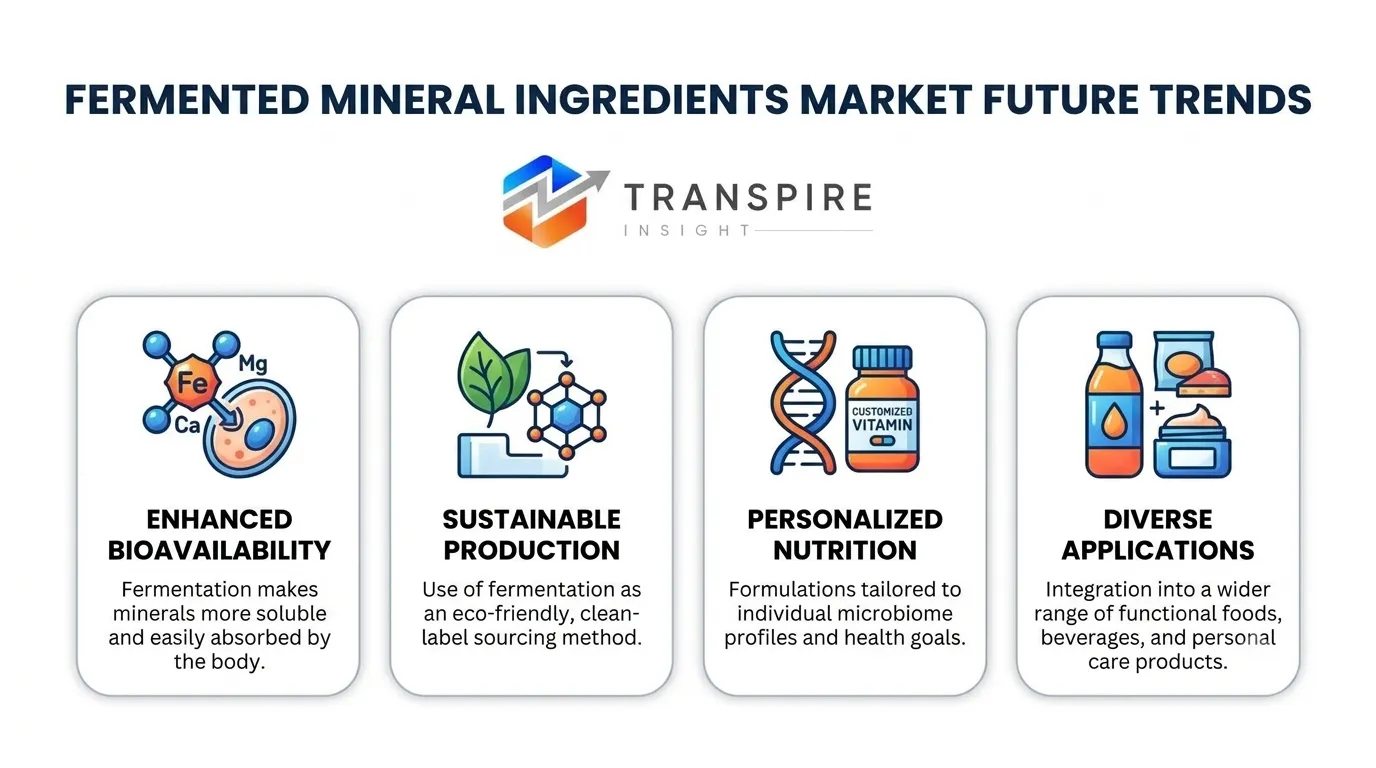
Description
According to a research report published by Transpire Insight, the fermented mineral ingredients market size is projected to grow from USD 1.47 billion in 2026 to USD 2.34 billion by 2035, at a 6.95% CAGR during the 2027-2035 forecast period. Surging consumer demand for high-bioavailability "food-state" nutrients, rising clinical awareness of gastrointestinal-friendly minerals, expanding clean-label dietary supplement trends, and advancements in bio-fermentation technology drive the fermented mineral ingredients market.
Introduction
The fermented mineral ingredients market marks a major shift from synthetic inorganic mineral salts to highly biocompatible, microbe-derived nutrients. Using specialized bioprocesses such as yeast and bacterial fermentation, these ingredients culture essential minerals, including zinc, iron, selenium, and magnesium, into cellular organic matrices. This process enhances gastrointestinal absorption while eliminating digestive discomfort, establishing fermented minerals as pivotal raw materials across the nutraceutical, functional food, and pharmaceutical industries.
Recent Development News
July 2026: fermentation innovator Lallemand completed the strategic acquisition of U.S.-based enzyme and probiotic producer BIO-CAT, expanding its biomanufacturing network across Virginia and Minnesota to scale fermented nutrient operations.
March 2026: Future Market Insights released an industry analysis highlighting that yeast-based fermented minerals reached a major market adoption threshold, commanding 52.1% of market share due to established safety profiles and scalable bioreactor capacities.
Stay Ahead of Emerging Opportunities with Expert Market Insights by Transpire Insight
Transpire Insight provides comprehensive, data-driven market intelligence to support smarter business decisions. Our research is rooted in comprehensive analysis, authoritative predictions, and industry expertise, enabling organizations to make informed decisions in rapidly evolving markets. We provide in-depth analysis of market segmentation, competitive positioning, regional trends, and emerging investment opportunities in high-growth areas. We blend accuracy with actionable intelligence, helping companies uncover new growth avenues, strengthen strategic decision-making, and stay ahead in a dynamic market.
Fermented Mineral Ingredients Market Size & Statistics
The Market Size for Fermented Mineral Ingredients Was Estimated to be Worth USD 1.47 Billion in 2026.
The Market Size is Going to Expand at a CAGR of 6.95% between 2026 and 2035.
The Fermented Mineral Ingredients Market Size is anticipated to reach USD 2.34 Billion by 2035.
North America is projected to drive the highest demand during the forecast period, accounting for 34% of the fermented mineral Ingredients market.
Asia-Pacific is projected to grow the fastest during the forecast period at a CAGR of 8.4% in the fermented mineral Ingredients market.
Regional Growth and Demand Analysis by Transpire Insight
North America remains the leading regional market for fermented mineral ingredients, supported by high consumer awareness, an advanced nutritional supplement industry, and strong appetite for premium health products. Demand in the United States is shaped by the hyper-competitive direct-to-consumer supplement sector, where brands reformulate quickly and look for gentler, better-absorbed minerals to cut customer churn caused by nausea from conventional salts. The regional supply base is anchored by fermentation specialists such as Alltech in the United States and Lallemand in Canada, which own proprietary yeast strains and large bioreactor capacity.
Asia-Pacific is gaining ground fastest as local manufacturers and health systems adopt fermented minerals at scale. In India, upgraded maternal anemia protocols are replacing harsh iron oxides with gentler fermented iron, driving the region’s highest projected growth. China is driven by high-throughput dairy fortification, which needs minerals that do not precipitate during UHT processing. Domestic producers such as Angel Yeast are also helping localize mineral-binding strain development, so countries are moving from importing finished active ingredients to producing them in-region.
Top 15 Trends in the Fermented Mineral Ingredients Market
Formulators are replacing oxides and carbonates with fermented mineral complexes because they cause fewer digestive side effects, improve tolerance, and help brands retain loyal customers.
Consumers increasingly want minerals that absorb efficiently without nausea, pushing supplement makers toward fermented forms that deliver nutritional benefits for bone, immunity, and metabolic health.
Brands are prioritizing recognizable, naturally derived ingredients, and fermented minerals let them promote whole-food positioning while avoiding synthetic-sounding labels that shoppers increasingly distrust on packaging.
Zinc holds the largest mineral share because binding it to peptides reduces nausea common with standard zinc salts, securing placement in premium retail supplement networks.
Yeast-based processes lead production thanks to established safety dossiers and large existing bioreactor capacity, giving suppliers scalable, regulator-familiar platforms for mineral enrichment across multiple applications.
Confectionery engineers use fermented mineral complexes in functional gummies because they avoid cross-linking problems, helping manufacturers add minerals without compromising texture, shelf stability, or taste.
List of Top 25 Companies Leading the Fermented Mineral Ingredients Market
1. Lallemand Inc.
pioneer in cultivating specialized mineral-fortified yeast strains for human health.
Founded: 1915 | HQ: Montreal, Canada
Why It Ranks: Holds massive market share in primary cultured yeast-bound bio-minerals.
Regional Dominance: Dominates North America and Europe with widespread international distribution networks.
Product Line: Lalmin® yeast-bound minerals including zinc, selenium, iron, and chromium.
2. Lesaffre Group
Century-old yeast giant leading large-scale industrial nutrient fermentation processing.
Founded: 1853 | HQ: Marcq-en-Barœul, France
Why It Ranks: Leverages unmatched worldwide bioreactor capacity to produce bioavailable nutrition ingredients.
Regional Dominance: Strong footprint across Europe, South America, and expanded Asian markets.
Product Line: Lynxside® mineral-enriched yeast and active functional yeast nutrient matrices.
3. Novonesis
Formed via the historic merger of bioscience pioneers Novozymes and Chr. Hansen.
Founded: 2024 | HQ: Bagsværd, Denmark.
Why It Ranks: World leader in advanced bio-solutions, enzymes, and specialized biological fermentation.
Regional Dominance: Powerful operational presence across Europe, North America, and the Asia-Pacific region.
Product Line: Precision microbial cultures and enzymatic biosolutions for nutrient bio-transformation.
4. Angel Yeast Co., Ltd.
Asia’s largest yeast producer rapidly scaling dedicated bio-nutrient extraction manufacturing facilities.
Founded: 1986 | HQ: Yichang, Hubei, China.
Why It Ranks: Drives high-volume, cost-effective fermented nutritional yeast and mineral production globally.
Regional Dominance: Unmatched market control in China with rapid expansion across Asia-Pacific.
Product Line: AngeoPro powders, organic yeast minerals, and specialized yeast extracts.
5. Kerry Group plc
Integrated taste and nutrition giant expanding functional bio-fermented ingredient capabilities globally.
Founded: 1972 | HQ: Tralee, Ireland.
Why It Ranks: Combines sensory formulation expertise with advanced bioprocessing for functional food applications.
Regional Dominance: Dominates European and North American functional food and beverage supply chains.
Product Line: Wellmune® yeast complexes, functional fermented peptides, and micronutrient premixes.
6. dsm-firmenich
World leader in health, nutrition, and bioscience functional ingredient innovation.
Founded: 2023 | HQ: Kaiseraugst, Switzerland.
Why It Ranks: Exceptional R&D capabilities in micronutrient premixes and precision fermentations.
Regional Dominance: Widespread supply chain dominance across Europe, Asia-Pacific, and the Americas.
Product Line: Custom bio-mineral premixes, functional enzymes, and advanced yeast-derived nutrients.
7. Alltech Inc.
Industry pioneer in yeast-derived organic trace minerals for animal and human health.
Founded: 1980 | HQ: Nicholasville, Kentucky, USA.
Why It Ranks: leader in chelated and organically bound bio-fermented mineral solutions.
Regional Dominance: Deep operational foothold across North America and key Latin American agricultural markets.
Product Line: Sel-Plex® organic selenium yeast and Bioplex® bio-fermented trace minerals.
8. Archer-Daniels-Midland Company (ADM)
Agricultural processing power scaling large-scale precision fermentation contract manufacturing facilities globally.
Founded: 1902 | HQ: Chicago, Illinois, USA.
Why It Ranks: Infrastructure scale enables industrial-level fermentation of functional health ingredients.
Regional Dominance: Strong strategic presence across North America and expanding Western European networks.
Product Line: Specialty bio-based health ingredients, fermented proteins, and micronutrient fortifiers.
9. Cargill, Incorporated
food and agricultural titan investing heavily in sustainable bio-fermentation platforms.
Founded: 1865 | HQ: Minnetonka, Minnesota, USA.
Why It Ranks: Massive supply chain capability to deliver fermented functional food inputs globally.
Regional Dominance: Extensive market reach spanning North America, South America, and Asia-Pacific.
Product Line: EpiCor® postbiotic fermented yeast complexes and functional food mineral fortifiers.
10. Associated British Foods plc (ABF)
Major diversified food and specialty yeast ingredient manufacturing conglomerate.
Founded: 1935 | HQ: London, United Kingdom.
Why It Ranks: Owns primary yeast and specialty ingredient operations serving nutraceutical makers.
Regional Dominance: Strong market presence across the United Kingdom, Europe, and Asia.
Product Line: Specialty yeast extracts, bio-bound mineral additives, and yeast culture solutions.
Conclusion
The fermented mineral ingredients market is undergoing rapid evolution as consumer preferences shift definitively toward bioavailable, food-state nutrition. Fermentation technology bridges the critical gap between raw mineral elements and gentle human digestion, drastically reducing side effects linked to legacy synthetic salts. Led by biomanufacturing titans, the market continues to expand across North America, Europe, and Asia-Pacific, cementing fermented minerals as the standard for next-generation dietary supplements.


Send us a brief description of your challenge and we'll get back to you within 24 hours.

 inquiry@transpireinsight.com
 APAC:+91 7666513636
 Address


