
Oct 27, 2026
By Transpire Insight
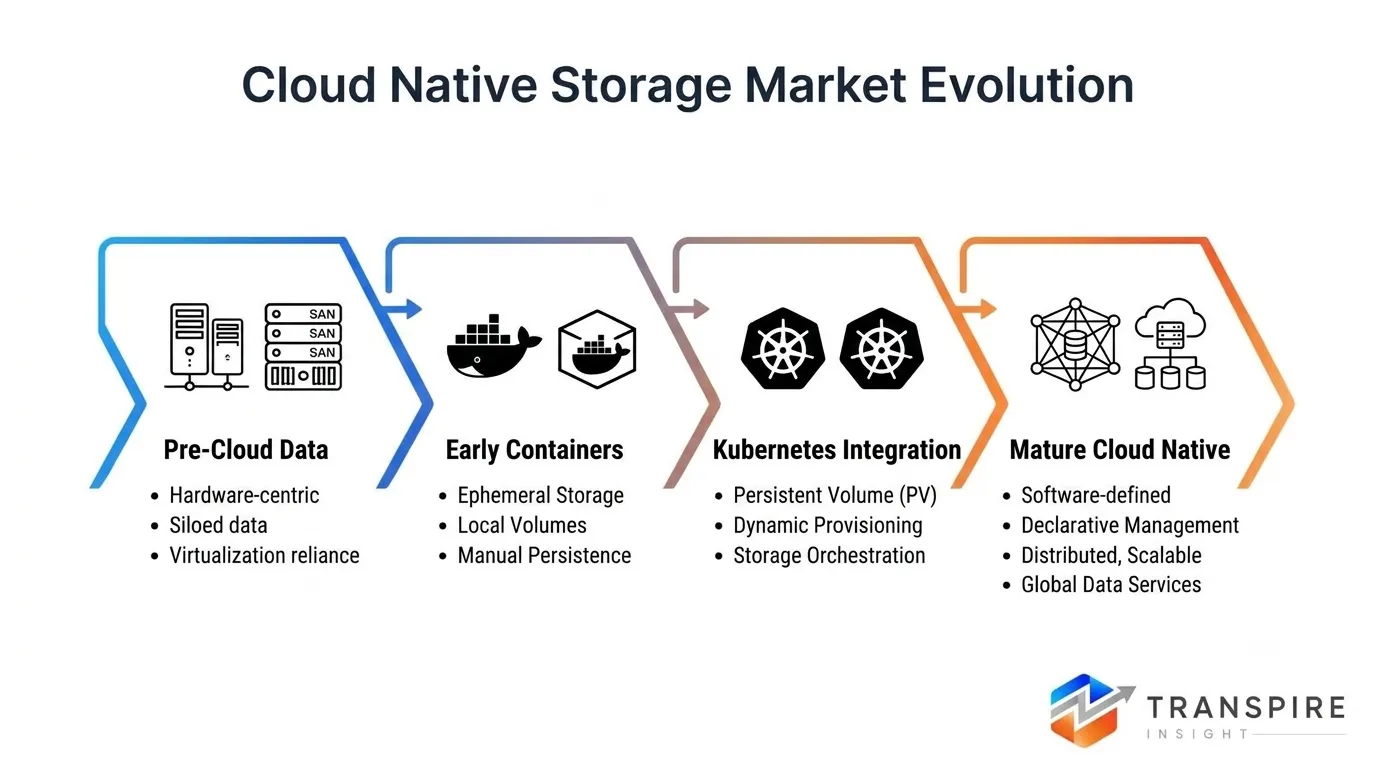
Description
According to a research report published by Transpire Insight, the cloud native storage market size is projected to grow from USD 23.9 billion in 2026 to USD 100.12 billion by 2035, at a 22.72% CAGR during the 2027-2035 forecast period. Rapid containerization, widespread Kubernetes adoption, and expanding microservices drive market expansion. Additionally, burgeoning AI data pipelines and enterprise multi-cloud strategies necessitate scalable, high-performance persistent storage solutions.
Introduction
The Cloud Native Storage (CNS) market has evolved into a vital pillar of modern enterprise IT infrastructure. Built specifically to support dynamic, containerized environments and microservices architectures, CNS delivers seamless data persistence, rapid elasticity, and automated orchestration. As organizations scale Kubernetes deployments, integrate real-time analytics, and train complex AI workloads, CNS platforms overcome conventional hardware bottlenecks to ensure consistent performance, continuous availability, and enterprise-grade data security across hybrid and multi-cloud environments.
Recent Development News
January 2026: Major enterprise cloud providers upgraded hybrid cloud storage frameworks to prioritize data gravity, enabling localized high-speed processing and lower egress costs for distributed AI workloads.
March 2026: Leading software-defined storage vendors rolled out AI-driven storage management platforms featuring automated predictive tiering and automated CSI driver provisioning.
Stay Ahead of Emerging Opportunities with Expert Market Insights by Transpire Insight
Transpire Insight provides comprehensive, data-driven market intelligence to support smarter business decisions. Our research is rooted in comprehensive analysis, authoritative predictions, and industry expertise, enabling organizations to make informed decisions in rapidly evolving markets. We provide in-depth analysis of market segmentation, competitive positioning, regional trends, and emerging investment opportunities in high-growth areas. We blend accuracy with actionable intelligence, helping companies uncover new growth avenues, strengthen strategic decision-making, and stay ahead in a dynamic market.
Cloud Native Storage Market Size & Statistics
The Market Size for Cloud Native Storage Was Estimated to be Worth USD 23.9 Billion in 2026.
The Market Size is Going to Expand at a CAGR of 22.72% between 2026 and 2035.
The Cloud Native Storage Market Size is anticipated to reach USD 100.12 Billion by 2035.
North America is projected to drive the highest demand during the forecast period, accounting for 37% of the cloud native storage market.
Asia-Pacific is projected to grow the fastest during the forecast period at a CAGR of 24.06% in the cloud native storage market.
Regional Growth and Demand Analysis by Transpire Insight
North America leads the market because enterprises there have moved early and deeply into containers, microservices, and Kubernetes, which need scalable and persistent storage. One publisher notes that growing adoption of microservices, containers, and Kubernetes drives demand for scalable and persistent cloud-native storage, with telecom and IT as the leading end-use segment. Suppliers such as IBM, Microsoft, AWS, and Google, along with Pure Storage and Red Hat OpenShift Storage, supply the platforms behind this demand. Public cloud deployment also dominates, contributing 68% of market revenue, which suits the region’s cloud-first enterprises.
Asia Pacific is growing fastest as telecom, banking, and e-commerce companies adopt cloud-native data platforms. As one publisher puts it, the region records the fastest growth as telecom, BFSI, and e-commerce sectors expand adoption of cloud-native data platforms. Providers such as Alibaba Cloud and TCS offer scalable solutions to businesses handling large data volumes and lead adoption in the region. Rising data volumes and ongoing digital transformation keep pushing organizations there toward scalable, container-ready storage.
Top 15 Trends in the Cloud Native Storage Market
Containerized applications need data that survives pod restarts, so Kubernetes-integrated persistent volumes let teams run stateful services, scale storage on demand, and avoid manual provisioning.
Enterprises are spreading workloads across public clouds and private data centers, which drives demand for portable storage that keeps data consistent and avoids vendor lock-in.
Machine learning embedded in storage platforms predicts capacity needs, detects anomalies, and automates tiering and tuning, reducing administrative effort while improving performance, reliability, and resilience.
Developers are breaking applications into independent microservices that scale separately, which requires elastic, API-driven storage able to serve many short-lived containers without creating performance bottlenecks.
Container Storage Interface drivers let storage be provisioned, resized, and snapshotted through declarative code, giving platform teams consistent automation across vendors and speeding up deployment.
Edge computing generates data close to users and devices, pushing demand for lightweight, distributed storage that syncs with central clouds and supports fast local access.
List of Top 25 Companies in the Cloud Native Storage Market
1. Amazon Web Services (AWS)
AWS provisions scalable cloud native persistent storage across container clusters.
Founded: 2006 | HQ: Seattle, Washington, USA.
Why It Ranks: Market leadership in public cloud container workloads and Kubernetes cloud storage.
Regional Dominance: North America leads with extensive cloud infrastructure presence across regions.
Product Line: Amazon EFS, Amazon EBS, Amazon S3, AWS EBS CSI Driver.
2. Microsoft Azure
Azure offers deeply integrated persistent file and disk storage for Kubernetes.
Founded: 2010 | HQ: Redmond, Washington, USA.
Why It Ranks: Massive adoption across enterprise workloads and AKS-managed Kubernetes cluster deployments.
Regional Dominance: North America and Europe with strong worldwide enterprise enterprise cloud availability.
Product Line: Azure Disk Storage, Azure Files, Azure Blob Storage, AKS Storage.
3. Google Cloud Platform (GCP)
Google pioneering Kubernetes architecture powers its state-of-the-art native cloud storage services.
Founded: 2008 | HQ: Mountain View, California, USA.
Why It Ranks: Exceptional performance for AI workloads and GKE containerized data management.
Regional Dominance: North America with expansive, rapidly expanding data footprints across Asia-Pacific.
Product Line: Persistent Disk, Filestore, Google Cloud Storage, GKE Persistent Volumes.
4. Red Hat (IBM)
Red Hat OpenShift Data Foundation powers hybrid cloud enterprise container storage.
Founded: 1993 | HQ: Raleigh, North Carolina, USA.
Why It Ranks: Dominant provider of open-source enterprise Kubernetes and container management solutions.
Regional Dominance: reach with extensive hybrid deployments across North America and Europe.
Product Line: Red Hat OpenShift Data Foundation, Ceph Storage, OpenShift Platform.
5. Pure Storage
Portworx by Pure Storage leads enterprise Kubernetes persistent data management platforms.
Founded: 2009 | HQ: Santa Clara, California, USA.
Why It Ranks: Recognized leader in enterprise-ready Kubernetes storage, backup, and disaster recovery.
Regional Dominance: Strong presence across North America, Europe, and major Asia-Pacific markets.
Product Line: Portworx Enterprise, Portworx Data Services, Pure360, FlashBlade, FlashArray.
6. NetApp
NetApp Trident CSI orchestrates unified cloud native storage across multi-cloud infrastructure.
Founded: 1992 | HQ: San Jose, California, USA.
Why It Ranks: Unmatched pedigree in enterprise data management integrated directly with cloud containers.
Regional Dominance: High adoption across enterprise data centers in North America and Europe.
Product Line: Astra Control, NetApp Trident, Cloud Volumes ONTAP, Spot Storage.
7. VMware (Broadcom)
VMware vSAN container storage interface provisions persistent volumes for Tanzu Kubernetes.
Founded: 1998 | HQ: Palo Alto, California, USA.
Why It Ranks: Massive private cloud footprint transitioning workloads into cloud native container environments.
Regional Dominance: Globally dominant across enterprise private clouds in Americas, EMEA, and APAC.
Product Line: VMware vSAN, VMware Tanzu Kubernetes Grid Storage, Cloud Foundation.
8. Dell Technologies
Dell Container Storage Modules enable automated block and file storage provisioning.
Founded: 1984 | HQ: Round Rock, Texas, USA.
Why It Ranks: hardware scale bringing software-defined storage to hybrid cloud Kubernetes.
Regional Dominance: Unrivaled hardware and software distribution footprint across all markets.
Product Line: PowerScale, PowerStore, Dell Container Storage Modules (CSM), APEX Storage.
9. Hewlett Packard Enterprise (HPE)
HPE Ezmeral and Alletra deliver cloud-native persistent storage across edge-to-cloud infrastructure.
Founded: 2015 | HQ: Spring, Texas, USA.
Why It Ranks: Strong hardware-software integration for containerized stateful apps and hybrid clouds.
Regional Dominance: Extensive enterprise penetration throughout North America, Europe, and Asia-Pacific.
Product Line: HPE Alletra, HPE Ezmeral Data Fabric, CSI Driver for HPE.
10. Nutanix
Nutanix Data Services for Kubernetes delivers cloud native storage to hyperconverged platforms.
Founded: 2009 | HQ: San Jose, California, USA.
Why It Ranks: Simplifies stateful application deployment across multi-cloud and hyperconverged infrastructure setups.
Regional Dominance: Strong enterprise customer footprint across North America and Western European markets.
Product Line: Nutanix Unified Storage, Nutanix Volumes, NDK (Data Services for Kubernetes).
Conclusion
The Cloud Native Storage market is undergoing a fundamental transformation as containerized workloads shift from stateless microservices to data-intensive, stateful enterprise applications. Fueled by Kubernetes automation, hybrid cloud expansion, and rigorous demands from AI processing, cloud native storage has evolved from an emerging technology into essential IT infrastructure. Looking ahead, providers offering high-performance, automated, multi-cloud storage drivers will continuously define the industry's growth trajectory.


Send us a brief description of your challenge and we'll get back to you within 24 hours.

 inquiry@transpireinsight.com
 APAC:+91 7666513636
 Address


