
Oct 26, 2026
By Transpire Insight
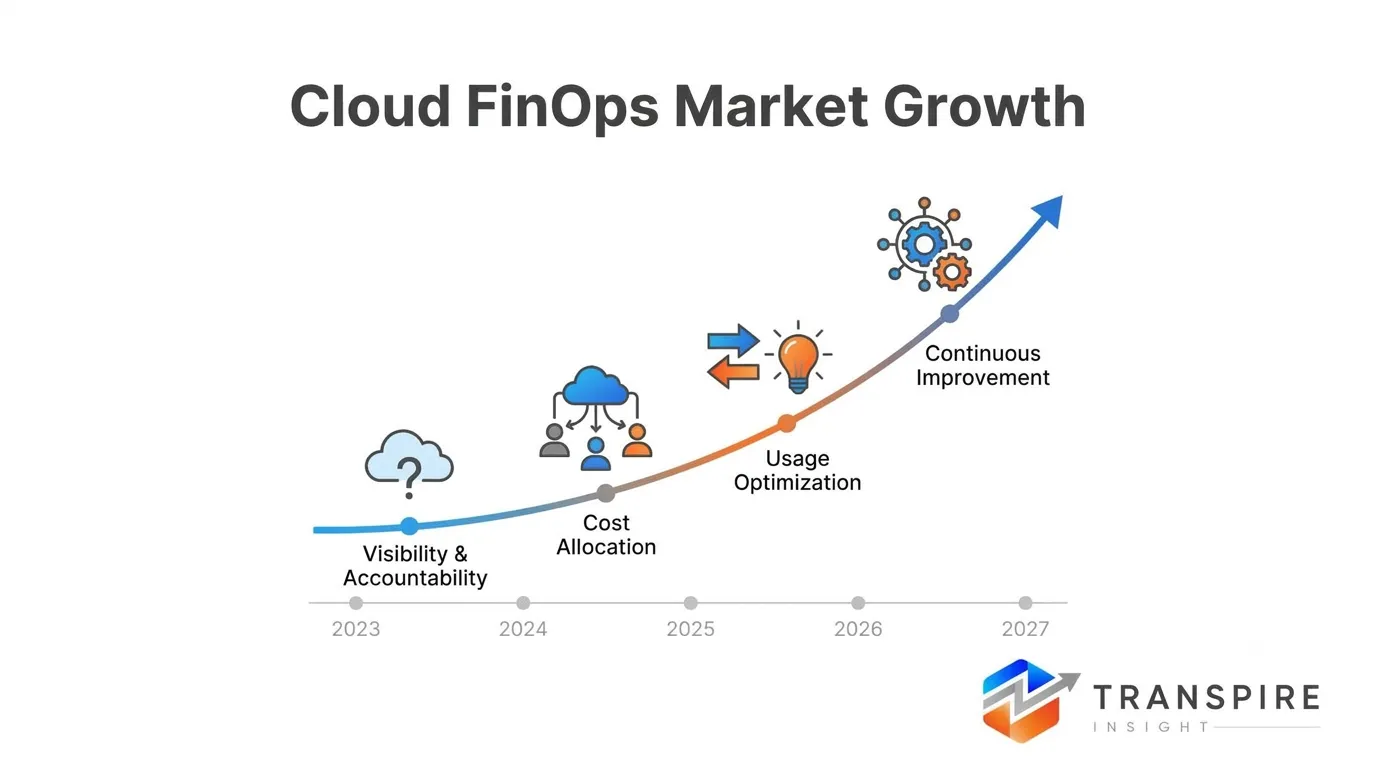
Description
According to a research report published by Transpire Insight, the cloud FinOps market size is projected to grow from USD 23.9 billion in 2026 to USD 100.2 billion by 2035, at a 23.4% CAGR during the 2027-2035 forecast period. Accelerating multi-cloud complexity, unmonitored cloud waste, surging AI infrastructure spending, and demand for cross-functional cost accountability across engineering and finance drive market expansion.
Introduction
The cloud finOps market combines financial accountability with cloud engineering, enabling organizations to maximize business value from cloud investments. As enterprises scale multi-cloud infrastructure and complex AI workloads, managing variable cloud spend becomes critical. FinOps bridges finance, operations, and engineering teams, providing real-time visibility, automated governance, and cost optimization to drive operational efficiency across digital transformations.
Recent Development News
May 2026: CloudZero launched its financial control plane for AI, providing granular unit cost allocation for multi-dimensional AI workload spend.
January 2026: Flexera launched real-time FinOps Key Performance Indicators alongside carbon forecasting tools to satisfy European Union ESG compliance mandates.
Stay Ahead of Emerging Opportunities with Expert Market Insights by Transpire Insight
Transpire Insight provides comprehensive, data-driven market intelligence to support smarter business decisions. Our research is rooted in comprehensive analysis, authoritative predictions, and industry expertise, enabling organizations to make informed decisions in rapidly evolving markets. We provide in-depth analysis of market segmentation, competitive positioning, regional trends, and emerging investment opportunities in high-growth areas. We blend accuracy with actionable intelligence, helping companies uncover new growth avenues, strengthen strategic decision-making, and stay ahead in a dynamic market.
Cloud FinOps Market Size & Statistics
The Market Size for Cloud FinOps Was Estimated to be Worth USD 23.9 Billion in 2026.
The Market Size is Going to Expand at a CAGR of 23.4% between 2026 and 2035.
The Cloud FinOps Market Size is anticipated to reach USD 100.2 Billion by 2035.
Asia-Pacific is projected to drive the highest demand during the forecast period, accounting for 37.45% of the cloud FinOps market.
North America is projected to grow the fastest during the forecast period at a CAGR of 12.21% in the cloud FinOps market.
Regional Growth and Demand Analysis by Transpire Insight
North America leads the Cloud FinOps market because it is home to the major hyperscalers and to enterprises that adopted cloud-first strategies early. Boards across the region treat cloud budgets as strategic levers, which has pushed FinOps practices to a high level of maturity. Large banks, software firms, and retailers run multi-cloud estates where unmanaged spend quickly turns into a boardroom issue. The vendor ecosystem has consolidated too: IBM’s acquisition of Apptio, the company behind Cloudability, put enterprise-grade cloud cost management inside a mainstream IT portfolio. AWS, Microsoft Azure, Google Cloud, and Oracle now support exports in the FOCUS billing format, which lets regional enterprises compare spend across providers without building custom data pipelines.
Asia-Pacific is expanding faster because cloud adoption is accelerating across China, India, and Japan as enterprises digitalize rapidly. Small and mid-sized businesses, which make up most of the region’s companies, are adopting FinOps once cloud bills become a significant operating expense. Healthcare providers and government agencies are also moving workloads to the cloud, which adds new demand for cost governance. Hyperscaler cloud regions continue to open across India and Japan, and enterprises are setting up FinOps centers of excellence to normalize costs across several providers. The main brake on growth is a shortage of certified practitioners, since demand for FinOps Foundation certifications is outpacing supply across the region.
Top 15 Trends in the Cloud FinOps Market
Machine learning models now flag unusual spending spikes early, forecast future bills accurately, and recommend corrective actions, helping enterprises prevent budget overruns before invoices arrive.
The FOCUS specification standardizes billing data across cloud providers, letting teams compare costs consistently, reduce custom data engineering, and adopt vendor-neutral FinOps platforms more easily.
Expensive GPU clusters and generative AI workloads push organizations to track training and inference costs very closely, creating fresh demand for specialized AI-focused FinOps tooling.
Enterprises running several public clouds alongside private infrastructure need unified cost visibility, so platforms that normalize pricing and usage data across providers are gaining adoption.
Engineering teams increasingly review cost estimates during design and deployment, embedding budget guardrails into pipelines so financial accountability sits with developers rather than finance departments.
Organizations lacking in-house expertise are outsourcing cost governance, optimization, and reporting to managed FinOps providers, which speeds up implementation and sustains cost savings over time.
List of Top 25 Companies in the Cloud FinOps Market
1. IBM (Apptio / Kubecost)
Delivers enterprise-grade cloud financial management and Kubernetes cost optimization solutions.
Founded: 1911 | HQ: Armonk, New York, USA.
Why It Ranks: Market leader with comprehensive hybrid, multi-cloud, and container cost visibility.
Regional Dominance: Strong leadership with primary revenue dominance across North America.
Product Line: IBM Apptio Cloudability, Kubecost, IBM Turbonomic enterprise resource management platform.
2. VMware by Broadcom (CloudHealth)
Offers scalable multi-cloud financial analytics and operational governance for enterprises.
Founded: 1998 | HQ: Palo Alto, California, USA.
Why It Ranks: High adoption among enterprise clients managing complex multi-cloud hybrid environments.
Regional Dominance: Dominates North American and European enterprise multi-cloud cost management sectors.
Product Line: VMware CloudHealth, VMware Tanzu Cloud Health, multi-cloud optimization analytics suites.
3. Flexera
Provides unified IT asset management, software licensing, and cloud spend optimization.
Founded: 1987 | HQ: Itasca, Illinois, USA.
Why It Ranks: Industry pioneer integrating FinOps visibility with comprehensive software asset governance.
Regional Dominance: Strong presence across North America and rapidly expanding across Western Europe.
Product Line: Flexera One FinOps, Spot by Flexera, SaaS Management platform.
4. Amazon Web Services (AWS)
Delivers native hyperscaler cost management, allocation, and budget optimization capabilities.
Founded: 2006 | HQ: Seattle, Washington, USA.
Why It Ranks: Dominates native cloud cost tracking for the largest cloud infrastructure network.
Regional Dominance: Massive market presence across North America, Europe, and Asia-Pacific markets.
Product Line: AWS Cost Explorer, AWS Cost Optimization Hub, AWS Budgets platform.
5. Microsoft
Integrates native billing analytics and open-standard cost optimization across Azure.
Founded: 1975 | HQ: Redmond, Washington, USA.
Why It Ranks: Embedded natively within Microsoft Azure, driving massive enterprise-level adoption.
Regional Dominance: reach with extensive dominance in enterprise IT ecosystems worldwide.
Product Line: Microsoft Cost Management, Azure Advisor, Azure Cost Analysis tools.
6. Google Cloud
Offers intelligent cloud billing analytics, anomaly detection, and automated cost recommendations.
Founded: 2008 | HQ: Mountain View, California, USA.
Why It Ranks: Essential native FinOps platform for containerized workloads and big data infrastructure.
Regional Dominance: footprint with massive adoption across the Americas and Asia-Pacific regions.
Product Line: Google Cloud Billing, Active Assist Recommendations, Cloud Cost Management hub.
7. CloudZero
Delivers code-driven cost intelligence connecting cloud infrastructure spend directly to engineering.
Founded: 2016 | HQ: Boston, Massachusetts, USA.
Why It Ranks: Innovator in telemetry-based cost allocation and unit economics for software engineers.
Regional Dominance: Rapid growth across North America's tech and SaaS software sector.
Product Line: CloudZero Architecture, AnyCost Engine, CloudZero Financial Control Plane AI.
8. Harness
Automates continuous integration and delivery pipelines, and intelligent cloud developer cost management.
Founded: 2016 | HQ: San Francisco, California, USA.
Why It Ranks: Unique integration of active deployment pipelines with continuous cloud developer spend governance.
Regional Dominance: Strong footprint across North America and key European software technology hubs.
Product Line: Harness Cloud Cost Management, DevOps Continuous Delivery, Continuous Efficiency suite.
9. Anodot
Applies advanced autonomous machine learning to detect cloud cost anomalies in real time.
Founded: 2014 | HQ: Ashburn, Virginia, USA.
Why It Ranks: Leading AI-driven predictive insights engine minimizing unexpected operational cloud spend spikes.
Regional Dominance: Strong market presence in North America, Middle East, and European sectors.
Product Line: Anodot Cloud Cost Management, Autonomous Business Monitoring, Anomaly Detection Engine.
10. NetApp (Spot.io)
Automates compute workload optimization through intelligent cloud instance and capacity management.
Founded: 1992 | HQ: San Jose, California, USA.
Why It Ranks: Industry benchmark for automated infrastructure scaling and cloud compute spot optimization.
Regional Dominance: Strong footprint backed by established enterprise NetApp storage distribution channels.
Product Line: Spot by NetApp, Eco, Elastigroup, Ocean container infrastructure manager.
Conclusion
The Cloud FinOps market continues its evolution from simple cost tracking to automated, multi-cloud financial engineering. As enterprises integrate AI workloads alongside complex hybrid cloud architectures, continuous spend transparency and real-time governance become essential. Key market leaders and agile startups are driving standardization and automation, empowering modern organizations to optimize technological efficiency, maintain budget accountability, and achieve strategic long-term business value.


Send us a brief description of your challenge and we'll get back to you within 24 hours.

 inquiry@transpireinsight.com
 APAC:+91 7666513636
 Address


